



By Bohdan Vasylkiv
- CEO & Co-Founder
Top 15 Logistics and Supply Chain Software Development Companies in 2026
Compare the top 15 logistics and supply chain software development companies of 2026 - TMS, WMS and inventory expertise, pricing and how to choose.
Key Takeaways
- The right partner knows logistics first and code second, and that domain depth beats a generic dev shop every time.
- TMS, WMS, fleet, 3PL, and inventory systems each ask for different expertise, so match the vendor to your real problem.
- Integrations like EDI, carrier APIs, ERP, and telematics are where most projects quietly succeed or quietly fall apart.
- Custom software earns its keep once off-the-shelf tools no longer fit how your operation actually runs.
Choosing a tech partner for logistics works differently than choosing one for a regular app. Your software has to move real trucks, real pallets, and real money. And it has to keep doing that at 3 a.m. when a carrier API goes down.
That pressure shapes who you should hire. So we built this guide to point you toward teams that actually ship supply chain and freight systems, and away from firms that simply list "logistics" on a services page.
Below you'll find fifteen strong options, what each one does well, and a clear way to choose. If you've been comparing the top logistics software development companies and feeling a little lost, this should help. The right pick always depends on what you're trying to build.
We'll keep it practical and specific, the way a friend in the industry would explain it before you sign anything.
What Logistics and Supply Chain Software Development Companies Do
A logistics software development company builds the digital systems that keep goods moving. That covers transportation management, warehousing, route planning, freight billing, driver apps, real-time tracking, and the dashboards your ops team watches all day.
A good supply chain software development company works more broadly. It looks at the whole chain, from suppliers and factories to warehouses, carriers, and the customer's doorstep, and at how data should move between all of them.
That wider view is where a lot of value lives. Once your planning tools talk to your warehouse, and your warehouse talks to your carriers, you spend less time firefighting and more time actually managing.
Some teams specialize even further. An inventory management software development company lives and breathes stock accuracy, cycle counts, reorder logic, and multi-warehouse balancing. Others focus entirely on the moving-vehicle side.
That specialization matters when you hire. A firm that's brilliant at warehouse systems can still be shaky on fleet telematics, since each requires different experience.
Most of these firms also handle the quieter, critical work: integrations, migrations, security, and keeping everything running after launch. What you're really buying is a system your business can lean on, and the strongest supply chain software development companies treat it that way.
How We Selected These Logistics Software Development Companies
One quick note before the list: the order below reflects fit for specific kinds of work, so read it as a set of specialists, each strong for a different situation. A firm that suits a scrappy last-mile startup can be overkill for a global 3PL, and the reverse holds just as often.
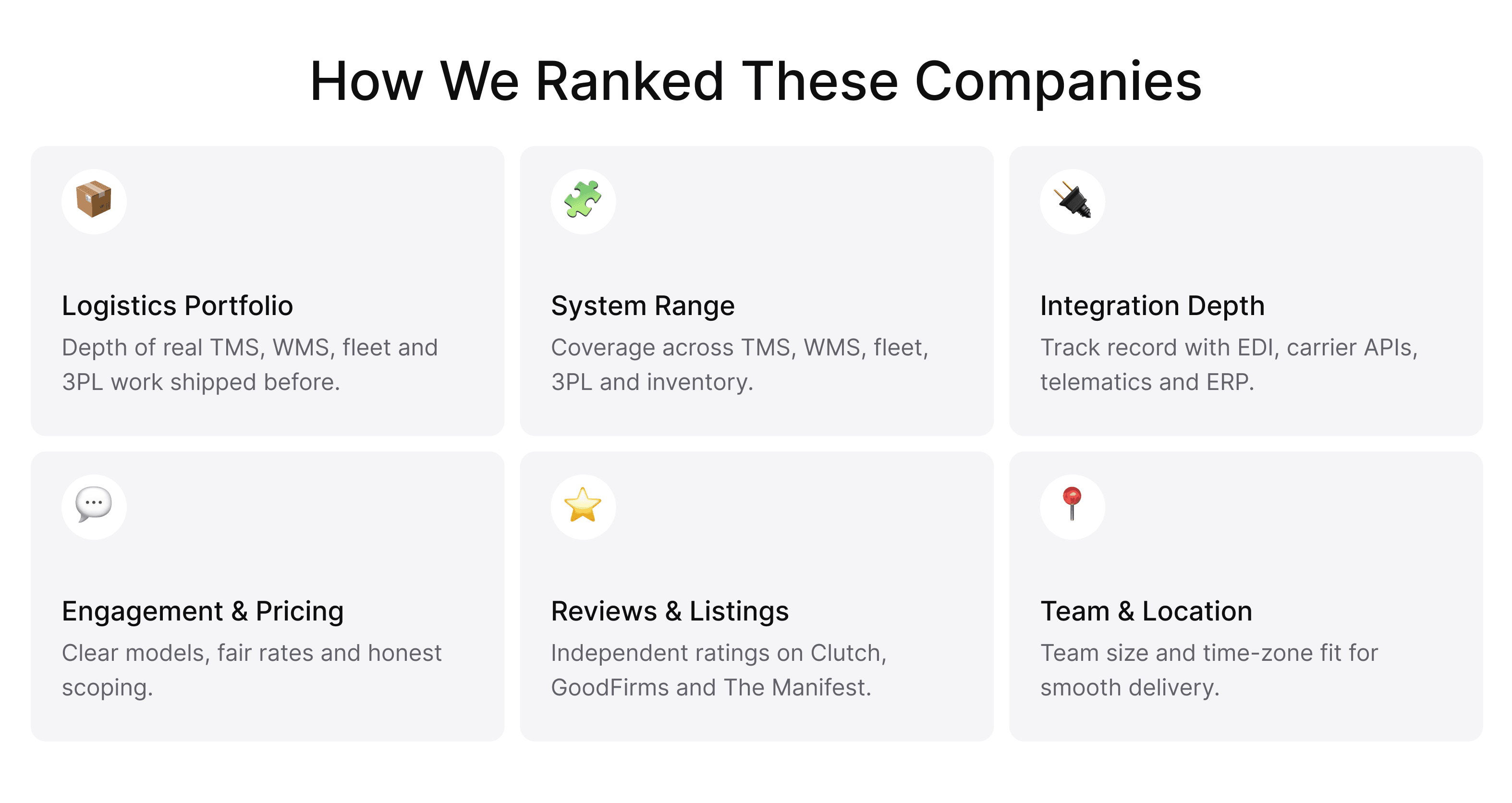
Here's what we weighed. First, depth of logistics and SCM portfolio, because you want to know whether they've shipped this kind of thing before or would learn on your budget.
Second, the range of systems they build: TMS, WMS, fleet, 3PL, and inventory. Third, and this one gets underrated, is their integration experience with EDI, carrier APIs, telematics, and ERP. That's the area where a logistics management software development company truly proves itself.
 Click to expand
We also looked at engagement models and pricing, third-party listings and reviews, team size, and location. When you compare logistics software development companies side by side, those details decide whether the partnership feels smooth or exhausting.
The same goes for a supply chain software development company, where steady and clear wins out over flashy every time. A well-run logistics software development company makes the whole process feel calm and predictable, which is exactly what you want when your operation is on the line.
Top 15 Logistics and Supply Chain Software Development Companies in 2026
Here's the list, and you can filter it by your own needs, since these teams shine in different situations. If you've searched for the top supply chain software development companies, you'll spot familiar names and probably a few new ones worth a look.
1. Incora
We'll be upfront with you. Incora is our team, and we put ourselves first here, though the reasoning comes down to fit. Incora is a software development and tech integration company that builds logistics and supply chain systems from the ground up.
The work includes custom TMS and WMS platforms, shipping-rate engines, parcel and last-mile apps, and the integrations that tie it all together.
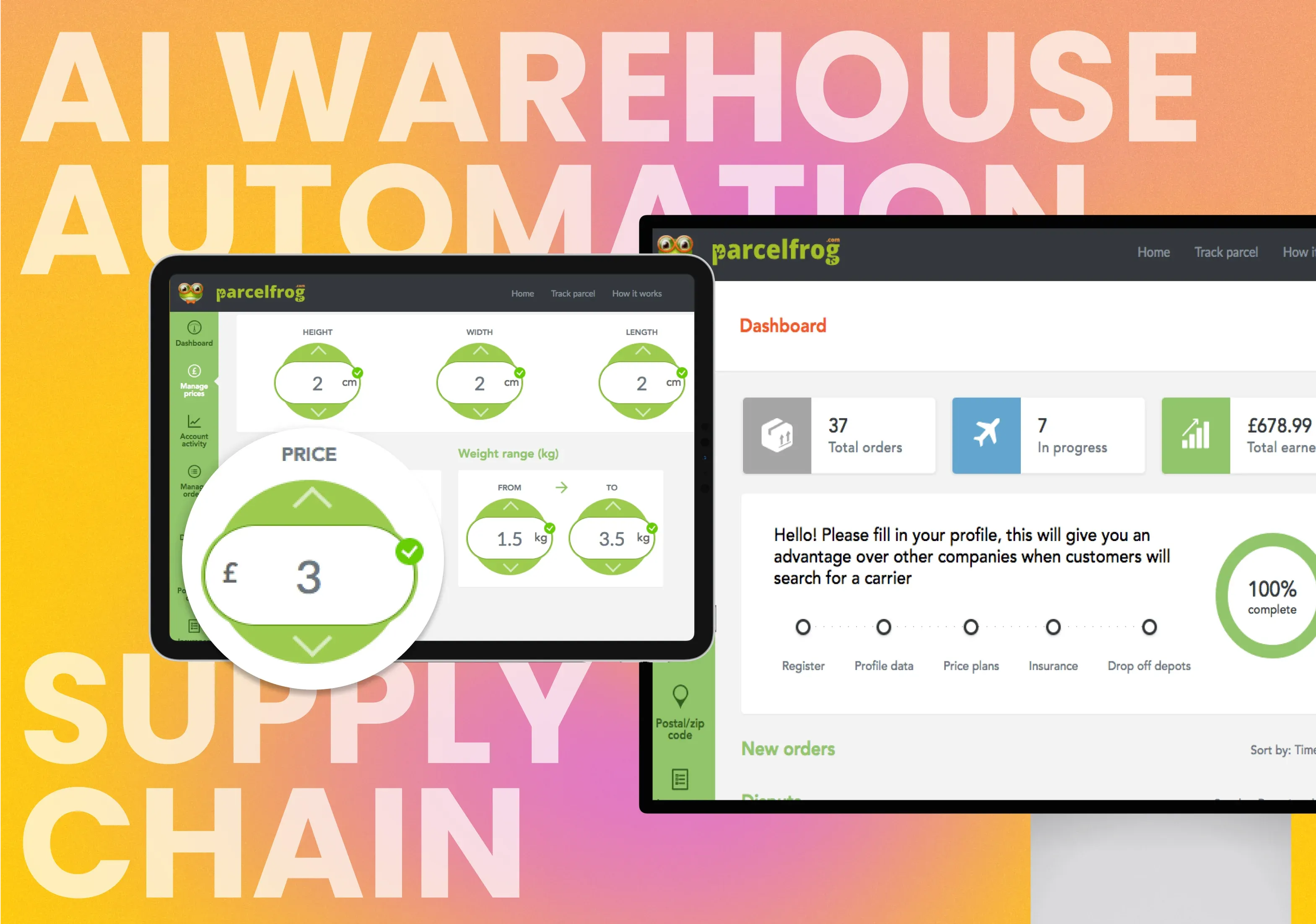
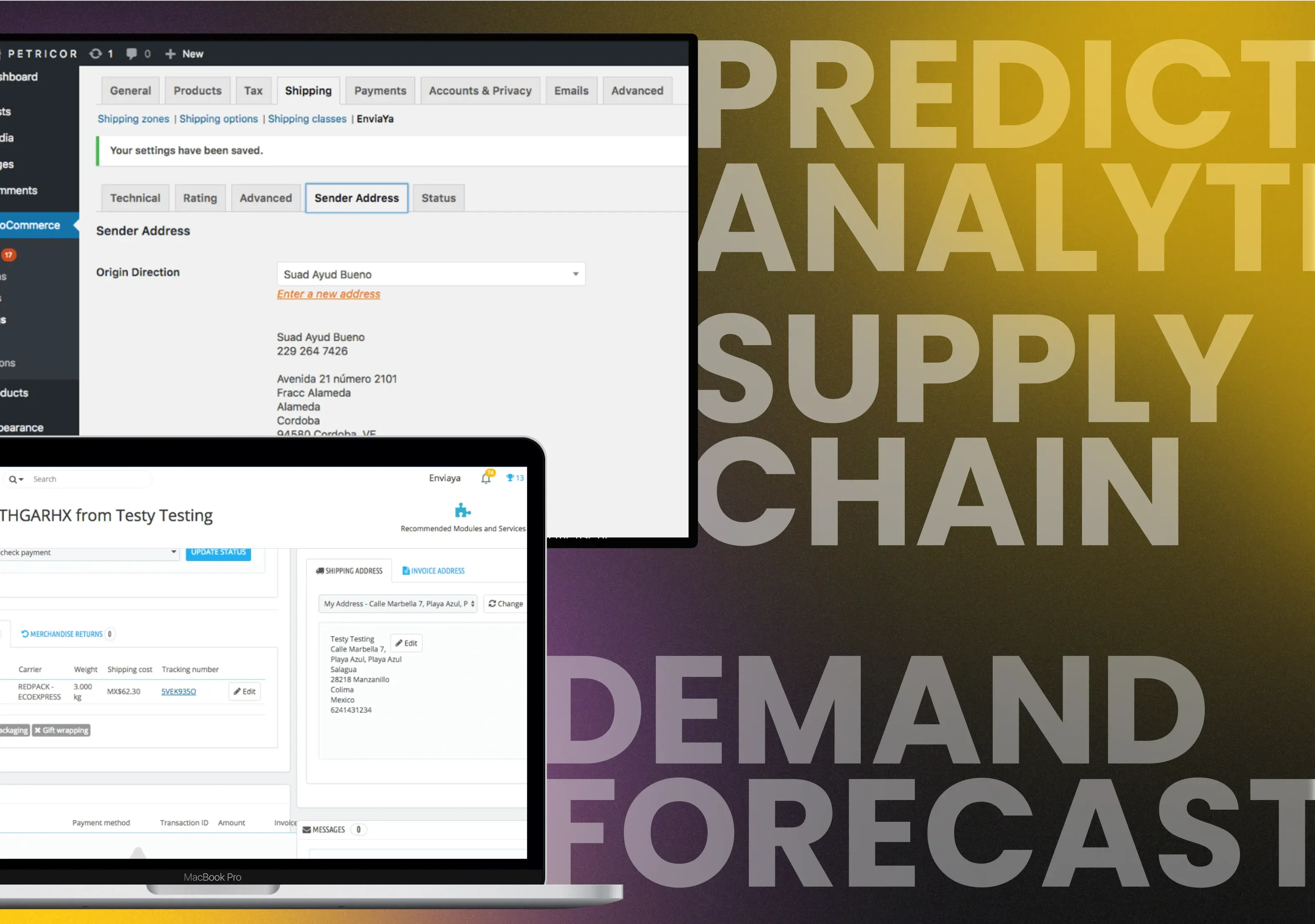
What stands out is the mix of range and focus. We have shipped real logistics products, including a shipping flow platform, Enviaya (a shipping rates platform) for multi-carrier rate shopping, and ParcelFrog (parcel delivery) for delivery operations. That portfolio speaks for itself.
If you want a custom logistics software development company that already understands carriers, rates, and tracking, this is a natural place to start.
2. Itransition
Itransition is a large, long-established global firm with a broad services menu and a solid enterprise track record. They've handled everything from data platforms to full logistics systems, and they scale comfortably for bigger engagements.
That breadth is the main draw. If your project spans several departments and needs a lot of hands, Itransition can staff it without much friction.
The trade-off with any big generalist is that logistics sits among many other practice areas, so ask pointed questions about their freight and warehouse work. They fit well when you value size, process maturity, and a partner ready for a complex, multi-year build.
3. Intellias
Intellias is a well-known engineering company with deep roots in mobility and transportation tech. They've done serious work across automotive, navigation, and fleet-adjacent systems, so the domain knowledge runs real.
If your product leans toward connected vehicles, mapping, or large-scale platform engineering, Intellias is worth a call. They're built for scale and long partnerships.
Smaller teams sometimes find enterprise-grade firms a little heavy for a lean MVP, so weigh that against your stage. For transportation-heavy roadmaps, the fit is strong.
4. RTS Labs
RTS Labs is a US-based firm with a genuine focus on logistics and data. They speak fluently about ERP integration, AI, and process automation, and they've built a reputation around measurable results.
They're a strong match when you're US-based and want a partner in a close time zone who already knows supply chain. Their sweet spot is mid-market companies modernizing tangled legacy workflows.
If your headache sounds like "our systems don't talk to each other," RTS Labs is the kind of team that enjoys untangling exactly that.
5. Appinventiv
Appinventiv is a large app-development company with a strong mobile pedigree and a growing enterprise practice, including logistics and delivery apps. When you need a polished, consumer-grade mobile experience across driver apps, customer tracking, and delivery UX, they shine.
Their main consideration is focus, since they build across many industries. Confirm the logistics-specific experience of the exact team you'd get.
For mobile-first delivery products with big user bases, Appinventiv brings serious design and app muscle to the table.
6. WEZOM
WEZOM has leaned hard into logistics and digital transformation, with TMS and custom platform work front and center. As a focused logistics management software development company, they sit comfortably in the supply chain space.
That focus makes them an easy pick for transport and distribution companies that want a partner already fluent in the domain. As with any mid-sized firm, scope your must-have integrations early.
When you need a team that understands freight without a long ramp-up, WEZOM belongs on the shortlist.
7. Saritasa
Saritasa is a US custom software house with strengths in mobile, IoT, and emerging tech. In logistics, that IoT and hardware-integration angle proves genuinely useful for sensors, telematics, and connected warehouse gear.
They fit well when your project blends software with physical devices, or when you want a US partner comfortable with experimental tech. If you need deep freight domain expertise from day one, probe that during scoping.
For IoT-flavored logistics builds, Saritasa is a strong option to keep in the running.
8. Fingent
Fingent is an enterprise-focused software company with a broad footprint across the US and beyond. They handle complex business systems, workflow automation, and the integrations that hold larger operations together.
Their strength shows in enterprise process work. When logistics forms one piece of a wider digital-transformation program, Fingent can carry the whole thing.
Smaller, single-feature projects may sit outside their comfort zone. For companies rethinking several business systems at once, they're worth evaluating.
9. Yalantis
Yalantis is a well-regarded engineering company that has delivered logistics, fintech, and other data-heavy products. They're strong on solid architecture and clean delivery, which matters more than people expect once a system has to scale.
They suit teams that want dependable, senior engineering and a mature process. If you're building something that needs to grow without falling over, Yalantis is a safe pair of hands.
Align on domain specifics up front, as you would with any broad-portfolio firm.
10. IntexSoft
IntexSoft brings experience across e-commerce and logistics, including warehouse and order-management work. That e-commerce crossover comes in handy, since so much of modern logistics is really about getting the online order to the door.
They're a reasonable fit for retailers and distributors bridging their storefront and their warehouse. Scope the fleet or heavy-freight side carefully if that's your world.
For e-commerce-driven fulfillment, IntexSoft earns a spot on your list.
11. Vention
Vention is a software-development company known for flexible teams and a startup-to-enterprise range. Companies often choose them for the ability to spin up capable engineers quickly.
When you need to scale a team fast and keep momentum, Vention's model fits nicely. As a broad-based firm, their logistics depth depends on the specific people assigned, so meet the team behind the brand.
For fast-moving product roadmaps, they're a practical choice.
12. Acropolium
Acropolium has focused on SaaS and logistics for years, often through a subscription-style engagement model that appeals to companies wary of huge upfront bills. They talk sensibly about cloud, modernization, and long-term support.
They suit businesses that want an ongoing partner for steady iteration. If predictable monthly cost sounds appealing, their approach is worth a look.
Confirm capacity for your specific system type during those first conversations.
13. Django Stars
Django Stars is a Python-and-Django specialist with a track record across transport, fintech, and travel. That focused stack becomes a real advantage for data-heavy, API-rich logistics platforms.
They're a strong fit when you value a lean, senior team and a clean technical approach. Keep in mind they're a specialist rather than a giant, so match project size accordingly.
For Python-based logistics builds, few teams feel more at home.
14. A3logics
A3logics offers logistics and supply chain software alongside ERP and broader IT services, spanning US and offshore delivery. They often appear on industry shortlists, reflecting steady output.
They fit companies wanting a wide service range under one roof, including ERP-adjacent work. As with any large multi-service firm, confirm the logistics credentials of your specific pod.
For businesses that want logistics and ERP in the same conversation, A3logics is worth including.
15. Trinetix
Trinetix focuses on enterprise digital transformation, AI, and data-driven products, with growing supply chain and process-automation work. They lean into analytics and intelligent workflows, where logistics value increasingly shows up.
They're a good match for larger organizations chasing smarter decisions from their data. If your goal is insight and automation across a complex operation, Trinetix speaks that language.
For pure early-stage MVPs, a leaner specialist may serve you better.
Logistics Software Development Companies at a Glance: Comparison Table
Here's a quick side-by-side so you can scan the field fast. It's the quickest way to weigh the top logistics software development companies without re-reading every profile, since some are built for scale, some for speed, and some for one specific system type.
What Logistics and Supply Chain Software These Companies Build
Let's talk about systems now. When you hire one of these teams, you're usually asking for one or a few core platform types. Knowing the categories helps you brief a logistics software development company clearly and notice when someone's out of their depth.
Inventory and Warehouse Management Systems
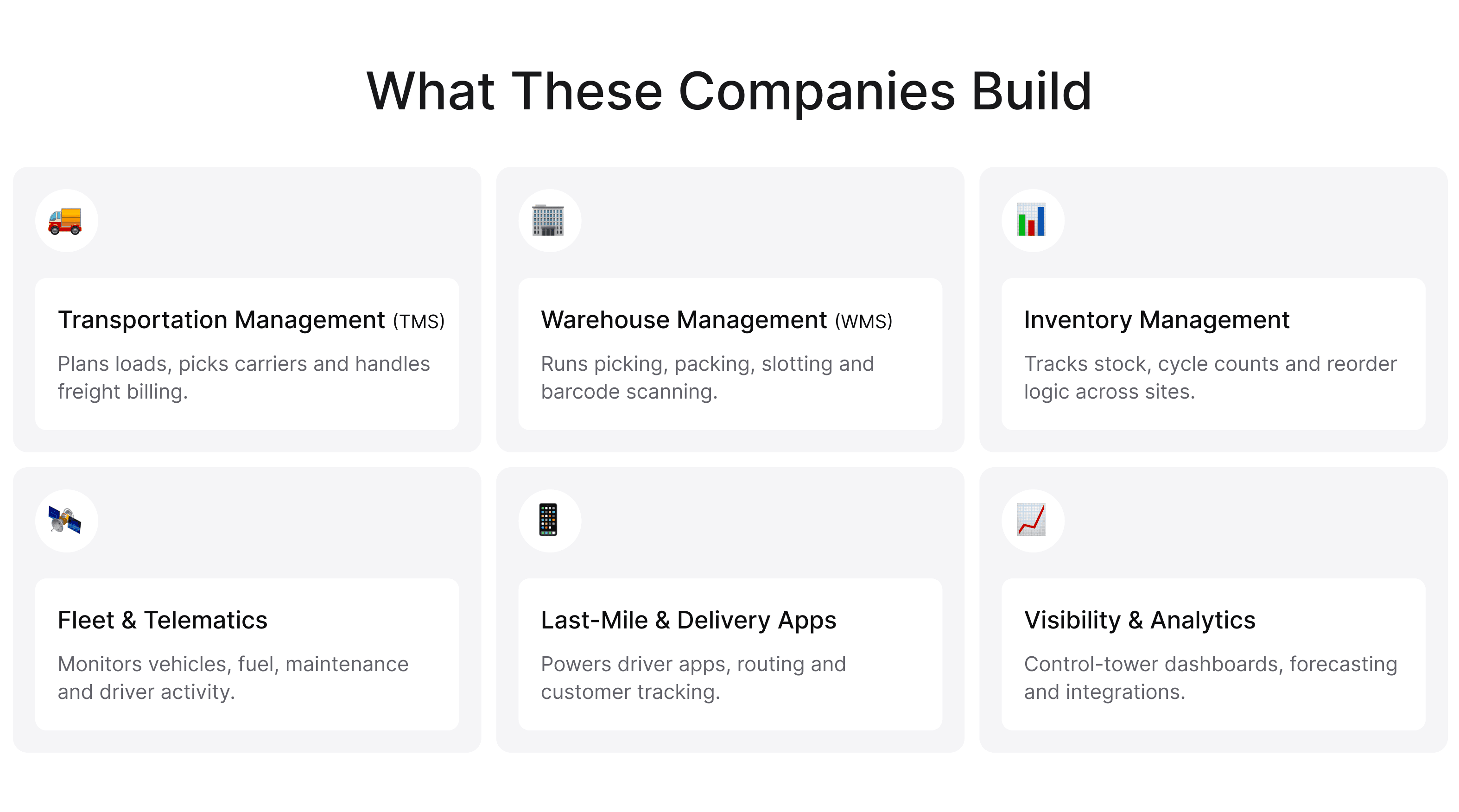
This is the backbone for anyone holding stock. A serious inventory management software development company builds tools that track every unit across every location, automate reordering, and keep counts accurate enough to trust.
Layer warehouse management on top, with picking, packing, slotting, and barcode and RFID scanning, and you get the difference between a warehouse that hums along and one that's always one bad count away from a bad day.
A focused inventory management software development company obsesses over that accuracy, because everything downstream depends on it. If you're curious what a build like this runs, our breakdown of warehouse management system cost walks through the real drivers.
 Click to expand
Transportation and Fleet Systems
This is the moving-vehicle world: transportation management systems (TMS), fleet management, route optimization, and driver apps. A TMS plans loads, picks carriers, and handles freight billing, while fleet tools track vehicles, fuel, and maintenance.
If you're weighing a build here, start with our guide on how to develop a TMS, which walks through the moving parts step by step. It'll save you a few expensive misunderstandings.
This category also covers delivery and shipping app development, especially for last-mile operations where the customer experience can make or break the whole route.
Visibility, Integration, and Analytics Layers
This layer is the glue that holds everything together. It covers real-time tracking, control-tower dashboards, demand forecasting, and the integrations that connect your systems into one flow.
It's also where broader supply chain software development comes together, since a dashboard only works as well as the data feeding it. The best supply chain software development companies obsess over this layer, because it turns scattered systems into one clear picture your team can act on. This integration-heavy glue is exactly the kind of custom work a team like Incora builds from scratch, wiring your tools into one clean flow.
How to Choose a Logistics Software Development Company
Now for the practical part, because choosing well comes down to matching a team to your actual problem. A great logistics software development company for a global carrier might be the wrong call for a regional distributor, so here's how to think it through without getting overwhelmed.
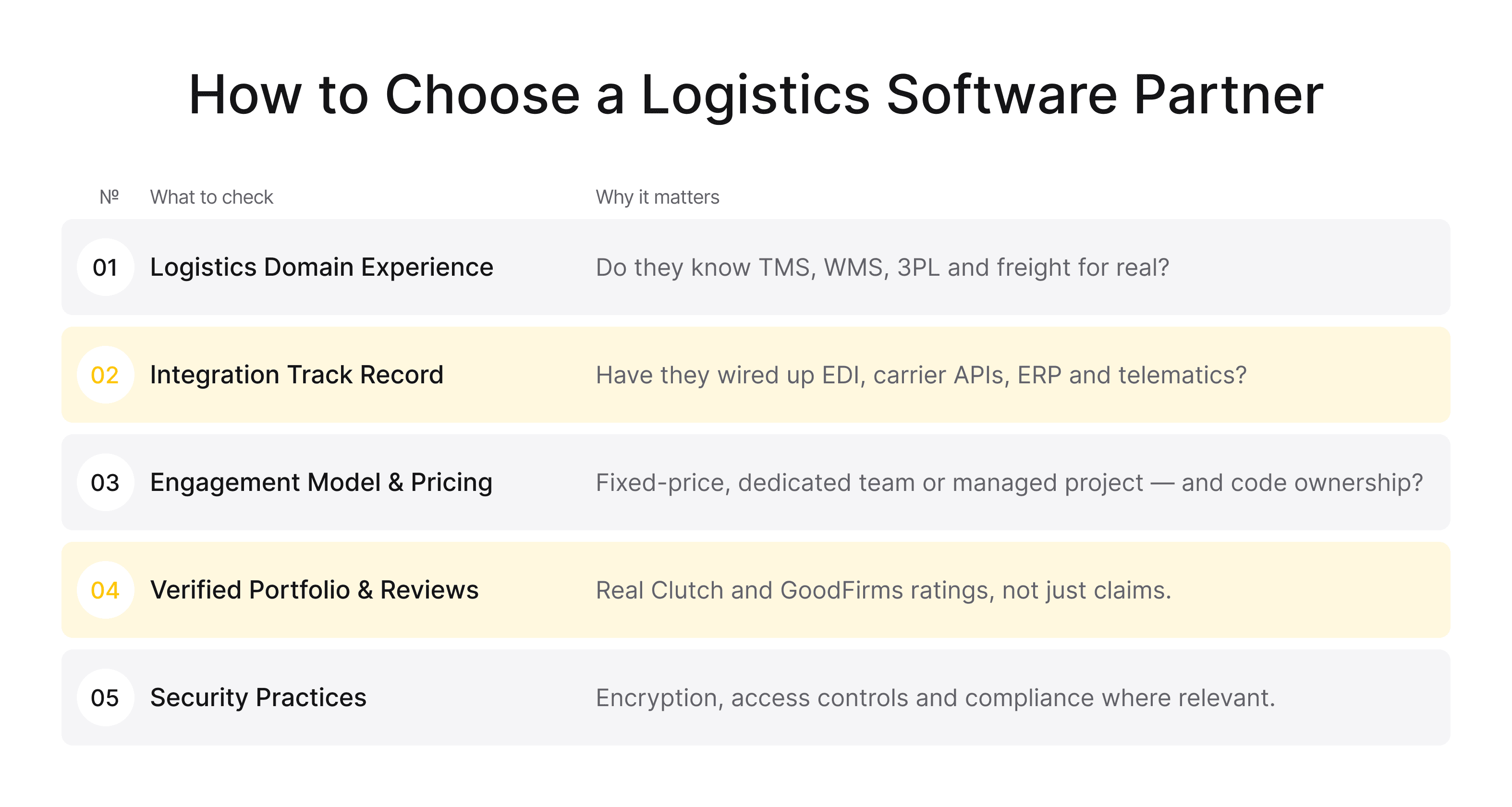
Logistics Domain Experience (TMS, WMS, 3PL, Freight)
Ask what they've actually built, and for whom. Generic engineering talent is everywhere, while people who understand load boards, dock scheduling, and detention charges are rare.
When someone calls themselves a custom logistics software development company, ask them to prove it with specifics: screenshots, case studies, and stories from real projects. A partner who knows the real TMS workflow will talk you through load tendering, rating, and settlement without missing a beat. If they can't explain why carrier rate shopping gets tricky, keep looking.
 Click to expand
Integration Track Record: EDI, Carrier APIs, ERP, Telematics
This area makes or breaks a project, and it's dull enough that people rush past it. Give it real attention. Your system will need to talk to EDI trading partners, carrier APIs, your ERP, and probably telematics hardware.
Ask how many carrier integrations they've done and what broke last time. A team that lights up at that question has clearly done it before, and their war stories will tell you plenty.
A seasoned logistics management software development company will happily walk you through its integration history, including what went sideways.
Engagement Models and Pricing
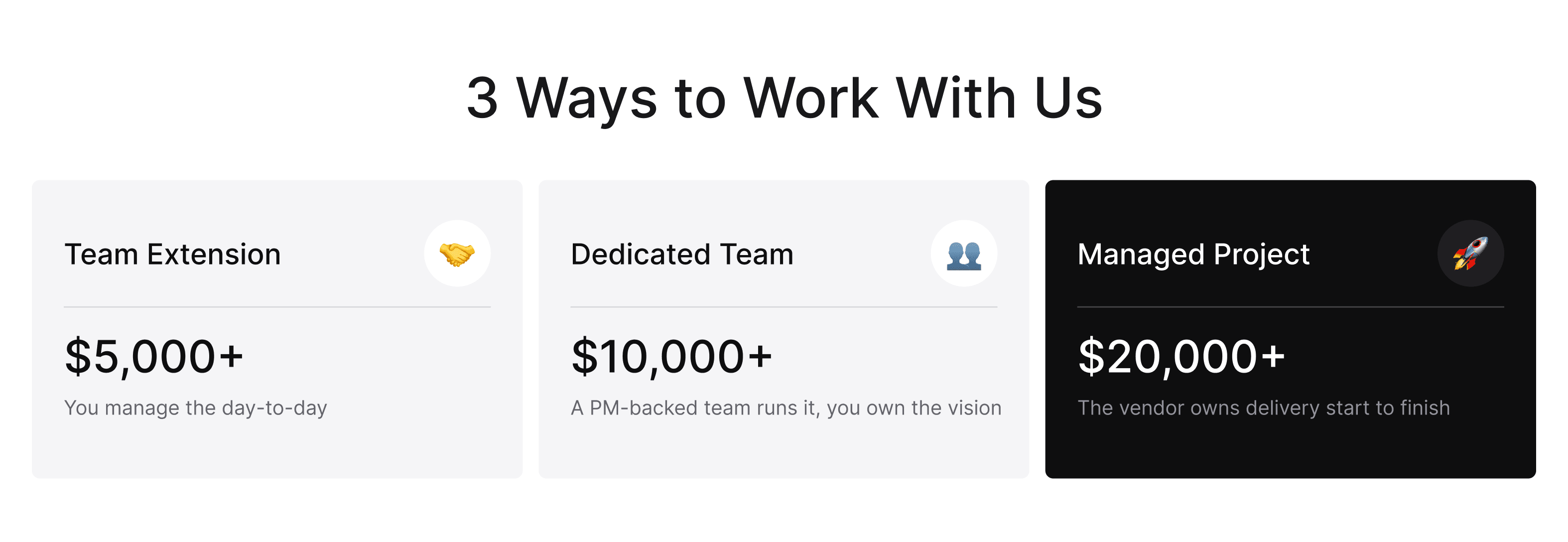
Fixed-price, time-and-materials, or a dedicated team- each model has its place. Fixed-price works for a tight, well-defined scope, while a dedicated team works for a product that keeps evolving.
Clarify who owns the code, how change requests work, and what support looks like after launch. The transparency behind the pricing matters more than the label, and a partner who explains the trade-offs plainly is worth more than the cheapest quote.
 Click to expand
Portfolio, Reviews and Security Practices
Do your homework here. Read third-party reviews, check independent listings, and ask for references you can actually call.
On security, ask about data handling, access controls, and compliance, since logistics data is sensitive and a breach gets expensive fast. This kind of diligence is how you find the best logistics software development company for your needs and see straight through a slick sales deck.
If you'll also need ERP muscle, it's reasonable to hire ERP developers who've worked alongside logistics systems before.
How Much Custom Logistics Software Development Costs
This is often everyone's first question, so let's be honest. Cost depends on scope, complexity, integrations, and team location, and there's no single sticker price.
A focused module might land in the tens of thousands, while a full platform with many integrations climbs well into six figures. The biggest cost driver is usually how many external systems you need to connect and how messy those connections get.
Working with a logistics software development company in a region with strong engineering talent and reasonable rates, like Eastern Europe, often gives you senior skills without US-agency pricing.
A capable inventory management software development company or TMS builder will scope the work in phases, so you can spread the risk across the timeline. And the math on a custom logistics software development company usually favors custom once off-the-shelf tools start forcing you to change how you actually operate.
When the tool fights your process, that's your cue to build. A seasoned supply chain software development company will tell you that plainly, even when it means a smaller first invoice.
Will AI Replace Supply Chain Management Software?
Short version: AI won't replace your logistics software, and it's reshaping that software quickly. Your TMS and WMS stay in place while AI makes them noticeably smarter.
Picture demand forecasts that actually hold up, dynamic routing that adapts to traffic and weather, and anomaly detection that flags a problem shipment before your customer notices. The software carries the workflow, and the intelligence inside it keeps leveling up.
Here's the realistic view. A modern supply chain software development company now bakes AI into planning, visibility, and automation from the start. You'll see it more in forecasting, document processing, and predictive maintenance for fleets.
If you want to go deeper, our overview of supply chain automation trends covers where this is heading. Treat AI as a powerful copilot for your supply chain, one that strengthens the systems already running your operation.
Why Logistics and Supply Chain Teams Partner With Incora
We'll keep this short and honest, since you can judge for yourself. Teams come to Incora when off-the-shelf logistics tools stop fitting how they really work, and when they want a partner who understands carriers, warehouses, and rates without a long ramp-up.
The pull comes down to real portfolio and real ownership. As a custom-software team built entirely around logistics, Incora has shipped shipping-rate engines, parcel-delivery platforms, and the integrations that make them useful in daily operations.
You work with senior people, you keep your code, and you get a team that treats your operation's quirks as the whole point. If that sounds like the partnership you want, we're easy to talk to.
Not sure where to start with custom logistics software?
We can help you figure out what's actually slowing you down and what to build first.
Final Takeaway
So where does this leave you? With a clear shortlist instead of a random Google scroll. The top logistics software development companies each bring a different strength, and your job is to match that strength to your problem.
Get the domain fit and the integration experience right, and the rest tends to follow. Skip the pull of the biggest logo, and hire the team that already understands your corner of logistics.
Among the top supply chain software development companies, the right one for you has already built your kind of system and can prove it with real work.
FAQ
What is logistics software development?
Logistics software development is the process of building custom digital systems that plan, track, and optimize the movement of goods across transportation, warehousing, and inventory. In practical terms, a logistics software development company replaces spreadsheets and phone calls with software that keeps up with your operation and grows alongside it.
What are the top logistics software companies?
The top logistics software companies in 2026 include Incora, Itransition, Intellias, RTS Labs, Appinventiv, WEZOM, Saritasa, Fingent, Yalantis, IntexSoft, Vention, Acropolium, Django Stars, A3logics, and Trinetix. The most useful way to compare logistics software development companies is by the system type you're building, such as TMS, WMS, fleet, or inventory, since size alone tells you very little.
What is the best software for logistics?
The best software for logistics is the platform built around your specific operation and integrated cleanly with your carriers and ERP. No single product wins for everyone, so the best logistics software development company for you is the one that has already built your kind of system. Off-the-shelf tools work well until your process becomes your competitive edge, and that's the moment custom starts to pay off.
How much does custom logistics software development cost?
Custom logistics software development usually costs from the tens of thousands for a focused module to six figures for a full, integration-heavy platform. The main variables are scope, the number of external integrations, and your team's location. A good partner scopes the work in phases, so you can validate value before committing the full budget.
How do I choose a supply chain software development company?
To choose the right partner, match the team to your problem and check four things: real logistics portfolio, integration experience across EDI, carrier APIs, ERP, and telematics, engagement model and code ownership, and independent reviews plus security practices. A trustworthy supply chain software development company welcomes those questions and answers them with specifics.


INSIGHTS




Get in Touch
Got no clue where to start? Why don’t we discuss your idea?

