



By Bohdan Vasylkiv
- CEO & Co-Founder
Supply Chain Automation Trends in 2026
Explore supply chain automation trends in 2026: AI, predictive logistics, retail shifts, and practical strategies to future-proof your operations and cut costs.
Key Takeaways
- Agentic AI is moving from pilot projects into real decision-making roles.
- Predictive logistics is replacing static demand planning across most categories.
- IoT and digital twins are merging into one real-time operating layer.
- Sustainability tracking has become a compliance requirement.
If you run logistics or operations, 2026 already feels different. The supply chain automation trends worth your attention this year are quieter than the trade-show demos. They live in how decisions get made, and who (or what) is allowed to act on them.
Below are 6 shifts reshaping how supply chains operate, and how to plan around them.
Why 2026 Is a Breaking Point for Supply Chain Automation
The last 2 years were defined by pilots. Companies tested AI forecasting on a single product line, ran one robot in a single warehouse zone, and deployed a digital twin at one port. 2026 is when those pilots either scale into production or get shut down.
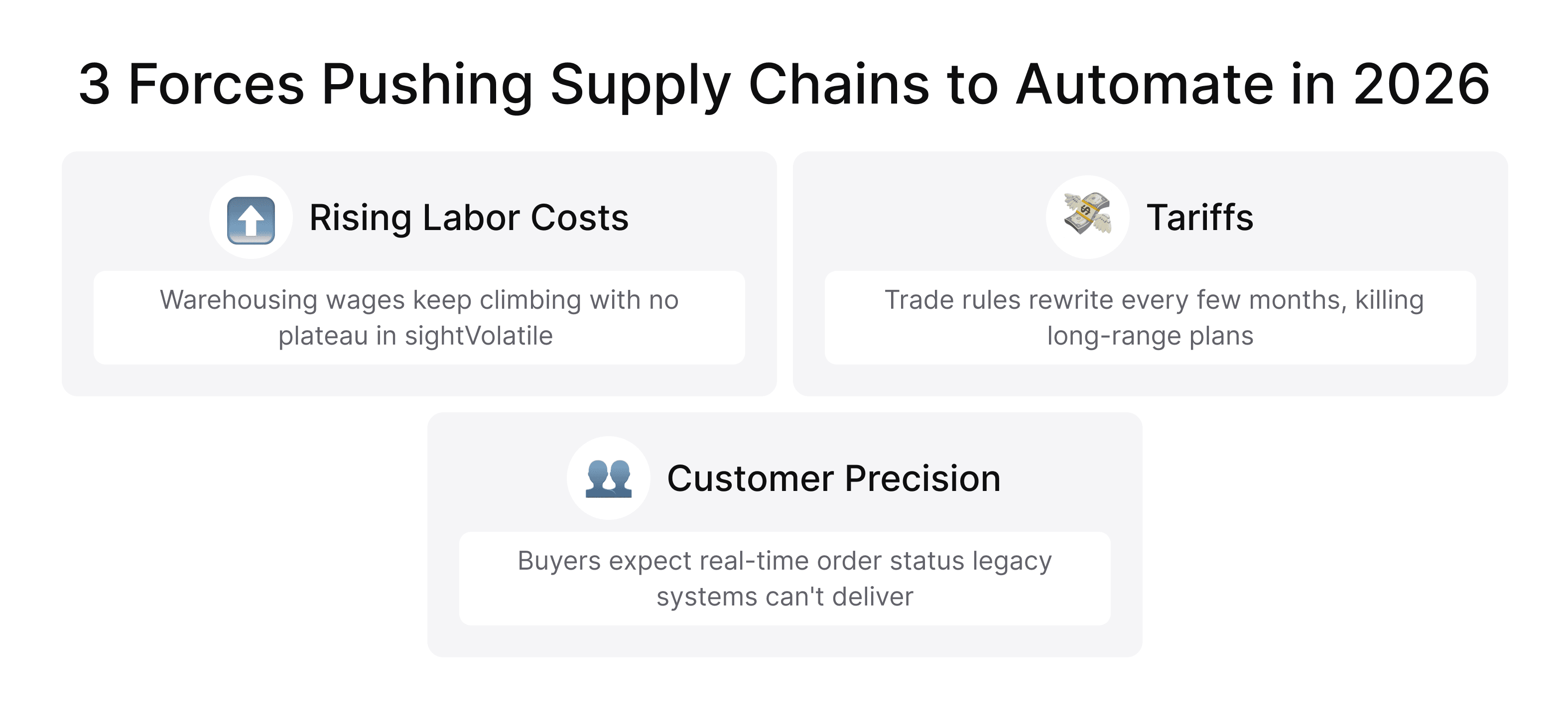
3 pressures are forcing the timing. Labor costs in warehousing keep climbing. The tariff environment rewrites itself every few months, making long-range planning with legacy tools nearly impossible. And customers now expect order-status precision that older systems were never designed to deliver.
 Click to expand
That's the real story behind the supply chain automation trends 2026 conversation. Automation has stopped being a competitive edge and has become the baseline because the manual alternative is no longer viable.
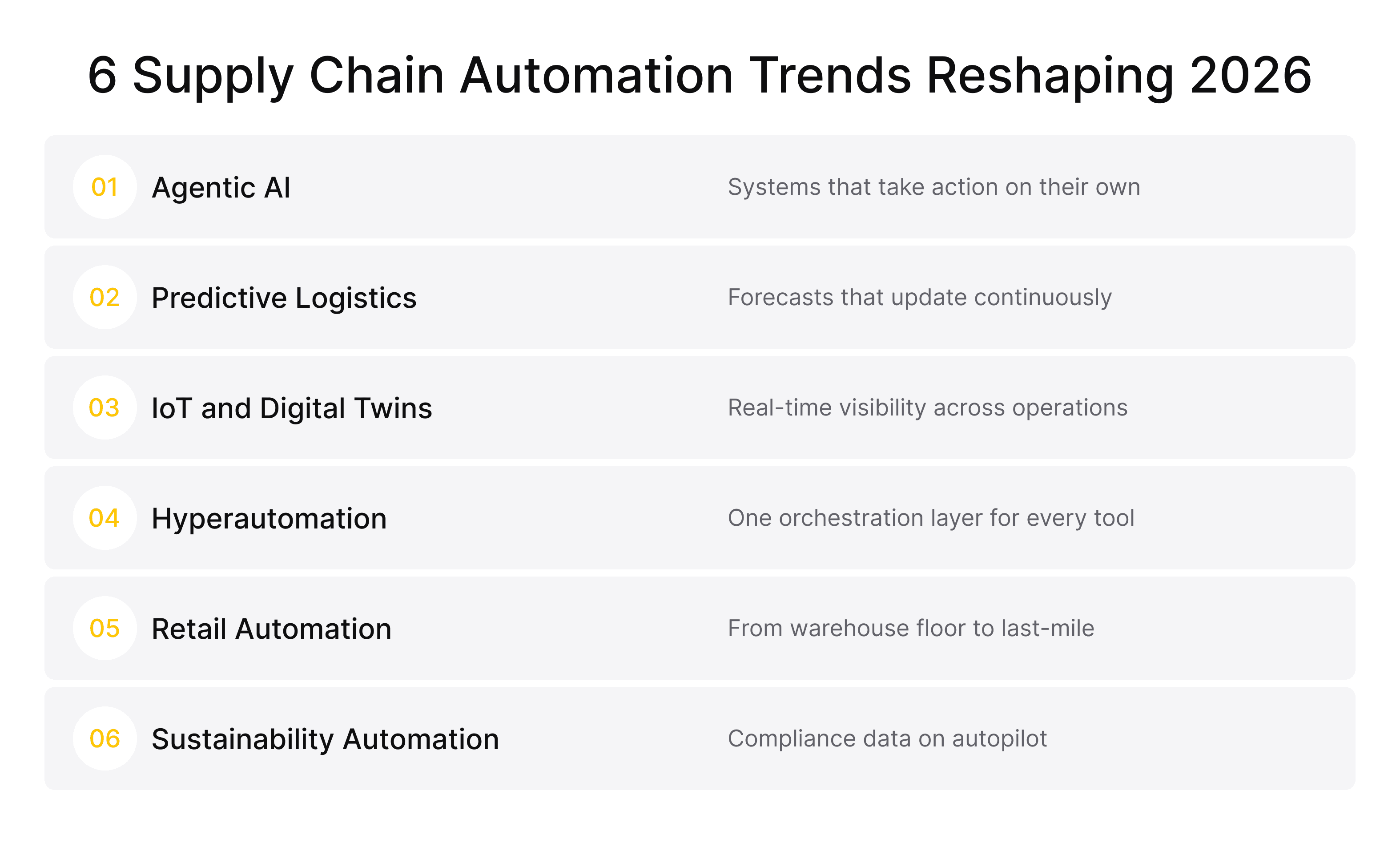
The 6 Supply Chain Automation Trends Defining the Logistics Landscape in 2026
1. Agentic AI Is Taking Over Supply Chain Decision-Making
Until recently, AI in supply chains mostly meant forecasting. Better numbers, but a human still pulled the trigger. Agentic AI changes that. These systems take action on their own. They reroute a shipment, switch a supplier, adjust safety stock, or pause a purchase order without human approval.
The interesting part is the trust question. Companies set tight guardrails. Agents act within a price range, a delivery window, or a risk threshold. Anything outside those bounds escalates to a human. Bottom line: if your team still handles routine reorder approvals by hand, that work is on borrowed time.
2. Predictive Logistics Is Replacing Traditional Demand Planning
Classic demand planning runs on historical sales plus a planner's gut. It works fine when the world is stable, but it no longer works when the world is unstable. Predictive logistics is one of the supply chain automation AI trends logistics leaders are betting on most heavily right now. It pulls in weather, port congestion, social signals, supplier health, and macro indicators, and continuously updates the forecast.
In practice, replenishment plans adjust daily. Transport bookings get pre-positioned before demand spikes. Warehouse labor schedules reflect what's actually arriving. ROI usually shows up inside 9 to 12 months, which is fast by enterprise standards.
Honestly, this is why the supply chain automation AI trends logistics conversation now dominates every operations review. The math works, the tooling is mature, and the early adopters are pulling ahead fast.
3. Real-Time Visibility Through IoT and Digital Twin Convergence
Visibility used to mean a dashboard refreshing every few hours. That's a slow rear-view mirror. The 2026 shift is the merging of IoT sensors with digital-twin modeling that models the entire operation in real time. You stop asking "where is my shipment?" and start asking "what happens if it's two days late?" The twin runs the simulation, IoT keeps it honest, and you decide before the problem hits your dock.
This is also where solid AI warehouse automation pays off, because robots, WMS, and twins all share the same picture of reality. Without that shared picture, automation just adds noise.
 Click to expand
4. Hyperautomation: AI, RPA, and Robotics Stop Working in Silos
Hyperautomation is a clunky word for a simple idea: stitch everything together. For years, companies bought RPA for finance, AI for forecasting, robots for warehouses, and APIs for carriers, and ran them as separate islands nobody could orchestrate end-to-end.
The 2026 move is an orchestration layer that lets a single business event, say a customer order, trigger a chain of actions across every system. Done well, automation feels like an operating system for the entire supply chain.
5. Retail Supply Chain Automation: From Warehouse Floor to Last-Mile Delivery
Retail gets the most public attention because customers see the result. The real action sits upstream. Supply chain automation trends in retail now cover the full path: AI-driven assortment planning, robotic micro-fulfillment in dark stores, automated returns, and increasingly autonomous last-mile routing.
Walmart and Amazon are the obvious examples. The playbook is also spreading fast to mid-market retailers through custom supply chain software development rather than off-the-shelf tools. If you sell to a consumer in 2026, the gap between "we have an online store" and "our operation is automated end-to-end" has become the gap between survival and irrelevance.
6. Sustainability Automation Is Shifting From Nice-to-Have to Compliance Requirement
Sustainability tracking used to live in a slide attached to the annual report. That era is over. CSRD reporting is in force across the EU; US states are following suit with their own disclosure rules; and you can't hand-collect emissions data from 200 suppliers anymore.
Automation does the heavy lifting. It pulls carrier emissions data, scores supplier ESG, and flags shipments that exceed your carbon budget before they ship. Of all the supply chain automation trends on this list, this one shifts fastest from a finance line item into a board-level KPI.
Not sure where to start with supply chain automation?
We can help you figure out what's actually slowing you down and what to build first.
What These Trends Mean for Logistics Leaders
If you sit in a head-of-operations seat, your job is shifting. You used to run the operation. Now you design how it runs itself. The supply chain automation trends above each push your role in the same direction. 3 shifts to plan for:
- Your team gets smaller in transactional roles and larger in data, analytics, and exception-handling.
- Your tech stack consolidates. Point tools lose to platforms that orchestrate well.
- Supplier conversations become data conversations. If a supplier can't share live data, they become a risk.
The Real Barriers to Supply Chain Automation (and How to Work Around Them)
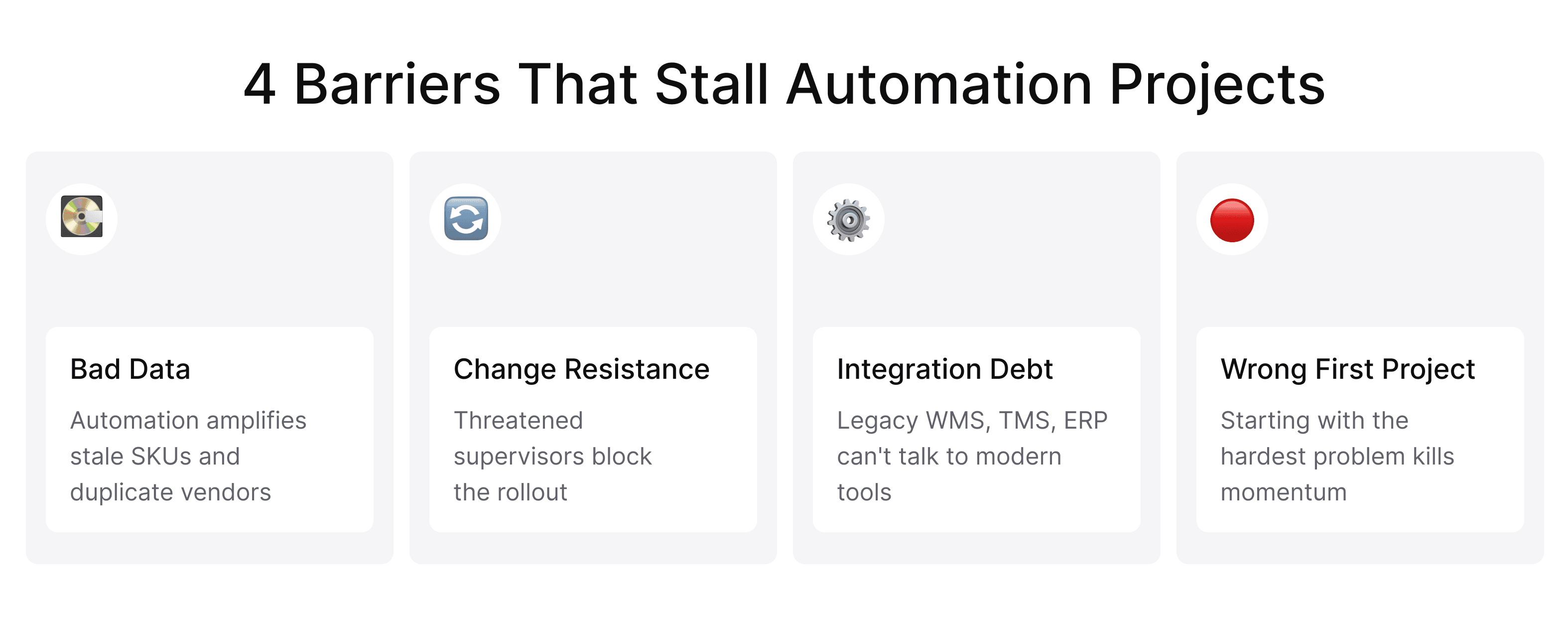
Honestly, the technology is rarely the hard part. The supply chain automation trends above usually stumble on people and process. 4 things actually trip companies up.
- Bad data. Most ERPs are full of stale SKUs and duplicate vendors. Automation amplifies bad data. The bot reorders the wrong part faster than your team ever could. Fix the data first.
- Change resistance. If warehouse supervisors think automation is coming for their job, they won't make it work. Bring them in early and give them ownership of the rollout.
- Integration debt. Legacy WMS, TMS, and ERP systems weren't built to talk to anything modern. This is where engaging a dedicated development team pays off. The goal is to build the integration layer that lets existing systems participate, without ripping anything out.
- Wrong first project. Don't start with the most painful problem. Pick the highest-confidence win, prove the model, then go after the hard stuff. Bringing in outside software development consulting early is usually cheaper than fixing decisions made without it.
 Click to expand
How to Position Your Supply Chain for What's Coming in 2027
If 2026 is the year of scaling pilots, 2027 is when the gap between automated and non-automated operators becomes uncomfortable. Four moves to make in the next 12 months:
- Get your data architecture in shape. You need a clean source of truth for inventory, orders, and suppliers. Without it, every initiative starts at zero.
- Pick one process and automate it end-to-end rather than 5 in half. Depth beats breadth early on.
- Build internal capability. Someone on your team needs to write smart RFPs, evaluate vendors honestly, and own the roadmap.
- Treat AI like a teammate. Design workflows where AI and humans each do what they're good at.
That last point matters most. The AI automation trends in logistics and supply chain 2026 winners are the teams that stopped trying to replace humans and started pairing them with AI agents.
On the build side, Incora works with logistics and supply chain teams that need custom orchestration, integration, and AI layers on top of existing systems. The team handles everything from AI automation services to full-stack platform builds. If you've outgrown off-the-shelf software, and a full Oracle or SAP replatform feels too heavy, that's the gap Incora fills.
Final Takeaway
The hard part of 2026 is accepting that the supply chain automation trends 2026 all point in the same way. Decisions get made faster than humans can review them. Data flows continuously instead of in batches. And the operator who can't keep up becomes the supplier nobody wants to use.
Most companies will spend this year planning. A smaller group will spend it building. By the time 2027 arrives, you'll know which group you joined, because the supply chain automation trends show up in margin, instead of in slide decks.
FAQ
What is supply chain automation in simple terms?
It means using software, robots, and AI to handle work that people used to do manually. Reordering inventory, routing trucks, tracking shipments, flagging delays. The goal is to free humans from decisions that need judgment.
Which supply chain automation trends have the biggest ROI in 2026?
Predictive logistics and agentic AI lead the pack. They usually pay back within a year. Real-time visibility through IoT and digital twins sits in close second. Hyperautomation pays off more slowly, though it compounds the hardest over time.
How is AI transforming logistics and supply chain operations?
AI does three things at once. It forecasts demand more accurately than any planner. It executes routine decisions without approval. And it surfaces exceptions that need human attention. The result is a leaner supply chain with fewer firefighting meetings.
What does supply chain automation look like in retail?
It shows up at every layer. Assortment planning, robotic fulfillment, dynamic pricing, autonomous last-mile, automated returns. Winners stitch these together rather than running them as separate experiments.
How long does it take to automate a supply chain?
Realistic answer: 18 to 36 months for meaningful end-to-end automation. Single workflows can be done in 8 to 12 weeks. Anyone promising a transformed supply chain in 90 days is selling something.


YOU MAY ALSO LIKE


Get in Touch
Got no clue where to start? Why don't we discuss your ideas?

