



By Bohdan Vasylkiv
- CEO & Co-Founder
Warehouse Automation Technology: Types, Benefits, and Future
Explore warehouse automation technology: key types, real benefits, RFID, inventory control, and future trends. A practical guide for modern logistics operations
Key Takeaways
- Automated warehouse systems cut labor costs and error rates while boosting throughput across every stage of fulfillment.
- The right warehouse automation technologies depend on your operation’s size, complexity, and growth trajectory.
- RFID, AMRs, and AI-driven WMS platforms are making real-time inventory tracking and automated fulfillment practical at any scale.
- The future of warehouse automation is heading toward fully autonomous facilities—but smart, phased investments win today.
If you’ve been running a warehouse for any length of time, you know the pressure. Customers expect faster shipping, fewer errors, and full visibility into the status of their orders. That’s a tall order when you’re still relying on clipboards, manual counts, and spreadsheets held together with hope.
Here’s the thing: automating your warehouse isn’t just a trend for enterprise giants anymore. It’s becoming essential for mid-size operations that want to stay competitive. This guide breaks down what warehouse automation technology actually is, how it works, which types matter most, and where the whole industry is headed. No jargon overload, no sales pitch—just a clear look at what’s worth your time and money.
If you’re still wondering why invest in supply chain automation, this article will give you the practical context you need to make that decision.
Warehouse Automation Technology: Definition and Core Concept
Let’s start with a clear warehouse automation definition. At its core, warehouse automation technology uses software, hardware, and robotics to perform warehouse tasks with minimal human intervention. That covers everything from barcode scanning and conveyor systems to AI-driven demand forecasting and autonomous mobile robots navigating your aisles.
Simply put, it’s about replacing repetitive, error-prone manual work with systems that are faster, more accurate, and more consistent systems. The goal isn’t to eliminate people—it’s to free them up for higher-value work while the technology handles the heavy lifting. Modern warehouse automation technology goes well beyond basic conveyor belts, combining physical equipment with intelligent software layers that learn, adapt, and optimize in real time.
How an Automated Warehouse Differs from a Traditional One
So, what is automated warehouse operations compared to the traditional approach? In a conventional setup, workers walk the floor picking items, manually check inventory, and rely on periodic cycle counts to catch discrepancies. Growth exposes every crack: misplaced inventory, shipping errors, and labor shortages that peak right when demand does.
An automated warehouse flips this model. Inventory is tracked in real time. Robots bring items to pickers. Software anticipates demand patterns and repositions stock before you even realize you need to. The difference isn’t just speed—it’s the level of control over your entire operation.
How Warehouse Automation Technology Actually Works
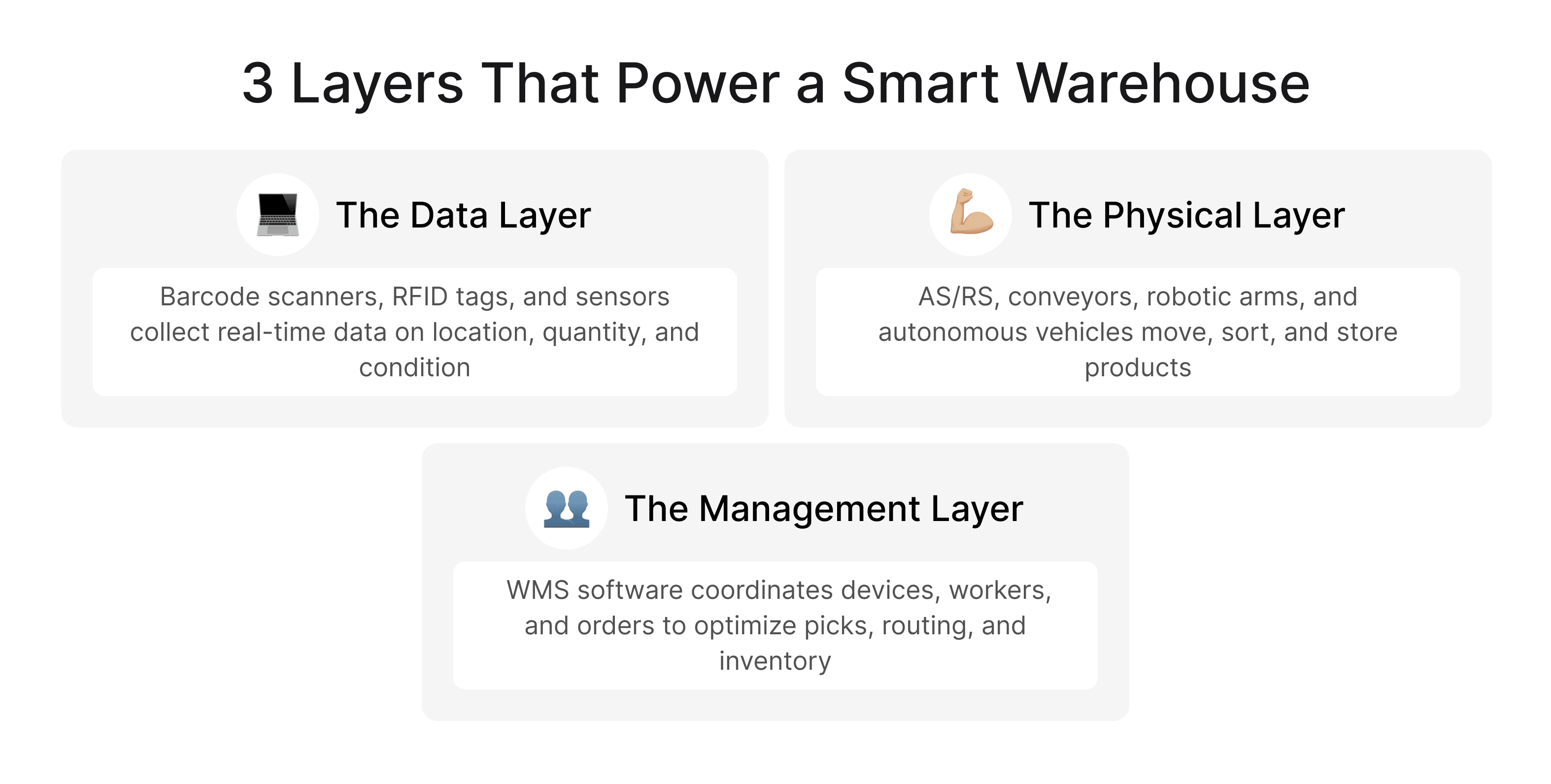
Understanding automation in warehouse management means looking at three interconnected layers. None works in isolation—and that’s the key insight most people miss. You can’t just drop robots onto your floor and call it a day. The magic happens when data, hardware, and software work as one system.
 Click to expand
The Data Layer: How Systems Collect and Process Information
Everything starts with data. Barcode scanners, RFID tags, weight sensors, and vision systems constantly feed information into your automation platform. Every item that enters, moves through, or leaves your warehouse generates data points—location, condition, quantity, timestamp.
This data layer is what makes intelligent decision-making possible. Without it, your robots and conveyors are just expensive equipment running on preset routines. With it, your entire operation becomes responsive and self-correcting. When a sensor detects a misplaced pallet, the system reroutes automatically. When demand spikes, the software shifts picking priorities in real time.
The Physical Layer: Hardware That Executes Operations
The physical layer includes all hardware that moves, sorts, stores, or retrieves products: automated storage and retrieval systems, conveyor networks, robotic arms, autonomous vehicles, and sortation equipment. This is the most visible part of warehouse automation, and often the most expensive.
But here’s the nuance: you don’t need all of it at once. Many successful automated warehouse systems start with just one or two hardware upgrades—say, an automated sortation line or a small fleet of mobile robots—and expand from there as ROI becomes clear.
The Management Layer: Software That Connects It All
This is where automated warehouse management really comes together. Your warehouse management system (WMS) acts as the central nervous system, coordinating every device, every worker, and every order in real time. It decides what gets picked first, which robot handles which task, and how inventory should be slotted for maximum efficiency.
The best WMS platforms today don’t just manage—they optimize. They use machine learning to identify bottlenecks, predict staffing needs, and continuously improve pick paths. If you’re evaluating automated inventory management software, this management layer deserves the most attention.
Types of Warehouse Automation Technologies Explained
When people talk about types of warehouse automation, they’re usually referring to a mix of hardware and software solutions, each designed for specific operational challenges. Let’s walk through the ones that matter most.
Automated Storage and Retrieval Systems (AS/RS)
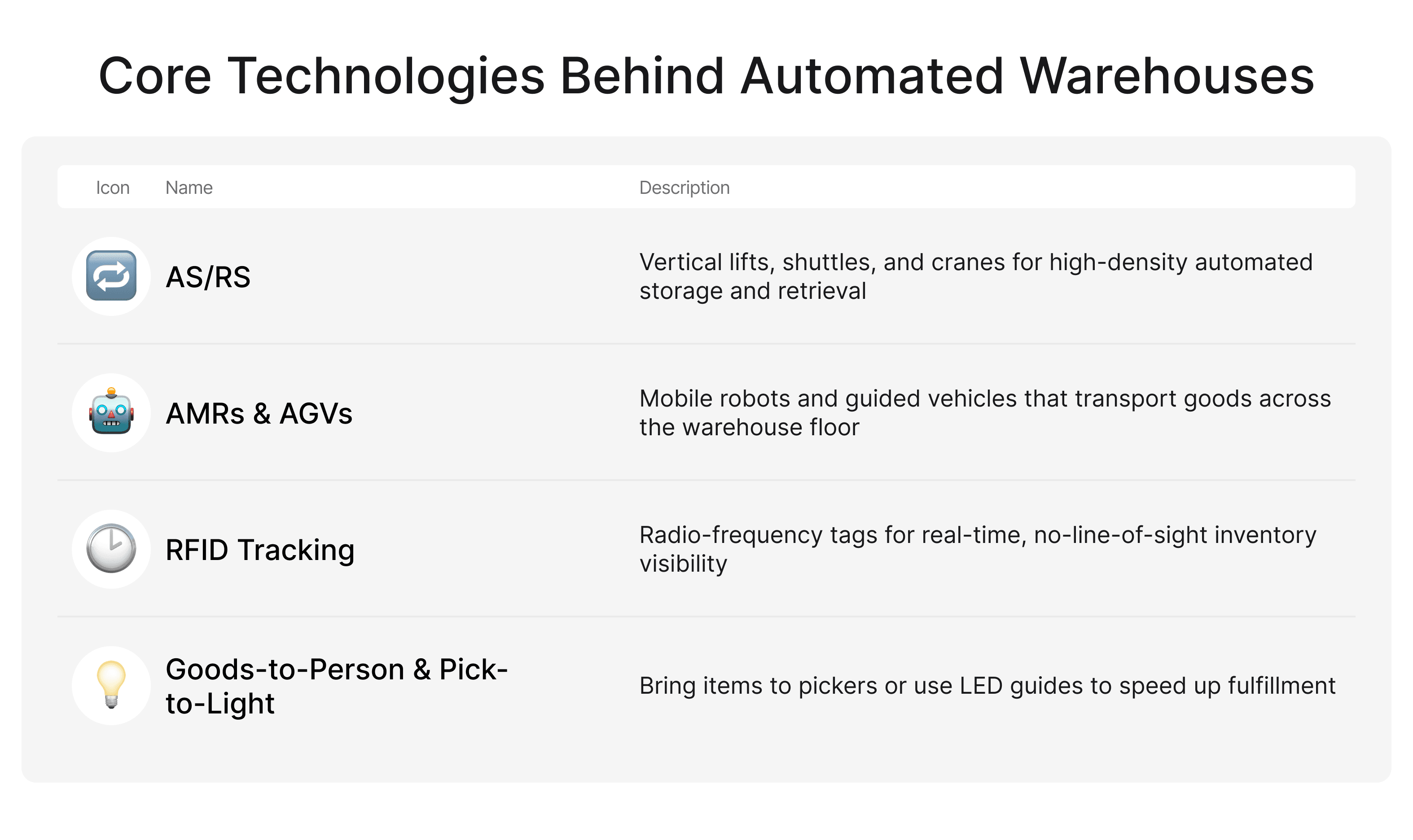
AS/RS systems are among the most established types of warehouse automation available. These computer-controlled systems automatically place and retrieve products from defined storage locations—think vertical lift modules, shuttle systems, and crane-based solutions operating in narrow aisles and tall racking.
The biggest draw? Space savings. AS/RS lets you store more product in less square footage by using vertical space that traditional layouts waste. They reduce picking errors to near zero and operate around the clock without fatigue. For high-volume, high-SKU operations, these automated warehouse systems are a game-changer.
Autonomous Mobile Robots (AMRs) vs Automated Guided Vehicles (AGVs)
Both AMRs and AGVs move products around your warehouse, but they’re fundamentally different. AGVs follow fixed paths—magnetic strips, wires, or painted lines. They’re reliable and cost-effective for repetitive routes, but rigid. Rearrange your layout, and you rearrange the AGV infrastructure too.
AMRs use onboard sensors, cameras, and AI to navigate dynamically. They map your facility, avoid obstacles, and adapt to changes without physical modifications. They cost more upfront, but the flexibility pays for itself in fast-changing environments. These are among the most popular warehouse automation technologies currently being deployed.
RFID Technology in Warehouse Automation
RFID technology in warehouse automation solves one of the oldest problems in logistics: knowing exactly what you have and where it is, in real time. Unlike barcode scanning, RFID doesn’t require line-of-sight. Tags can be read from a distance, through packaging, and in bulk.
That means faster receiving, more accurate cycle counts, and dramatically reduced shrinkage. When combined with a strong WMS, RFID gives you real-time visibility that manual processes can’t match. It’s one of those warehouse automation technologies that delivers outsized returns relative to cost.
 Click to expand
Goods-to-Person and Pick-to-Light Systems
In a goods-to-person system, automated warehouse systems bring products directly to the picker’s workstation. This slashes travel time—which, in a traditional warehouse, can account for more than half of a picker’s shift.
Pick-to-light systems complement this by using LED indicators to guide pickers to the exact location and quantity needed. Simple technology, but it reduces errors and significantly speeds up picking.
Warehouse Management Systems (WMS) as the Automation Backbone
No automation stack is complete without a solid WMS. It’s the software that ties every piece of your operation together—from inbound receiving to outbound shipping, and everything between. Effective automated warehouse management runs through the WMS: task assignment, wave planning, labor management, and real-time reporting all depend on it.
If your current WMS can’t integrate with modern robotics and IoT devices, it becomes a bottleneck rather than an enabler. Successful automated warehouse management depends on this integration layer, so that’s worth evaluating early—especially if you need dedicated backend developers for WMS integration to bridge the gap.
Core Benefits of Warehouse Automation Technology for Modern Operations
The benefits of warehouse automation aren’t just talking points—they’re measurable outcomes that show up on your balance sheet. The benefits of warehouse automation technology are wide-ranging, but let’s focus on what matters most.
Inventory Control and Real-Time Visibility
Inventory control and warehouse automation go hand in hand. When you automate tracking—through RFID, barcode systems, or sensor-based monitoring—you get a live, accurate picture of your inventory at all times. No more guessing. No more emergency counts because the numbers don’t add up.
This real-time visibility cascades through your entire supply chain. You can promise accurate delivery dates, prevent stockouts, and avoid over-ordering. It’s the foundation that makes every other warehouse automation advantages possible.
Labor Efficiency and Error Reduction
Honestly, labor is where most warehouses feel the most pain. Finding workers is hard, training takes time, and turnover is constant. Automated warehouse systems reduce dependency on manual labor for repetitive tasks—picking, packing, sorting—while dramatically cutting human error.
That doesn’t mean fewer people. It often means the same headcount doing more valuable work—quality control, exception handling, and customer communication —higher output, fewer mistakes, and direct bottom-line impact.
Space Optimization and Throughput Growth
Here’s a warehouse automation advantages factor that often gets overlooked: space. Automated storage systems use vertical space more efficiently, narrow-aisle robots reduce the footprint needed for aisles, and intelligent slotting keeps your fastest-moving products in the most accessible locations.
The result? You handle more volume in the same square footage, or the same volume in a smaller facility. Either way, throughput goes up, and per-unit costs come down.
Scalability Without Proportional Cost Increase
One of the key benefits of warehouse automation is that scaling up doesn’t require a proportional increase in headcount or space. Adding another shift? Your robots don’t need overtime pay. Hitting a peak season? Software-driven systems flex capacity without the hiring scramble. Modular automation approaches let you add capacity incrementally, keeping capital expenditure manageable.
Improved Safety and Regulatory Compliance
Automated systems handle the heavy, repetitive, and dangerous tasks that cause the most workplace injuries. Fewer forklift incidents, less heavy lifting, and reduced exposure to hazardous environments all mean a safer warehouse floor. Beyond safety, automation supports regulatory compliance through detailed audit trails, temperature-controlled cold-chain integrity, and consistent processes that meet quality standards, without relying on manual vigilance.
Advanced Warehouse Automation Technology: What Sets It Apart
So what makes advanced warehouse automation technology different from the basics? The intelligence layer. Standard automation handles repetitive tasks efficiently. Advanced systems learn, predict, and adapt—they’re not just executing, they’re optimizing.
AI and Machine Learning in Predictive Warehouse Operations
AI and machine learning are transforming warehouse operations from reactive to predictive. Instead of responding to problems after they occur, these systems anticipate them. Demand forecasting models analyze historical sales data, seasonal trends, and external factors like weather to predict what you’ll need and when.
Predictive maintenance is another major application. Sensors monitor equipment performance in real time, and ML algorithms detect patterns indicating impending failure—so you fix it during planned downtime, not your busiest shift. Companies exploring AI warehouse automation solutions are seeing measurable improvements in uptime and order accuracy.
IoT Integration for Real-Time Asset Tracking
The Internet of Things brings new granularity to warehouse visibility. IoT sensors track not just inventory location but environmental conditions—temperature, humidity, vibration, and light exposure. For warehouses handling pharmaceuticals, food, or electronics, this data is critical for compliance and quality.
Not sure where to start with warehouse automation?
We can help you figure out what’s actually slowing you down and what to build first.
IoT-connected devices also enable predictive analytics at the asset level. You know exactly how much life is left in a battery, how a conveyor is performing, and which zones are underutilized. This is exactly the kind of logistics warehouse automation technology that turns raw data into actionable intelligence.
Logistics and Warehouse Automation Technology in Supply Chain Context
Warehouse automation doesn’t exist in a vacuum. Its true value emerges when connected to the broader supply chain—from procurement to last-mile delivery.
How Automation Connects Warehouse to Last-Mile Delivery
The warehouse is the last controlled environment before your product reaches the customer. Automated sortation, intelligent wave planning, and real-time order tracking compress the time between “order placed” and “out for delivery.” In an era where same-day and next-day shipping are baseline expectations, that compression matters enormously.
When your warehouse automation technologies integrate with your transportation management system, you can dynamically route orders to the carrier closest to the customer. That kind of coordination is nearly impossible to manage manually at scale.
Inventory Control and Warehouse Automation as a Unified Strategy
Thinking about inventory control and warehouse automation as separate initiatives is a mistake. They’re two sides of the same coin. Automation generates the data that powers smart inventory decisions, and strong inventory control ensures your automation systems work with accurate inputs.
When both are aligned, you get fewer stockouts, less dead stock, lower carrying costs, and faster turns. Better data leads to better decisions, which leads to better outcomes.
How to Choose the Right Warehouse Automation Technology for Your Business
Choosing the right warehouse automation technology is less about finding the “best” system and more about finding the right fit. That means being honest about your current pain points, your budget, and your operational maturity.
Small and Mid-Size Warehouse: Where to Start
If you’re running a small or mid-size operation, you don’t need a full-blown automated warehouse systems overhaul on day one. Start where manual processes create the most friction: usually picking, inventory accuracy, and order routing.
A modern WMS with barcode scanning can be transformative. From there, add pick-to-light systems or a handful of mobile robots. The key is choosing solutions that integrate well and scale as you grow. If you need help, you can hire Python developers for automation to connect your existing tools to new automation capabilities.
Enterprise-Level Operations: Full Automation Roadmap
Enterprise warehouses face different challenges: legacy systems, complex workflows, multi-site coordination, and the need for minimal disruption during rollout. A full automation roadmap starts with a comprehensive audit of current processes, followed by a phased implementation plan.
Prioritize quick wins—high-impact, low-disruption changes—before moving to deeper integrations. That might mean starting with automated sortation and real-time tracking, then layering in AS/RS and AMRs over 12–18 months. Incora’s team specializes in helping businesses build a custom warehouse automation solution that fits exactly this kind of phased approach, from initial architecture through deployment.
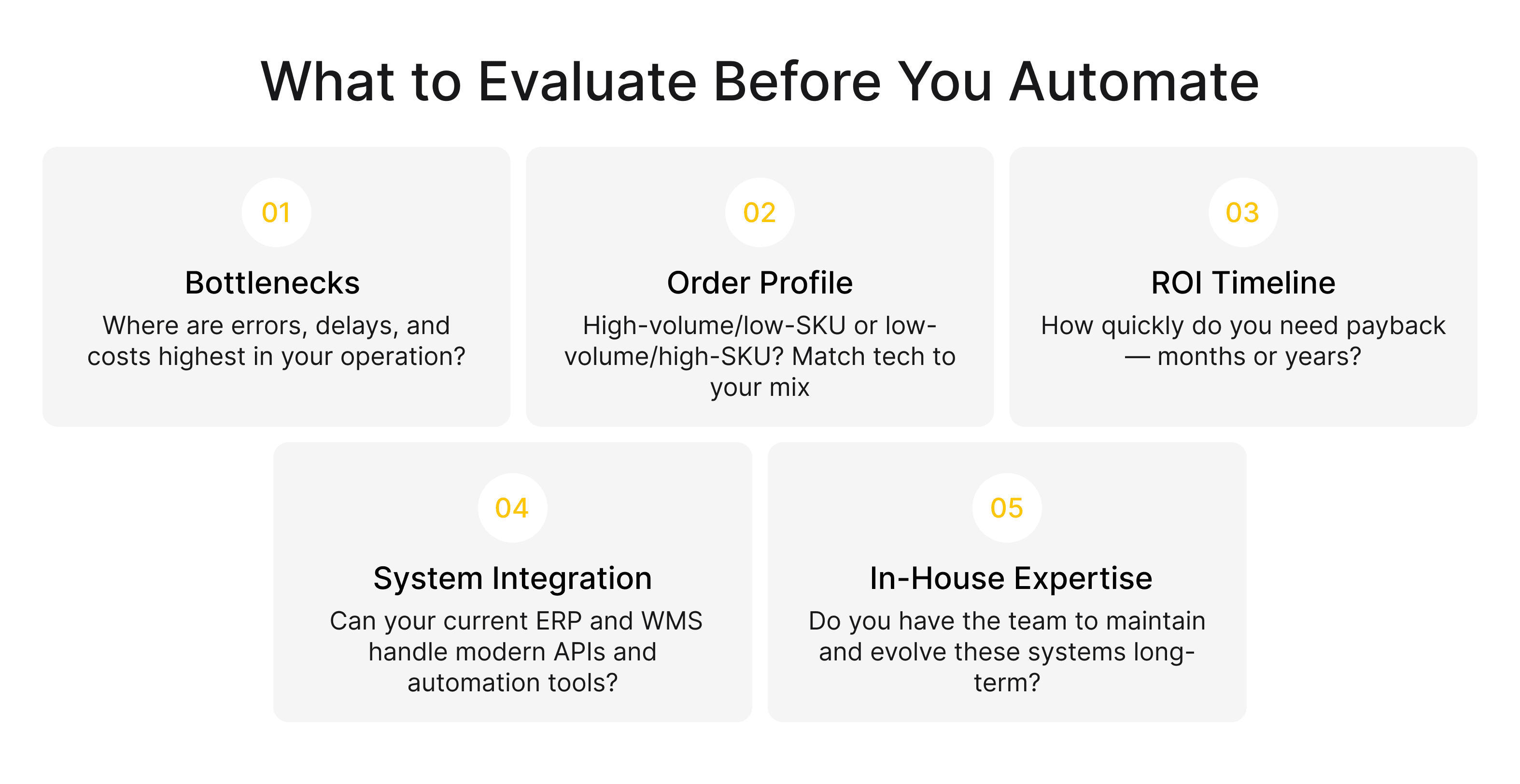
5 Questions to Ask Before Investing in Automation
- What are your biggest operational bottlenecks right now? Don’t automate everything—automate the pain points. Target areas with the highest errors, delays, and costs.
- What does your order profile look like? High-volume, low-SKU operations need different tech than low-volume, high-SKU ones. Match technology to your actual order mix.
- How quickly do you need to see ROI? Some investments pay back in months; others take years. Align choices with your financial timeline.
- Can your existing systems integrate with new automation? Legacy ERP and WMS platforms sometimes struggle with modern APIs. Factor integration costs into your planning. If infrastructure needs work, consider DevOps engineers for warehouse cloud infrastructure to ensure a solid foundation.
- Do you have the in-house expertise to manage this transition? Automation is a journey, not a project. You’ll need people who can maintain and evolve your systems over time.
 Click to expand
The Future of Warehouse Automation Technology
The future of warehouse automation is accelerating faster than most industry observers expected. What seemed like science fiction five years ago—fully autonomous facilities, drone-based inventory counts, AI-driven supply chain orchestration—is either here or close to deployment.
Trends Shaping Warehousing Through 2026 and Beyond
Several trends are converging to reshape what’s possible. Collaborative robots are becoming more affordable and easier to deploy. Digital twins let operators simulate changes before committing to them. Edge computing brings processing power closer to the warehouse floor, reducing latency for real-time decisions.
The future of warehouse automation technology also includes deeper integration with supply chain planning tools. Expect to see automated warehouses that dynamically adjust operations based on upstream signals—supplier delays, transportation disruptions, demand shifts—without human intervention.
Will Fully Autonomous Warehouses Become Standard?
The honest answer: eventually, yes—but not overnight. Fully autonomous “dark warehouses” that operate without lighting exist today, but only for high-volume, standardized products.
For most operations, the near-term outlook for warehouse automation looks like a hybrid model: humans and machines working together, with the balance gradually shifting toward more automation as technology improves and costs come down. The businesses that win will be the ones that start building their automation foundation now, even if full autonomy is still years away.
Final Takeaway
Warehouse automation technology isn’t a single product you buy—it’s a strategic capability you build over time. The warehouse automation technologies that deliver the best results are chosen deliberately, integrated thoughtfully, and scaled based on real performance data.
Whether you’re just getting started with basic barcode scanning or planning a full-scale robotic deployment, the principles are the same: know your pain points, start with the highest-impact changes, and build a system that grows with you. Bottom line, the question isn’t whether to automate—it’s how fast you can do it intelligently.
FAQ
What is the definition of warehouse automation?
Warehouse automation refers to the use of software, robotics, and sensor systems to perform warehouse operations with minimal human intervention. It covers everything from barcode scanning to fully autonomous picking and packing, all aimed at increasing speed, accuracy, and efficiency.
What are the main benefits of warehouse automation technology?
The core benefits include improved inventory accuracy, faster order fulfillment, lower error rates, better space utilization, and reduced reliance on labor. Over time, these improvements compound into significant cost savings and higher customer satisfaction.
How does RFID technology support warehouse automation?
RFID tags allow warehouses to track inventory without line-of-sight scanning. Tags can be read in bulk, from a distance, and through packaging. This speeds up receiving, improves cycle count accuracy, and provides real-time visibility into stock levels.
What is the difference between AMR and AGV?
AGVs follow fixed paths using magnetic strips or painted lines. AMRs use sensors and AI to navigate dynamically and adapt to layout changes. AMRs offer more flexibility, while AGVs are more cost-effective for repetitive, fixed-route tasks.
What does the future of warehouse automation look like?
The industry is moving toward intelligent, interconnected systems. AI-driven forecasting, digital twins, collaborative robots, and deeper IoT integration are gaining traction. Full autonomy is emerging in limited cases, but most operations will adopt a hybrid model combining human judgment with automated execution.


YOU MAY ALSO LIKE



Get in Touch
Got no clue where to start? Why don't we discuss your ideas?

