



By Bohdan Vasylkiv
- CEO & Co-Founder
IoT in Warehouse Management: Solutions & Benefits
Explore how IoT in warehouse management improves efficiency, accuracy, and visibility. Discover use cases, solutions, and real-world benefits.
Key Takeaways
- IoT in warehouse management replaces guesswork with accurate, real-time data.
- Connected sensors, RFID, and AMRs need a unified platform to deliver real value.
- Implementation challenges are real, but solvable with clear goals and the right architecture.
- The IoT in warehouse management market is growing fast, including mid-market operations.
What Is IoT in Warehouse Management?
IoT in warehouse management means equipping your facility with connected sensors, RFID readers, cameras, and software that streams live data from every shelf, vehicle, and loading dock. Instead of manual counts and spreadsheets, you get continuous, automatic updates.
The role of IoT in modern warehouse management is to bridge physical operations and digital decision-making. When goods move, data moves with them — automatically, accurately, and without human intervention at every step.
How IoT Works in Warehouse Operations
An IoT warehouse system runs on 3 layers. First, edge devices — sensors, RFID readers, scanners, wearables — collect raw data at the point of action. Second, a communication layer (WiFi, Bluetooth, LPWAN) carries that data to a central hub or cloud platform. Third, software processes and visualizes everything so your team can act on it.
The value isn't in any single device. It's what happens when those data streams connect: low stock triggers a reorder, a temperature sensor alerts before a product spoils, and a picker gets a smarter route. That loop from detection to action is where IoT earns its keep.
Key Benefits of IoT in Warehouse Management
 Click to expand
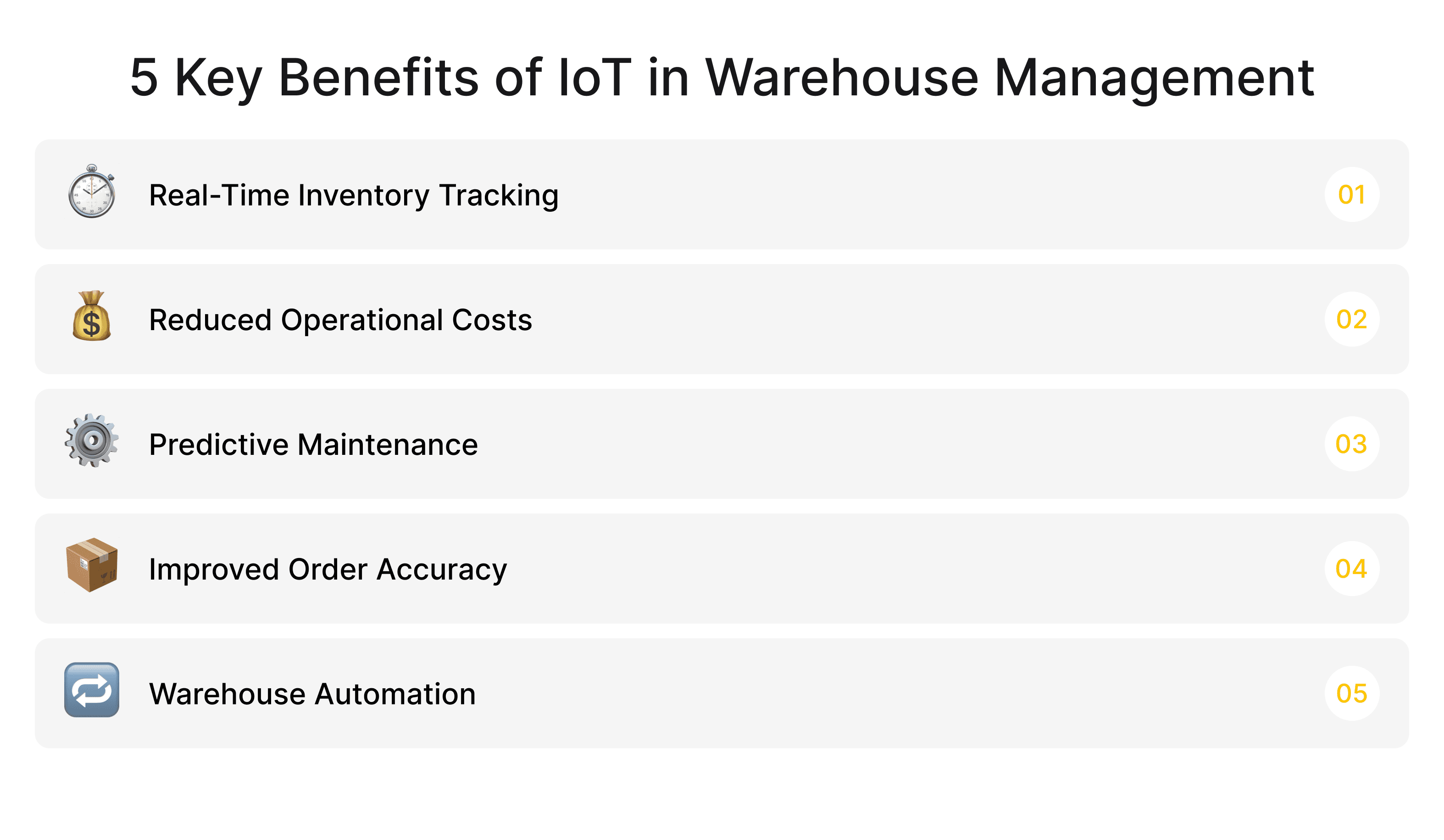
Real-time inventory tracking and improved visibility
IoT in warehouse management eliminates batch counting and end-of-day reconciliation. You get real-time inventory visibility in warehouses that surfaces shortages before they become stockouts and keeps counts accurate across multiple locations. When you know exactly what you have, everything downstream gets easier.
Reducing operational costs and minimizing waste
Waste in a warehouse hides in plain sight — unnecessary movement, over-ordered supplies, expired perishables, and idle equipment. IoT in warehouse management surfaces everything. Smart sensors flag at-risk items. Route optimization cuts picker travel. Automated alerts prevent over-purchasing.
Predictive maintenance and equipment monitoring
Connected equipment monitors its own health: vibration levels, temperature, and usage cycles. The system flags problems before they become breakdowns, allowing your maintenance team to intervene on schedule rather than react to a crisis. This shift from reactive to predictive is one of the strongest ROI drivers in any IoT warehouse deployment.
Improving order accuracy and customer satisfaction
Scan-verified picking, real-time order tracking, and automated quality checks create tighter accountability from order entry to dock departure. Fewer errors mean fewer returns, fewer support calls, and more repeat business.
Increasing warehouse efficiency with IoT automation
Automated guided vehicles handle repetitive transport. Smart slotting places fast-moving items closer to packing stations. Dynamic task assignment routes workers based on live priorities. The gains compound — not because people work harder, but because the system works smarter.
IoT Devices and Technologies Used in Smart Warehouses
 Click to expand
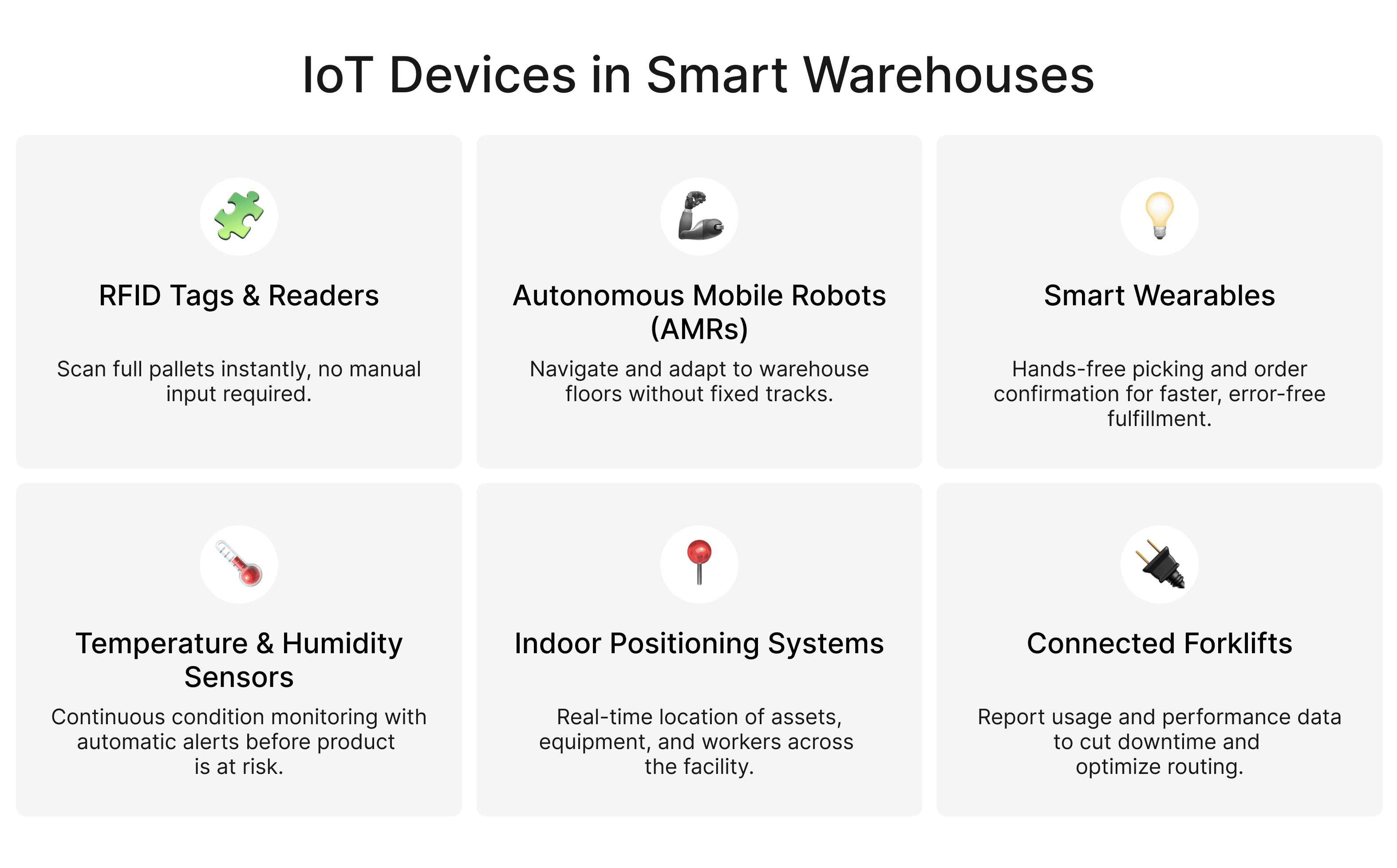
RFID tags and smart labeling systems in warehouses
RFID is the backbone of most IoT warehouse setups. Tags don't need line-of-sight — you can scan an entire pallet in seconds, hands-free. Smart labels combine RFID with printed data for flexible, readable identification at scale.
Wearable technology for warehouse staff productivity
Smart glasses and ring scanners let workers pick up orders and confirm tasks without stopping to use a handheld device. In high-volume operations, eliminating that motion adds up to real throughput gains — and fewer errors from misread screens.
Autonomous mobile robots (AMRs) and smart automation
AMRs navigate warehouse floors without fixed tracks, mapping the environment and adjusting in real time. They handle goods-to-person fulfillment, inter-zone transport, and sorting — and can be redeployed quickly as your layout or demand changes.
IoT platforms and software for warehouse optimization
The best IoT solutions for warehouse management depend on a strong software layer — platforms that normalize device data and integrate it with your existing WMS and ERP. The goal is for IoT data to flow into the systems you already run, not into a separate silo to manage.
Challenges of Implementing IoT in Warehouse Management
 Click to expand
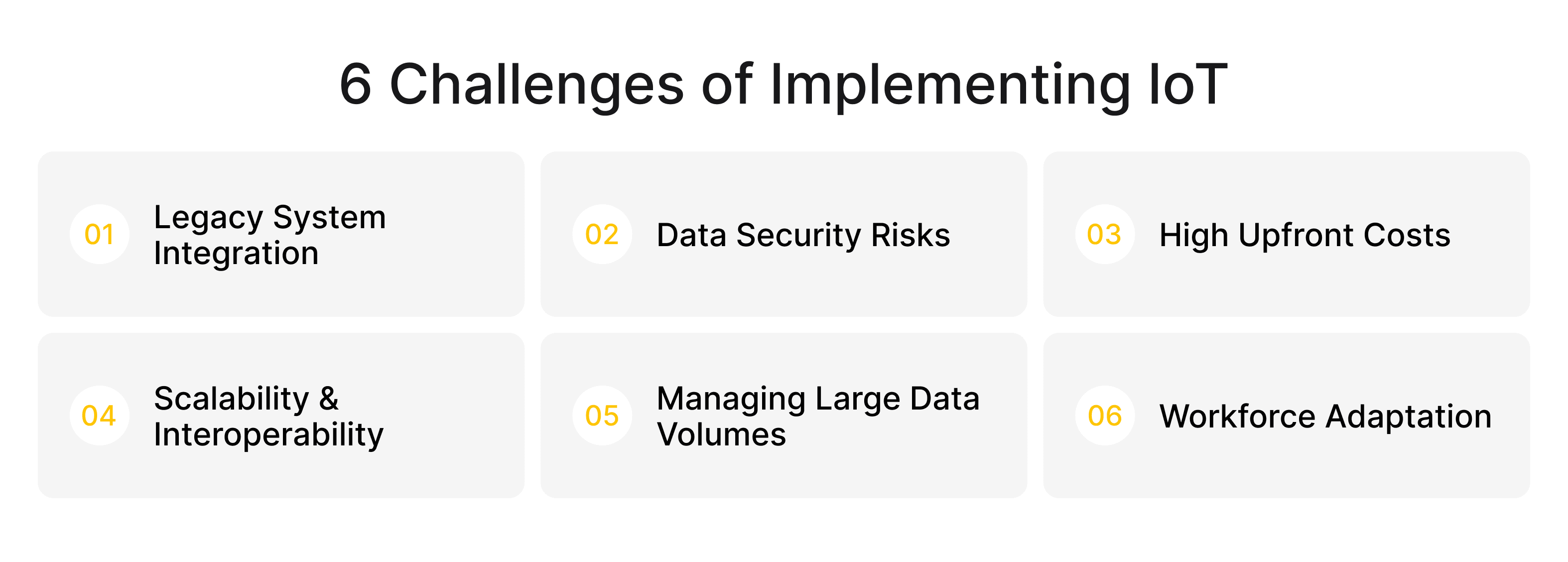
Integration with legacy warehouse systems
Most warehouses weren't built with IoT in mind. Older WMS platforms and proprietary hardware rarely connect out of the box. Integration requires careful API work, sometimes middleware, and thorough testing before going live.
Data security and privacy concerns in IoT environments
More connected devices mean a larger attack surface. IoT endpoints are harder to patch than traditional IT systems. Device authentication, encrypted communications, and network segmentation need to be baked in from day one — not added later.
High implementation and infrastructure costs
The upfront investment is significant, especially for mid-sized facilities. That said, the ROI case for IoT in warehouse management is usually strong once you account for labor savings, reduced error rates, and improved asset utilization over a two-to-three-year horizon.
Scalability and interoperability issues
Not all IoT devices speak the same protocol. MQTT, Zigbee, and LoRaWAN each have different compatibility profiles. Architecture decisions made early determine whether your system grows cleanly or becomes an expensive patchwork.
Managing large volumes of IoT-generated data
A mid-sized connected facility can generate terabytes of sensor data monthly. Without clear analytics pipelines and defined alert thresholds, you end up drowning in readings rather than acting on insights.
Workforce adaptation and change management
The technology is often the easier part. Getting your team to trust new workflows takes training, clear communication, and genuine buy-in from leadership. Implementations that skip change management rarely deliver their full potential.
IoT in Warehouse Management Market and Trends
Growth of the IoT in warehouse management market
The IoT in warehouse management market has expanded rapidly, driven by e-commerce growth, labor shortages, and supply chain pressure following recent global disruptions. What was once an enterprise-only conversation is now accessible to mid-market operations deploying targeted solutions.
Automation and robotics in modern logistics
Robots and IoT are increasingly inseparable. Knowing how IoT can be used in warehouses to drive automation is becoming a core logistics competency — especially for companies extending smart operations through IoT-enabled transportation and delivery tracking.
Sustainability and green warehouse initiatives
IoT is playing a growing role in cutting energy consumption and waste. Smart lighting adjusts to occupancy. Climate control optimizes in real time. For companies with sustainability goals, connected infrastructure is increasingly integral to operational solutions.
How to Successfully Implement IoT in a Warehouse
 Click to expand
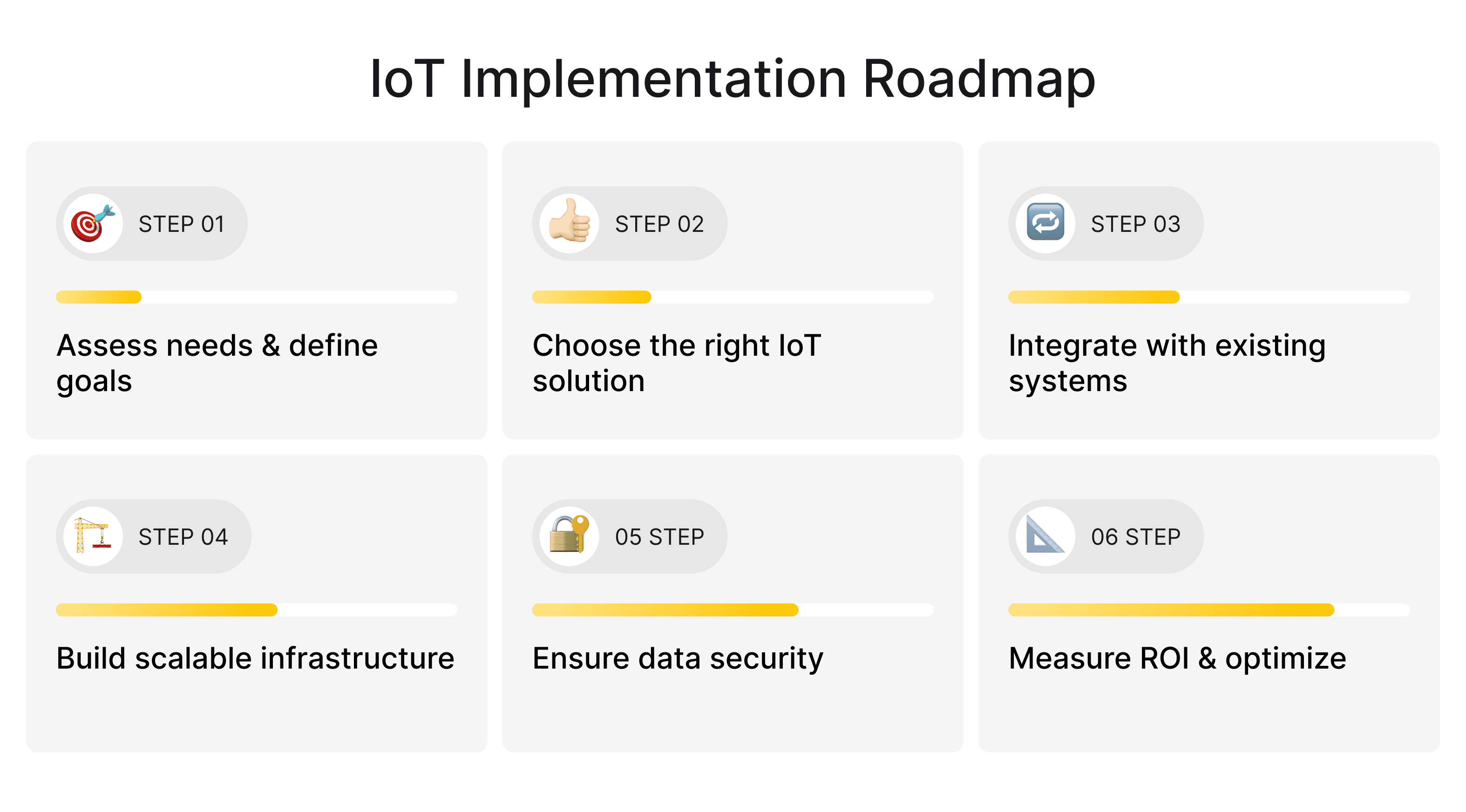
Assessing warehouse needs and defining IoT goals
Start with the specific problem you're trying to solve — inventory inaccuracy, pick rate, equipment downtime. A clear, measurable goal makes technology selection straightforward and ROI tracking honest.
Choosing the right IoT solutions for warehouse management
Off-the-shelf platforms handle standard use cases well. But if your operation has unique constraints or complex integration requirements, a custom solution typically performs better and costs less in the long term. That's exactly where Incora comes in — helping you build IoT-based warehouse management platforms built around your specific needs, not retrofitted from a generic template. You can also hire full-stack developers for IoT solutions who cover the full stack from device firmware to production dashboard.
Integrating IoT with existing warehouse systems
Plan integration points before deploying anything. Map your data flows, use open APIs where possible, and test integrations in staging. Understanding how IoT can be used in warehouses effectively depends on clean, stable connections to your WMS and ERP.
Building scalable and flexible IoT infrastructure
Design for where you'll be in three years, not just today. Cloud-ready architecture, modular device selection, and open protocols prevent vendor lock-in. Custom supply chain software development should treat scalability as a first-class requirement — not an afterthought.
Ensuring data security and compliance
Build your security model before a single sensor goes in. Device authentication, role-based access controls, encrypted data in transit and at rest, and regular vulnerability assessments are baseline requirements. Regulatory data-handling obligations vary by industry — factor them in from the start.
Measuring ROI and optimizing IoT performance
Define your metrics upfront — pick rates, inventory accuracy, equipment uptime — and track them consistently. IoT in warehouse management improves over time as you refine thresholds, expand sensor coverage, and act on more granular data.
Ready to transform your business?
Our experts will guide you through every step of the digital transformation journey.
Future of IoT in Warehouse Management
The next wave moves deeper into AI and machine learning — from descriptive data (what happened) to predictive insight (what's about to happen). Digital twins of entire facilities, AI-optimized slotting that updates in real time, and edge computing that processes data locally without cloud round-trips are all shifting from experimental to practical.
Companies investing in IoT in warehouse management infrastructure today will have a structural advantage as these capabilities mature. The cost of waiting grows every year, and the gap widens.
Conclusion
IoT in warehouse management is a practical, proven toolkit — not a future concept. From RFID-driven inventory accuracy to AMR-powered fulfillment, the technology is working at scale right now. The gap between connected and disconnected warehouses is widening every year. The real question isn't whether IoT makes sense; it's how to implement it in a way that fits your actual operation and delivers measurable results.
FAQ
How is IoT used in warehouse management?
IoT in warehouse management is used to track inventory in real time, monitor equipment health, guide autonomous robots, manage environmental conditions, and connect operations to broader supply chain systems. Sensors feed continuous data into management software, enabling faster, more accurate decisions.
What are the main benefits of IoT in warehouses?
The role of IoT in modern warehouse management delivers improved inventory accuracy, lower operational costs, reduced equipment downtime through predictive maintenance, better order accuracy, and faster fulfillment — all of which add up to stronger customer satisfaction.
What devices are used in IoT warehouses?
Common devices include RFID tags and readers, temperature and humidity sensors, barcode scanners, autonomous mobile robots, smart wearables for staff, GPS and indoor positioning systems, smart cameras, and connected forklifts. Some warehouses also deploy environmental monitors for lighting and climate control, as well as edge computing units that process data locally before sending it to the cloud. The right mix depends on your facility's size, throughput, and specific use cases — there's no single standard stack.
Is IoT expensive to implement in warehouses?
Costs vary by scale and complexity. Targeted deployments can be relatively affordable; full smart warehouse buildouts require more investment. Most operations see strong ROI within 2 to 3 years through labor savings, error reduction, and better asset utilization.
What is the future of IoT in logistics?
Tighter integration between IoT, AI, and robotics — warehouses that anticipate demand, self-optimize layouts, and coordinate autonomous systems with minimal human input. Sustainability will be a growing driver as pressure to reduce operational waste intensifies.


YOU MAY ALSO LIKE


Get in Touch
Got no clue where to start? Why don't we discuss your ideas?

