



By Tetiana Stoyko
- CTO & Co-Founder
How to Improve Inventory Visibility in the Supply Chain: Benefits, Challenges & Best Practices
Learn how to improve inventory visibility in the supply chain, overcome common challenges, and unlock key business benefits with real-time data.
If you don't know exactly what stock you have, where it sits, and when it moves, your supply chain is already working against you. Poor inventory data leads to excess holding costs, frustrated customers, and operations that can't keep up with demand. This guide covers everything you need to know about inventory visibility in supply chain operations — from the inventory visibility challenges that are likely slowing you down right now, to a practical framework for fixing them across every node in your network.
Strategic Overview of Supply Chain Visibility
Inventory visibility in supply chain management refers to the real-time ability to track stock levels, locations, and movements across every stage of operations — from raw material suppliers and warehouses to distribution centers and end customers. It is not simply about knowing how many units sit in a particular location. Rather, true visibility connects procurement, fulfillment, and demand planning into a unified data stream, enabling faster decisions and fewer costly errors.
Organizations that build this capability unlock measurable inventory visibility benefits — from reduced emergency procurement and tighter lead time management to more predictable fulfillment performance. Of course, achieving it requires aligning people, processes, and technology around a shared standard for inventory data. Those who commit to this alignment gain concrete supply chain visibility benefits across every operational function.
The Benefits of Real-Time Inventory Visibility
Understanding the full scope of inventory visibility benefits requires looking beyond stock accuracy numbers. Real-time inventory data transforms how operations teams make decisions, how finance teams model costs, and how customer-facing teams make and honor delivery commitments.
Operational Efficiency and Cost Control
Accurate, live inventory data eliminates manual reconciliation cycles that drain warehouse and procurement teams. Effective inventory visibility in supply chain operations means stock levels update automatically — so teams spend less time on counts and more time on fulfillment. The result is lower labor costs, fewer emergency orders, and faster cycle times throughout the operation.
Reduced Stockouts and Overstock
One of the most direct benefits of inventory visibility is the ability to prevent both stockouts and excess inventory simultaneously. Real-time data allows replenishment to trigger at exactly the right moment — trimming carrying costs while keeping stock consistently available across all channels.
Improved Customer Experience
Customers expect accurate, reliable delivery commitments. One of the most impactful ways to improve inventory visibility is to connect order management systems directly to real-time stock positions — enabling fulfillment teams to set honest expectations, reduce order cancellations, and meaningfully shrink order-to-delivery windows, all of which drive loyalty and repeat purchases.
Stronger Demand Forecasting Accuracy
Historical inventory data, captured consistently across all locations and channels, feeds more accurate demand models. Predictive analytics for demand forecasting becomes far more reliable when the underlying stock data is clean, continuous, and complete — removing one of the most common sources of forecast error.
Inventory Visibility Business Benefits at Scale
The inventory visibility business benefits compound as operations grow. Businesses managing thousands of SKUs across multiple distribution networks benefit disproportionately from standardized inventory data flows. Early investment in visibility infrastructure enables scalable growth without a proportional increase in operational overhead, making the ROI case stronger the earlier organizations act.
The Hidden Costs of Poor Inventory Visibility
Poor inventory visibility is not a passive problem — it actively generates costs that erode margins and slow organizational growth. The full benefits of inventory visibility only become apparent when you calculate what the business is losing without it.
Financial Losses and Margin Erosion
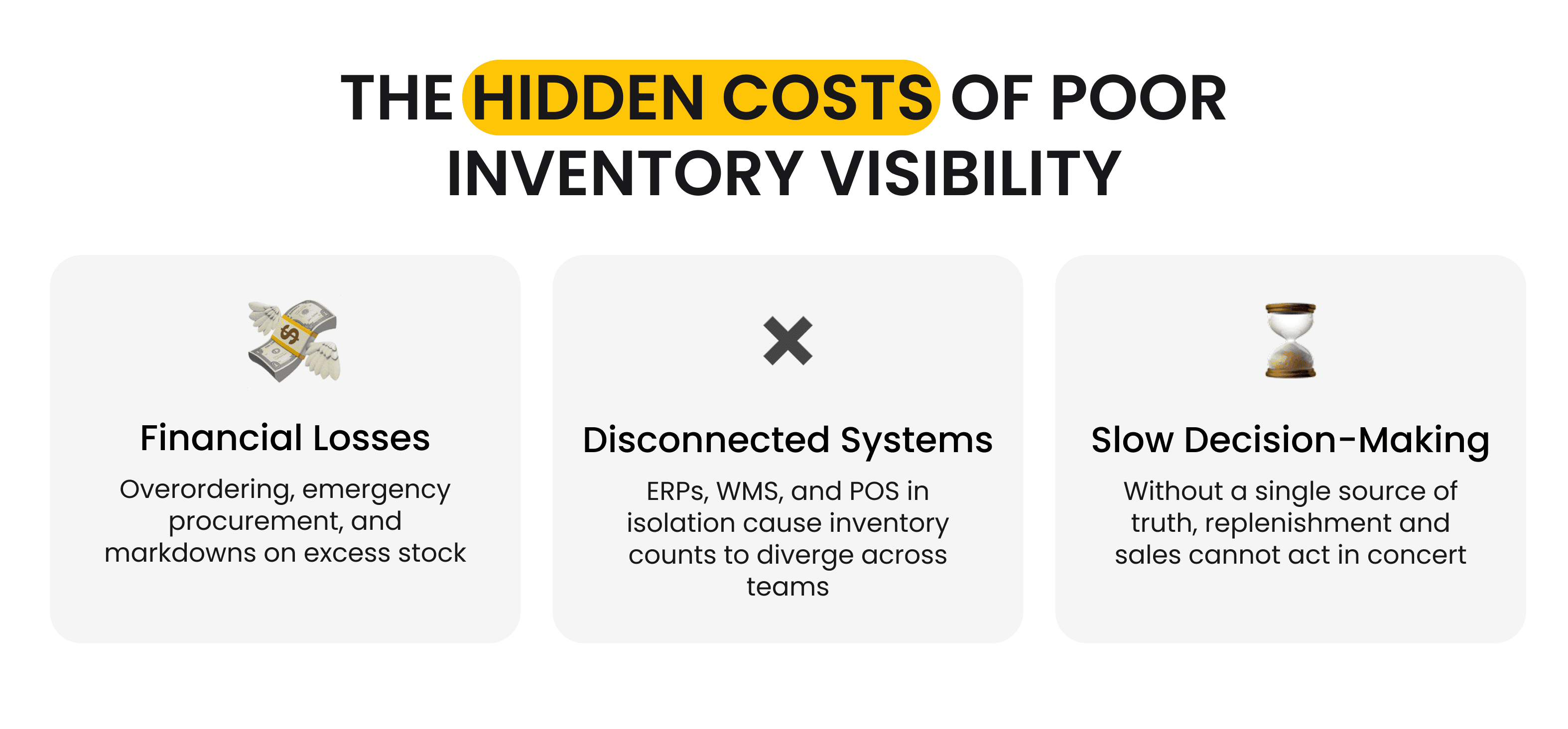
Inaccurate inventory data leads directly to overordering, emergency procurement, and markdowns on excess stock. Carrying costs for surplus inventory typically represent 20–30% of the stock's annual value. For organizations operating on thin margins, this is not a line item to optimize — it is a structural threat to profitability.
Disconnected Systems and Data Silos
When ERPs, warehouse management systems, and point-of-sale platforms operate in isolation, inventory counts diverge across departments. Teams begin to work from conflicting figures, making every planning decision slower and riskier. Siloed systems are among the most common root causes of visibility failure, regardless of company size or sector.
Slow Decision-Making Across Departments
 Click to expand
The Most Common Inventory Visibility Challenges
Closing the gap between fragmented tracking and genuine end-to-end visibility requires identifying and directly addressing the specific inventory visibility challenges most likely to affect your operation.
Legacy Infrastructure
Older warehouse systems and ERP platforms were not designed for real-time data exchange. Integrating them with modern tracking tools typically requires custom middleware layers and API development, adding both cost and project complexity that discourages action. Yet organizations that want to genuinely improve inventory visibility cannot afford to leave legacy systems unaddressed, as they perpetuate the very data gaps that undermine operational performance.
Lack of Real-Time Data Synchronization
Batch updates, whether hourly or nightly, are insufficient when fulfillment windows are measured in hours or minutes. Any initiative to improve inventory visibility must prioritize real-time data synchronization across all connected systems, which is technically demanding to implement and maintain reliably at scale.
Multi-Location Complexity
The more warehouses, distribution centers, and retail locations a business operates, the harder it becomes to consolidate inventory data into a coherent, unified picture. Each location may run different systems with different data standards, compounding the synchronization challenge.
Omnichannel Inventory Fragmentation
Retail, ecommerce, wholesale, and marketplace channels frequently draw from shared inventory pools but track stock independently. This fragmentation makes overselling and stock discrepancies nearly inevitable without a centralized platform connecting all fulfillment channels.
Manual Processes
Spreadsheets and manual cycle counts remain common even in growing businesses. They introduce errors, processing delays, and audit gaps that systematically undermine the accuracy of any visibility initiative — creating a ceiling on how much improvement technology investments can deliver.
How to Improve Inventory Visibility: A Step-by-Step Framework
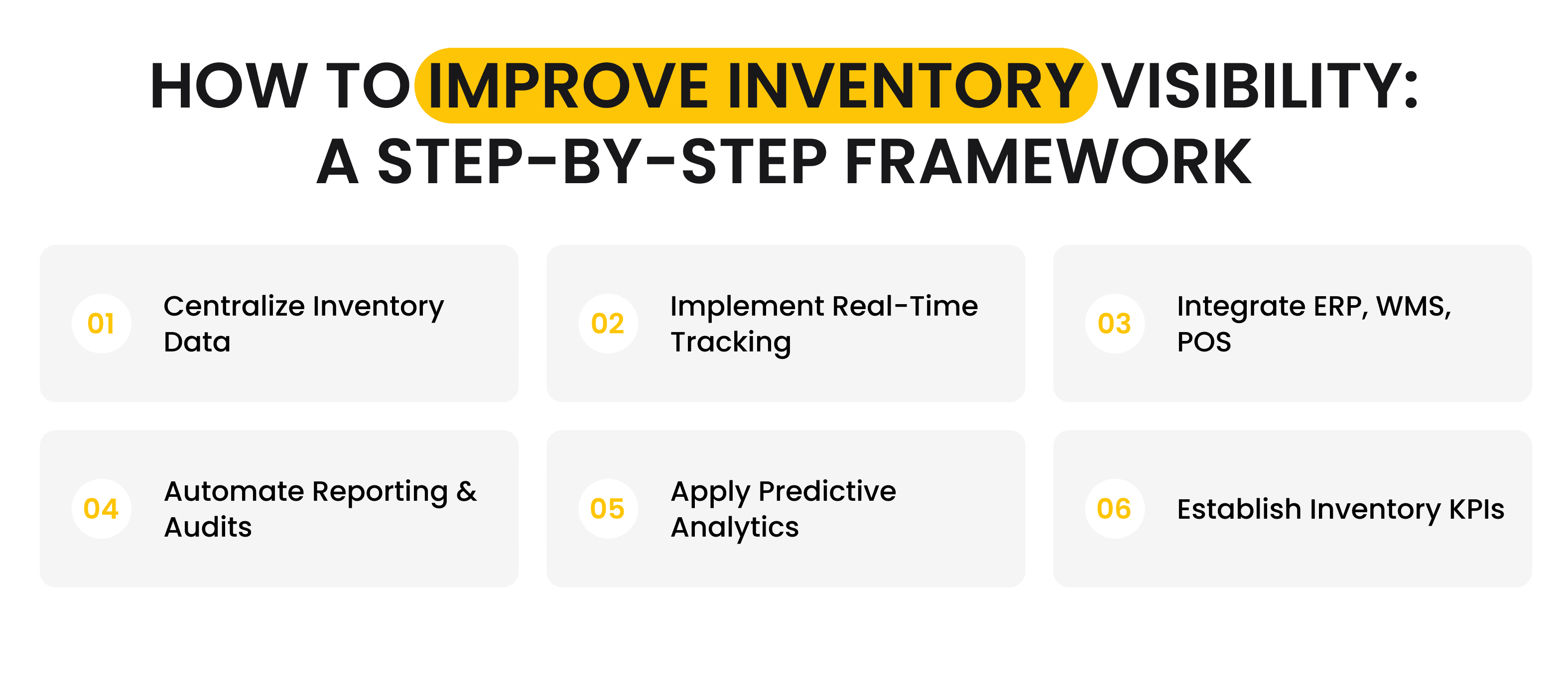
Understanding how to improve inventory visibility requires both a technical roadmap and genuine organizational alignment. The following six-step framework offers a structured path from reactive, fragmented tracking to proactive, end-to-end supply chain clarity.
1. Centralize Inventory Data Across Systems
The foundation of visibility is a single, authoritative inventory data source. This typically means selecting or building a central platform — whether a modern ERP, a dedicated inventory management system, or a custom data layer — that aggregates records from all channels, locations, and fulfillment partners into one accessible view.
2. Implement Real-Time Inventory Tracking
Adopt barcode scanning, RFID, or IoT sensors to capture every stock movement as it happens. Real-time tracking eliminates the gap between physical reality and system records that causes most accuracy problems — and provides the live data that underpins every other visibility initiative.
3. Integrate ERP, WMS, POS
Disconnected systems are the leading cause of divergence in inventory data. Understanding how to improve inventory visibility starts here: integrating your ERP, warehouse management system, and point-of-sale platform via APIs or middleware enables bidirectional data flows that keep all systems aligned. Experienced supply chain software development teams can design and accelerate this integration, ensuring it scales reliably as transaction volumes grow.
4. Automate Reporting and Inventory Audits
Manual reporting introduces delays at every decision point. Automated dashboards and scheduled audit triggers enable teams to monitor key inventory metrics in real time and surface anomalies before they escalate into stockouts or excess inventory.
5. Apply Predictive Analytics with Voice-Directed Warehouse Systems
Combining predictive analytics for demand forecasting with a voice picking system enables warehouse teams to execute replenishment and fulfillment with greater speed and precision. Voice-directed workflows reduce picking errors, while predictive models anticipate demand fluctuations before they appear in historical data.
6. Establish Clear Inventory KPIs
 Click to expand
Technology That Enables End-to-End Inventory Visibility
Getting visibility at scale isn't just about picking the right tools — it's about building the right architecture around them. That's exactly what Incora's supply chain software development team does for companies in logistics, retail, and manufacturing: custom solutions that give you real-time inventory intelligence without tearing apart what's already in place.
Cloud-Based Inventory Platforms
Cloud infrastructure removes the hardware constraints that limit on-premise systems. It scales dynamically with transaction volume, supports remote access across all locations, and reduces total cost of ownership compared to legacy deployments — making it the default architecture choice for organizations building long-term visibility capabilities.
Event-Driven Architectures
Event-driven systems process every inventory update the moment it occurs — a shipment arriving, a pick being confirmed, a return being logged — rather than waiting for scheduled batch processing cycles. This architectural pattern is essential for operations in which even a brief data lag poses meaningful fulfillment risk.
RFID and Smart Tracking
RFID tags enable item-level tracking without requiring line-of-sight scanning. In high-volume warehouse environments, RFID readers log hundreds of movements per second, dramatically reducing the labor required for cycle counts and improving stock accuracy well beyond what barcode-only systems can achieve.

Unified Commerce Infrastructure
A unified commerce platform consolidates inventory across all sales channels — retail, ecommerce, B2B — into a single shared pool. This eliminates channel-level fragmentation and enables accurate available-to-promise calculations regardless of the order's origin. Notably, in event-based industries, the benefits of real-time ticket inventory visibility are particularly significant: overselling a single ticket allocation can cause immediate reputational damage that takes far longer to repair than the transaction itself.
When all of these technologies are integrated thoughtfully, supply chain automation creates a resilient foundation capable of adapting in real time to shifts in demand, supplier delays, and operational disruptions.
So, if your organization is ready to close the gap between fragmented stock data and end-to-end supply chain clarity, Incora's engineering team is available to assess your current architecture and design a roadmap tailored to your operational scale and technology environment.
Measuring Inventory Visibility Success
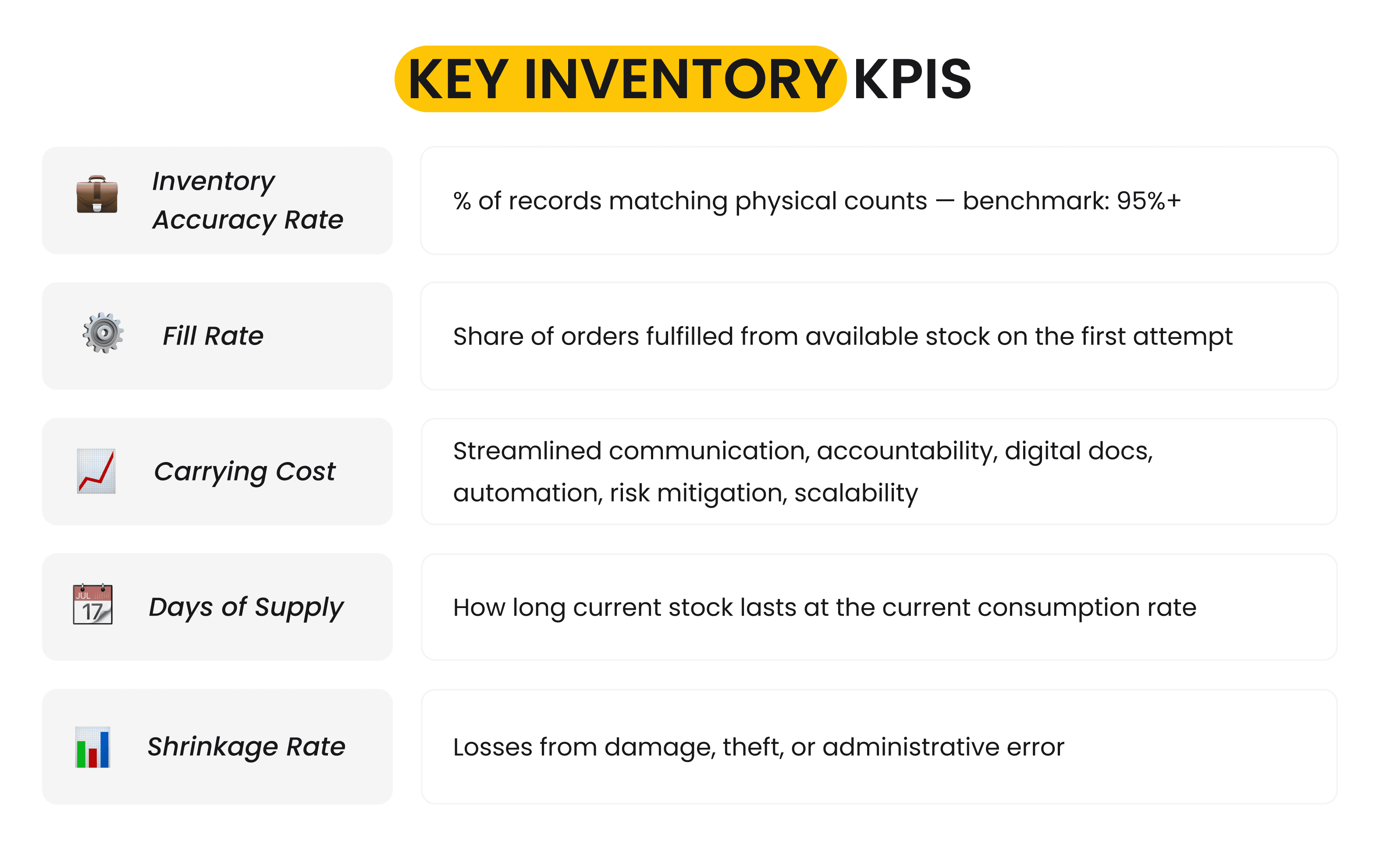
Implementing visibility technology only delivers value when performance is consistently measured and tracked. The following KPIs provide a practical framework for quantifying progress and communicating ROI to stakeholders:
- Inventory Accuracy Rate — the percentage of records matching physical counts — an industry benchmark of 95% or higher signals a well-controlled inventory environment.
- Fill Rate — the share of customer orders fulfilled from available stock on the first attempt. High fill rates indicate strong alignment between supply and demand.
- Carrying Cost as a Percentage of Inventory Value — tracks the financial burden of holding stock. Each percentage point reduced here contributes directly to margin improvement.
- Days of Supply — measures how long current stock will last at the current consumption rate. Tighter ranges reflect leaner, more responsive replenishment cycles.
- Shrinkage Rate — monitors losses from damage, theft, or administrative error. Visibility improvements consistently reduce shrinkage by increasing operational accountability.
 Click to expand
These metrics should be reviewed weekly or monthly to detect trends early and support data-driven replenishment decisions. To improve inventory visibility outcomes over time, teams must treat measurement not as a periodic reporting exercise but as an active management discipline.
The Future of Inventory Visibility in Supply Chains
Inventory management is moving fast, and if you're not keeping up, the gap only widens. AI-driven demand sensing is quietly replacing those old static forecasting models, picking up on signals your historical data wouldn't catch until it was too late. Bottom line: the benefits of inventory visibility in supply chain operations will only grow as customer expectations rise and global networks become messier.
Smart tags, warehouse robotics, and predictive replenishment are no longer future concepts — they're moving into production right now. If you invest in flexible, API-first infrastructure today, you won't need a costly overhaul to take advantage of it. The real question isn't whether you need better inventory visibility — it's how long you can afford to wait.
FAQ
What is inventory visibility in supply chain management?
Inventory visibility in supply chain management is the real-time capability to track where products are at every stage — from raw material sourcing through final customer delivery. It connects physical stock positions to digital records across all locations, channels, and logistics partners. The benefits of inventory visibility extend to cost reduction, customer satisfaction, and more accurate strategic forecasting.
How does inventory visibility improve forecasting?
Accurate, continuous inventory data provides demand planning models with a reliable input stream. This improves the precision of replenishment orders, reduces the need for large safety stock buffers, and allows teams to anticipate demand spikes rather than react to them after costs have already been incurred.
What are the biggest challenges in achieving inventory visibility?
The most common obstacles include legacy systems that resist integration, manual data entry errors, disconnected channel-level tracking, and the absence of standardized data formats across supply chain partners. Each of these challenges must be addressed systematically for visibility improvements to hold at scale.
What technology improves inventory visibility the most?
Cloud-based platforms combined with RFID tracking, event-driven integration architectures, and predictive analytics consistently deliver the highest-impact visibility improvements. Supply chain automation tools that unify ERP, WMS, and POS systems in real time are particularly effective — especially when built on a flexible, API-first infrastructure that can evolve with the business.


YOU MAY ALSO LIKE

Get in Touch
Got no clue where to start? Why don't we discuss your ideas?

