



By Bohdan Vasylkiv
- CEO & Co-Founder
The Building Construction Process From Start to Finish: All Key Steps Explained
Learn the full building construction process step by step from planning and design to final handover. A complete guide to all stages and phases of construction.
Key Takeaways
- The construction process has 10 distinct steps, from site selection to formal handover, skipping any one of them tends to cost more than doing it right the first time.
- A well-managed building construction process from start to finish depends on clear roles, realistic budgets, and a schedule built around actual site conditions.
- The stages of building construction that most projects underestimate are pre-construction planning and the permitting phase, both of which set the pace for everything that follows.
- Technology is reshaping how teams track, communicate, and deliver — from AI scheduling to GIS site analysis, digital tools have become part of the standard construction process.
Most construction projects don’t fail during the build. They fail long before the first shovel goes in the ground because someone rushed the planning, skipped a feasibility study, or signed a contract without reading the fine print. Here’s the thing: the construction process is predictable. The steps are well-known. And yet, projects still go over budget, miss deadlines, and hand over buildings that need immediate fixes.
This guide walks you through every stage of the building process — not just the obvious steps, but the parts that actually determine whether your project lands on time and budget.
What Is the Construction Process?
Simply put, the construction process is the full sequence of coordinated activities that transforms a concept — a sketch on paper, a business need, a plot of land — into a completed, functional building. It covers everything from initial planning and permitting through physical construction, inspections, and final handover to the client.
The process of construction isn’t 1 long task, it’s a chain of dependent phases where each stage feeds the next. That dependency is why sequence matters and why skipping ahead creates problems you’ll pay to fix later.
Core Phases vs. Steps: What’s the Difference?
You’ll often see “phases” and “steps” used interchangeably, but they mean something slightly different. Phases are broader categories: pre-construction, construction, and post-construction. Steps are the specific, actionable activities within each phase. For example, “procurement” is a phase; selecting a general contractor is a step within it.
When you’re thinking about a schedule, you’re working with phases. When you’re managing day-to-day work, you’re working with construction process steps. The best project managers switch between these views constantly.
Who Is Involved in the Construction Process?
Before we get into the construction process step by step, it’s worth being clear about who’s responsible for what. Role confusion is one of the fastest ways to create delays and disputes.
Owner and Developer
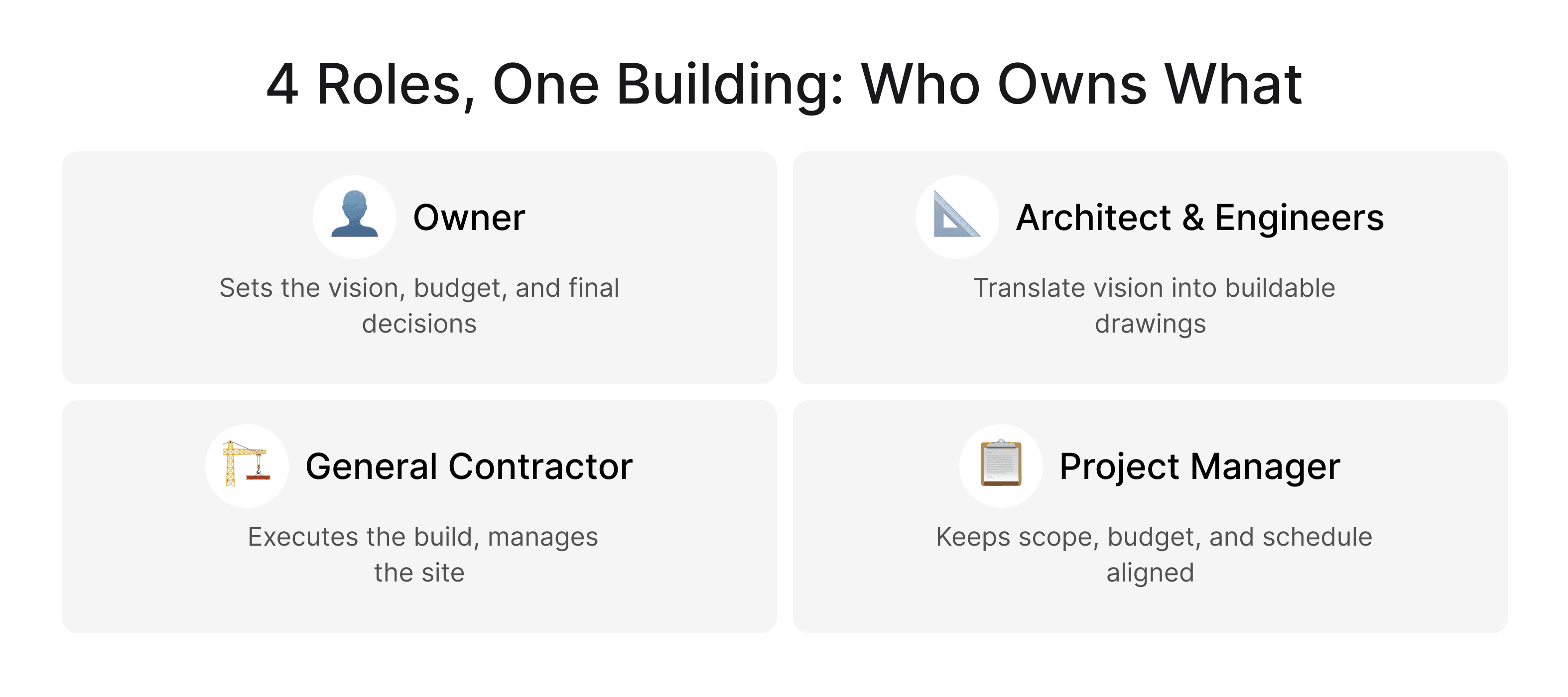
The owner funds the project and defines what needs to be built. On smaller projects, they may be hands-on; on larger ones,s they work through a development or project manager for day-to-day oversight.
Architect and Engineering Team
The architect turns the owner’s vision into a buildable design. The engineering team — structural, mechanical, electrical, plumbing — ensures it works technically. Together, they produce the drawings and specs that contractors build from.
 Click to expand
General Contractor and Subcontractors
The GC manages the site, coordinates subcontractors, and maintains the schedule. Understanding the construction process of building begins with knowing who you’re trusting to execute it, which is why GC selection is arguably the most important procurement decision you’ll make.
Construction Project Manager
The PM keeps budget, schedule, and scope aligned, flags issues before they escalate, and facilitates communication among all parties. On complex projects, it’s a full-time, high-stakes role.
Step 1: Pre-Construction: Planning and Development
This is the most underestimated stage in the building construction process. Done well, it makes every subsequent step easier. Skipped or rushed, it creates a cascade of problems that compound throughout the project.
Site Selection and Land Assessment
If you’re choosing a site, it needs to work for your project in practice. That means evaluating access, topography, soil conditions, existing infrastructure, and environmental constraints. GIS in construction tools can dramatically improve how quickly and accurately you assess a site, flagging issues that a traditional walkthrough would miss.
Feasibility Study and Risk Evaluation
A feasibility study answers one question: Can this project actually be built as conceived, within the expected budget and timeline? It should cover financial viability, regulatory constraints, market conditions, and technical risks. Skipping this step is how developers end up midway through a project, realizing the numbers never worked.
Construction Budget Estimation
Early budget estimates are inherently rough — and that’s fine, as long as everyone understands they’re rough. What matters is building a budget that includes a realistic contingency (typically 10–15% for new construction), accounts for soft costs such as permits and professional fees, and is progressively refined as the design matures. Budget estimation is a core part of the building construction procedure that shouldn’t be treated as a one-time exercise.
Project Scheduling and Milestone Planning
A construction schedule at the pre-construction stage won’t be perfect, but it forces you to think through sequencing, dependencies, and lead times. Long-lead items like structural steel need to be identified early. AI scheduling in construction is increasingly used to model scenarios and stress-test timelines before breaking ground.
Step 2: Architectural Design and Engineering
Design is where your building construction process takes real shape. You can’t move forward without complete, coordinated drawings, and the quality of those drawings directly affects how smoothly the build goes.
Schematic Design and Concept Development
The schematic design phase produces a high-level layout: the building’s massing, floor plans, key space relationships, and a rough sense of materials. This is where major decisions get made before they become expensive to change.
Construction Documents and Technical Drawings
Construction documents are the full package: architectural drawings, structural plans, MEP (mechanical, electrical, plumbing) drawings, specifications, and schedules. These documents are what contractors price from and build from. Incomplete or inconsistent documents are one of the leading causes of change orders and disputes.
Value Engineering: Balancing Cost and Quality
Value engineering sounds like cost-cutting, but done right, it’s about achieving the same function at lower cost. As a key step in construction planning, it involves reviewing the design with the team to identify substitutions or simplifications that deliver savings without compromising quality.
Step 3: Permits, Approvals, and Regulatory Compliance
You cannot legally begin construction without the right permits. The permitting process is also, honestly, one of the biggest schedule risks in the building process, particularly in dense urban areas where review times can stretch to months.
Building Permit Application Process
A building permit application typically requires full construction documents, site plans, and evidence that the design complies with local building codes. Different construction processes have different permitting requirements — some jurisdictions have streamlined digital submissions, others still involve paper plans and in-person reviews. Submitting a complete, code-compliant application the first time is the best way to avoid delays.
Zoning Laws and Code Requirements
Zoning determines what you can build where. Building codes determine how it must be built. These aren’t the same thing, and the same authority does not always administer them. Before finalizing a design, confirming compliance with both is non-negotiable — variances and appeals add months you probably haven’t budgeted for.
Environmental and Safety Clearances
Depending on the site, you may need to complete environmental impact assessments, obtain contamination clearances, or submit specific safety plans before permits are issued. Brownfield sites and projects near sensitive habitats carry the most risk here — assessments can add weeks or months to the pre-construction timeline. Factor this in early: finding out about a contamination issue after you’ve committed to a schedule is a painful way to learn.
Step 4: Procurement: Contractors, Materials, and Equipment
Procurement is where you turn your design into contracts and commitments. The steps in construction that follow depend heavily on the quality of the procurement decisions you make here.
How to Select a General Contractor
GC selection typically involves competitive bidding or a negotiated contract. Evaluate bids not just on price but on schedule, methodology, references, and financial stability. The cheapest bid is rarely the best value.
Subcontractor Bidding and Contracts
The GC manages subcontractor procurement, but the owner or PM should understand which key subs are involved. Back-to-back contracts — where subcontract terms mirror the main contract — are standard practice and protect the project if disputes arise.
Material Sourcing and Equipment Planning
Material procurement, especially long-lead items, needs to start early. Supply chain disruptions have made lead times unpredictable, so procurement planning is now a critical part of the construction process steps. Purpose-built software for the construction industry can automate supplier tracking and flag delays before they hit the schedule.
Step 5: Site Preparation and Foundation Work
The construction steps of building begin the moment crews arrive on site. Site preparation and foundation work set the physical baseline for everything that follows — errors here are expensive to fix once the structure goes up.
Site Clearing, Grading, and Excavation
Site clearing removes existing structures, vegetation, and debris. Grading reshapes the land to achieve the design elevations and establish drainage patterns. Excavation involves digging out foundations, basement levels, and underground utilities. All three need to happen in sequence, and each depends on an accurate survey.
Foundation Types and Their Construction
Foundation selection depends on soil bearing capacity, building loads, and groundwater conditions — factors assessed during the site investigation phase. Understanding the process of construction at the foundation level matters here: shallow foundations (spread footings, slab-on-grade) work for stable soils, while deep foundations (piles, caissons) transfer loads to deeper bearing strata. The foundation is literally what your building sits on, so getting it right is not optional.
Utility Installation Before Construction Begins
Temporary utilities — site power, water, sanitation — go in before the build starts. Permanent underground utilities (water, sewer, electrical conduit) are installed during site prep, before the slab is poured. Sort this out with local utility providers early; waiting until later is a reliable way to lose 2 weeks.
Step 6: Structural Construction and Building Envelope
This is the phase that looks most like “construction” from the outside — the visible rise of the building. The stages of building construction here involve building the structural skeleton and then closing it in against the weather.
Structural Framing Systems
Framing systems vary by building type and scale. Wood framing dominates residential construction. Steel and concrete — cast-in-place, precast, or post-tensioned — are standard for commercial and high-rise work. The framing system determines floor-to-floor heights, span lengths, and how MEP systems get routed through the structure. It also sets the pace for everything that follows, so delays in structural work ripple through the entire schedule.
Roofing and Exterior Wall Enclosure
Once the structure is up, the building needs to be enclosed — roof first, then exterior walls. Enclosure is a critical milestone because it allows interior work to proceed regardless of the weather.
Windows, Doors, and Weatherproofing
Windows and doors complete the envelope. Weatherproofing — membranes, sealants, flashings — protects against water infiltration. Failures here are among the most expensive long-term defects a building can have.
Not sure where to start with the construction process?
We can help you figure out what's actually slowing you down and what to build first.
Step 7: MEP Systems Installation
Mechanical, electrical, and plumbing (MEP) systems are the arteries and nerves of a building. The construction of building process reaches its most complex point here — multiple trades, strict sequencing, and coordination that can’t be improvised. Installing MEP is one of the most demanding phases in the entire build.
Mechanical Systems (HVAC)
HVAC installation — ductwork, air handling units, chillers, controls — is typically the most space-intensive MEP system. Coordinating its routing with structure and other services is increasingly done in BIM before crews arrive on site.
Electrical Wiring and Panels
Electrical rough-in — conduit, wire pulls, panel boxes, grounding — happens before walls are closed. Trim-out (fixtures, devices, final connections) follows after drywall. Tight sequencing between these phases needs careful scheduling.
Plumbing and Water Systems
Plumbing rough-in follows a similar pattern: below-slab work occurs before concrete is poured, and above-slab work occurs before walls close. Coordinating the steps in building construction for MEP systems is where project managers earn their keep, a missed coordination issue can mean opening finished walls.
Step 8: Interior Finishing and Final Installations
Interior finishing is the process by which a building transitions from a functional shell to a livable or workable space. This phase involves dozens of trades working in sequence, which is why scheduling the construction process from start to finish requires particular attention to finish trades.
Insulation, Drywall, and Interior Framing
Interior framing divides the floor plate into rooms. Insulation — thermal, acoustic, or fire-rated — goes into walls and ceilings, then drywall follows to complete the wall surfaces.
Flooring, Ceilings, and Wall Finishes
Flooring varies by space: tile in wet areas, carpet or hardwood in offices, and polished concrete in industrial settings. Suspended ceilings or exposed structure above. Sequence matters: ceilings before walls, walls before floors.
Fixtures, Fittings, and Built-In Elements
Final installations include plumbing fixtures, lighting, cabinetry, shelving, and any built-in furniture or equipment. These items often carry long lead times, 4 to 16 weeks is common for custom millwork or imported fittings, so they need to be ordered early in the project, even though installation happens near the end. Getting this sequencing wrong is one of the most common causes of last-minute delays before handover.
Step 9: Inspections, Quality Control, and Punch List
Inspections aren’t a formality at the end, they run throughout the entire construction process, starting with the foundation and continuing through the structure, MEP rough-in, and finish work.
Stages of Construction Inspection
Building inspectors check specific milestones: foundations before pours, framing before insulation, and MEP rough-in before drywall. Each inspection signs off or flags deficiencies to fix before work continues. Failing an inspection doesn’t just create rework — it creates schedule loss.
How to Build a Snag List That Works
A snag list (or punch list) is a formal record of incomplete or defective items at the end of construction. The key is specificity: not “paint defects in Corridor 3” but “paint finish on east wall of Corridor 3, between gridlines C and D, showing roller marks — requires remediation.” Vague entries get disputed. Specific entries get fixed. For a full breakdown of how to run this process, see our guide: What is a snag list in construction.
Quality Assurance vs. Quality Control in Construction
Quality assurance (QA) is the system: the processes, standards, and protocols that prevent defects. Quality control (QC) is the checking and inspection of work against those standards. Both are necessary. A well-run construction process includes both. Many projects have QC without QA, which means you’re catching problems after the fact rather than preventing them.
Step 10: Post-Construction: Closeout and Handover
The final phase of the construction process is often underestimated in both time and complexity. Closeout involves completing all contractual obligations, obtaining final approvals, and formally transferring the building to the client.
Certificate of Occupancy and Final Approvals
A certificate of occupancy (CO) is issued after a final inspection confirms the building meets code requirements. Without it, you can’t legally occupy the building. Teams managing complex closeout workflows often turn to bespoke software development to track outstanding sign-offs, automate reminders, and keep the closeout process from stalling in the final stretch.
Project Documentation and As-Built Drawings
As-built drawings record how the building was actually constructed — often differing from the original design due to field changes. These documents are essential for maintenance and future renovations, yet collecting them is a closeout task that is consistently underestimated.
Client Walkthrough and Formal Handover
The client walkthrough confirms the building is complete: systems commissioned, snag list resolved, O&M manuals handed over. Formal sign-off marks the start of the warranty period.
Warranty Period and Post-Construction Support
Most construction contracts include a one-year warranty period during which the contractor is responsible for defects that emerge under normal use. Before you sign off on handover, make sure you understand exactly what’s covered, how to report defects, and who handles the response. This conversation is much easier to have before handover than after something goes wrong and you’re trying to work out who’s liable.
Construction Process Timeline and Cost Overview
One of the most common questions about the construction process steps is how long everything takes and what it costs. Honest answer: It depends. But here are useful reference points.
How Long Does Each Phase Take?
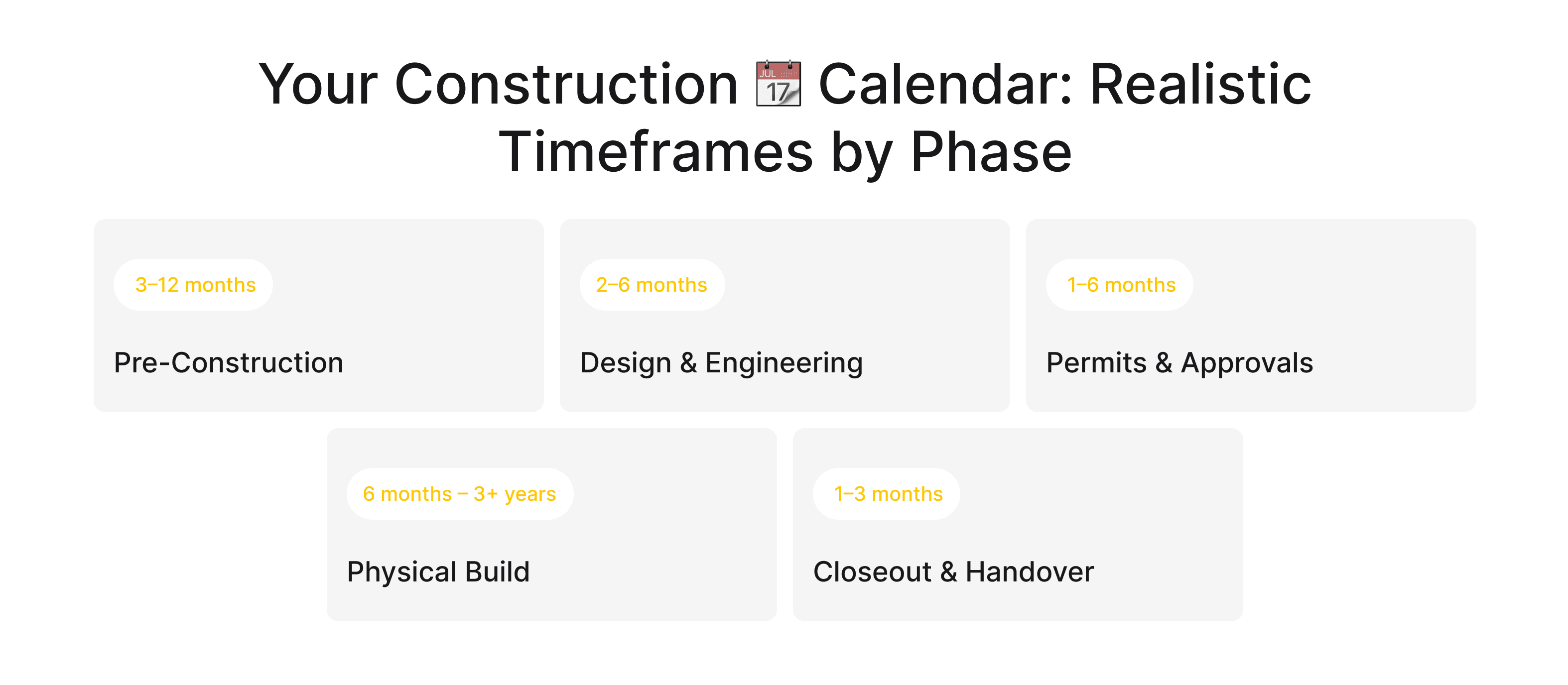
Pre-construction typically runs 3–12 months; design 2–6 months; the physical build from 6 months (small fit-out) to 3+ years (large mixed-use). Closeout adds 1–3 months. Rushing any phase doesn’t save time, it creates downstream problems.
 Click to expand
What Factors Affect the Construction Schedule?
Beyond scope and size, the factors that most consistently affect schedule are: permitting delays, weather disruptions, design changes, supply chain lead times, and labor availability. The construction processes that run on time tend to share a few characteristics: a realistic baseline schedule, proactive procurement, and a project manager who escalates issues before they become crises.
Typical Budget Breakdown by Phase
As a rough guide across the full construction process, site acquisition and pre-construction typically account for 15–25% of total cost. Structural and envelope work: 25–35%. MEP systems: 20–30%. Interior finishes: 10–20%. Contingency and closeout: 5–15%. If you need dedicated support to build cost-tracking or reporting tools for your projects, you can hire a dedicated team that works inside your workflows.
Common Mistakes in the Construction Process (and How to Avoid Them)
Understanding what can go wrong in the process of building construction is as valuable as knowing what to do right. These are the mistakes that show up most consistently across projects of all sizes.
Skipping the Pre-Construction Phase
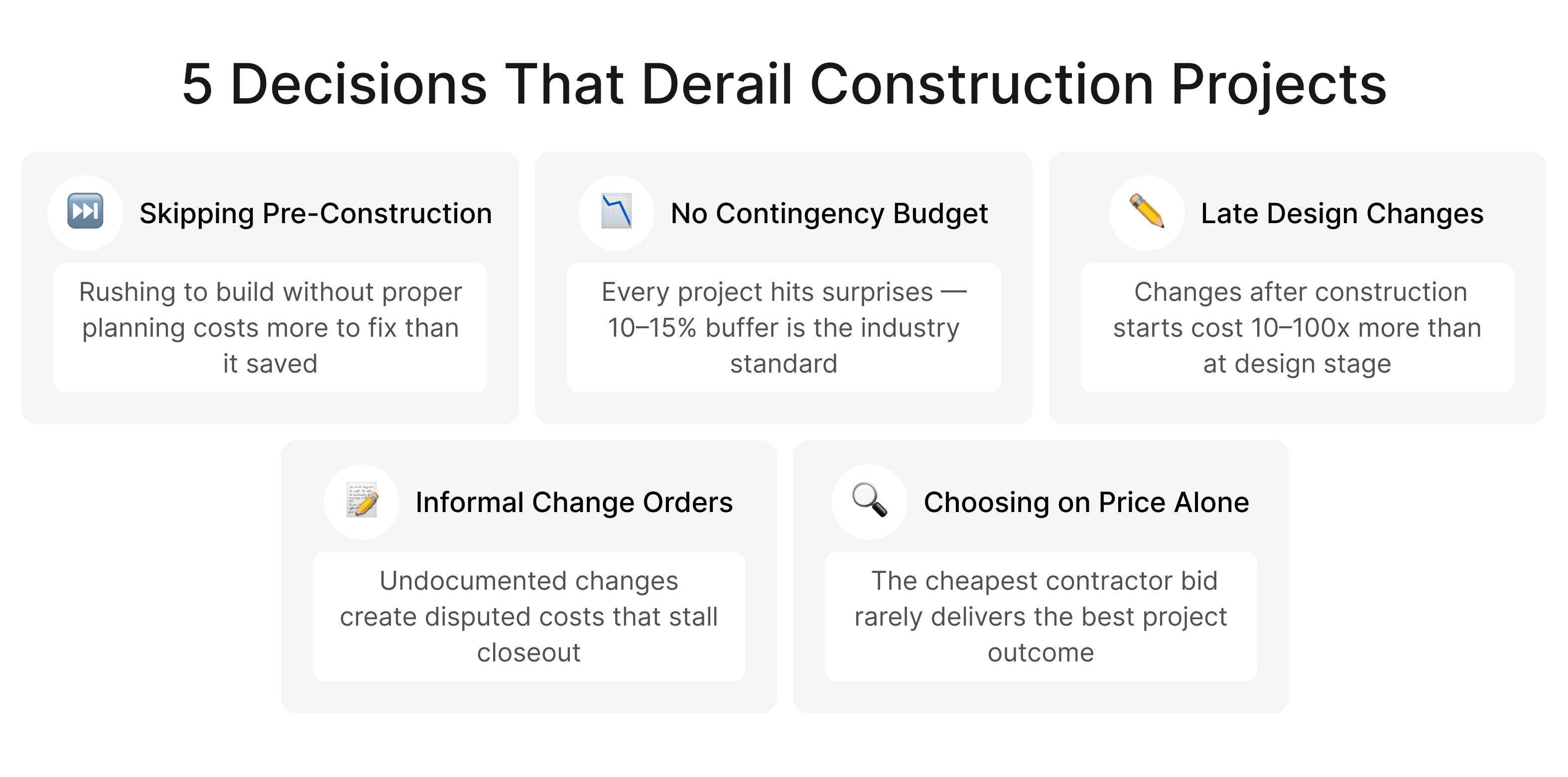
Pre-construction planning costs a fraction of what reactive problem-solving costs once work has started. Skipping feasibility studies or proper site investigation to move fast isn’t faster — you’re borrowing time you’ll pay back with interest.
Underestimating the Budget and Contingency
Early estimates are uncertain, that’s normal. The problem is that those estimates are treated as commitments rather than as starting points. Build in a realistic contingency (10–15% for new construction is standard), update your numbers at each design milestone, and don’t let the pressure to show a tight budget push out the contingency that actually protects the project.
 Click to expand
Poor Communication Between Stakeholders
Most construction disputes stem from communication failures. The step by step construction process involves dozens of parties making interdependent decisions — without a clear protocol, things get decided in silos and contradictions emerge. Structured communication tools help, and software development consulting can help you identify exactly which part of your workflow needs fixing first.
Ignoring Change Order Management
Change orders are inevitable. What’s avoidable is letting them accumulate unpriced. Document, price, and approve every change before work proceeds — informal handling creates disputed costs that are painful to resolve at closeout.
Final Takeaway
The building process is a sequence of well-understood steps. What separates projects that succeed from those that don’t isn’t secret knowledge. It’s consistent execution, realistic planning, and the discipline to keep everyone aligned when things don’t go to plan. Understanding it, from pre-construction through closeout, gives you the context to make better decisions at every stage. Better decisions, made earlier, are the whole game.
FAQ
What is the construction process from start to finish?
The construction process from start to finish covers pre-construction planning (site selection, feasibility, design, permitting), physical construction (site prep, foundation, structure, MEP, finishes), inspections and quality control, and post-construction closeout, including handover and warranty.
What are the main steps in the building construction process?
The main steps in building construction are: pre-construction planning, design and engineering, permits, procurement, site prep and foundation, structural work, MEP installation, interior finishing, inspections, and closeout.
How long does the building construction process take?
Timeline varies by project size and type. A small fit-out might take 6–12 months. A mid-size office building typically runs 2–3 years. Large mixed-use projects: 4–6 years or more. Pre-construction and permitting often take longer than people expect.
What is the most critical phase of construction?
Pre-construction planning. Decisions made here — about budget, scope, schedule, and design — set constraints that all subsequent phases must work within. Nothing is being built yet, but errors here are the hardest and most expensive to fix.
What is the difference between construction phases and construction steps?
Phases are broad categories of work: pre-construction, construction, and post-construction. Construction process steps are the specific activities within each phase. Understanding both levels is useful: phases help you track overall project progress, while steps help you manage day-to-day execution and identify where things might be at risk.


YOU MAY ALSO LIKE



Get in Touch
Got no clue where to start? Why don't we discuss your ideas?

