



By Bohdan Vasylkiv
- CEO & Co-Founder
New Technologies and Innovations in the Construction Industry
Discover the latest construction innovations and new technology in construction industry, transforming building design, safety, and project efficiency.
Key Takeaways
- Independent deployment allows teams to ship features without coordinating releases
- Services can be scaled individually based on demand
- Technology choices are not locked in — each service can use the best tool
- Failure isolation means one broken service doesn't bring down the whole system
The construction industry has never been under more pressure. Rising costs, shrinking timelines, labor shortages, and sustainability pressure — firms are being pushed to rethink how they build. Innovation in the construction industry is no longer a competitive edge; it's table stakes. This article covers what's driving change, what technologies are making the biggest impact, and what still stands in the way.
What Construction Innovation Means Today
Construction innovation goes deeper than new tools or software upgrades. It's a fundamental shift in how the entire project lifecycle is managed — from early-stage innovation in building design through to delivery and long-term maintenance. Construction was one of the least digitized industries in the global economy. That's changing fast. The market is projected to exceed $14 trillion by 2030, and the firms winning are the ones turning data, automation, and connected systems into real advantages. Today, innovation in construction means faster decisions, fewer surprises on-site, and better cost control from day one.
Key Drivers Behind Innovation in Construction
 Click to expand
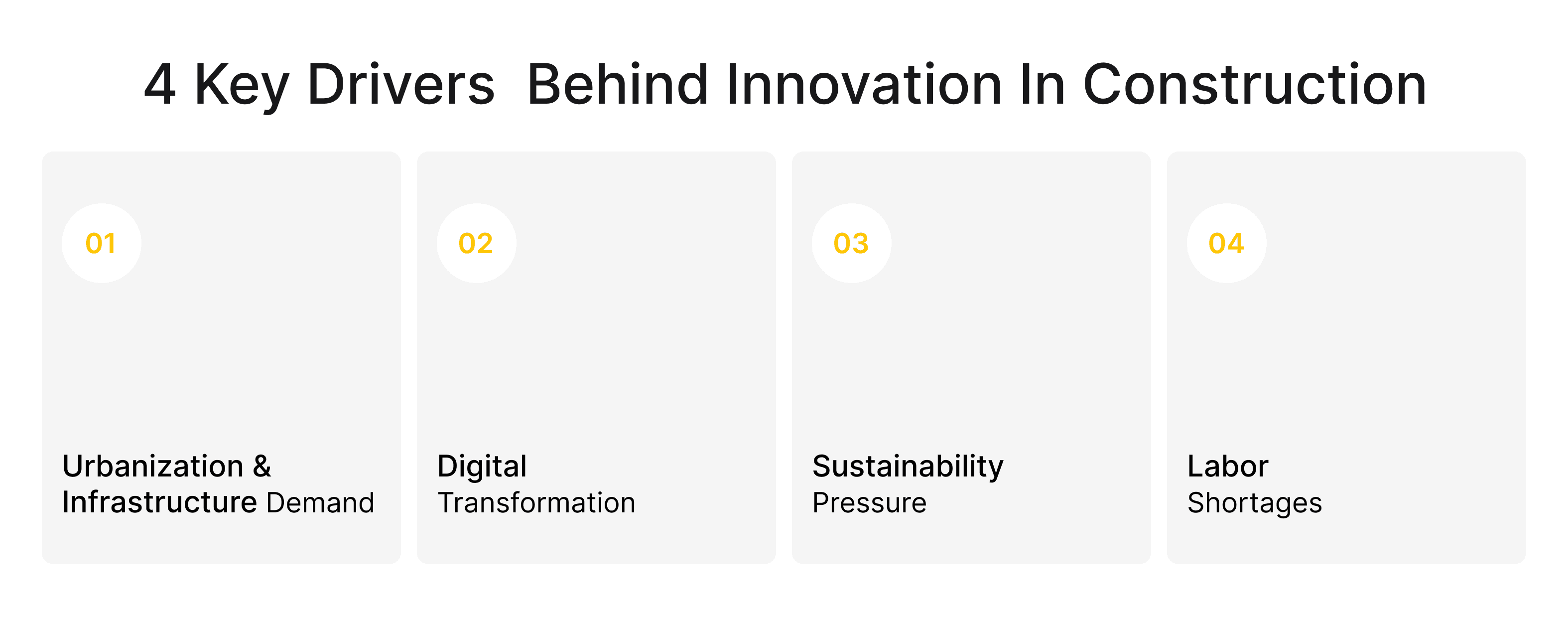
Urbanization and infrastructure demand
The world is building more than ever. By 2050, roughly 70% of the global population is expected to live in cities, which means a sustained, large-scale demand for housing, transport, energy infrastructure, and commercial space. That kind of demand compresses timelines and raises the stakes for every project. It's one of the core reasons innovation in the construction industry has accelerated so sharply over the last decade, particularly in emerging markets where the pace of urbanization is almost hard to comprehend.
Digital transformation of construction workflows
Cloud-based project management, BIM platforms, and connected communication tools have transformed how construction teams coordinate. What once required weekly site visits and thick paper documents now happens in real time, on any device. New technology in construction has made it possible to run more complex projects with tighter oversight — and when something goes wrong, teams find out immediately rather than at the next scheduled progress meeting.
Sustainability and environmental pressure
Construction accounts for roughly 40% of global energy consumption and around 25% of global CO2 emissions. Regulators are tightening standards, clients are demanding greener builds, and institutional investors are applying ESG pressure. These aren't just ethical concerns — they're economic ones. New technologies in construction are central to the response: from lower-carbon materials to smart building systems that monitor and optimize energy use across a building's entire operational life.
Labor shortages and productivity challenges
The construction workforce is shrinking relative to demand. In the US, the industry faces a shortage of hundreds of thousands of workers, and the gap is expected to grow. Automation and intelligent software don't eliminate jobs — they allow the people you have to work more effectively. New technology in the construction industry adoption is accelerating precisely because it helps firms manage more complexity with leaner teams.
Major Construction Innovations Changing the Industry
 Click to expand
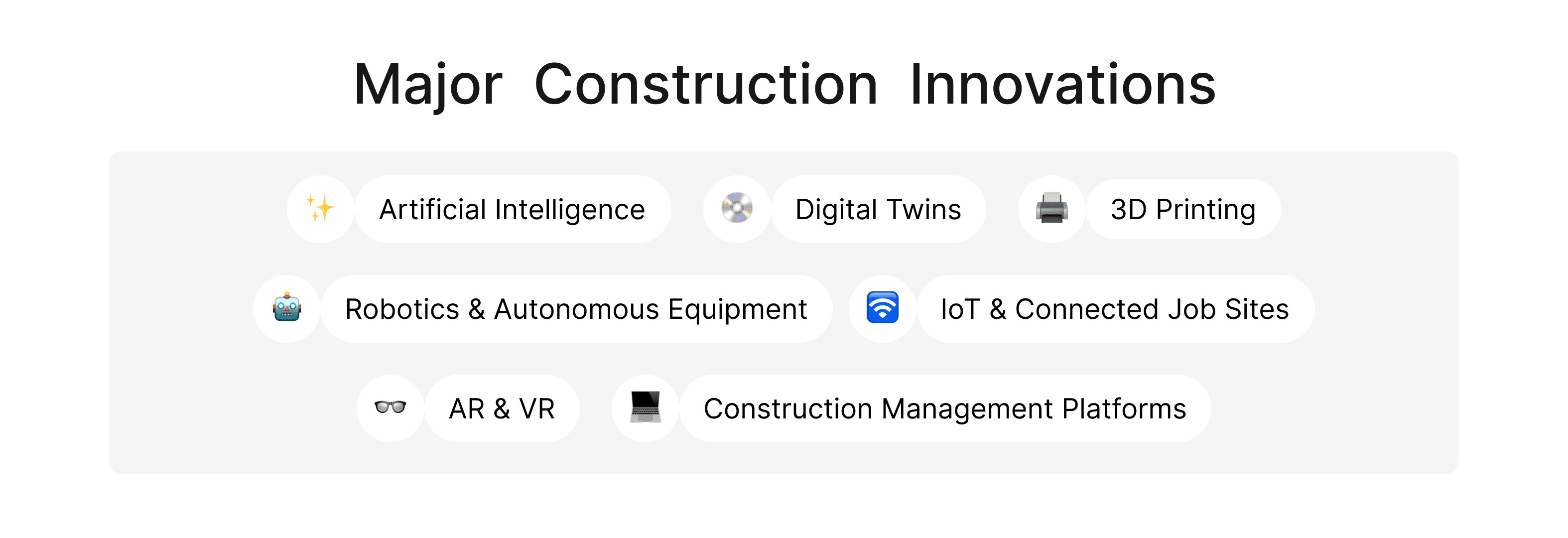
Artificial Intelligence in Construction Planning
AI is transforming how construction projects get planned and managed. Machine learning models can analyze historical data to predict cost overruns, flag scheduling conflicts early, and optimize resource allocation across multiple sites. Specifically, AI-based document analysis for construction teams is changing how contracts, drawings, and specs get reviewed — cutting days of manual work down to minutes. New construction technology built on AI is also improving bidding accuracy, letting firms estimate more precisely and compete more effectively.
Digital Twins for Smarter Infrastructure Management
A digital twin is a live virtual replica of a physical structure, updated in real time using sensor data and BIM inputs. Infrastructure owners can simulate load conditions, plan maintenance proactively, and model design changes before committing to them physically. Innovative construction technology like digital twins shifts the industry from a reactive maintenance posture to a predictive one — and over the life of a large structure, that translates into significant cost savings.
3D Printing for Faster Building Development
Concrete 3D printing has moved well past the concept stage. Full walls, structural components, and even complete housing units are being printed on-site or off-site, reducing material waste and eliminating certain labor-intensive steps. Construction innovation in this space is accelerating — print speeds are improving, the range of usable materials is expanding, and the cost gap between printed and conventional construction is steadily narrowing.
Robotics and Autonomous Construction Equipment
Robotic bricklayers, autonomous excavators, and rebar-tying machines are operating on active job sites today. These systems handle the work that's most repetitive, physically demanding, or hazardous — freeing skilled workers for tasks that genuinely require human judgment. New technology building construction through robotics also addresses the labor shortage problem directly: you can scale output without scaling headcount at the same rate.
IoT Sensors and Connected Job Sites
Embedded sensors in equipment, structures, and wearables generate a continuous stream of data from the job site — equipment performance, environmental conditions, structural stress, and worker location. This data feeds back to management platforms in real time. Construction technology innovation based on IoT creates job sites that are actively self-monitoring rather than being inspected periodically, which changes how supervisors and engineers actually spend their time.
AR and VR for Construction Visualization
AR and VR tools let teams walk through a building before construction starts. Clash detection, design reviews, and client presentations all improve when stakeholders can interact with a 3D model in real space rather than interpreting 2D drawings. VR is also being used extensively for safety training — workers can run through high-risk scenarios in a controlled environment, reducing the chance of first-time mistakes in the field.
Advanced Construction Management Platforms
Modern construction management software integrates budgeting, scheduling, change order management, RFIs, and compliance tracking in a single platform accessible from any device. This matters most on complex, multi-phase projects where coordination overhead alone can cause cost overruns. Custom construction budget control software is a particularly valuable category here — giving project owners real-time visibility into spend versus plan, and making it easier to intervene before small variances become large problems.
Innovations in Sustainable Construction Materials
Low-carbon concrete technologies
Concrete is responsible for roughly 8% of global CO2 emissions. Alternatives like geopolymer concrete, blends with supplementary cementitious materials, and carbon-cured concrete are reducing that footprint without sacrificing structural performance. Construction innovation in materials science is arguably one of the highest-leverage areas for the industry's sustainability goals — because concrete is used everywhere, and small improvements in its carbon profile compound at scale.
Recycled and circular building materials
Reclaimed steel, recycled concrete aggregates, bio-based insulation, and reclaimed timber are all finding their way into mainstream construction projects. Circular building design — where deconstruction and material recovery are planned from the start — is shifting from a niche concept to a planning requirement in some markets. Innovations in construction in this area depend heavily on better material tracking, supply chain transparency, and standards that make reuse practical at scale.
Energy-efficient building solutions
High-performance insulation, smart glazing, phase-change materials, and passive design strategies are reducing building energy consumption over their operational lifetimes. Smart building systems that monitor and automatically adjust energy use are becoming standard in commercial construction. This is one of the most active areas of construction technology innovation, precisely because it's where digital systems and physical materials converge to produce measurable ROI.
Construction Safety Innovations Improving Job Site Protection
 Click to expand
Construction is consistently among the most dangerous industries globally. In the US, it accounts for nearly 20% of all workplace fatalities. The business case for innovations in construction safety is clear — incidents are expensive, they damage reputations, and they're preventable at a much higher rate than the industry currently achieves.
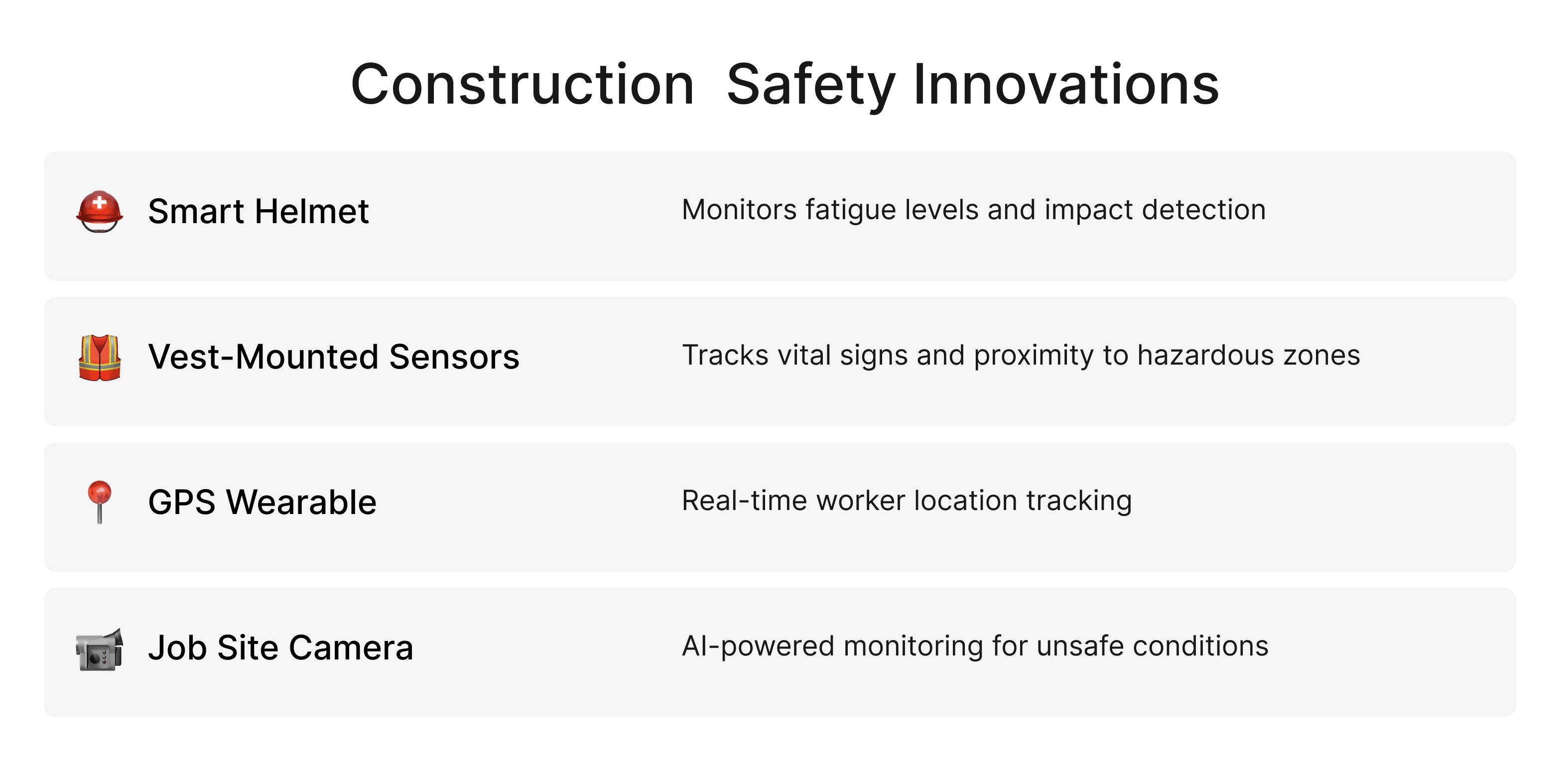
Wearable technology for worker safety
Smart helmets, vest-mounted sensors, and GPS wearables track worker location, fatigue levels, vital signs, and proximity to hazardous zones in real time. When someone enters a restricted area or shows signs of heat stress, supervisors receive an immediate alert. Construction innovation in the wearables category is moving fast — newer devices are smaller, more reliable, and less expensive than the first generation, and adoption is growing across both large contractors and mid-sized firms.
AI-based risk monitoring systems
Computer vision systems mounted on job-site cameras can automatically identify unsafe conditions — missing PPE, equipment operating too close to workers, and unstable scaffolding. Innovations in construction safety powered by AI shift safety management from periodic audits to continuous, automated monitoring. Instead of relying on a supervisor to catch every hazard, the system watches constantly and flags anomalies the moment they appear.
How Digital Platforms Are Transforming Construction Management
Real-time project monitoring
Weekly progress reports and scheduled site visits are being replaced by continuous dashboards that provide all stakeholders with real-time visibility into a project's status. GPS tracking, drone surveys, time-lapse cameras, and IoT data feed into platforms that update in real time. The firms that get the most out of these tools are typically the ones that have invested in custom construction software solutions tailored to how they actually operate — not a generic platform they've had to retrofit.
Data-driven decision making
When data flows continuously from job sites, the decision-making process changes fundamentally. Project managers can compare actuals against estimates as work progresses, spot trends before they turn into problems, and make resourcing decisions based on evidence rather than intuition. Innovation in construction at the management level isn't about replacing experienced people — it's about giving them better information, faster. That's a lever every firm can pull, regardless of its size or how tech-forward it is.
Challenges Slowing Down Innovation in Construction
 Click to expand
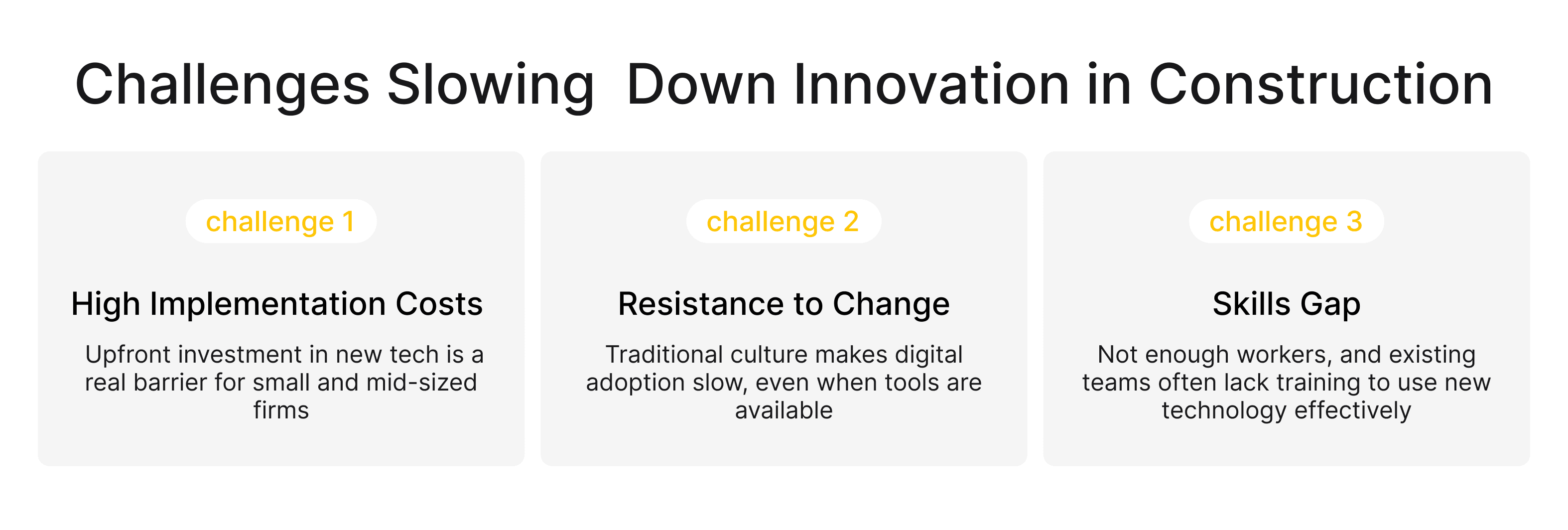
High implementation costs
The upfront cost of new technology is a real barrier, particularly for small and mid-sized firms operating on tight project margins. Enterprise-grade platforms, sensor infrastructure, AI tooling — none of it comes cheap, and the ROI isn't always immediately visible. That said, the firms that navigate this most effectively are usually the ones that invest in custom software development services to build exactly what they need rather than paying for bloated platforms designed for someone else.
Incora works directly with construction firms to build custom technology solutions that fit specific workflows — from project data platforms to field-facing mobile tools — without the overhead of one-size-fits-all systems. The goal is always to match the technology to how the team actually works, not the other way around.
Resistance to digital transformation
Construction has a deeply traditional culture. Subcontractors, site foremen, and project managers who've operated the same way for decades don't automatically embrace new systems — especially when those systems require real behavioral change on-site. Honestly, change management is often the harder problem than the technology itself. Firms that succeed with digital transformation tend to invest as heavily in training and rollout as they do in the tools.
Skills gap in the construction workforce
Even when technology is available and affordable, you need people who can use it effectively. The industry's skills gap runs in both directions: not enough workers, and the workers who are there often lack the technical training to extract full value from new tools. Closing this gap requires sustained investment in workforce development — not just deploying technology and hoping for uptake.
The Future of Innovation in Construction
The trajectory here is pretty clear. The tools are getting better, adoption costs are coming down, and the pressure to perform isn't going away. A few areas worth watching closely:
AI will move from answering specific questions to operating continuously across the project lifecycle — planning, monitoring, forecasting, flagging issues with minimal human input.

Modular and offsite construction will grow as firms look to manage labor costs and quality more predictably, pairing naturally with digital manufacturing and automation.
Data interoperability will become the real competitive differentiator. As the number of connected systems on any project grows, platforms that integrate cleanly with everything else win.
Bottom line: the firms building an advantage today aren't waiting for the technology to mature. Most of it already has.
Final Thoughts
The construction industry is changing more in the next decade than it did in the previous five. The tools are proven, the pressure is real, and the firms moving early are building a competitive advantage that latecomers will struggle to close. The question isn't whether to adopt new technology — it's which to prioritize, in what order, and how to integrate it with how your team actually works. Start there, and most other decisions follow naturally.
FAQ
How is new technology improving efficiency in construction projects?
Primarily through better data visibility, task automation, and faster communication. AI planning tools cut scheduling errors, IoT sensors catch equipment issues early, and digital platforms replace manual reporting with real-time dashboards accessible to every stakeholder.
What role does artificial intelligence play in construction innovation?
AI handles planning, document review, safety monitoring, and cost forecasting — with the biggest immediate impact on information-heavy tasks like contract review and drawing analysis, cutting days of work to minutes.
What challenges slow down innovation in the construction industry?
High implementation costs, resistance to change, and a skills gap in the workforce. Firms on tight margins struggle to justify tech investment without clear short-term ROI, and change management is often underinvested — which is where most digital transformation efforts stall.
How will construction innovation evolve in the future?
Deeper integration of AI, IoT, and robotics will push job sites toward greater automation and continuous monitoring. Modular construction will grow, and data interoperability between platforms will become a key competitive factor.


YOU MAY ALSO LIKE


Get in Touch
Got no clue where to start? Why don't we discuss your ideas?

