



By Bohdan Vasylkiv
- CEO & Co-Founder
What Are General Conditions in Construction? Full Guide & Examples
A complete guide to general conditions in construction: definition, cost breakdown, inclusions, and how they work in contracts and projects.
Key Takeaways
- General conditions = the cost of running a project, not building it
- Most of these costs are time-based — every schedule slip makes them bigger
- Flat percentages don't work — estimate bottom-up, resource by resource
- Digital tools catch budget variance early, before it becomes a real problem
General conditions don't get much attention — until something goes wrong. A project runs 3 months over schedule, costs balloon, and suddenly everyone's trying to figure out where the money went. More often than not, it went into construction general conditions that were never properly estimated in the first place.
This guide covers everything you need to know about general conditions in construction: what they actually include, how to estimate them without leaving money on the table, and the mistakes that quietly kill margins on otherwise well-run projects.
What Are General Conditions in Construction?
Let's start with the basics. What are general conditions in construction? Simply put, the costs of managing and supporting a project, not building it. The general conditions construction definition covers supervision, permits, insurance, temporary facilities, safety programs, and site administration. Everything that makes it possible for the trades to show up and actually do their work.
A useful way to think about it: plumbers and electricians build the project. General conditions in construction keep the site operational.
What does “general conditions” mean in construction from a budget perspective? It's a category that typically runs 5–15% of contract value, scales directly with project duration, and can quietly wreck your margin if it's estimated carelessly.
Why General Conditions Matter in Construction Projects
Here's the thing: construction general conditions aren't glamorous. Nobody celebrates a well-estimated superintendent budget. But get construction general conditions wrong, and you'll feel it — in margins, in delays, and in a site that's under-resourced when it counts.
What is “general conditions in construction", really, beyond a cost category? It's the infrastructure of project management. When it's funded right, things move. When it's not, everything slows — even when the trade work is solid.
And most of these costs are time-based. Every month the schedule slips, you're paying another month of superintendent time, trailer rental, and insurance. That link between schedule and general conditions cost is direct — and it's one of the most important things to get right.
What Is Included in General Conditions in Construction?
So what is included in the general conditions in construction on a real project? The answer depends on project type and contract structure, but the core categories are consistent across most commercial builds. The full list of general conditions in construction covers everything from people to paperwork to portable toilets — here's a breakdown of what is included in general conditions and what each category actually means on the ground.
The table below maps out the standard general conditions construction components, and what each one covers:
Project Administration and Management
PM and project engineer salaries, scheduling, RFI and submittal management, document control. On complex projects, this alone can run 2–4% of contract value — and it's usually the first thing cut in competitive bidding, which almost always backfires.
Site Operations and Supervision
Superintendent, supervisors, field office staff, and daily subcontractor coordination. They don't build anything directly, but nothing gets built correctly without them.
Permits, Licenses, and Legal Requirements
Building permits, inspections, code compliance testing, and environmental filings. Often underestimated — especially in slow approval jurisdictions. One stop-work order costs far more than the permit ever would have.
Insurance and Bonding
Performance bonds, payment bonds, general liability, builder's risk, workers' comp. Non-negotiable on commercial projects. Estimate against the specific risk profile of this job, not a previous one.
Temporary Facilities and Utilities
Field offices, portable toilets, temporary power, fencing, and site signage. All duration-dependent — the longer the project runs, the more they cost. Schedule slippage hits this category hard.
Safety, Security, and Compliance
Safety programs, PPE, training, first aid, site access controls, and security personnel. On public or federally funded projects, requirements can be extensive. Budget specifically — don't bury it in contingency.
Cleanup, Waste, and Site Maintenance
Daily housekeeping, debris hauling, dumpsters, dust control, and final cleanup. Easy to underestimate long projects where the costs accumulate quietly week by week.
General Conditions vs General Requirements
Easy to mix up, but not the same thing.
Construction general conditions are a cost category — the operational expenses of running a job site. General requirements are Division 01 of the CSI MasterFormat: the contractual rules that govern how a project gets executed.
General conditions live in your estimate. General requirements live in your contract documents. They overlap, and some Division 01 items will end up in your general conditions budget — but they're not interchangeable. Treating them as if they are creates gaps in both your pricing and your contract language.
What Are General Conditions Costs in Construction?
What are general conditions costs in construction, and how do you put a number on them? General conditions in construction costs typically account for 5% to 15% of the total contract value, but that range is almost meaningless on its own. A small tenant improvement might come in at 4%. A large hospital with a complex 24-month schedule could run 18%. The only way to estimate these costs accurately is to build them up from actual project requirements — not percentages from past jobs.
Typical Cost Categories
The major cost drivers are:
- Personnel (project manager, superintendent, engineers, administrative staff)
- Temporary facilities (trailers, utilities, fencing, site signage)
- Insurance and bonding
- Permits, inspections, and regulatory compliance
- Shared equipment (small tools, compressors, hoists used across all trades)
- Safety and environmental compliance programs
- Cleanup, waste management, and ongoing site maintenance
Hard Costs vs Soft Costs
Hard costs are tangible: trailer rental, dumpsters, and temporary power.
Soft costs are the less visible side: PM time, administrative coordination, and documentation.
Both are real, both need to be captured, and soft costs are usually the first to be squeezed in competitive bidding, creating execution risk even when the hard cost estimate looks solid.
Direct vs Indirect Costs
Direct costs are tied to a specific project: the superintendent on that site, the trailer at that address, the permit for that job. Indirect costs — sometimes called extended general conditions — are broader: company management time, regional overhead, and home office support.
The distinction matters for job costing, cost-plus billing, and defending your numbers in the event of a dispute.
How to Estimate General Conditions
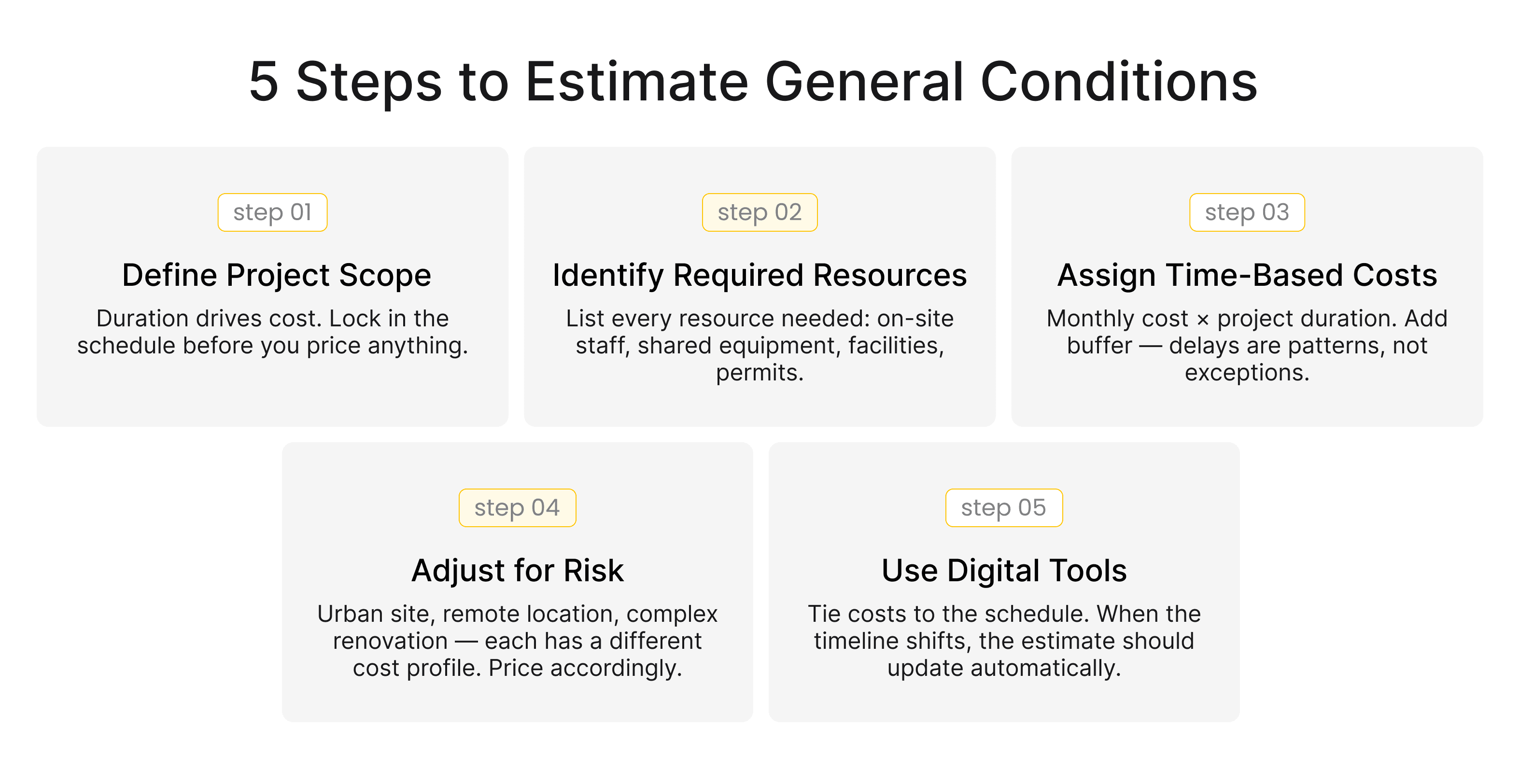
There's no reliable formula that works across all project types. The only approach that actually works is a bottom-up build: every resource, every week, for every major cost category. Understanding what is general conditions in construction for your specific project — its size, location, duration, and complexity — is the starting point.
 Click to expand
Step 1: Define Project Scope
Duration is the single biggest driver of general conditions costs. Before pricing anything, you need a reliable schedule. A 6-month renovation has fundamentally different general conditions needs than a 20-month ground-up build. Get the timeline right first — then build your costs around it.
Step 2: Identify Required Resources
Walk through the project systematically and list every resource needed to manage and support it: who's on-site full-time, what equipment is shared across all trades, what facilities are required, and what permits and inspections are mandated. Don't skip the obvious items — that's usually where gaps end up.
Step 3: Assign Time-Based Costs
For every duration-dependent resource — superintendent salary, trailer rental, temporary utilities, security — multiply the monthly cost by the project schedule. Then add a buffer for schedule risk. Delays are not exceptions; they're patterns. Your estimate should reflect that.
Step 4: Adjust for Risk and Delays
Not every project carries the same risk profile. A project in a dense urban environment has higher logistics, security, and compliance costs. A remote site has higher mobilization costs. A complex renovation has higher coordination requirements than a standard new build. Tailor your estimate to the specific conditions of the job — and build in contingency for what you can't predict.
Step 5: Using Digital Tools to Improve Estimation Accuracy
Spreadsheets work up to a point. But as general conditions in construction budgets grow more complex, manual tracking introduces errors that compound quickly. Modern estimation platforms let you build standardized templates, tie costs to schedule activities, and update projections automatically when the schedule changes — which is far more useful than a static spreadsheet.
The team at Incora has built custom construction software that integrates estimation, scheduling, and cost tracking into a single workflow. Instead of manually reconciling separate systems, project teams get a live cost picture that updates as conditions change. That kind of integration is one of the highest-value investments a construction company can make in digital tools for construction projects.
Common Mistakes When Managing General Conditions
Underestimating General Conditions Costs
Applying a flat percentage to the contract value is the most common mistake in estimating general conditions. It's fast, but it ignores the actual drivers: project duration, site complexity, staffing requirements, and local compliance rules. The only way to get it right is to do the work — resource by resource, week by week.
Lack of Digital Tracking Tools
Many construction teams still manage general conditions in spreadsheets. That works until it doesn't — and it tends to stop working right when you need accurate data most. Without proper cost control in construction tools, the connection between estimated and actual costs gets lost in manual updates, version conflicts, and delayed reporting.
Poor Tracking and Cost Visibility
Even teams that estimate well often struggle to track actual costs against budget during execution. Monthly cost reports don't catch variance early enough to do anything about it. Linking actuals to your estimate in real time — as time cards, purchase orders, and invoices come in — is what separates projects that stay on budget from the ones that don't.
How General Conditions Impact Construction Contracts
In any general conditions in construction contract, the language defines what costs the contractor can recover, how scope changes affect the general conditions budget, and what happens when the schedule extends beyond the original contract duration.
Ready to transform your business?
Our experts will guide you through every step of the digital transformation journey.
What are general conditions in a construction contract, from a practical standpoint? They're the financial baseline for project management. If the contract doesn't clearly define what's included and how costs are calculated, you're exposed — especially when delays happen. Both sides are trying to assign responsibility for the extended general conditions costs.
Extended general conditions — costs incurred when a project runs long due to owner-caused delays or unforeseen conditions — are among the most common sources of construction claims. Clear contract language up front is far cheaper than arbitration later. Good construction client communication tools can also keep stakeholders aligned on costs before things escalate.
How Digitalization Is Transforming General Conditions Management
 Click to expand
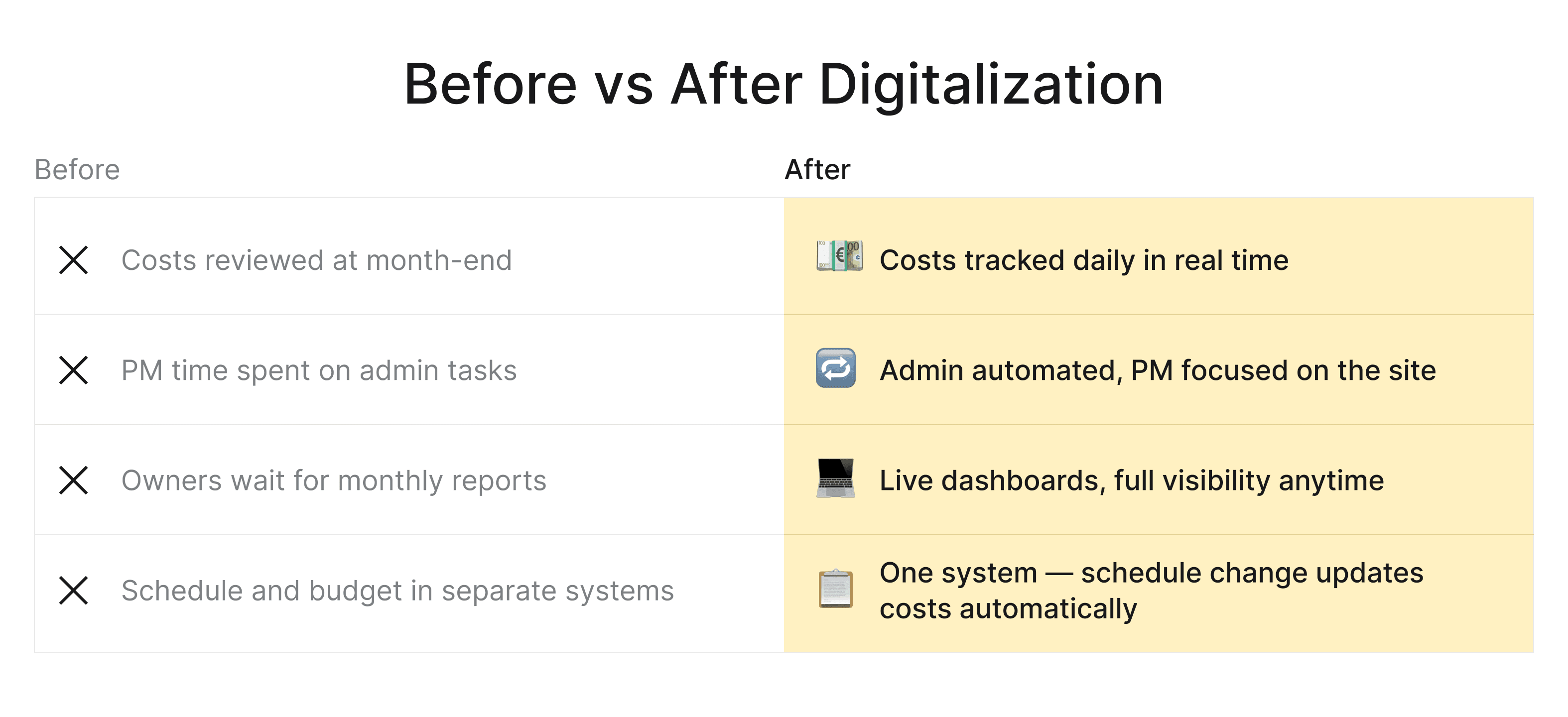
Real-Time Cost Tracking
Tracking costs at month-end is too late. When field data — time cards, purchase orders, receipts — feeds into a central system daily, you catch variance early enough to actually do something about it.
Automation of Administrative Tasks
Scheduling meetings, circulating documents, logging RFIs, tracking submittals — a lot of general conditions cost is just administrative labor. Modern platforms automate most of it, freeing up PM and superintendent time for work that actually needs them.
Improved Transparency for Stakeholders
Owners want to see where their money is going, not wait for a monthly report. Live dashboards showing general conditions spend against budget reduce friction on cost-plus projects, and build owner confidence.
Integrated Schedule and Cost Management
Most general conditions costs are duration-based, so when the schedule changes, the cost projection should update automatically. Integrating both into one system is far more accurate than maintaining two spreadsheets and reconciling them manually.
Tips to Control and Optimize General Conditions Costs
Bottom line: General conditions costs are manageable.
Here are the habits that actually make a difference:
- Build estimates from the ground up — every resource, every week, never from percentages alone.
- Lock in site setup costs and rental rates before mobilization. Negotiate on longer projects.
- Track actuals weekly against your estimate. Monthly reviews don't catch variance soon enough.
- Build schedule risk into your estimate. Delays are patterns, not exceptions.
- Automate administrative tasks where possible. Every hour spent on manual reporting is an hour not managing the project.
- Review and update your general conditions forecast at every project milestone.
- Make sure your contract language clearly defines what's included and what triggers additional compensation for extended conditions.
FAQ
What are general conditions in construction in simple terms?
If you need to define the general conditions for construction in plain language, they're the costs of running a job site, not of building the project. Supervision, permits, temporary facilities, insurance, safety programs, and site cleanup — everything required to make construction possible, without contributing directly to the physical structure.
What is included in general conditions in construction projects?
Project management, supervision, temporary facilities, permits, insurance, bonding, safety programs, shared equipment, and site cleanup. The exact scope depends on project type, contract structure, and local requirements.
What do general conditions mean in a construction contract?
They define what costs a contractor can recover for managing the job site, separate from trade costs. They also govern how scope or schedule changes affect the general conditions budget, and what happens when a project runs long for reasons outside the contractor's control.
Are general conditions considered overhead or project costs?
Direct general conditions tied to a specific project are project costs. Company-level allocations — regional management, home office support — are overhead. The distinction matters for job costing, lien waivers, and cost-plus billing.
Why are general conditions important for project success?
They're the operating system of the project—a well-resourced, well-managed site finishes on time and on budget. When general conditions are underfunded or poorly tracked, things unravel — even when the trade work is excellent.


YOU MAY ALSO LIKE


Get in Touch
Got no clue where to start? Why don't we discuss your ideas?

