



By Tetiana Stoyko
- CTO & Co-Founder
Why Construction Firms Are Switching to AP/AR Automation?
Discover why construction firms are switching to AP/AR automation to reduce costs, prevent errors, improve cash flow, and gain real-time financial visibility.
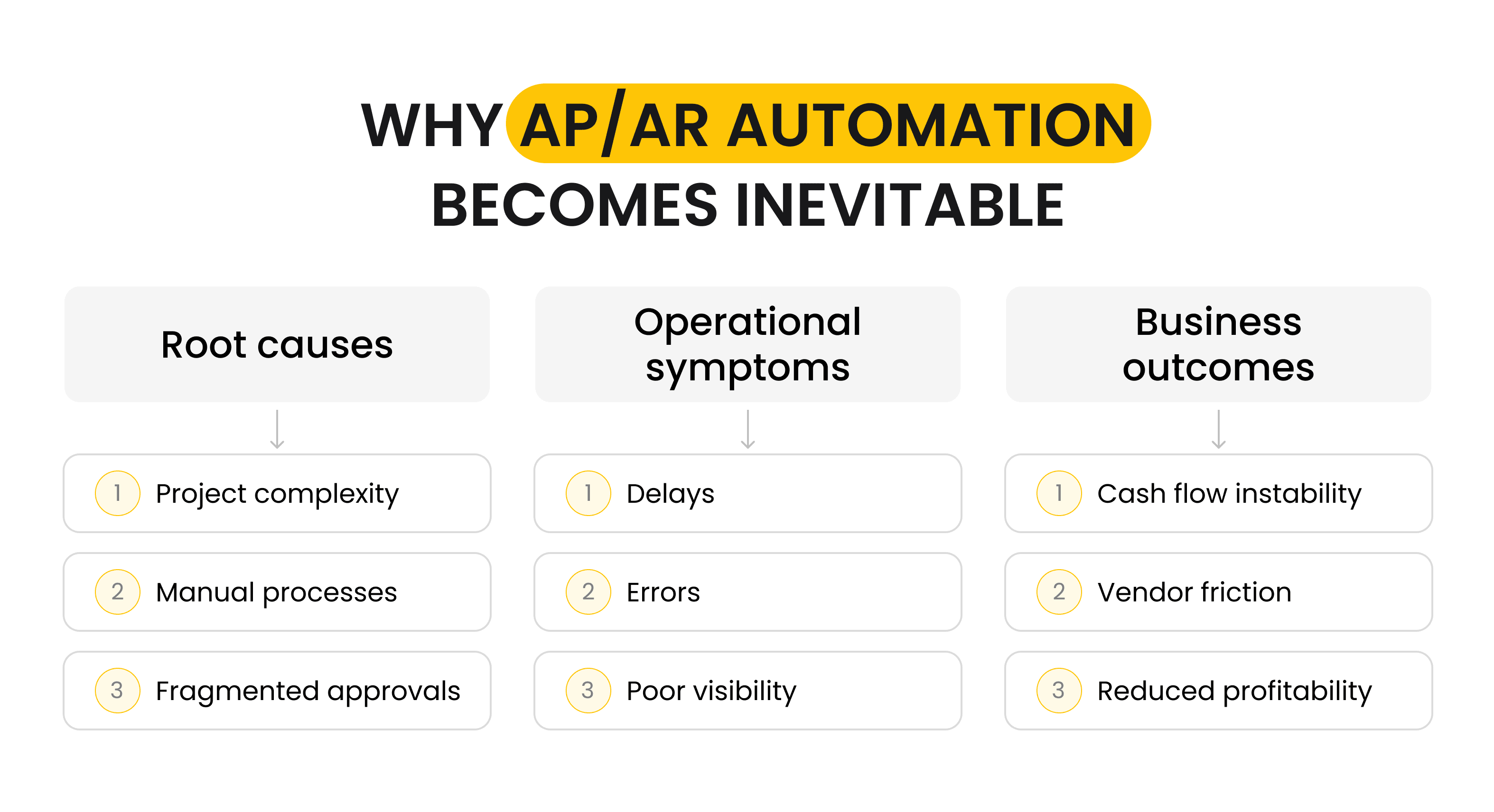
The shift toward AP and AR automation represents more than just a technological upgrade.
It's a strategic move that addresses fundamental pain points in construction financial management.
Companies implementing these systems report significant improvements in cash flow, reduced processing times, and better project visibility.
Modern construction projects involve dozens of subcontractors, suppliers, and vendors.
Manual handling of these transactions consumes valuable time and resources that could be better spent on core business activities.
The construction industry has been slower to adopt digital transformation compared to other sectors.
However, the competitive pressure and operational benefits of construction AP and AR automation are rapidly reshaping this landscape.
“Firms that embrace automation gain measurable advantages in efficiency and profitability.”
 Click to expand
The Cost of Manual AP/AR Processes
Manual financial processes carry hidden costs that extend beyond obvious inefficiencies.
“Processing a single invoice manually can cost between $15 to $30 in labor and administrative expenses.”
For construction firms handling hundreds or thousands of invoices per month, these costs can accumulate quickly.
Human error introduces another layer of financial risk. Data entry mistakes lead to duplicate payments, missed discounts, and strained vendor relationships.
These errors require additional resources to identify and correct, further increasing operational costs.
Paper-based systems create physical storage challenges and make information retrieval time-consuming.
Finding a specific invoice from months ago can take hours of searching through filing cabinets. This inefficiency impacts decision-making speed and financial transparency.
The approval process for invoices often involves multiple stakeholders across different project sites.
Physical documents must be routed between offices, creating delays that can span days or weeks. These bottlenecks affect cash flow management and vendor satisfaction.

Common Pain Points in Construction Finance
Construction companies typically manage payments across multiple job sites simultaneously.
Each project has unique billing requirements, retention schedules, and payment terms.
Tracking these details manually becomes increasingly complex as project portfolios grow.
Subcontractor payments require careful coordination with project milestones and completion percentages.
Manual systems struggle to maintain accurate records of completed work versus billed amounts.
This creates disputes and payment delays that damage professional relationships.
Compliance requirements add another layer of complexity.
Construction firms must track certified payroll, lien waivers, and insurance certificates for each vendor and subcontractor.
Cash flow forecasting becomes nearly impossible without real-time visibility into outstanding payables and receivables.
Finance teams spend countless hours compiling data from multiple sources to create accurate projections. By the time reports are completed, the information is often outdated.
The Problem with Duplicate Payments
Duplicate payments are among the most common and costly errors in manual construction accounts payable workflows.
When invoices arrive through multiple channels, tracking becomes nearly impossible without automated systems. A single duplicate payment can cost thousands of dollars.
Manual systems cannot reliably detect duplicate invoices from different sources. A vendor might submit an invoice via email and mail simultaneously.
Without automated duplicate detection, both payments may be processed.
Processing Delays and Vendor Relationships
Slow payment processing damages vendor relationships and may result in lost discounts.
Vendors expect timely payments as part of professional relationships. Delays create frustration and may lead vendors to demand prepayment terms or increase pricing.
Paper routing between multiple approval locations creates bottlenecks.
An invoice might sit on a desk awaiting a manager's approval. During busy project periods, delays can stretch from days to weeks.
Vendors struggle to manage cash flow when payment timing remains uncertain.
Construction subcontractors operate with thin margins and depend on predictable payment schedules.
Late payments can force them to increase their own financing costs or reduce service quality.
Hidden Costs of Data Entry Errors
Data entry errors extend beyond simple typos and can affect payment amounts. Incorrect vendor information routes payments to the wrong accounts.
Wrong cost codes misallocate expenses and corrupt financial reporting.
Correcting these errors requires investigation and manual adjustment. The finance team must contact vendors to verify information and reprocess payments.
This detective work requires hours of effort for each error identified.
Errors in cost allocation prevent accurate analysis of project profitability. Managers cannot trust financial reports when data quality is questionable.
Better decisions require reliable financial information from clean data entry.
Key Benefits of AP and AR Automation
 Click to expand
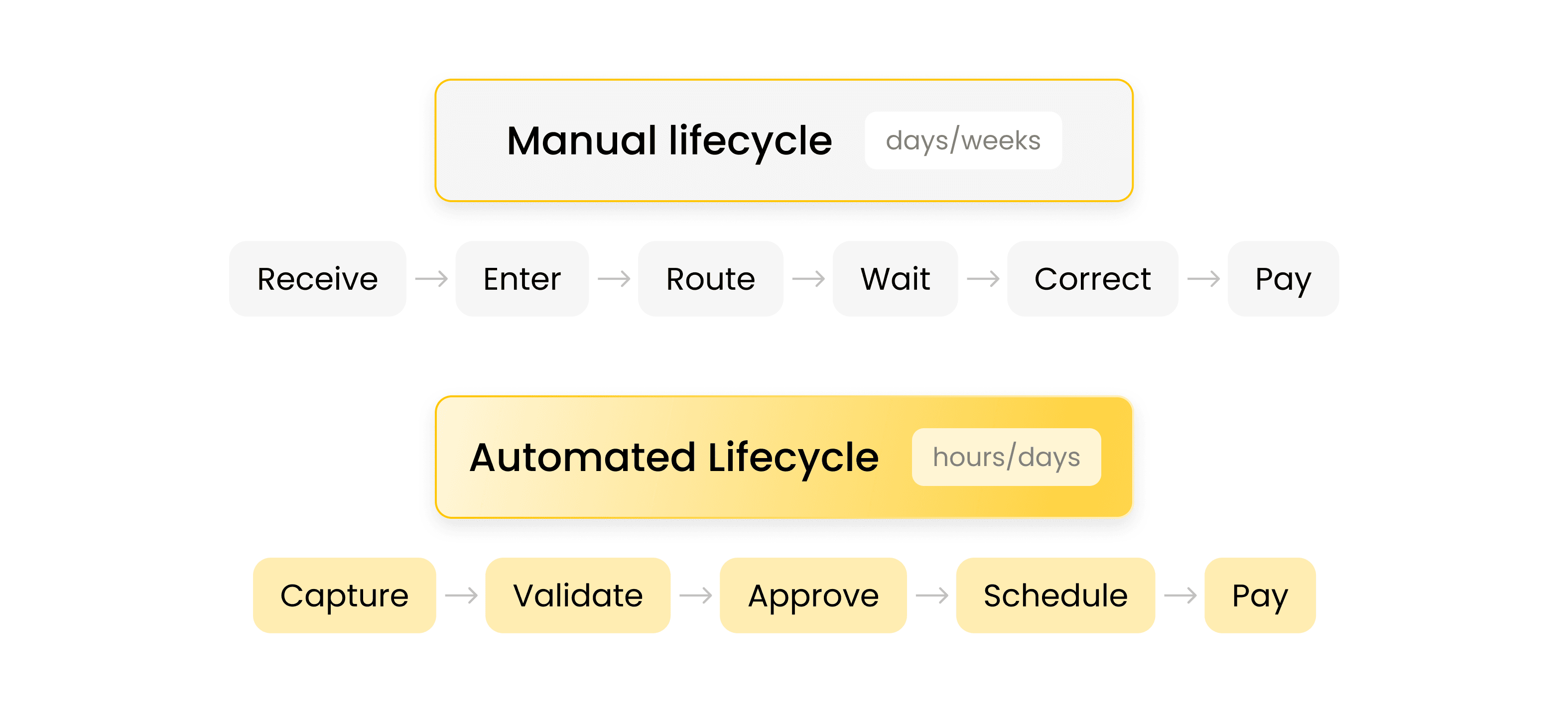
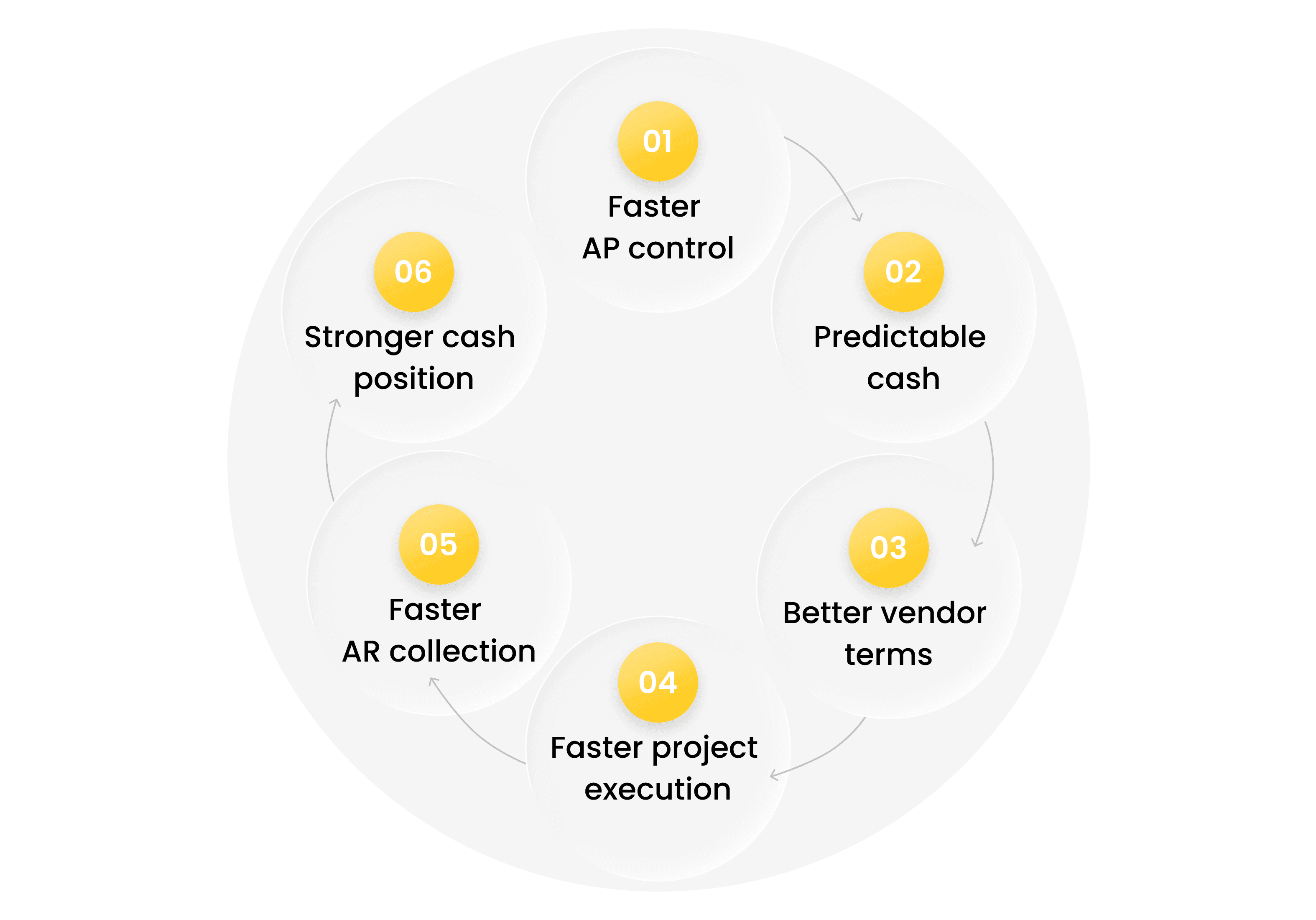
AP and AR automation delivers transformative benefits that directly impact the bottom line.
Companies report processing invoices up to 80% faster after implementing AR automation for construction.
This speed improvement translates to better cash flow management and stronger vendor relationships.
Automation reduces processing costs by eliminating manual data entry and routing tasks.
The savings accumulate quickly, with most firms recouping their automation investment within the first year.
Long-term cost reductions continue as the system handles growing transaction volumes without additional staff.
Error rates drop dramatically when automated AP software handles data capture and validation.
Optical character recognition technology extracts information from invoices with high accuracy.
Built-in validation rules catch anomalies before payments are processed, preventing costly mistakes.
Real-time visibility into financial data empowers better decision-making across the organization.
Project managers can instantly view payment status for their jobs.
Finance teams access comprehensive dashboards that show the cash position and upcoming obligations.
Improved Cash Flow Management
AP and AR automation provides unprecedented control over cash flow timing.
Automated systems can strategically schedule payments to maximize early payment discounts while maintaining adequate working capital.
This optimization can save thousands of dollars annually in discount captures.
Payment scheduling becomes more strategic when systems automatically track due dates and discount opportunities.
Finance teams receive alerts about upcoming payments and can make informed decisions about timing. This prevents late payment penalties while preserving cash when needed.
The accounts receivable side benefits equally from automation. Automated invoicing ensures bills are sent promptly and accurately.
Follow-up reminders are triggered automatically for overdue accounts, improving collection rates without manual effort.
Integration with project management systems enables accurate progress billing.
AR automation for construction generates invoices based on actual work completed and approved milestones.
This accuracy reduces billing disputes and accelerates payment cycles.
Strategic Discount Capture
Early payment discounts represent significant financial opportunities that many construction firms miss.
Vendors often offer 2/10 net 30 terms, meaning 2% discounts for payments within 10 days.
Capturing these discounts requires reliable systems to identify opportunities and track deadlines.
Manual tracking of discount deadlines fails frequently during busy periods. Finance teams juggle dozens of invoices from different vendors with varying terms.
Deadlines slip, discounts expire, and thousands of dollars in savings are lost.
Automated systems flag all invoices eligible for early payment discounts. Finance managers receive daily alerts about approaching deadlines.
This visibility enables strategic decisions on how to use available cash for discount capture.
The return on early payment discounts often exceeds typical business investment returns. A 2% discount on a $10,000 invoice equals $200 in savings.
With hundreds of invoices monthly, total savings can reach tens of thousands of dollars annually.
Working Capital Optimization
Improved working capital efficiency frees cash for growth investments and operational needs.
Improved payables management enables construction firms to extend payment terms without jeopardizing vendor relationships.
Simultaneously, faster receivables collection improves cash inflows.
Construction projects require significant upfront expenditures before revenue is received. Optimizing working capital timing helps firms manage this cash flow challenge.
Even minor improvements in payment cycle duration can significantly impact cash position.
Seasonal projects create additional cash flow challenges in construction.
Some firms experience heavy spending in spring and summer, with revenue arriving throughout the year.
Construction accounts payable automation helps manage these cyclical patterns more effectively.
Enhanced Compliance and Audit Readiness
Regulatory compliance requirements continue to increase in complexity for construction companies.
Construction invoice processing automation maintains comprehensive audit trails for every transaction.
These digital records make compliance verification straightforward and reduce audit preparation time.
Lien waiver tracking becomes automated, ensuring proper documentation before releasing payments.
The system can require specific documents for each payment, reducing legal risks. Missing paperwork triggers automatic notifications to responsible parties.
Tax compliance improves when systems automatically track and report 1099 requirements.
Year-end tax preparation becomes simpler with accurate vendor payment records readily available. This reduces accounting costs and minimizes compliance risks.
Document retention policies are enforced automatically within digital systems.
Vital records remain accessible for required periods without manual filing systems. This ensures compliance while reducing physical storage costs.
Regulatory Compliance in Construction
Construction operates under strict regulatory requirements that vary by location and project type.
Payment regulations, prevailing wage requirements, and lien laws create complex compliance landscapes. Automation helps firms consistently meet these requirements.
Prevailing wage documentation requires detailed tracking of labor costs and certifications. Manual systems struggle to organize this information in auditable formats.
Digital systems maintain organized records that meet regulatory audit requirements.
Mechanic's lien laws vary by state and affect payment processes. Automation can enforce state-specific lien waiver requirements before releasing payments.
This protection prevents costly legal challenges from unpaid subcontractors.
Documentation and Audit Trails
Digital documentation creates permanent audit trails that satisfy regulatory requirements.
Every transaction includes timestamps, user information, and approval documentation. This comprehensive history protects firms during audits and legal disputes.
Detailed transaction records help investigate any issues that arise. Finance teams can instantly access all supporting documentation for any payment.
This capability accelerates issue resolution and reduces stress during audits.
Cloud-based systems provide backup and redundancy for critical financial records.
Digital storage eliminates the risk of losing important documents due to fire or damage. Regular backups ensure data can be recovered if problems occur.
How Construction AP Automation Works
 Click to expand
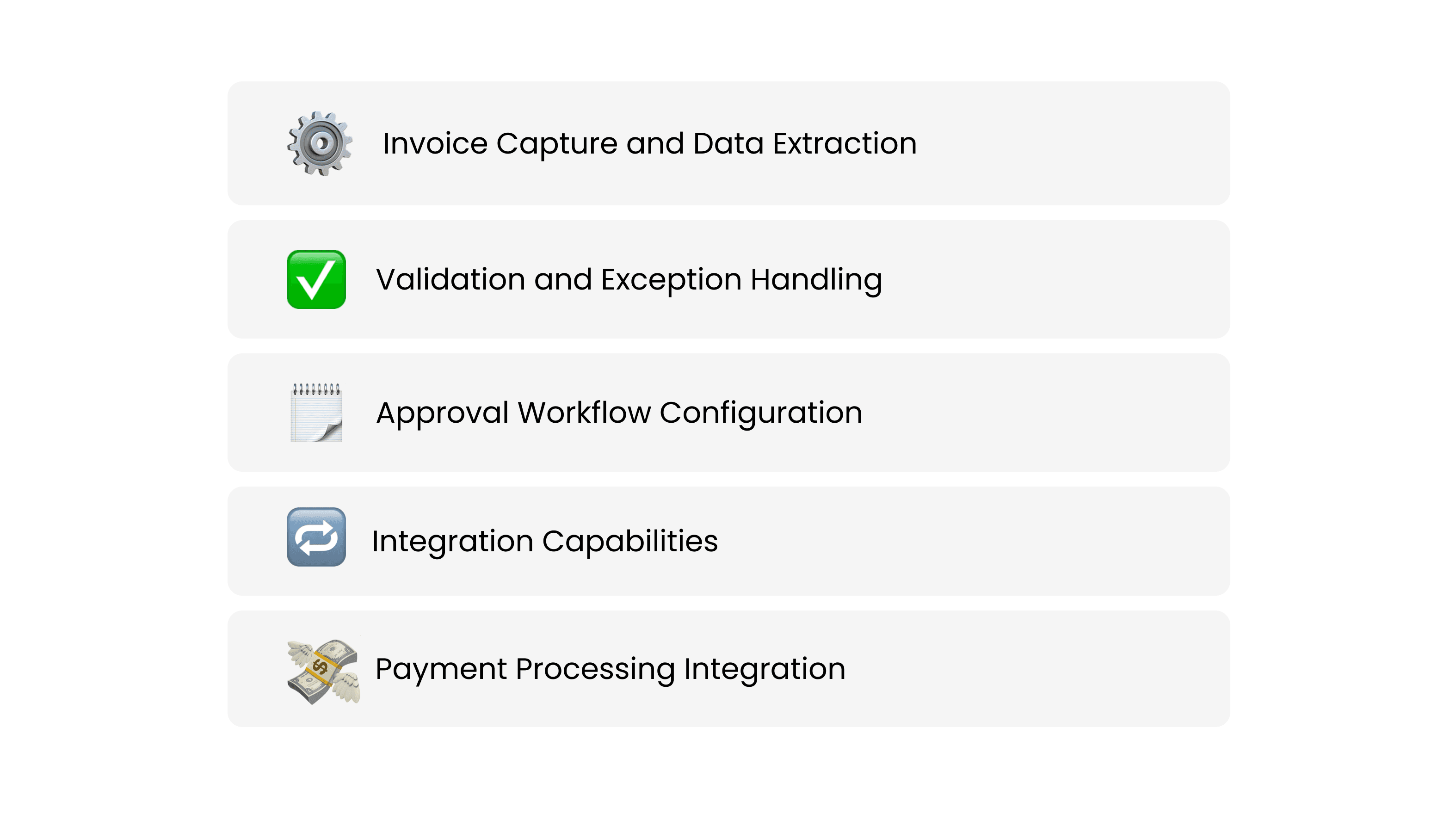
Construction AP automation begins with invoice capture through multiple channels.
Vendors can submit invoices via email, portal uploads, or direct system integration. The automation software identifies incoming invoices and begins processing immediately.
Optical character recognition (OCR) technology extracts key data from invoices.
The system captures vendor names, amounts, dates, and line item details with high accuracy. This eliminates manual data entry and associated errors.
Extracted data flows through validation rules that check for anomalies and duplicates.
The system compares invoice details against purchase orders and contract terms. Discrepancies trigger alerts for manual review before processing continues.
Approval workflows route invoices to appropriate stakeholders based on customizable rules. Project managers receive invoices related to their jobs for verification.
To achieve even higher efficiency and accuracy, some companies consider adopting AI powered AP automation.
Finance personnel handle final approval before payment processing.
Invoice Capture and Data Extraction
Modern systems capture invoices from diverse sources without requiring special formatting.
Email attachments, scanned documents, and native digital files all feed into the system. Vendors don't need to change existing processes or submit invoices in special formats.
OCR technology has advanced significantly, enabling it to handle complex documents with confidence.
Faded scans, low-quality photocopies, and unusual layouts no longer hinder accurate data extraction. The system learns vendor-specific invoice formats and adapts accordingly.
Line-item detail extraction goes beyond capturing invoice totals. The system identifies individual items, quantities, unit prices, and descriptions.
This detailed information enables cost allocation to projects and departments.
Validation and Exception Handling
Automated validation rules prevent obvious errors before payment processing.
The system detects mismatches, vendor name variations, and duplicate invoice numbers. These checks happen instantly without slowing the process.
Price variance alerts notify approvers when invoice amounts differ significantly from expected costs.
Threshold settings allow companies to define acceptable variance ranges. Items exceeding thresholds require additional investigation before approval.
Purchase order matching validates that invoices align with authorized purchases. The system confirms that quantities, prices, and terms match the original purchase order.
Mismatches receive detailed exception reports for investigation.
Approval Workflow Configuration
Customizable workflows adapt to each company's specific approval requirements.
Authority levels determine who must approve invoices for different amounts. Delegation rules handle situations when primary approvers are unavailable.
Multi-level approvals ensure proper oversight without creating bottlenecks in construction payment automation.
Project managers verify work completion and accuracy. Department heads confirm budget appropriateness. Finance reviews final compliance before payment authorization.
Mobile approval capabilities let managers approve invoices from anywhere. Smartphone and tablet apps provide complete functionality for reviewing and approving transactions.
Push notifications alert managers of pending approvals requiring attention.

Integration Capabilities
Modern AP automation for construction connects financial systems, project management platforms, and accounting software.
This connectivity ensures data consistency across all business systems. Updates in one system automatically reflect in connected applications.
ERP system integration eliminates duplicate data entry and synchronization issues.
Chart of accounts, vendor records, and project codes remain consistent across platforms. This integration improves accuracy and reduces administrative overhead.
Banking system connections enable direct payment processing from the automation platform.
Electronic payments can be scheduled and executed without manual intervention. Payment confirmations update records automatically, maintaining accurate financial positions.
Mobile access allows stakeholders to approve invoices and view payment status from anywhere. Project managers in the field can quickly review and approve vendor invoices.
This mobility accelerates approval cycles and reduces processing delays.
Payment Processing Integration
Payment execution integrates seamlessly with banking relationships. The system automatically formats payment files to meet bank requirements.
ACH, wire transfer, and check printing options accommodate different vendor preferences.
Payment scheduling optimizes timing based on discount opportunities and cash availability.
The system can schedule payments to arrive on specific dates. This precision helps capture discounts while minimizing idle cash.
Reconciliation happens automatically as payments clear the bank. Cleared payments update system records without manual effort.
Bank statement discrepancies trigger alerts for investigation.
AR Automation Benefits for Construction
AR automation for construction transforms the invoicing and collections process from reactive to proactive.
Automated systems generate invoices immediately upon milestone completion or scheduled billing dates.
This promptness reduces the time between work completion and payment receipt.
Progress billing becomes more accurate and timely with automated systems that pull data directly from project management tools.
The system calculates amounts due based on actual work completed and retention schedules. This accuracy reduces disputes and accelerates payment cycles.
Collections management improves dramatically with automated payment reminders.
The system sends professional follow-up communications at predetermined intervals for overdue invoices.
 Click to expand
Payment portal integration provides customers with convenient payment options. Clients can view outstanding invoices, submit payments electronically, and access historical records.
This convenience improves customer satisfaction and accelerates receipt of payments.
Automated Invoicing Process
Accounts receivable automation begins with the automatic generation of invoices from project data.
Completion milestones or scheduled billing dates trigger invoice creation without manual effort. The system pulls current project information to ensure accuracy.
Retention calculations happen automatically based on contract terms. The system tracks total project revenue, retention percentages, and released amounts.
Invoices show exactly which amounts are withheld and when they are released.
Change order integration ensures invoices reflect all project modifications. When change orders are approved, invoice calculations update automatically.
Customers see accurate bills that reflect their contracted work.
Invoice distribution happens instantly through multiple channels. Customers can receive invoices via email, printed mail, or portal access.
Delivery preferences are configured by the customer for optimal convenience.
Progress Billing Accuracy
Construction contracts often require payment based on the percentage of work completed.
Automated systems pull completion data directly from project management platforms. This integration eliminates manual percentage estimates and calculation errors.
The system tracks cumulative billings against contract amounts. Progress billings cannot exceed contract totals, preventing over-billing errors.
Customers can verify accuracy against actual work performed.
Retention tracking ensures the correct amounts are withheld in accordance with contract terms.
Final invoices automatically release retained amounts when project completion is verified. This accuracy prevents disputes about retained payment calculations.
Collections and Payment Management
Automated payment reminders increase collection rates without creating customer friction. Professional reminder messages are sent at configured intervals for overdue invoices.
Customers appreciate consistent communication that helps them manage their own obligations.
Payment status dashboards provide customers with visibility into their account balances.
They can see which invoices remain outstanding and upcoming payment due dates. This transparency reduces inquiry calls and speeds payment.
Electronic payment options reduce payment friction and accelerate collection.
Customers can pay directly through portals using credit cards or bank transfers. Instant payment processing updates accounts immediately.
Late fee tracking and application occur automatically in accordance with contract terms.
The system identifies past-due invoices and applies agreed-upon penalties. A transparent late fee policy reduces customer disputes.
Making the Switch to Automation
 Click to expand
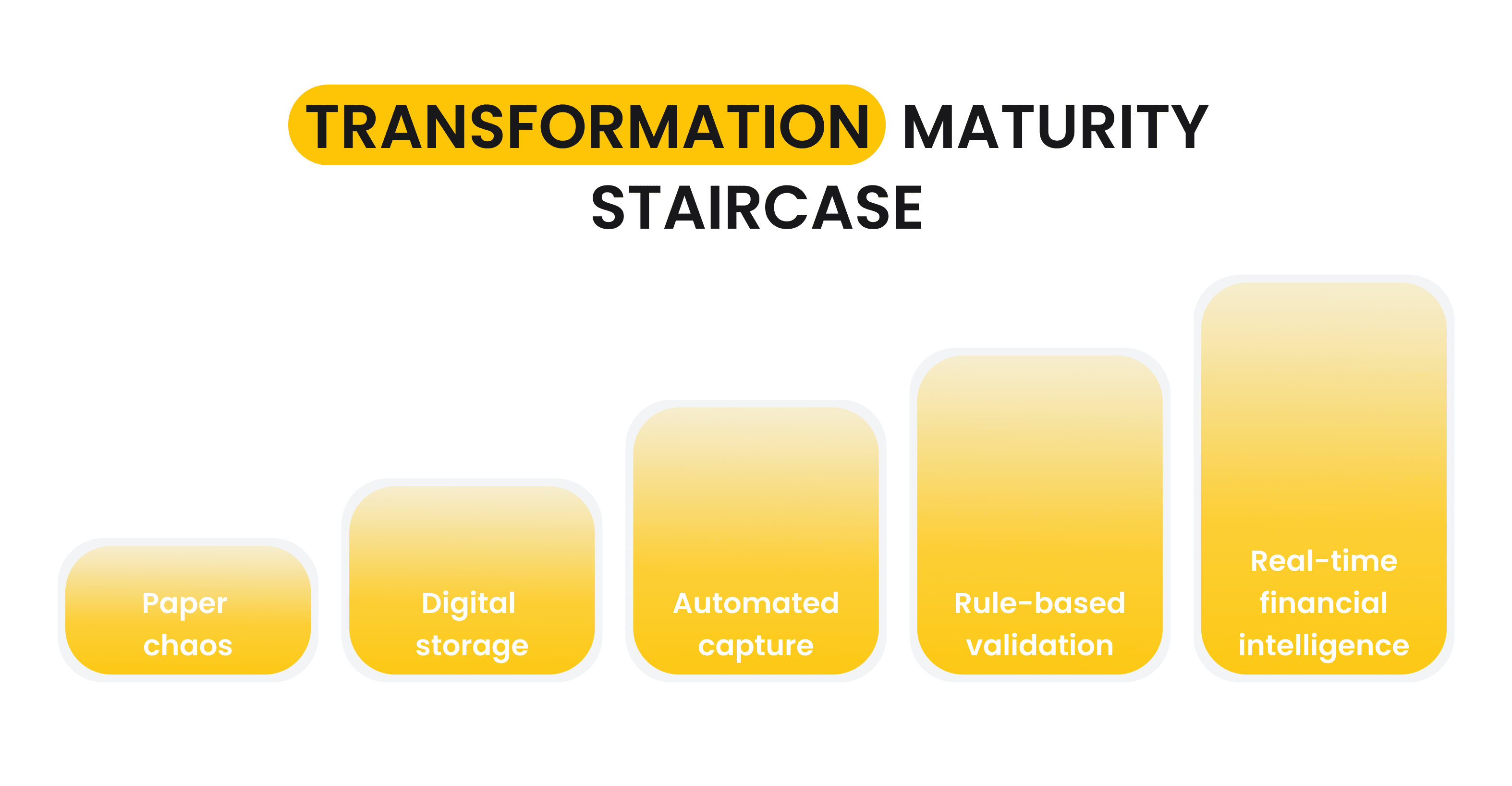
Construction firms ready to implement AP AR automation should start with clear objectives and success metrics. Define specific problems to solve and benefits to achieve.
These goals guide solution selection and provide benchmarks for measuring success.
Begin with a pilot program in one division or project type before company-wide rollout. This approach allows teams to learn and refine processes with a manageable scope.
Success in the pilot builds confidence for broader implementation.
Secure executive sponsorship to ensure adequate resources and organizational commitment.
Leadership support helps overcome resistance to change and ensures the initiative is prioritized. This backing proves critical when facing implementation challenges.
Starting with Clear Business Objectives
Identify specific problems the automation will solve:
- Are you struggling with processing speed?
- Dealing with too many duplicate payments?
The automation solution should directly address your particular challenges.
Establish measurable success criteria before implementation begins. Define targets for processing time reduction, cost savings, and error elimination.
Track progress against these benchmarks throughout implementation.
Align automation objectives with the overall business strategy. Automation should enable larger growth plans, not just reduce costs.
Strategic alignment ensures a sustained commitment to the success of automation.
Pilot Program Strategy
Select a division or project type for initial pilot implementation. Choose a group that's motivated to improve and willing to embrace change.
Success here will inspire company-wide adoption later.
Limit the pilot scope to a manageable volume while capturing enough transactions to support valid learning.
Process enough invoices to identify issues without so many that the problems become overwhelming. Typically, 5-10% of company volume works well.
Capture detailed feedback from pilot participants. Understand what worked well and what needs refinement. This feedback informs the broader implementation approach.
Document pilot results with before-and-after metrics. Quantify improvements in processing time, costs, and errors.
Share these results broadly to build enthusiasm for the company-wide rollout.
Market Positioning and Growth

Automation enables firms to scale without proportional staff increases. Growing companies maintain consistent processing efficiency.
This efficiency supports rapid growth without losing quality.
Better financial visibility enables strategic growth decisions. Understanding project profitability guides which types of work to pursue.
Data-driven growth strategies outperform intuition-based decisions.
Improved vendor relationships from reliable payments build partnership opportunities. Vendors treat reliable customers preferentially when supply is tight.
Prioritized access to materials and labor supports project success.
FAQ
What is AP and AR automation in construction?
AP (Accounts Payable) and AR (Accounts Receivable) automation uses software to digitize invoice processing, approvals, billing, and payments. It replaces manual, paper-based workflows with automated data capture, validation, approval routing, and payment execution tailored to construction projects.
Why are construction firms switching to AP/AR automation?
Construction firms are switching to AP/AR automation to reduce processing costs, eliminate duplicate payments, improve cash flow visibility, and handle growing transaction volumes without adding staff. Competitive pressure and tighter margins are accelerating adoption.
How does AP automation reduce costs and prevent errors?
AP automation eliminates manual data entry, detects duplicate invoices, enforces approval rules, and captures early payment discounts. These controls significantly reduce labor costs, data entry errors, and costly overpayments.
How does AR automation improve cash flow?
AR automation speeds up invoicing, improves billing accuracy, and automates payment reminders. Faster invoice delivery and proactive collections reduce days sales outstanding (DSO) and help construction firms get paid sooner.
Can AP and AR automation integrate with existing accounting and ERP systems?
Yes. Modern construction AP/AR automation platforms integrate with accounting software, ERP systems, project management tools, and banking platforms to ensure real-time data synchronization and eliminate duplicate data entry.
How quickly can construction firms see ROI from AP/AR automation?
Most construction firms see ROI within the first year. Savings come from reduced invoice processing costs, fewer errors, captured early payment discounts, and improved working capital management.


INSIGHTS

Get in Touch
Got no clue where to start? Why don’t we discuss your idea?

