This site uses cookies to improve your user experience. Read our Privacy Policy




By Bohdan Vasylkiv
- CEO & Co-Founder
What Is a Construction Snag List? Meaning, Format, and Best Practices
Learn what a construction snag list is, its meaning, and format. Discover how snagging lists help track unfinished work and defects before project handover.
Every construction project reaches a point where the bulk of the work is done — but not quite finished. Walls are painted, fixtures are in, and the building looks ready. Then someone walks through and finds a crack here, a missing seal there, a door that doesn't close right. That list of issues has a name: a snag list. This guide covers everything from snag list meaning to format, who's responsible, and how to manage the whole process.
What Is a Construction Snag List?
Simply put, a snag list in construction is a document that records all defects, unfinished work, and issues that must be resolved before a project is officially handed over to the client. Think of it as the final quality control checkpoint — a structured record of everything that still needs attention.
The term is widely used in the UK, Ireland, and Australia. In the US, the same concept is often called a punch list. Different name, same idea: find the problems, assign them, fix them, verify.
A snag list for construction projects can range from a one-page document for a small renovation to a multi-hundred-item spreadsheet for a large commercial build. Some teams call it a snagging list — the terms are interchangeable. Either way, the purpose is the same: make sure nothing slips through the cracks before the keys change hands.
Why is Snagging Important?
Here's the thing: skipping or rushing the snagging process almost always costs more in the long run. Defects that go unnoticed beforehand become disputes afterward. The client moves in, notices problems, and now you're dealing with warranty claims, callbacks, and damaged relationships.
A thorough snag list protects everyone. Contractors get a clear scope of what's still owed. Clients get documented proof that issues were identified and resolved. And project managers get a tool that keeps the final stretch organized and accountable.
When Are Snag Lists Created During a Construction Project?
There's no single universal moment when a snag list appears — snagging is more of a process than a one-time event. Most of it happens in the final stages, typically a few weeks before practical completion. The general contractor usually does an internal walkthrough first, then a formal inspection follows with the architect or client.
Experienced teams often start building their snag list for construction projects earlier, flagging issues as they go. This reduces last-minute pressure and gives subcontractors more time to resolve problems before handover.
Who Is Responsible for Creating a Snag List?
Snagging is rarely one person's job. In most projects, several parties contribute to the snag list, each from their own perspective and area of responsibility.
General contractors
The general contractor typically leads the snagging process. They're responsible for the overall quality of the finished build, which means they often initiate walkthroughs, coordinate with subcontractors, and ensure items are resolved on time. If something is on the snag list and it doesn't get fixed, that falls back on them.
Subcontractors
Each subcontractor — electrical, plumbing, finishing, and others — is responsible for the quality of their own work. When a snag list item falls under their trade, they're expected to fix it. In many projects, subcontractors also conduct their own pre-inspection to catch issues before the formal walkthrough, saving time for everyone.
Architects and project managers
Architects and project managers play a more verification-oriented role. They check that the work meets the original design intent, contractual specifications, and quality standards. Often, it's the architect or PM who conducts the formal inspection and produces the official snagging list that becomes the reference document for final sign-off.
What Should Be Included in a Construction Snag List?
A snag list is only useful if it's specific enough to act on. Vague entries like "bathroom needs work" don't help anyone. Here's what a well-structured snagging list actually covers.
Types of defects and issues
The most common categories of items you'll find on a construction snag list include:
- Structural and safety issues — cracks in walls or ceilings, improperly secured fixtures, fire door failures
- Finishing and aesthetic defects — paint runs or missed patches, uneven tiling, damaged flooring, gaps in skirting boards
- Mechanical, electrical, and plumbing (MEP) issues — sockets that don't work, leaks, and ventilation not functioning correctly
- Incomplete or missing work — hardware not installed, sealing not applied, areas simply left unfinished
Honestly, the list can get long on large projects. The key is to document everything, even minor cosmetic issues — because minor to you might be a dealbreaker for the client.
Key details for each snag item
Every entry on the snag list should include enough information for the responsible party to locate the issue, fix it, and verify it. That means:
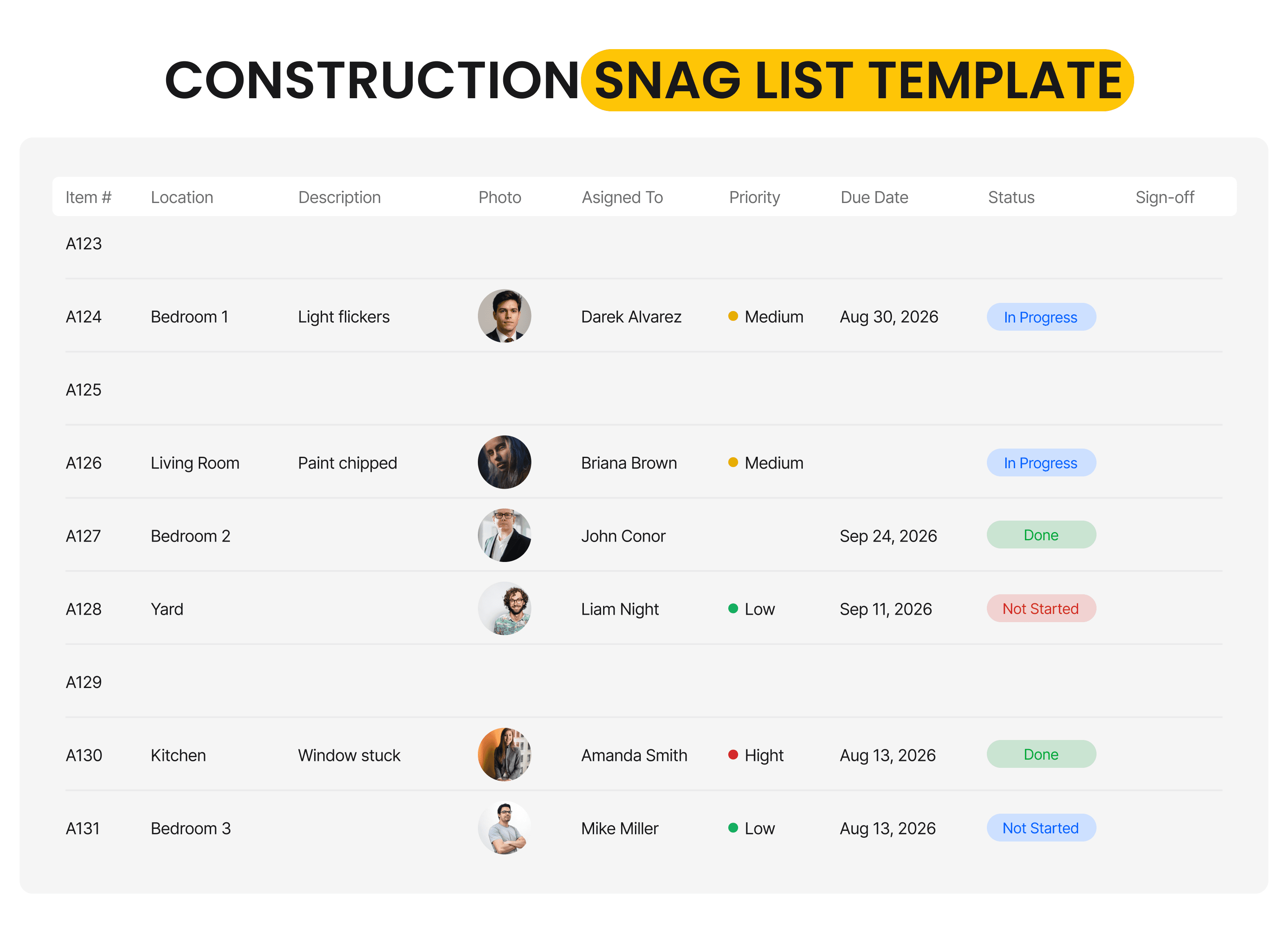
- Item number — for easy reference and tracking
- Location — specific room, floor, or zone on site
- Description — clear explanation of the defect or unfinished work
- Photo — visual evidence attached or referenced
- Assigned to — which contractor or trade is responsible
- Priority — High, Medium, or Low depending on impact
- Due date — realistic deadline for the fix
- Status — Open, In Progress, or Completed
- Sign-off — confirmation that the fix has been inspected and accepted
Construction Snag List Format and Example
When people ask about the construction snag list format, they're usually looking for a simple, consistent structure that the whole team can work from. There's no single official standard — formats vary by company and project type — but the most common approach is a table, either in Excel, a PDF, or a digital tool.
 Click to expand
Common Tools Used to Create Snag Lists
For years, construction teams managed snagging with clipboards, spreadsheets, and email threads. And honestly, it worked — until the project got big enough that tracking 200+ items across multiple trades became a full-time job in itself.
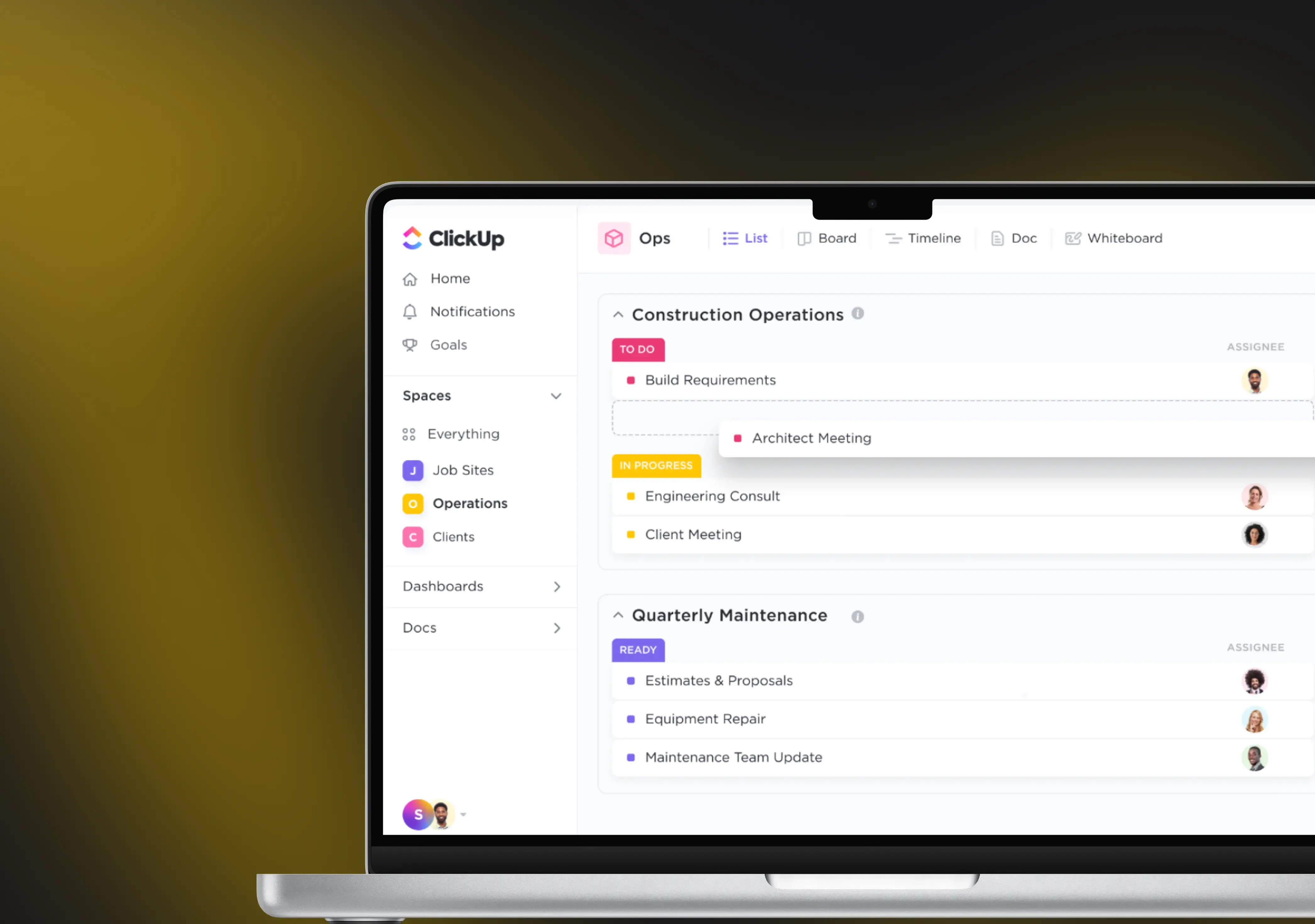
Today, most teams use one of three approaches: Spreadsheets (Excel, Google Sheets) — Simple and flexible. Great for small projects. Gets messy fast at scale. Dedicated construction management software — Purpose-built for site inspections and defect tracking. Handles photo attachments, task assignment, and real-time status updates. Check out how construction management in project management software typically handles this. Custom-built platforms — For teams with specific workflows that off-the-shelf tools don't cover. A team like Incora can build exactly what you need.
There is also a range of construction inspection and tracking tools that integrate snag tracking directly into broader project management workflows, which cuts down on duplicate work and keeps everything in one place.
How to Use a Construction Snag List Step by Step
Knowing what a snag list is and actually running a smooth snagging process are two different things. Here's how it typically works in practice.
 Click to expand
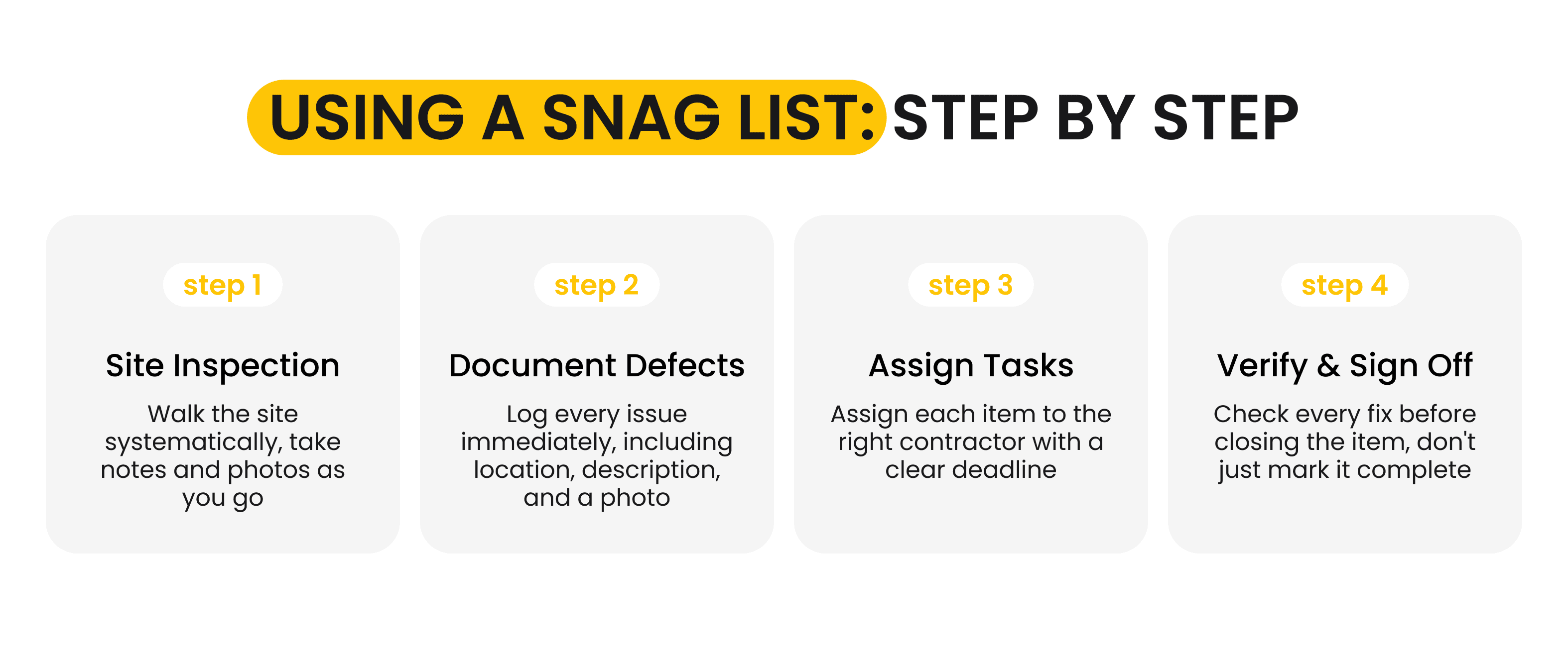
Step 1. Conducting the site inspection
Walk the site systematically — room by room, floor by floor. Don't rely on memory. Take notes and photos as you go. It helps to have the original drawings and specifications on hand so you can compare what was built against what was planned.
Step 2. Documenting defects and issues
Every issue gets logged immediately during or right after the inspection. Include location, description, and photo reference for each item. The goal is a snagging list that's specific enough for a subcontractor to act on without needing further explanation.
Step 3. Assigning tasks and responsibilities
Once the list is compiled, each item gets assigned to the relevant contractor or trade. Be clear about ownership — ambiguity here can cause things to fall through the gaps. Set realistic due dates and make sure everyone has visibility of what's theirs to fix.
Step 4. Tracking fixes and final verification
As items get resolved, they need to be checked — not just marked complete. Someone with authority (usually the architect or project manager) verifies the fix and signs off on it. The snag list stays open until every item is either completed and verified or formally agreed to be addressed under warranty.
Best Practices for Managing Snag Lists Efficiently
How you manage a snag list can make as big a difference as having one in the first place. A few things that consistently separate well-run snagging processes from chaotic ones:
Start inspections early
Don't wait until practical completion to start looking for issues. Rolling inspections throughout the build surface problems while there's still time to address them without disrupting the schedule.
Standardize snag list formats
Using a consistent construction snag list format across projects means less setup time and easier reporting. Everyone already knows what they're looking at.
Use digital construction management tools
Paper and spreadsheets create friction — items get missed, photos get lost. Digital tools keep everything linked: item, photo, assignee, status — with a real-time view of where things stand.
Maintain clear task ownership
Every item on the snag list should have one named person or company responsible for it. When ownership is unclear, items linger. When it's explicit, accountability is built in from the start.
Digitalizing Construction Snag List Management
The shift from paper to digital snag management isn't just about convenience — it changes what's actually possible in terms of speed, accuracy, and oversight.
How Digital Snag Lists Work in Modern Construction Projects
In a digital setup, inspectors log issues directly on a mobile device during the walkthrough. Photos are attached on the spot, locations are often pinned to a floor plan, and tasks are assigned automatically to the right contractor. Updates happen in real time — no emailing spreadsheet versions back and forth.
This is how “what is a snagging list in construction?” has evolved in recent years — from a document you print out to a live workflow that everyone on the project can access.
Key Features of Digital Snag List Systems
 Click to expand
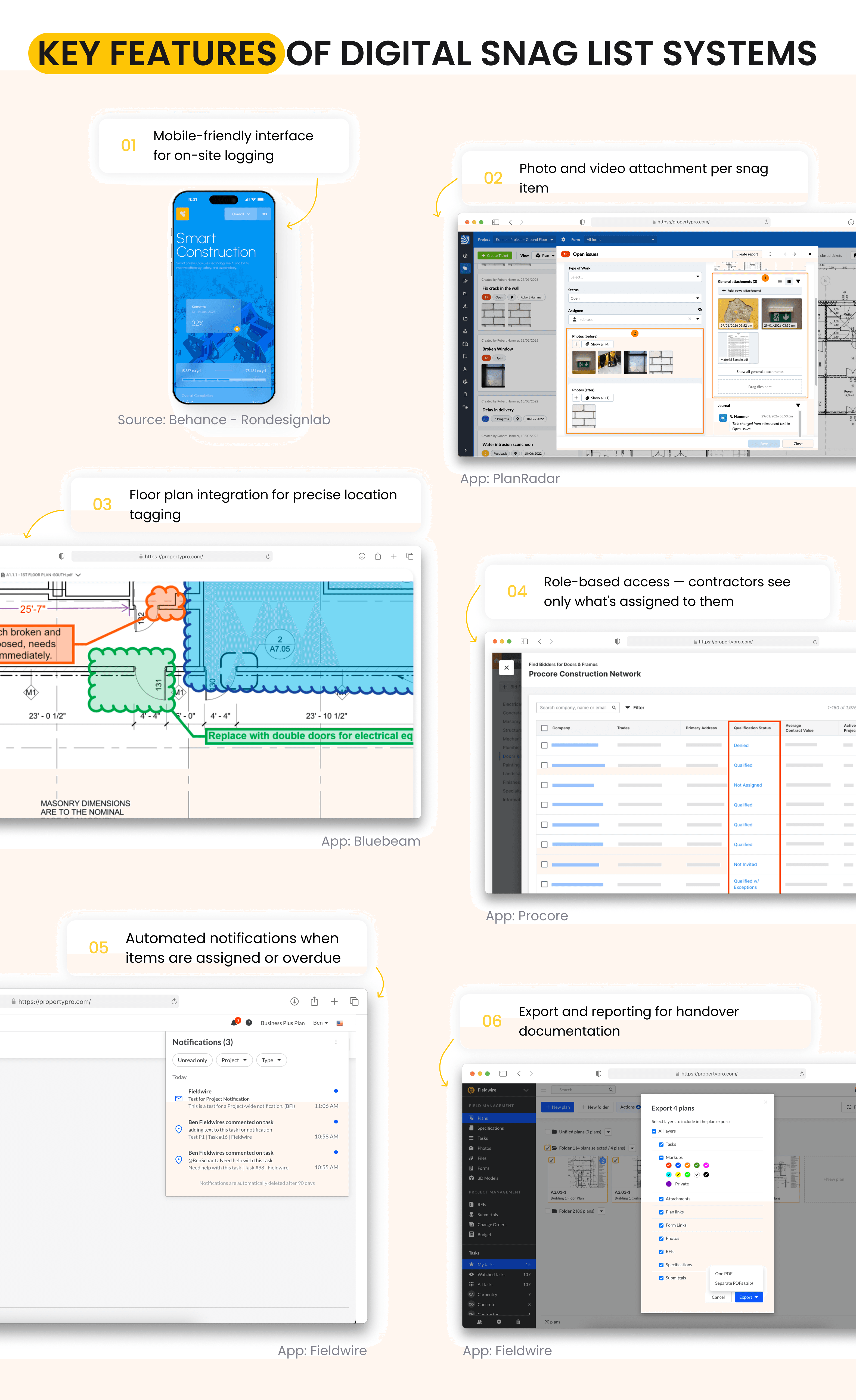
The most useful digital systems for a snag list in construction management typically include:
- Mobile-friendly interface for on-site logging
- Photo and video attachment per snag item
- Floor plan integration for precise location tagging
- Role-based access — contractors see only what's assigned to them
- Automated notifications when items are assigned or overdue
- Export and reporting for handover documentation
Tools for Digital Snag List Management
There's a growing market of construction tech platforms that include construction snag list or punch list functionality — ranging from large enterprise suites to lightweight field inspection apps. The right fit depends on your team size, project complexity, and how snag management fits into your broader workflow.
For companies with highly specific processes — or those looking to integrate snag tracking directly with their existing systems — a custom-built solution is often the most effective path. That's where teams like Incora come in. As specialists in custom SaaS platforms for construction project management, Incora can design and build snag management tools tailored to exactly how your team works — without forcing you to adapt your process to someone else's software.
There's also real potential in applying AI-powered automation to construction inspections to snag management — from auto-classifying defects by type and severity to automatically generating inspection reports. It's not just a future concept; it's already being explored in forward-looking construction teams.

Final Thoughts
A snag list isn't just admin — it's the difference between handing over a finished project and one that still needs work. Done well, snagging protects your reputation, keeps clients satisfied, and gives everyone a clear record of what was found and fixed. Bottom line: What is a construction snag list? Accountability in document form. Whether you manage it in a spreadsheet or a purpose-built platform, the principles stay the same — be thorough, be specific, and follow through.
FAQ
Can snag lists be managed digitally?
Yes — and for most projects, digital is the better option. Digital snag list tools let teams log issues in real time on mobile, attach photos, assign tasks, and track resolution without managing multiple document versions.
What information should a snag list include?
Each item on a snagging list should include an item number, location, defect description, photo evidence, responsible contractor, priority, due date, status, and a sign-off field. The more specific each entry is, the easier it is to act on.
What is the difference between a snag list and a punch list?
No functional difference. "Snag list" is standard in the UK, Ireland, and Australia; "punch list" is more common in the US. Same process, same purpose, same format.
When should snagging inspections be performed?
The main inspection happens in the final weeks before practical completion. Best practice is to run rolling inspections throughout the build, catching issues at each phase rather than leaving everything to the end.


YOU MAY ALSO LIKE


![How AI Negotiation Agents Improve Construction Procurement [And Why Do You Need It]](https://incora-uploads.s3.us-east-1.amazonaws.com/Cover_392b578d2f.webp)
Get in Touch
Got no clue where to start? Why don't we discuss your ideas?


