



By Bohdan Vasylkiv
- CEO & Co-Founder
How Much Does Warehouse Management Software Cost in 2026?
WMS software cost depends on deployment, features, and business size. Explore real pricing — SaaS, on-premise, and cloud WMS — plus hidden fees and ROI tips.
Key Takeaways
- The warehouse management system cost ranges from $350/month for entry-level SaaS tools to over $500,000 for enterprise deployments.
- SaaS, perpetual license, and open-source WMS have very different long-term cost profiles — the cheapest upfront option is rarely the cheapest overall.
- Hidden fees routinely add 30–50% to the quoted WMS cost — data migration, per-module upsells, and contract renewal hikes are the biggest culprits.
- Most businesses see ROI within 12–24 months when implementation is scoped correctly, and performance KPIs are tracked from day one.
If you've searched “how much does a warehouse management system cost” and come away with a range so wide it's useless, you're not alone. Vendor sites say “contact us for pricing.” Comparison tools spit out figures ranging from $300/month to $300,000. And by the time you're on a sales call, you've already lost an afternoon. This guide gives you actual numbers.
Below you'll find real 2026 price ranges, a full breakdown of every cost category buyers typically miss, and a step-by-step budgeting framework — whether you're running a single site or managing supply chain software solutions across multiple locations. The warehouse management software cost picture is more complicated than any vendor will admit upfront. Let's walk through it.
WMS Pricing Models Explained: Which One Fits Your Budget?
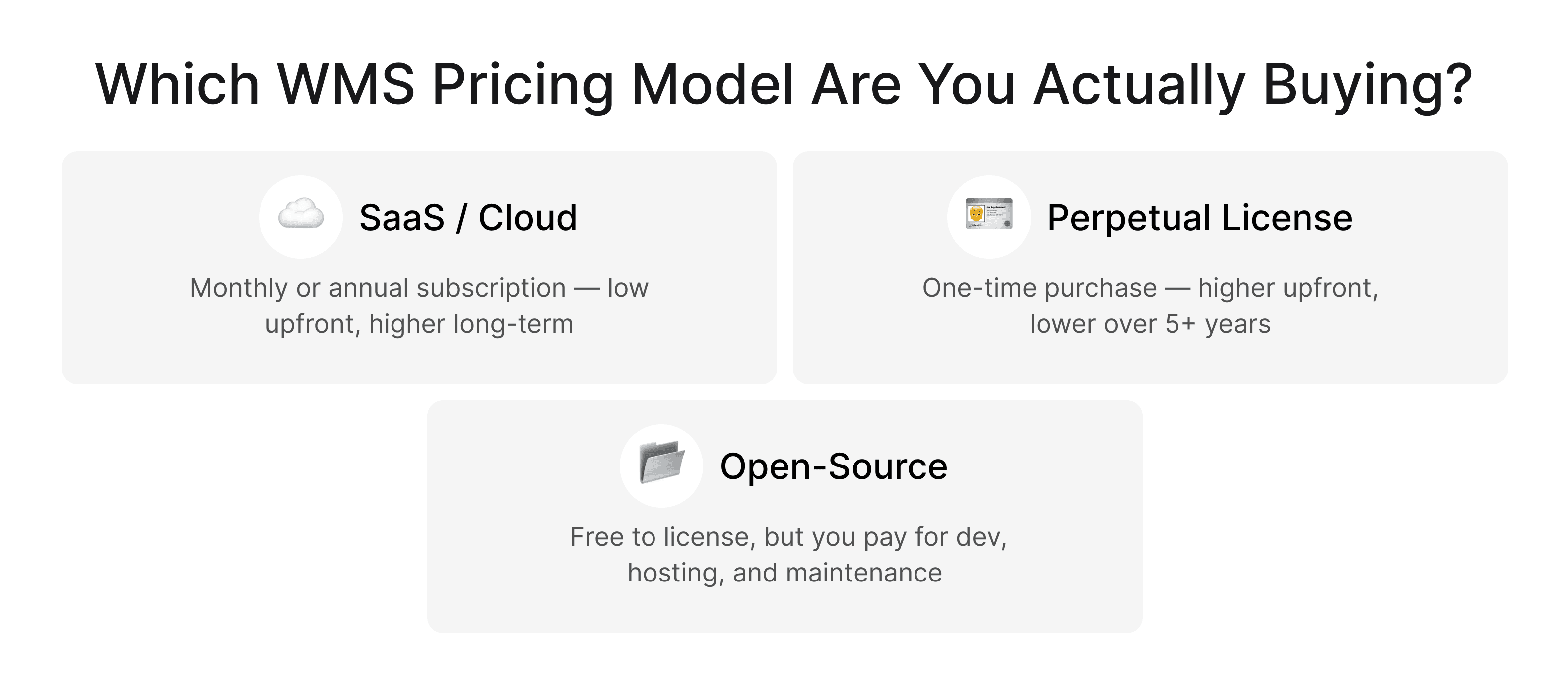
Before you compare any numbers, understand the model behind the price. The same feature set can carry a radically different price tag depending on how it's delivered and billed. Here are the three main models in 2026.
SaaS / Cloud Subscription
This is the most common entry point for small and mid-size operations. You pay monthly or annually — typically per user, per location, or per order volume — and the vendor handles hosting and updates. The WMS software cost on SaaS usually starts around $350–$500/month for basic plans and climbs to $3,000–$10,000/month for feature-rich tiers. The warehouse management system price you see advertised is almost always this tier's entry point.
The upside: lower upfront investment, faster go-live, predictable billing. The downside: over a 5-year window, you often pay more than a perpetual license, and you're dependent on the vendor's roadmap and pricing decisions.
Perpetual License
You pay once and own the software indefinitely. The cost of a warehouse management system on a perpetual license typically runs $30,000–$300,000 upfront, depending on scale and vendor. You'll also pay 15–25% of the license cost annually for maintenance and support.
This model makes financial sense for large enterprises with stable, predictable needs and an internal IT team. If you're running complex high-volume operations that won't change architecturally, the total cost of ownership over five-plus years often comes out lower than SaaS.
 Click to expand
Open-Source WMS
Free to license — but not free to run. Open-source platforms like Odoo WMS or OpenWMS give you the code, but you need developers to customize, deploy, and maintain it. Total warehouse management software cost for an open-source implementation typically lands between $20,000 and $150,000, depending on customization scope. Best for companies with in-house technical capacity or a trusted development partner.
Full WMS Cost Breakdown
The license or subscription fee is just the headline number. The real cost of a WMS implementation includes several layers that vendors rarely lead with.
Software Licensing & Subscription Fees
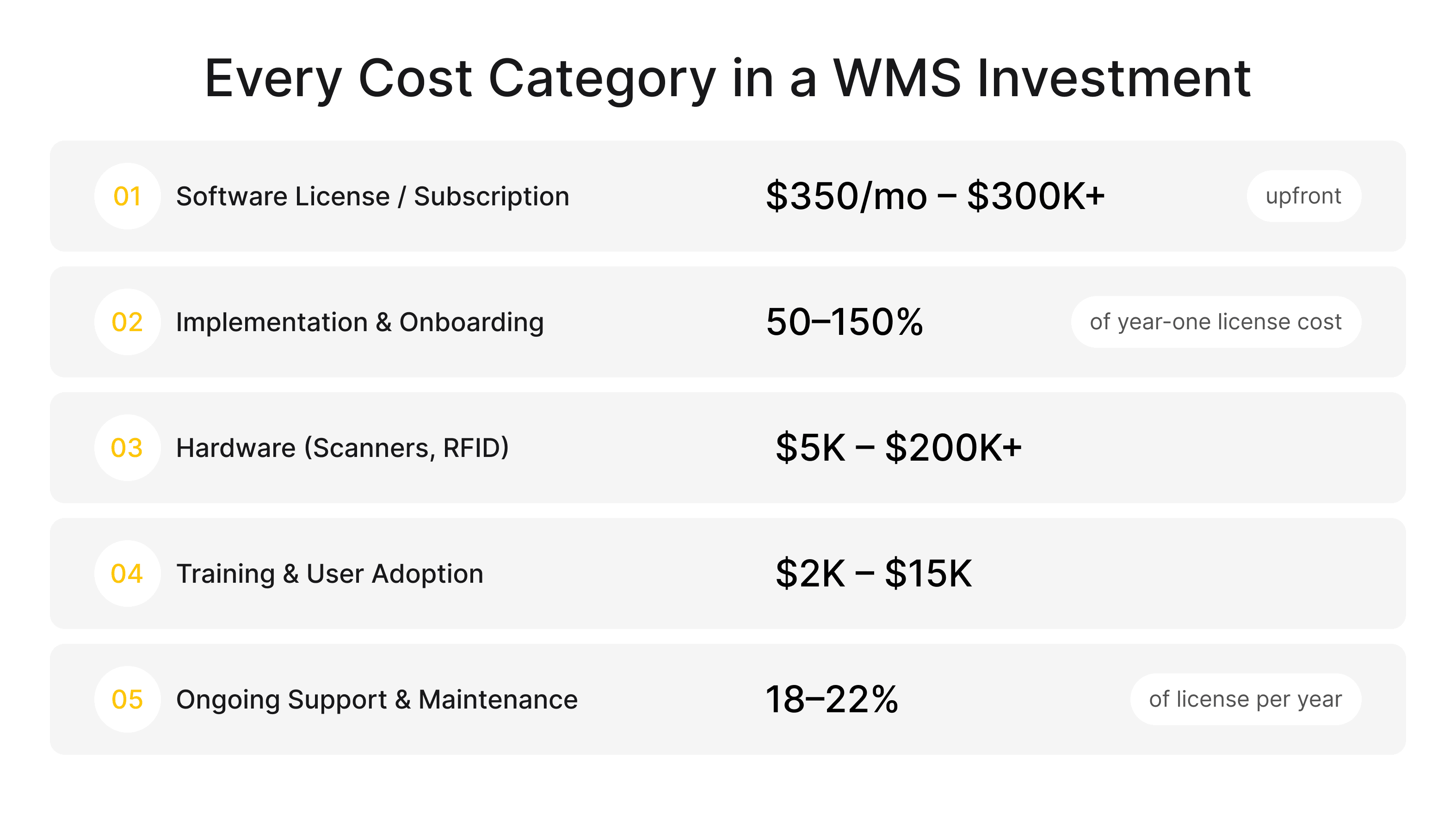
This is what you'll see quoted first. For SaaS: $350–$10,000+/month. For perpetual licenses: $30,000–$300,000+ upfront. Enterprise platforms from SAP, Manhattan Associates, or Oracle can run far higher. The warehouse management system software cost at the SMB level tends to cluster between $500 and $3,000/month for cloud solutions. The warehouse inventory management software cost for growing mid-market businesses often starts low but then increases sharply once you add users, locations, or advanced modules.
Implementation & Onboarding Costs
This is where budgets get blindsided. Implementation fees typically run **50–150% **of the first-year license cost. For a $2,000/month SaaS product, expect $12,000–$36,000 in implementation services. For enterprise systems, implementation regularly exceeds the license cost — $100,000 to $500,000 is common. It covers system configuration, workflow design, integration setup, testing, and go-live support.
Hardware Requirements (Scanners, RFID, Servers)
Cloud WMS eliminates on-premise server costs, but you still need endpoint hardware. A basic barcode scanner setup for a small warehouse runs $5,000–$20,000. Full RFID infrastructure is significantly more: $50,000–$200,000+, including readers, tags, and middleware. On-premise deployments add server hardware — budget $10,000–$80,000 depending on scale.
 Click to expand
Training & User Adoption Expenses
Underestimated almost universally. Vendor-provided training packages range from $2,000–$15,000 for the initial rollout. Factor in productivity dips during the first 4–8 weeks post-go-live as well. For a 20-person warehouse team, that's real money on top of the software costs.
Ongoing Maintenance and Support Fees
For SaaS, support is usually included in your subscription — but “included” often means a knowledge base and email queue, not a dedicated account manager. For perpetual licenses, annual maintenance runs 18–22% of the license cost. Don't assume base pricing includes 24/7 support. It usually doesn't.
WMS Software Cost by Business Size: Realistic Numbers for 2026
Here's the size-adjusted view. These are realistic 2026 ranges — not the best-case scenarios vendors use in their materials.
Small Business WMS Cost (1–3 Warehouses, Under 10 Users)
For small operations, SaaS is almost always the right move. The WMS cost for this segment typically runs $500–$2,500/month for a solid cloud WMS with core receiving, putaway, pick/pack/ship, and basic reporting. Add $5,000–$25,000 in one-time implementation costs plus hardware. Total first-year outlay: $15,000–$55,000. Annual cost from year two onward: $6,000–$30,000.
Mid-Market WMS Cost (10–50 Users, Multi-Location)
This segment has the widest range. The WMS system cost for mid-market operations typically ranges from $2,000–$8,000/month for SaaS platforms, with implementation costs of $30,000–$120,000. Adding ERP integration (SAP, NetSuite, Dynamics) brings another $20,000–$60,000 in integration work alone. Total first-year investment typically ranges from $75,000 to $220,000.
Enterprise WMS Cost (50+ Users, Complex Operations)
Enterprise buyers are in a different category entirely. Pricing at this scale — multi-site, high SKU count, complex fulfillment rules — typically starts at $150,000/year and easily exceeds** $500,000** for year one, including implementation. Many enterprises opt for a dedicated WMS development team or a fully custom-built system rather than forcing a packaged product to fit genuinely unique operations.
Not sure where to start with warehouse management software cost?
We can help you figure out what's actually slowing you down and what to build first.
Key Factors That Determine Your WMS Price Tag
Two companies of the same size can end up with wildly different WMS costs. Here's why.
Number of Users and Warehouse Locations
Most SaaS WMS platforms price on a per-user or per-location basis. Going from 5 to 15 users can double your monthly bill. Adding a second warehouse location often triggers a new pricing tier entirely. Before signing, run the warehouse management system price through at 1.5x and 2x your current headcount — you need to know where the pricing cliffs are before you commit.
Integration Complexity (ERP, TMS, eCommerce)
Integration is where cost projections go off the rails. A clean API connection to one ERP is manageable. Connecting to a legacy ERP, a TMS, an eCommerce platform, and multiple carrier APIs is something else entirely. Mid-complexity integration work runs $15,000–$60,000. For legacy systems, budget higher. It's worth reviewing AI warehouse automation as part of your planning — AI-driven features are increasingly shaping how WMS platforms connect with other systems and which integrations you'll need from day one.
Customization and Industry-Specific Requirements
Out-of-the-box WMS works fine for standard fulfillment. The moment you add lot traceability for food or pharma, hazmat handling, complex returns logic, or retail-specific slotting rules, you're in customization territory — and that means more time, more cost, and more dependency on implementation partners.
Deployment Environment and Security Needs
Cloud deployment is faster and cheaper to start. But regulated industries — healthcare, food, defense — often have data residency or security requirements that force on-premise or private cloud deployments. Those environments carry substantially higher infrastructure and compliance costs. This alone can change your total outlay by $50,000–$200,000.
Hidden WMS Costs Most Vendors Won't Mention Upfront
Honestly, this section saves people the most money. The list price is never the full cost.
Data Migration and Cleanup Fees
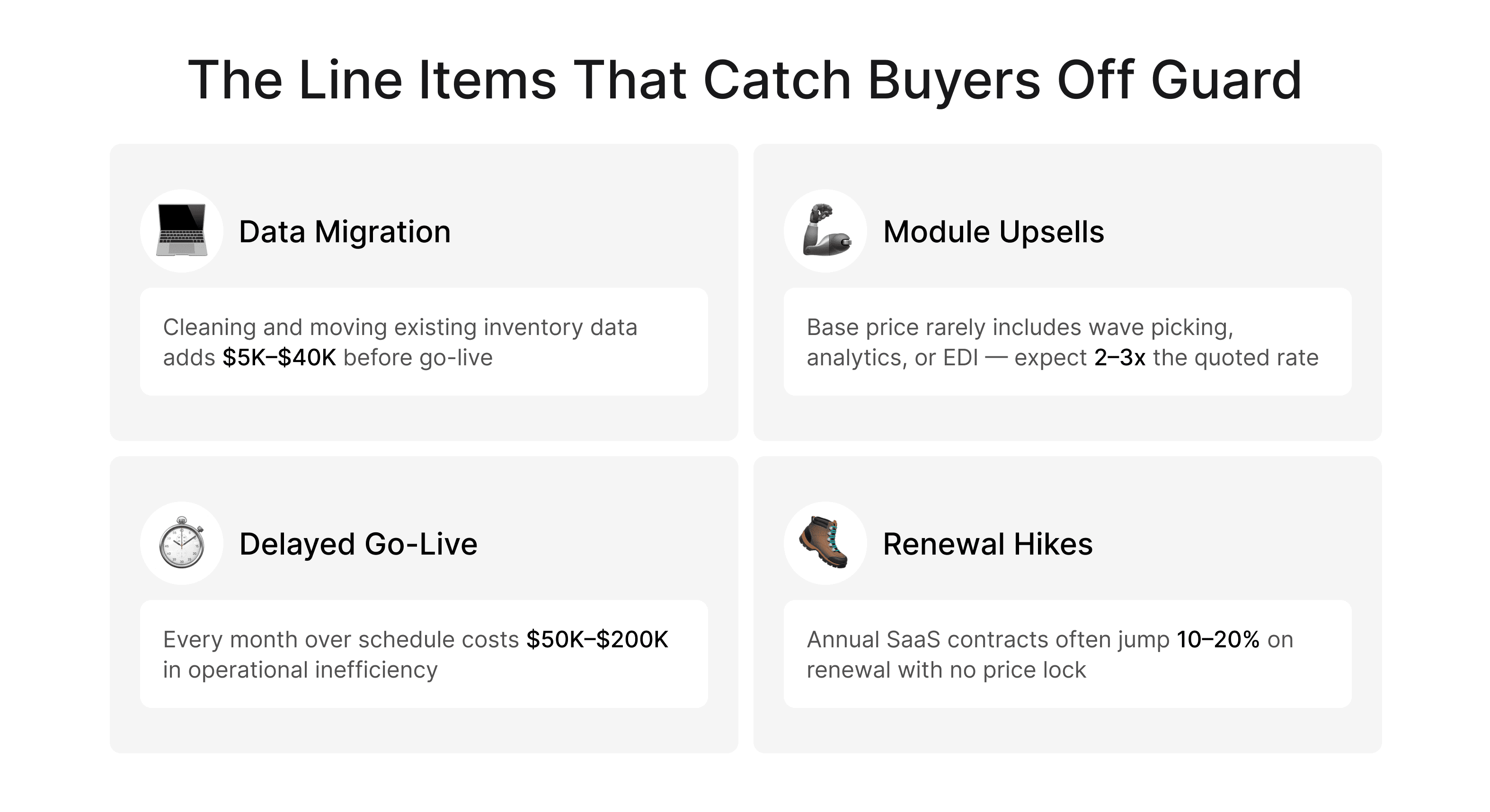
Migrating product master data, inventory records, and transaction history from your old system — or from spreadsheets — is almost always more painful than expected. Data cleanup before migration adds $5,000–$40,000 to most mid-market projects. When calculating the true cost of warehouse management system ownership, data migration is one of the most consistently underestimated line items. Some vendors include basic migration; complex scenarios are almost always billed separately.
 Click to expand
Per-Module or Per-Feature Upsells
Many WMS platforms advertise a competitive base price, then charge extra for everything actually useful: advanced analytics, wave picking, labor management, returns processing, EDI connectivity, and mobile apps. It's common to start a WMS cost evaluation at $1,500/month and end up at $4,000/month once the system is configured for real-world operations. Get a full feature list — and all add-on pricing — before you sign anything.
Contract Renewal Price Jumps
SaaS contracts often include a 10–20% price increase on renewal, buried in the fine print. If you're on annual terms with no price lock, model in escalation when building your 3-year cost projection. This matters especially for fast-growing operations where usage-based pricing compounds quickly.
Opportunity Cost of a Delayed Go-Live
This doesn't show up on any invoice, but it's real. A WMS implementation that runs 3 months over schedule means 3 more months of manual processes, picking errors, and overtime. For a warehouse doing $10M/year in throughput, that delay can represent $50,000–$200,000 in avoidable inefficiency. Build a timeline buffer into your plan — and your budget.
WMS ROI in 2026: When Does the Investment Pay Off?
WMS cost is only half the equation. The real question is what return it generates. Understanding custom software development cost versus long-term operational gains is what actually determines whether a purchase makes sense. And here's why that matters: a well-chosen WMS is not a sunk expense — it's an investment with a measurable payback period.
Average Payback Period by Business Size
Small businesses with clean SaaS implementations typically see payback in 12–18 months. Mid-market companies with more complex setups usually hit breakeven at 18–30 months. Enterprise implementations with significant customization may take 2–4 years to show full ROI, but the absolute dollar gains are proportionally much larger.
The variables that most affect payback speed: how inefficient your current operations are (more chaos = bigger improvement potential), how thoroughly staff adopt the system, and how well the implementation was scoped from the start.
KPIs to Track After WMS Implementation
If you're not measuring, you're guessing. The KPIs that best demonstrate WMS ROI: order accuracy rate (target: 99.5%+), inventory accuracy (target: 99%+), pick rate per hour, receiving cycle time, and cost per order. Establish a baseline before go-live, then measure monthly for the first year. Well-implemented WMS systems show meaningful improvement across all of these metrics within 60–90 days.
WMS Budget Planning Checklist
Here's a practical step-by-step approach to building a WMS budget that won't blow up mid-project.
Step 1 — Map Your Warehouse Profile and Volume Needs
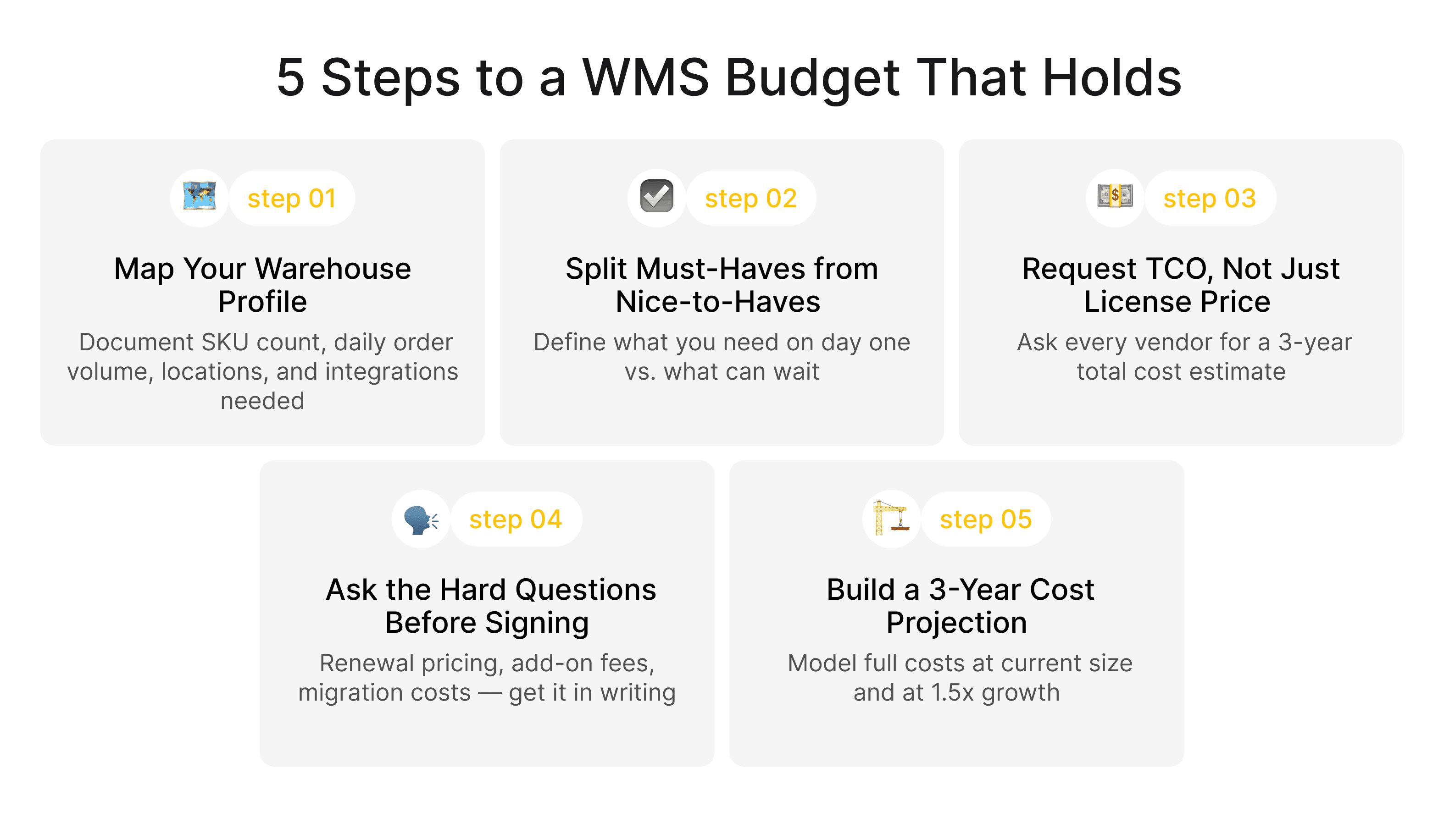
Before talking to any vendor, document your current state: number of SKUs, average daily orders, number of locations, existing software stack, and integrations needed. This is the foundation against which everything gets priced. Vendors price vagueness at a premium. The more specific you are, the more accurate — and comparable — your WMS software cost quotes will be.
Step 2 — Separate Must-Have from Nice-to-Have Features
Make a two-column list. Must-haves are features you need on day one to run operations. Nice-to-haves are improvements, not blockers. This discipline keeps scope — and cost — in check. Most WMS overspends happen because buyers try to solve every problem at once during the initial implementation.
 Click to expand
Step 3 — Request Total Cost of Ownership (TCO), Not Just License Price
Ask every vendor for a 3-year TCO estimate: license/subscription, implementation, integrations, training, hardware, and ongoing support. If they won't provide this, that's a red flag. Compare apples to apples — a $500/month subscription with an $80,000 implementation is more expensive in year one than a $2,000/month subscription with a $10,000 setup.
Step 4 — Ask These 7 Questions Before Signing a WMS Contract
- What's included in implementation, and what's billed separately?
- What does renewal pricing look like after year one — is there a price lock?
- Are there per-module or per-feature fees not in the base price?
- What are the SLAs for uptime and support response time?
- How is data migration handled — and does it cost extra?
- What's the process and cost for adding users or locations later?
- Do you have references from companies of similar size and industry to ours?
Step 5 — Build a 3-Year Cost Projection
Spread the full cost — implementation, license, hardware, support, projected user growth — across 36 months. This is the only honest way to compare SaaS, perpetual licenses, and outsourced software product development for a custom solution. Buyers who do this properly are often surprised by how competitive custom builds become at the 3-year mark for complex operations.
A few questions that often come up at this stage: What is the warehouse management system software price if you want to upgrade tiers in year two? What is the cost of retail warehouse management software versus a general-purpose WMS if you're in that vertical? And how much does a WMS system cost across different deployment models when you account for infrastructure? Build these scenarios into your projection before you sign.
Final Takeaway
The warehouse management system cost isn't a single number — it's a system of decisions: which model you choose, how complex your operations are, and whether you account for the fees vendors won't lead with. Get those right, and the investment pays off. Get them wrong, and you're looking at an expensive reset 18 months in.
Bottom line: a WMS that's cheap to license but costly to implement and scale isn't a bargain — it's a delayed cost. If your operation has outgrown off-the-shelf options, Incora builds custom WMS solutions designed to close exactly that gap.
FAQ
How much does a warehouse management system cost on average?
On average, the warehouse management system for small businesses starts at $6,000–$30,000/year on a SaaS basis. Mid-market systems land between $50,000 and $150,000 for year one, including implementation. Enterprise systems frequently exceed $500,000 in total first-year investment.
What is the cheapest WMS option for small businesses?
Entry-level SaaS platforms — Extensiv, Logiwa, Fishbowl — start around $350–$500/month. Open-source options can be cheaper on license, but factor in development and customization costs. The cheapest option isn't always the lowest total cost once implementation and support are included.
Is cloud WMS cheaper than on-premise in the long run?
For most SMBs, yes — in years one through three. Over a 5–7-year horizon with stable operations and an internal IT team, an on-premises perpetual license can be less expensive. Run a proper TCO model for your specific situation rather than assuming either way.
How long does WMS implementation take, and what does it cost?
Small implementations: 4–8 weeks, $5,000–$25,000. Mid-market: 2–6 months, $30,000–$120,000. Enterprise: 6–18 months, $100,000–$500,000+. Timeline and cost depend heavily on integration complexity, data quality, and the internal team's level of resourcing for the project.
Does the number of users affect WMS pricing?
Significantly. Most SaaS WMS platforms price per named or concurrent user. Going from 10 to 25 users can increase monthly costs by 2–3x depending on the vendor's tier structure. The WMS system cost also scales with the number of locations — always model expected user and site count at 18 months and 3 years, not just today's headcount.


YOU MAY ALSO LIKE




Get in Touch
Got no clue where to start? Why don't we discuss your ideas?

