



By Bohdan Vasylkiv
- CEO & Co-Founder
What Is a Virtual Warehouse? How It Works & Key Benefits
A virtual warehouse manages inventory across locations via one software system. Discover how it works, key benefits, and what to look for in a solution.
Key Takeaways
- A virtual warehouse manages inventory across multiple physical locations through a single software layer — no owned real estate required.
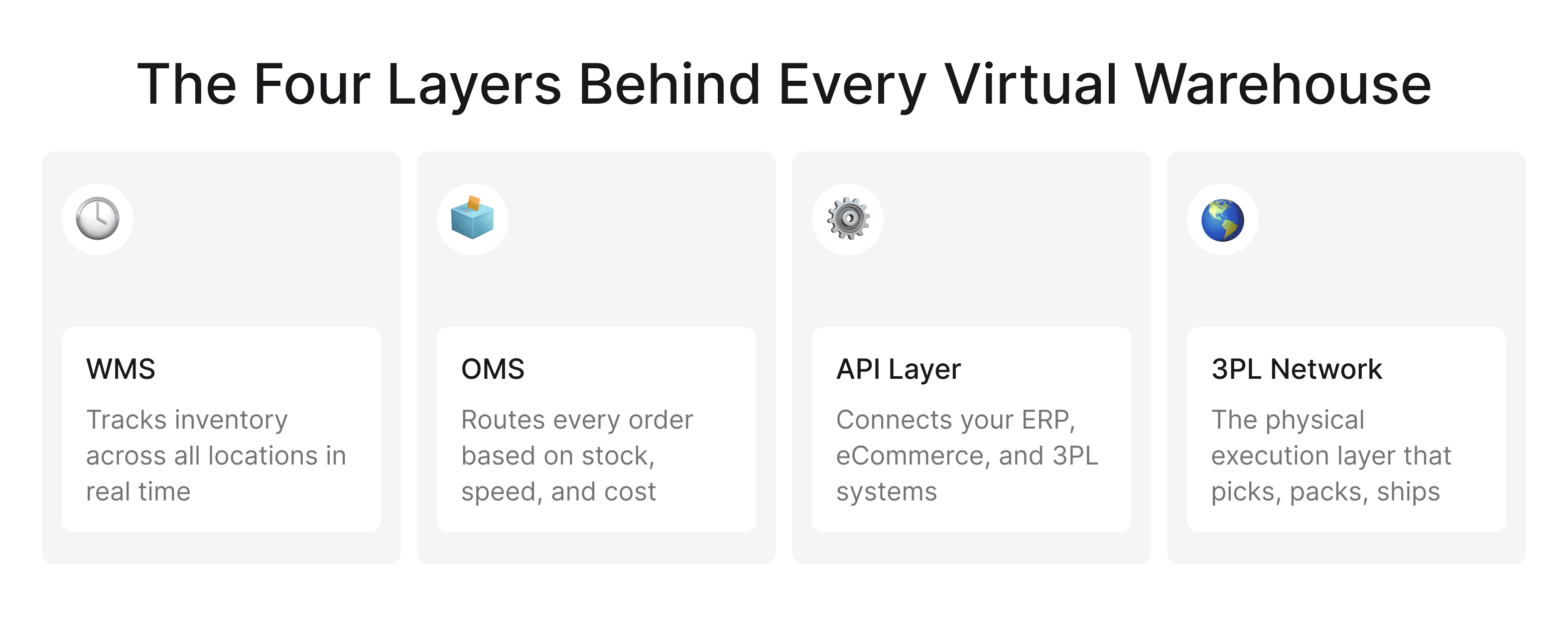
- The core technology stack includes a WMS, an OMS, API integrations, and 3PL network connections that work in sync.
- The model reduces overhead costs, accelerates fulfillment, and scales without capital investment in new facilities.
- Best suited for eCommerce brands, D2C businesses, seasonal sellers, and B2B distributors expanding into new regions.
If you've ever wondered what is a virtual warehouse and how it actually differs from a traditional setup, you're not alone. It's one of those terms that gets thrown around a lot in logistics circles, but is rarely explained clearly.
This guide breaks down how it works, what the tech stack looks like, and whether it's the right move for your business — without the buzzword stacking.
Virtual Warehouse vs. Physical Warehouse: What's the Real Difference?
A physical warehouse means owning or leasing space, paying for it whether it's full or not, and signing new leases every time you expand. A virtual warehouse doesn't require any real estate at all — it's a software layer that treats inventory across 3PL facilities, supplier locations, and distribution centers as one unified pool, routing orders based on stock levels, location, and cost.
The "virtual" part doesn't mean the goods aren't real. It means the management and visibility layer that connects all those physical locations behaves like a single coherent operation.
The core difference, practically speaking, comes down to 3 things:
- Capital: Physical warehouses require upfront investment. This model typically uses pay-per-use 3PL arrangements.
- Flexibility: You can spin up or spin down capacity far faster than signing or breaking a lease.
- Complexity: The challenge shifts from managing physical space to managing data and integrations. The tech burden is real — but so is the payoff.
How Does a Virtual Warehouse Actually Work?
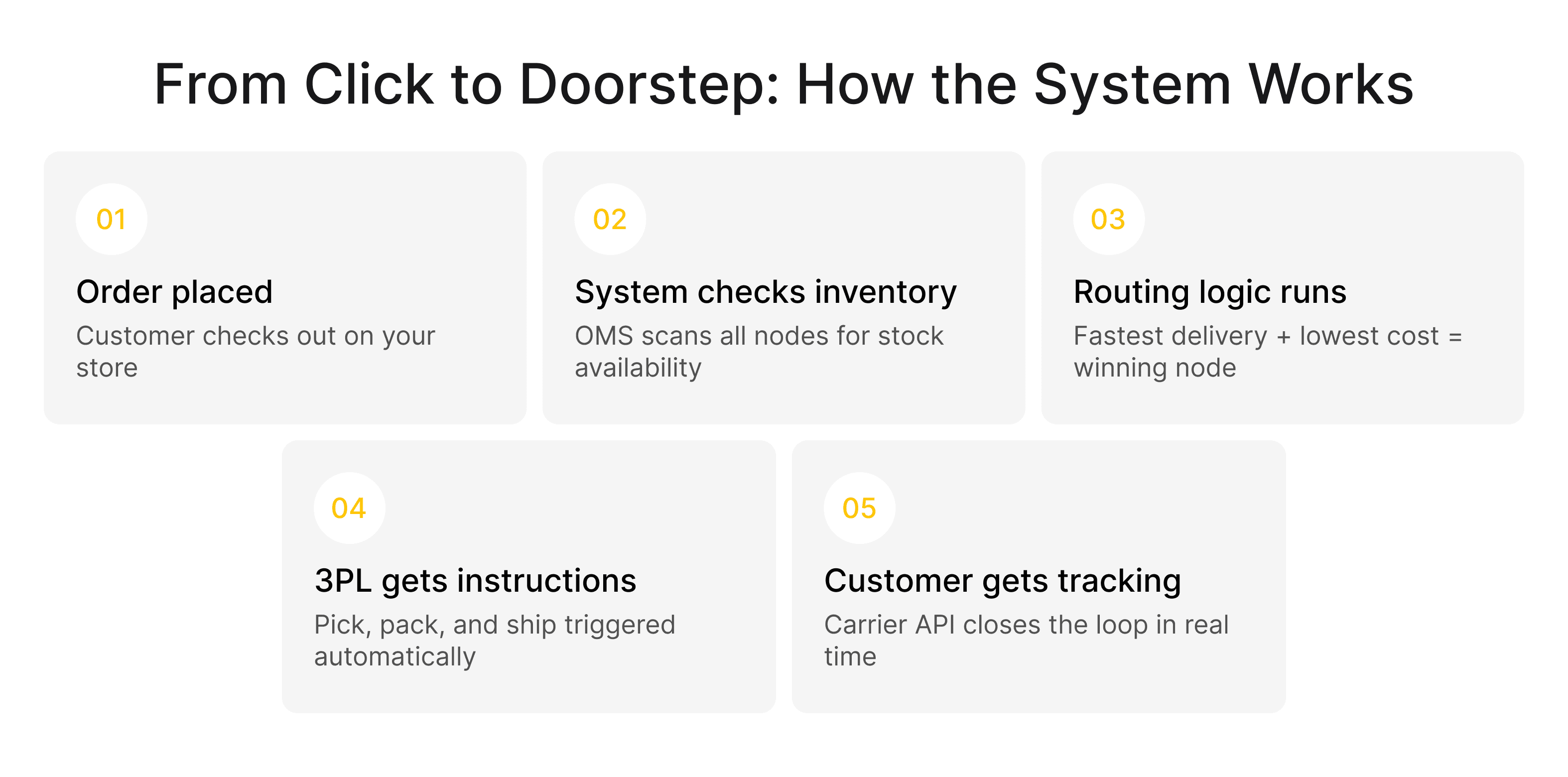
At its core, virtual warehousing connects all your inventory locations — your own facilities, 3PL partners, drop-ship suppliers — into a single system with real-time visibility and order routing.
When a customer places an order, the system doesn't just pick the nearest stock. It runs through logic in milliseconds: where is the item, which node ships it fastest, what's the cost, is a split shipment needed? Inventory syncs constantly, carrier APIs pull live rates, and 3PL partners receive pick-and-pack instructions automatically.
 Click to expand
For businesses operating in supply chain software development contexts, this kind of orchestration is the difference between scaling efficiently and drowning in operational complexity.
Key Components of a Virtual Warehousing System
Warehouse Management System (WMS)
The WMS is the operational brain. It tracks inventory in real time, manages locations and bin-level data, and handles the physical movement logic across all your nodes. A good WMS in this setup needs to work across multiple facilities simultaneously — not just one building.
Order Management System (OMS)
The OMS is where customer orders land and get routed. It's responsible for applying fulfillment rules — which delivery and shipping app development teams spend considerable time getting right — like "ship from the closest stocked location" or "never split a shipment unless stock is critically low."
API integrations and data layer
This is the connective tissue. Your WMS, OMS, eCommerce platform, ERP, and 3PL systems all need to talk to each other in real time. Business process automation services teams typically build or configure these integrations to ensure data flows without manual intervention or lag.
 Click to expand
3PL network and carrier connections
The model often relies on third-party logistics providers as the physical execution layer. Your system sends instructions to 3PL partners who actually pick, pack, and ship. Carrier integrations pull live rates and tracking data back into your system, closing the visibility loop.
Benefits of Virtual Data Warehousing for Growing Businesses
Honestly, this is where the model earns its reputation. A virtual data warehouse approach solves the problems that growing businesses face — without the capital commitment required to build your own infrastructure.
Reduced overhead and real estate costs
No lease, no utilities, no facility staff. You pay for storage and handling on a variable basis — costs scale with volume, not with the building you're locked into.
Faster order fulfillment and shorter delivery windows
By positioning inventory closer to your customers across multiple nodes, you dramatically reduce transit times. Two-day and next-day windows become achievable without an Amazon-scale infrastructure.
Improved inventory visibility across all locations
Instead of reconciling spreadsheets from different locations, you see one unified picture — critical for stockout prevention, demand forecasting, and slow-moving inventory. Teams working on ERP integration for warehousing typically cite this as one of the most impactful changes after go-live.
Scalability without capital investment
Adding a new fulfillment region? In a physical model, that means a new lease, new staff, and months of setup. In this model, you onboard a new 3PL partner and configure the integration. Weeks, not months. No capital outlay. That's a fundamentally different growth equation.
Sustainability impact: fewer empty miles, lower carbon footprint
Smarter routing means fewer unnecessary shipments and shorter distances — a meaningful operational lever, not just a talking point.
Challenges of Running a Virtual Warehouse
That said, virtual warehousing isn't without its friction points. Here's what tends to catch businesses off guard:
Technology dependency and system downtime risks
Your entire operation runs on software — if your WMS, OMS, or integrations go down, fulfillment stops. For a virtual warehouse in supply chain management scenarios, a single point of failure can cascade across the whole network, so solid SLAs, fallback processes, and monitoring aren't optional.
Data synchronization failures across nodes
When inventory data doesn't sync correctly across locations, you get overselling, phantom stock, and customer service nightmares. This usually comes down to integration quality and latency. It's solvable — but it requires careful architecture and ongoing monitoring, not a set-it-and-forget-it approach.
Managing 3PL partner quality and accountability
You can have perfect software and still deliver a poor customer experience if your 3PL partner is slow, inaccurate, or careless with packing. The model shifts physical execution to partners you don't directly manage. Vetting those partners thoroughly — and having SLA enforcement in your contracts — is non-negotiable.
Change management and team adoption
Making the switch is a significant operational shift. Your procurement team, your customer service team, your ops leads — everyone's workflows change. Underestimating the human side of this transition is one of the most common reasons implementations stall or fail.
Not sure where to start?
We can help you figure out what's actually slowing you down and what to build first.
Virtual Warehouse Software: What to Look for in 2026
The market for virtual warehouse software has matured quickly, but quality varies significantly. Here's how to separate the platforms worth your time from the ones that will slow you down.
Must-have features checklist
At a minimum, your platform should offer:
- Real-time inventory visibility across all nodes
- Automated order routing with configurable rules
- Multi-carrier shipping integration with live rate pulling
- Returns management workflow
- Reporting and forecasting dashboards
- Audit trail and data logging for compliance
Integration capabilities (ERP, eCommerce, marketplaces)
This is often where deals get made or broken. Your virtual warehouse software needs to connect cleanly with your ERP, your eCommerce platform (Shopify, Magento, WooCommerce, etc.), and any marketplaces you sell on (Amazon, eBay, etc.). Reviewing the top supply chain management software features can give you a solid baseline for what a well-integrated system should look like.
Pricing models and scalability tiers
Watch for platforms that charge by order volume, storage location count, or number of integrations. These costs can compound quickly as you scale. Look for transparent pricing with clear upgrade paths — and run projections showing what your cost would look like at 2x and 5x your current volume.
Red flags to avoid when choosing a vendor
- No native API — they rely entirely on file-based data exchange
- Lock-in clauses that prevent data portability
- Poor or absent documentation for integration
- No sandbox environment for testing before go-live
- Support that disappears after the sales contract is signed
Who Should Use Virtual Warehousing?
Virtual warehousing isn't a fit for every business. But for the right ones, it's transformative.
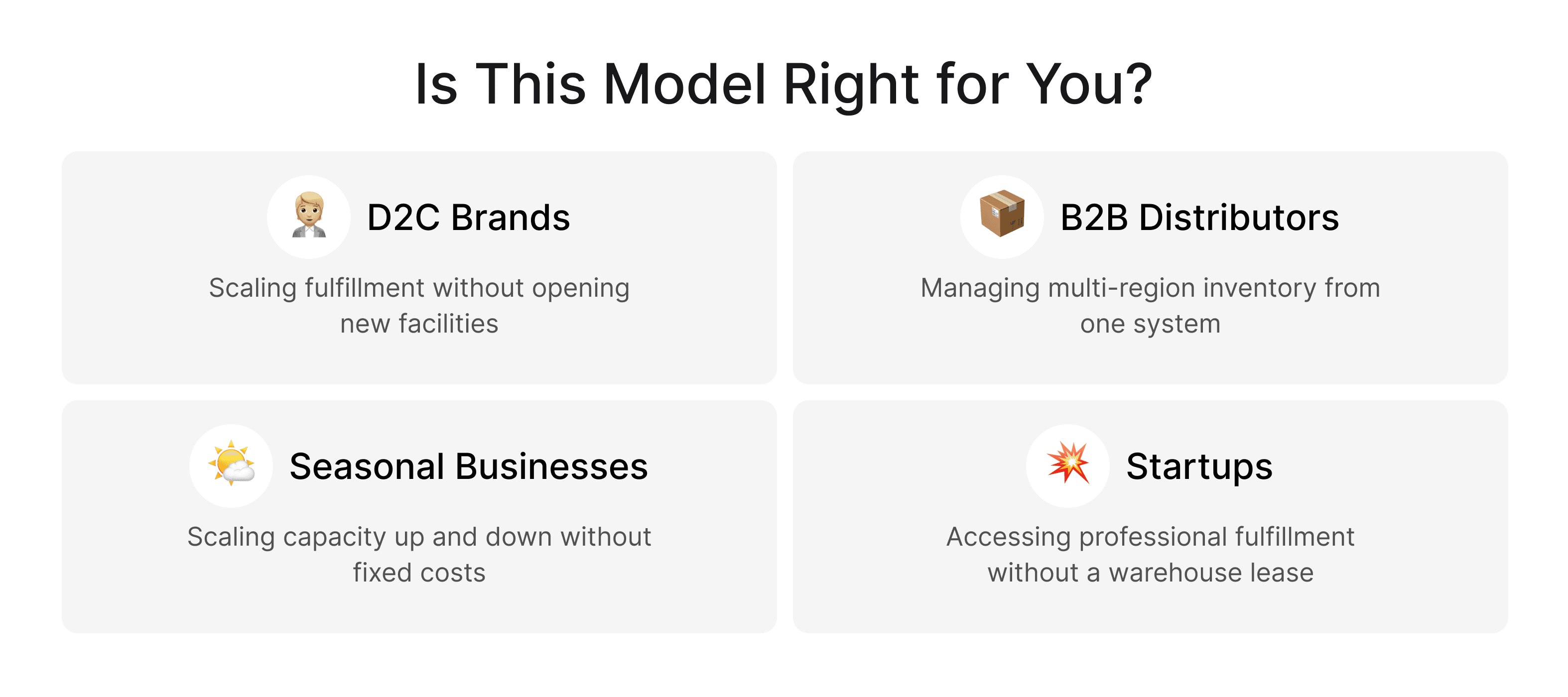
D2C and eCommerce brands scaling fulfillment
If you're a direct-to-consumer brand growing beyond a single warehouse's reach, a virtual warehouse lets you expand your fulfillment network without opening your own facilities. You get the geographic coverage; someone else handles the physical execution.
 Click to expand
B2B distributors with multi-region networks
For B2B distributors managing large SKU catalogs across multiple regions, this setup provides the inventory visibility and order-routing logic that make multi-region operations manageable. Understanding how to enhance ETA in logistics becomes much easier when you have a centralized system routing based on real-time data.
Seasonal businesses with fluctuating inventory demand
If your demand swings dramatically by season — think outdoor gear, holiday gifts, garden supplies — this model lets you scale fulfillment capacity up and down without carrying fixed costs year-round. Pay for what you use, when you use it.
Startups that can't afford physical warehouse space
For early-stage businesses, this is often the only viable path to professional fulfillment. You don't need to sign a multi-year lease or hire a warehouse team. You plug into existing 3PL infrastructure and focus your resources on product and growth.
Virtual Reality Warehouse vs. Virtual Data Warehouse: Don't Confuse Them
Quick clarification: these are completely different things, and it's worth clarifying the distinction.
A virtual reality warehouse refers to the use of VR technology in physical warehouse operations — think AR-assisted picking, spatial training simulations, or digital twin environments for layout planning. It's an emerging area with genuinely interesting use cases, but it has nothing to do with the distributed inventory model we've been discussing.
A virtual data warehouse is a data architecture concept where information from multiple sources is integrated and queried in real time without being physically consolidated in a single location. It's a business intelligence and analytics term, not a logistics one.
And then there's the Snowflake definition: in Snowflake's platform, a virtual data warehouse is a compute cluster that processes queries independently from the storage layer. If you're coming from a data engineering background, that context is entirely separate from everything discussed here.
So: virtual data warehousing = BI/analytics architecture. Virtual reality warehouse = VR in physical operations. And the model covered in this guide = distributed inventory management through software. Don't let the terminology mix you up.
How to Transition to a Virtual Warehousing Model
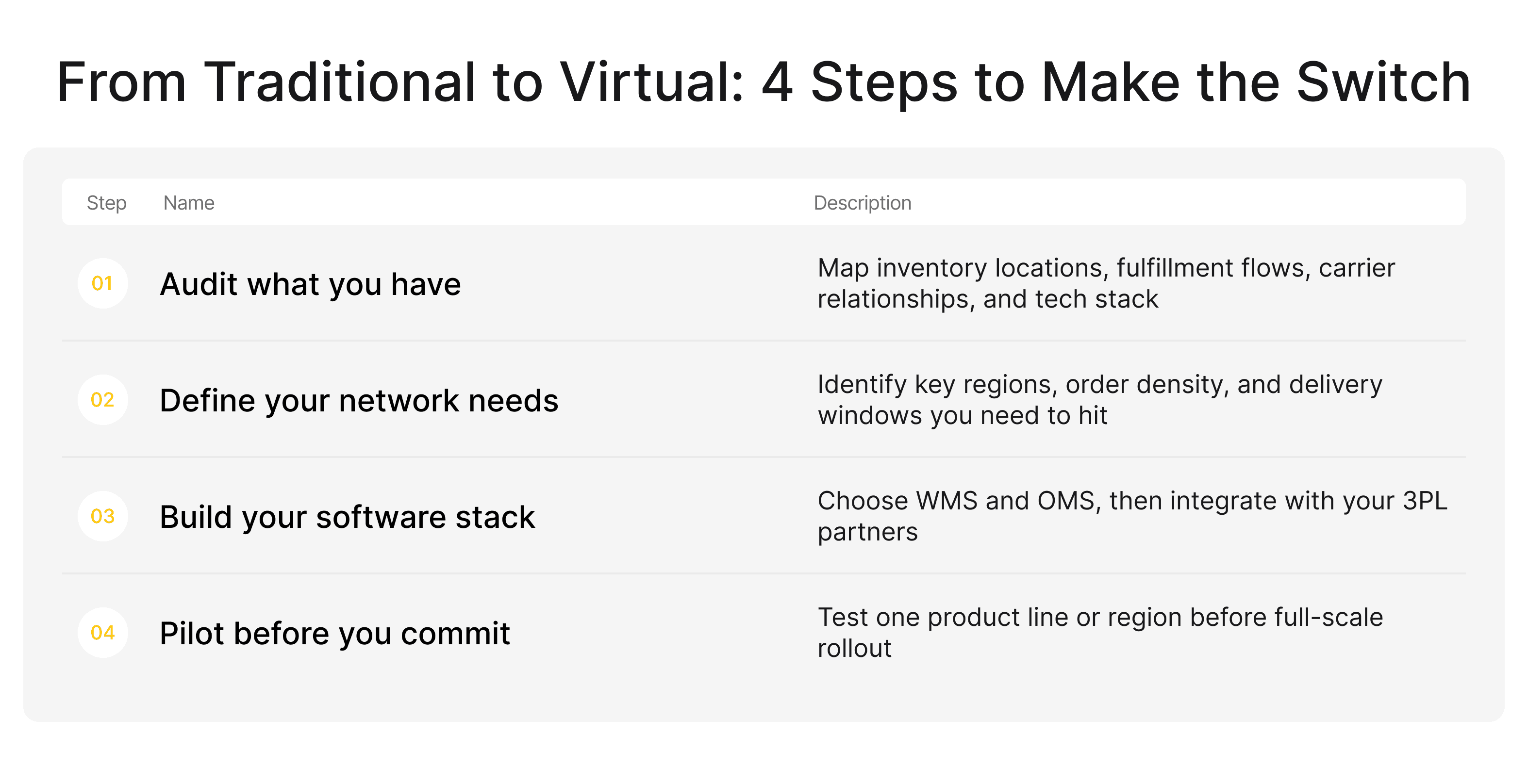
Audit your current warehousing setup.
Map your inventory locations, fulfillment flows, carrier relationships, and tech stack. You need to know where the gaps are before you can design something better.
Define your fulfillment network requirements.
Where are your customers? Which regions have the highest order density? What delivery windows do you need to hit? These answers drive your 3PL selection and node distribution.
 Click to expand
Select and integrate your software stack.
Choose your WMS and OMS, then build the integrations between your systems and 3PL partners. If you need custom integrations or workflows, a development partner like Incora can save you significant time and technical debt.
Run a pilot before full-scale rollout.
Start with one product line or one region. Stress-test the system, surface failures, and train your team before you're fully dependent on the new model.
KPIs to track after go-live
Once you're live, measure what matters:
- Order cycle time (order placed to shipment confirmation)
- Inventory accuracy rate across all nodes
- Fill rate and stockout frequency
- Fulfillment cost per order
- On-time delivery rate by fulfillment node
Final Takeaway
A virtual warehouse is one of those concepts that sounds abstract until you see the numbers. Businesses that make the shift thoughtfully — with the right tech stack, the right 3PL partners, and a proper implementation process — regularly report lower fulfillment costs, faster delivery times, and greater inventory visibility than they could get from a traditional setup.
Bottom line: if you're growing and your current setup is creating friction instead of enabling scale, this model is worth a serious look. The technology is mature. The partner ecosystem is wide. The main variable is execution — and that's entirely in your control.
FAQ
What is the difference between a virtual warehouse and a 3PL?
A 3PL handles the physical side: warehousing, picking, shipping. A virtual warehouse is the software layer that orchestrates one or many 3PL providers as fulfillment nodes.
Is virtual warehousing suitable for small businesses?
Yes. If you've been asking what is virtual warehouse and whether it works without owning infrastructure, it does. Just make sure the software you choose doesn't penalize low order volumes.
What is virtual data warehousing?
Virtual data warehousing is a BI architecture concept in which data from multiple sources is queryable through a single layer without being physically consolidated.
How does a virtual warehouse differ from a cloud warehouse?
A cloud warehouse, also called a virtual data warehouse in data engineering, is an analytics platform such as Snowflake, BigQuery, or Redshift designed for BI query processing, not inventory management. Different domains, similar-sounding names.
What is a virtual warehouse in Snowflake?
In Snowflake, a virtual warehouse is a compute cluster that runs SQL queries independently from the storage layer. Entirely unrelated to logistics — it's a database architecture term specific to Snowflake's platform.


YOU MAY ALSO LIKE


Get in Touch
Got no clue where to start? Why don't we discuss your ideas?

