



By Bohdan Vasylkiv
- CEO & Co-Founder
Warehouse Automation Trends 2026 You Need to Know
Discover the top warehouse automation trends for 2026: AI, robotics, autonomous vehicles, and data-driven systems reshaping how modern warehouses operate.
Key Takeaways
- AI and robotics have moved from pilot projects to everyday warehouse operations.
- Automating your data now matters as much as the physical robots on your floor.
- Automation-as-a-Service is putting advanced tech within reach of mid-market companies.
- Success depends on integration, flexibility, and a prepared workforce, not just hardware.
Walk into a modern warehouse today, and it feels like a different world. Robots move quietly between the racks. Software flags a demand spike before it hits. And the people on the floor are managing systems instead of pushing carts around all day.
That shift is happening fast, and it keeps accelerating. If you run fulfillment or distribution, the warehouse automation trends shaping this year are worth a close look. Early movers are pulling ahead, and the gap is getting harder to close. This guide keeps things simple: what is real, what is hype, and where your budget should actually go.
What Is Warehouse Automation and Why It's Accelerating in 2026
Warehouse automation means using technology to handle work that people used to do by hand. Think robots, sensors, and smart software picking, packing, sorting, moving goods, and tracking inventory. None of that is brand new on its own.
What has changed is the pace and the intelligence behind it. Rising labor costs, staffing shortages, and customers who expect next-day delivery have turned automation into a real survival requirement. That pressure is exactly why so many operators are studying warehouse automation trends 2026 more seriously than in any year before.
From Manual to Intelligent — a Brief Evolution
A while back, automation meant a conveyor belt and maybe a barcode scanner. Then warehouse management software arrived. Then, mobile robots. Now we have systems that genuinely learn from data.
The future of warehouse automation is really about intelligent systems that adapt, predict, and coordinate across the whole operation. That move from mechanical tools to connected, thinking systems is the story of the last decade, and it keeps speeding up.
Key Market Forces Driving Adoption Right Now
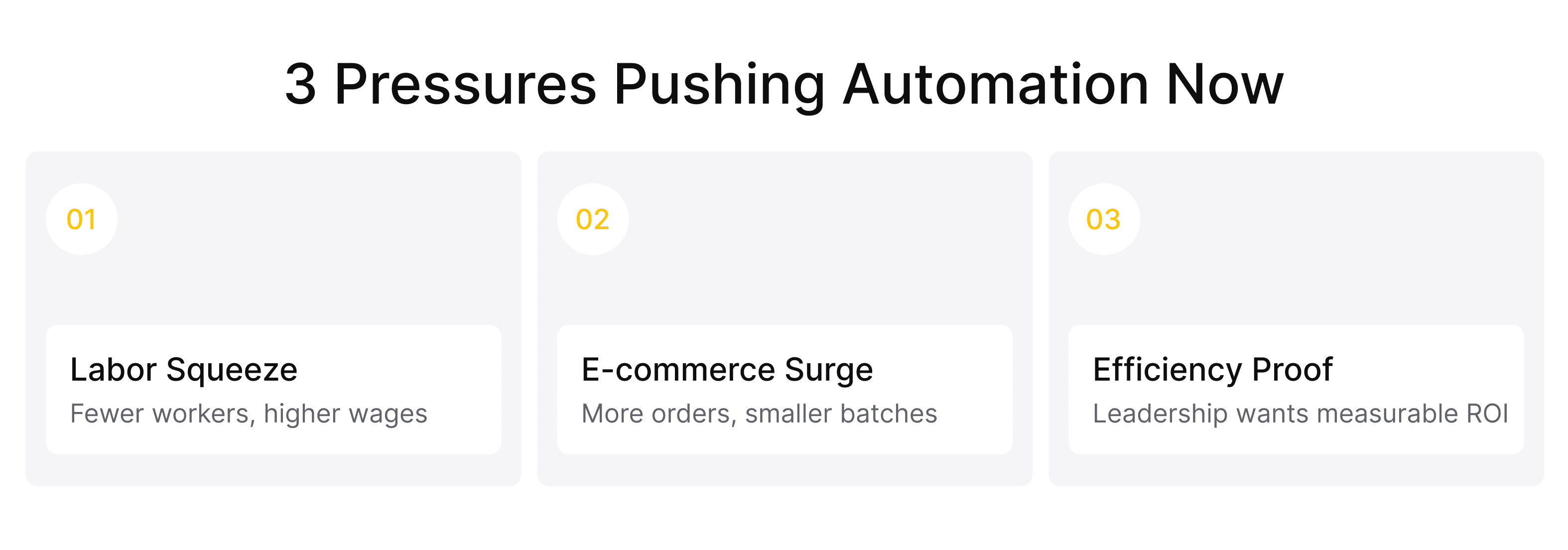
Several forces are pushing this forward at the same time. Labor is scarce and expensive. E-commerce keeps climbing, which means more orders in smaller batches. And leadership wants hard proof of efficiency before approving any budget.
 Click to expand
Look closely at the broader trends in warehouse automation, and they all trace back to these same pressures. Companies investing in supply chain software development tend to see automation pay off fastest when their systems talk to each other. Industry analysts report steady double-digit growth across the sector, and that momentum shows no sign of slowing.
Top Warehouse Automation Trends for 2026
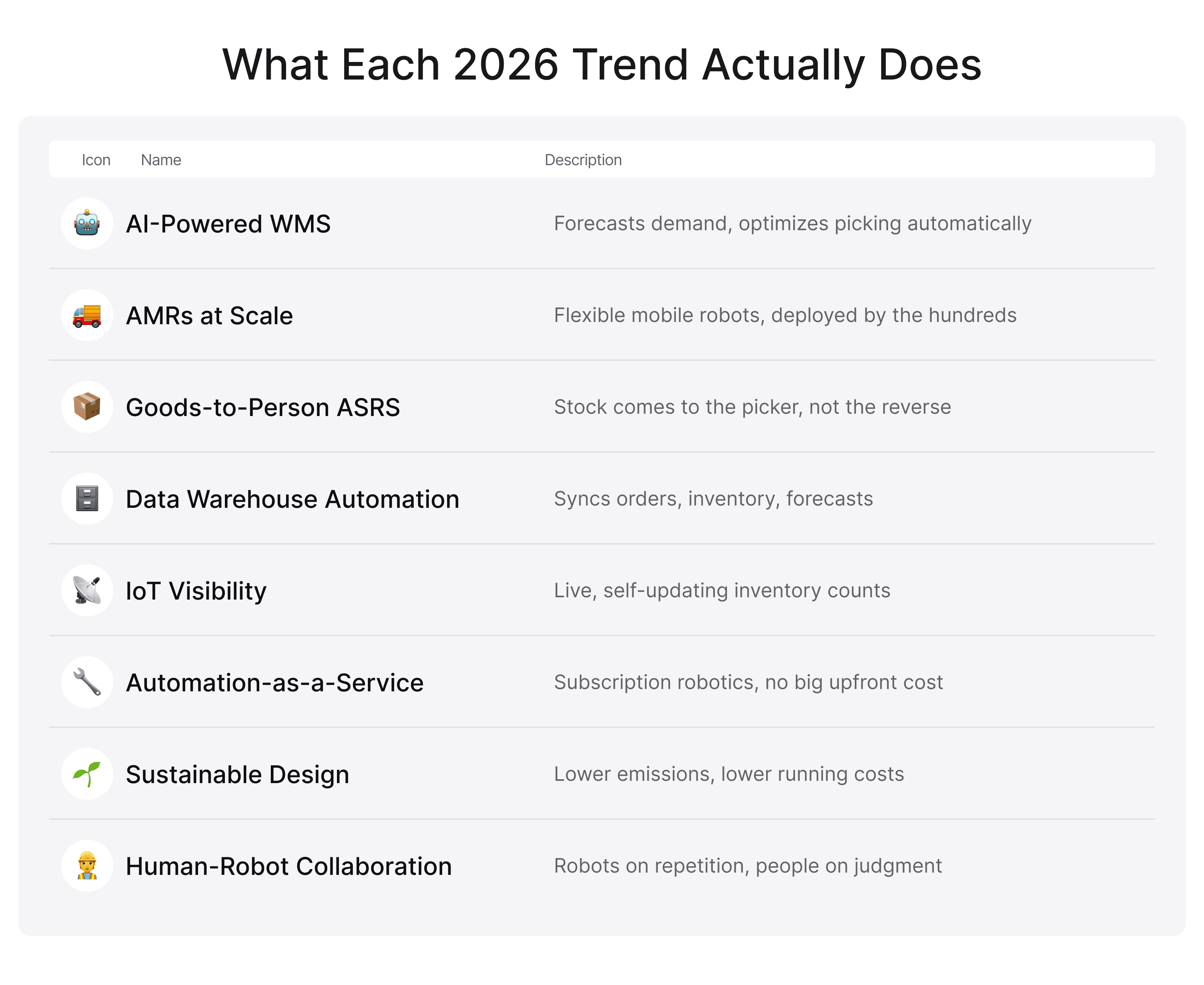
So what are the top trends in warehouse automation? Below are the 8 developments having the biggest real-world impact this year. Some you have heard about already. Others are quietly reshaping operations without the headlines. Together, they show where the industry is heading.
1. AI-Powered Warehouse Management Systems
AI has moved out of the pilot phase and into daily operations. Modern warehouse management systems now forecast demand, optimize pick paths, and rebalance inventory on their own.
Adopting AI warehouse automation means fewer stockouts, less wasted movement, and faster decisions. If you track only a handful of the latest trends in warehouse management, put smart WMS right at the top of that list.
2. Autonomous Mobile Robots (AMRs) at Scale
Autonomous Mobile Robots have gone from novelty to necessity. Unlike older fixed systems, AMRs navigate dynamically, avoid obstacles, and scale up during peak season without a floor redesign.
In 2026, they are being deployed by the hundreds in a single facility, working right alongside staff. That flexibility is a big reason mid-sized operators can finally afford serious automation. The warehouse automation market trends 2026 rank mobile robotics among the fastest-growing segments.
3. Goods-to-Person Fulfillment with ASRS
Automated Storage and Retrieval Systems flip the old model. Instead of workers walking to the shelves, the goods come to them.
This goods-to-person approach reduces travel time, improves pick accuracy, and delivers far higher throughput from the same square footage. With warehouse space more expensive than ever, ASRS is one of the clearest wins on the floor right now.
 Click to expand
4. Data Warehouse Automation and Predictive Analytics
Physical robots grab the attention, but the quiet revolution is in the data. Automating how information flows across orders, inventory, shipping, and forecasts eliminates manual reconciliation that slows everything down.
The rise of data warehouse automation trends shows that smart companies now treat clean, real-time data as core infrastructure. It has stopped being an afterthought.
5. IoT-Enabled Real-Time Inventory Visibility
Connected sensors give operators something they have always wanted: a live, accurate picture of every item, pallet, and vehicle.
Investing in IoT in warehouse management means inventory counts update themselves, misplaced stock gets flagged instantly, and equipment reports trouble before it breaks down. Real-time visibility is quickly becoming the baseline expectation.
6. Automation-as-a-Service (AaaS) for Mid-Market
Automation used to require huge upfront capital, which locked out smaller players. Automation-as-a-Service changes that with subscription and pay-per-use models.
You can scale robots and software up or down as demand shifts. This is one of the trends shaping warehouse automation for companies that could never justify a seven-figure install, and it is opening the market wide.
7. Sustainable and Energy-Efficient Warehouse Design
Sustainability has grown from a PR line into a real design principle. Energy-efficient lighting, regenerative braking in robots, smarter climate control, and route optimization all cut emissions and operating costs simultaneously.
In 2026, greener warehouses are simply cheaper to run, and customers keep asking about them. Sustainability now sits firmly among the warehouse automation technology trends that boards actually track.
8. Human-Robot Collaboration and Workforce Upskilling
The smartest operators have stopped chasing fully unmanned, lights-out facilities. They build teams where robots handle the repetitive, physically punishing tasks while people handle judgment, exceptions, and oversight.
That means upskilling your workforce to manage and troubleshoot automated systems, which pays back in both retention and productivity. Of all the current warehouse automation trends, this human-plus-machine balance may be the most underrated.
Technologies Behind the Trends: What's Actually Being Deployed
Trends are only as good as the technology behind them. Here is what is actually being installed on warehouse floors right now, and where a specialized partner earns its keep.
Teams like Incora build custom solutions that tie these pieces together, so you avoid bolting mismatched tools onto old infrastructure. Getting a handle on the warehouse automation technology trends underneath the hype helps you invest wisely.
Robotics and Cobots on the Warehouse Floor
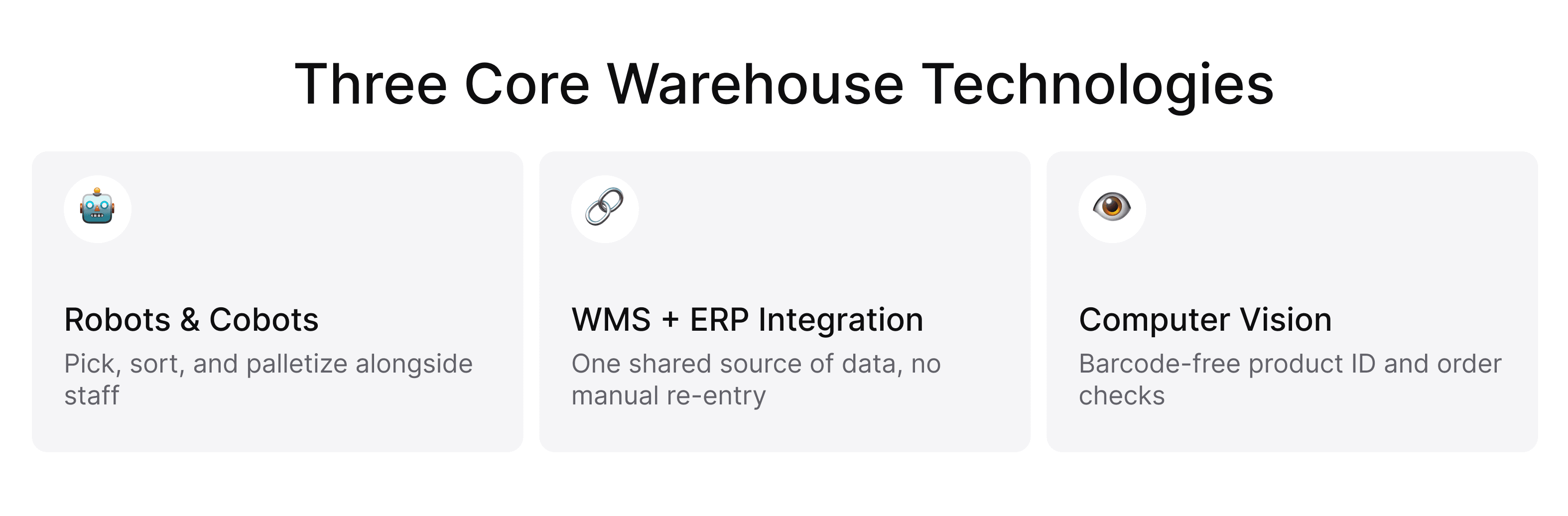
Collaborative robots, or cobots, are built to work safely beside humans without cages. They pick, sort, palletize, and pack, taking the strain off workers while keeping people in the loop.
Cobots are cheaper and faster to deploy than traditional industrial robots. That is a big part of why adoption keeps climbing across facilities of every size.
 Click to expand
WMS and ERP Integration as the Digital Backbone
Software is the nervous system of an automated warehouse. When your WMS and ERP share data cleanly, orders flow without manual re-entry, and every team works from the same numbers.
Good integration is what separates a genuinely smart warehouse from a pile of disconnected gadgets. This is where many of the deeper trends in warehouse automation actually live.
Computer Vision and Barcode-Free Identification
Cameras paired with AI can now identify products without a single barcode. Computer vision reads dimensions, spots damage, verifies orders, and tracks items as they move, faster and more reliably than manual scanning.
It is a quiet shift with a big payoff, cutting errors and speeding up almost every step on the floor. It also shows how far warehouse automation technology has come in just a few years.
Data Warehouse Automation: The Often-Overlooked Trend
Ask most people about warehouse automation, and they picture robots. But some of the biggest gains this year come from automating data instead of movement.
When your data pipelines run themselves, your physical automation finally gets the accurate inputs it needs to perform. This is where many of the warehouse automation industry trends for 2026 quietly come together.
Why Data Flows Matter as Much as Physical Automation
A robot is only as smart as the data feeding it. If your inventory numbers are stale or your forecasts are off, automating the physical layer just helps you make mistakes faster.
Getting data flows right, meaning clean, real-time, and connected, is often the highest-leverage move you can make. Many teams choose to hire data engineers to build reliable pipelines before scaling any hardware.
 Click to expand
How Analytics Layers Are Reshaping Inventory Decisions
Modern analytics layers turn raw warehouse data into decisions. When to reorder, where to position stock, and how to staff for a spike.
Predictive models catch demand shifts early, so you are never caught flat-footed. Following the warehouse automation trends here means treating analytics as an active decision engine, not a monthly report nobody opens.
Challenges Companies Face When Scaling Warehouse Automation
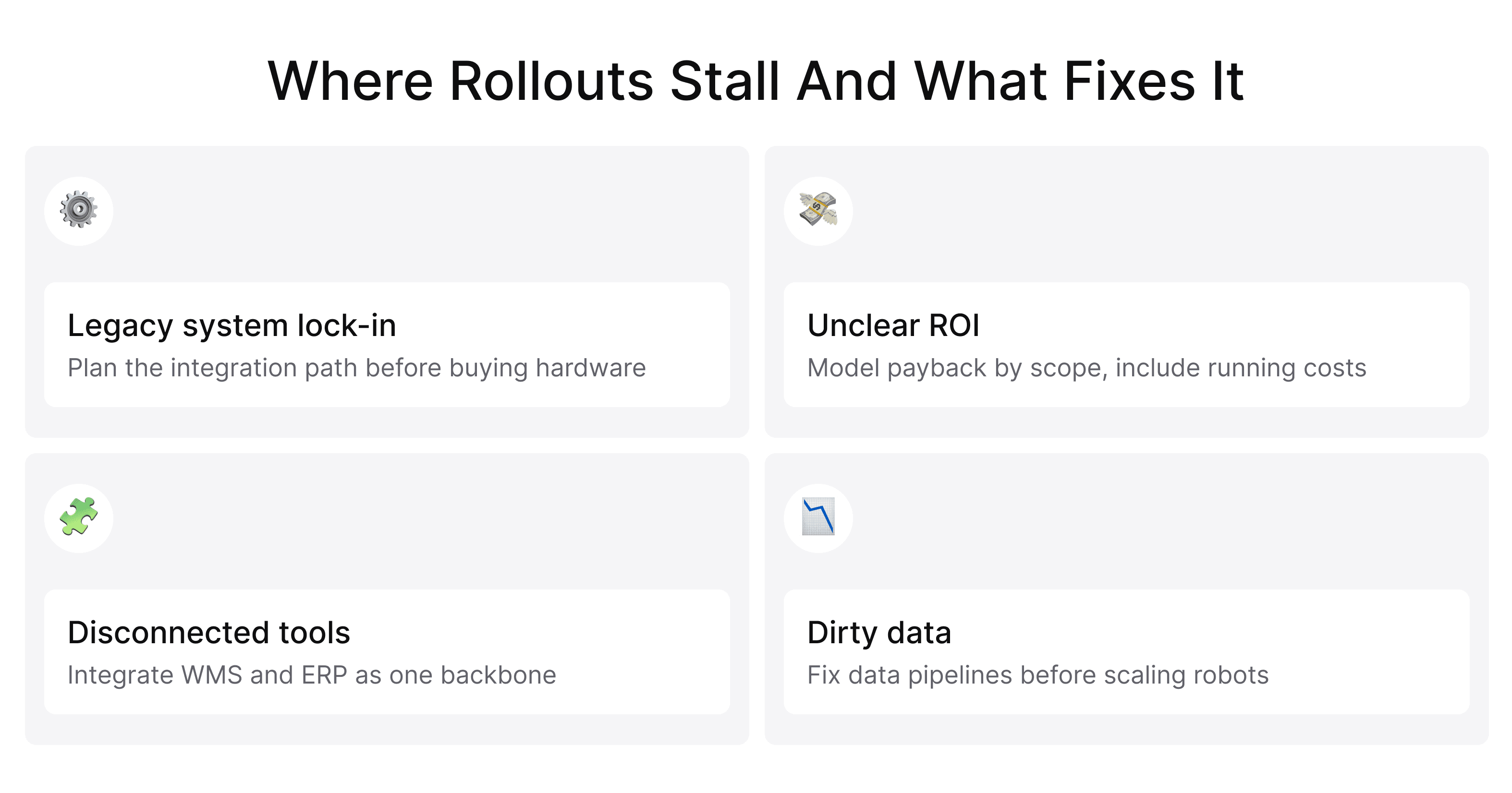
None of this is plug-and-play. Scaling automation comes with real obstacles, and pretending otherwise sets you up to fail. Understanding the warehouse automation trends is the easy part. Deploying them at scale is where companies stumble, usually for one of two reasons.
Integration Complexity and Legacy System Lock-In
Legacy systems are the usual culprit. Older WMS platforms, custom-built tools, and aging hardware often resist modern automation, and forcing them together gets expensive and fragile.
 Click to expand
This is especially common in [manufacturing IT services (https://incora.software/industries/manufacturing-it-services) environments, where equipment can be decades old. Planning your integration path up front, before you buy the robots, saves enormous pain later.
ROI Justification and Payback Period Expectations
Leadership will ask when the investment pays back, and you need a credible answer. Payback periods vary widely. A simple cobot deployment might return value in a year, while a full ASRS overhaul can take 3 to 5.
When you weigh warehouse automation technology trends against your own volumes, be honest about the ongoing costs. Maintenance, software, and training all matter, not just the sticker price.
How to Future-Proof Your Warehouse Automation Strategy
Technology keeps changing, so chasing the perfect system today is a losing game. Aim for a foundation that adapts instead. Here is how to stay ahead as the warehouse automation trends 2026 give way to whatever comes next.
Building for Flexibility, Not Just Efficiency
Chase flexibility over raw efficiency. A slightly less-optimized system that adapts to new products, volumes, and channels will outlast a hyper-tuned one that breaks down the moment conditions change.
Modular hardware and open software standards let you swap and expand pieces without ripping everything out. The future of warehouse automation rewards operations built to evolve.
Choosing the Right Technology Partner
The right technology partner matters as much as the technology itself. Look for a team that understands both the software and the messy reality of your floor, and that will not lock you into proprietary dead ends.
Strong AI automation services can help you prioritize, integrate, and scale without wasting budget on tools you will outgrow in a year. Watching the trends shaping warehouse automation with a good partner beats chasing them on your own.
Not sure where to start with warehouse automation?
We can help you figure out what's actually slowing you down and what to build first.
Final Thoughts
The takeaway for 2026 is simple. Automation is no longer optional for serious warehouse operators. The warehouse automation trends covered here are already live on real floors: smarter WMS, mobile robots, goods-to-person systems, automated data, IoT visibility, flexible service models, greener design, and human-robot teamwork.
Still, resist automating for its own sake. Start with your biggest bottleneck. Get your data foundation solid. Build in the flexibility to adapt.
The operators who win will be those who choose and integrate the right robots with care, rather than those who simply buy the most.
FAQ
What are the biggest warehouse automation trends in 2026?
The biggest warehouse automation trends 2026 are AI-driven warehouse management systems, autonomous mobile robots at scale, goods-to-person ASRS, and automated data pipelines. Prioritize the one that fixes your main bottleneck, usually labor pressure or inventory accuracy.
How does data warehouse automation differ from physical automation?
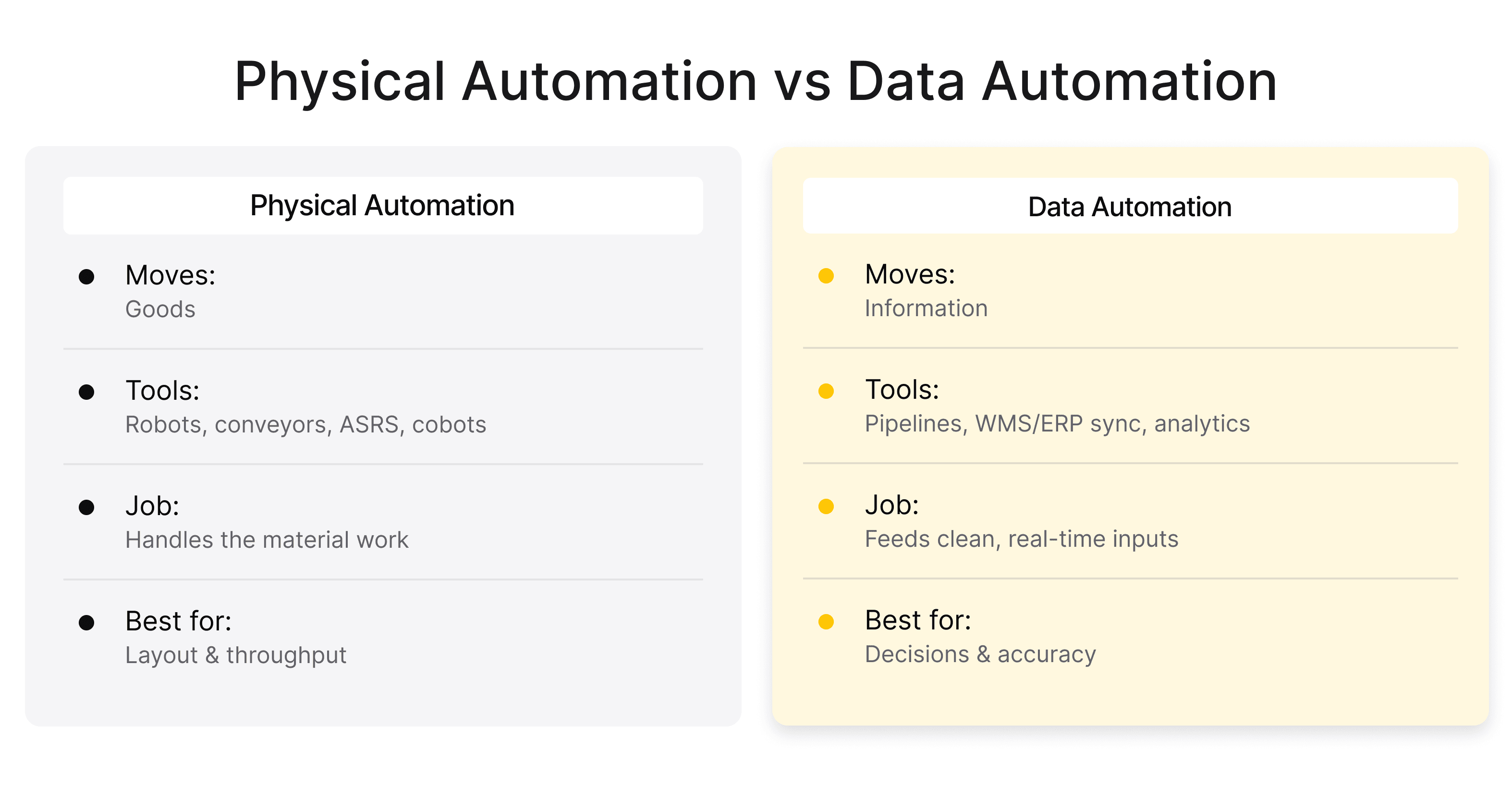
Physical automation moves goods; data automation moves information. The data warehouse automation trends reshaping 2026 focus on automatically syncing orders, inventory, and forecasts across systems, while robots and conveyors handle the manual work. You need both, since automation only performs well on clean, real-time data.
What is the ROI timeline for warehouse automation investments?
Most warehouse automation pays for itself in 1 to 5 years. A modest cobot or AMR rollout often returns value within 12 to 18 months, while a full ASRS or facility overhaul takes 3 to 5 years. Include software, maintenance, and training in the math.
Are warehouse automation solutions suitable for small and mid-sized businesses?
Yes. Automation-as-a-Service and modular robotics have removed the high upfront cost that once shut out smaller players. Many warehouse automation technology trends in 2026 target flexible, scalable, pay-as-you-go deployments built for mid-market budgets.
How can companies prepare their workforce for automated warehouses?
Focus on training and clear communication. Explain that automation takes over repetitive, physical tasks so staff can shift into oversight, exception-handling, and technical roles. Reskilling and defined career paths keep the latest trends in warehouse management working for your people, not against them.


YOU MAY ALSO LIKE



Get in Touch
Got no clue where to start? Why don't we discuss your ideas?

