



By Bohdan Vasylkiv
- CEO & Co-Founder
Supply Chain Business Intelligence: A Practical Guide for Logistics & Operations Teams
Explore how business intelligence in supply chain management improves logistics visibility, forecasting, and real-time decisions. Learn key tools and steps.
Key Takeaways
- Supply chain business intelligence turns raw logistics data into decisions your team can act on immediately.
- Real-time visibility across inventory, warehousing, and transport reduces costly blind spots.
- BI implementation works best when it connects ERP, WMS, and TMS into a single data layer.
- Teams that track the right KPIs gain a measurable competitive edge.
Modern supply chains generate enormous volumes of data every day — shipment statuses, inventory counts, supplier lead times, and carrier performance scores. The problem isn't a shortage of information. It's that most of it sits in disconnected systems and is reviewed too late to make any changes.
That's exactly where supply chain business intelligence steps in. When operations teams get a clear, unified view of what's happening across their supply chain, the decisions they make about inventory, vendors, and routing improve measurably.
This guide is written for logistics managers, operations leads, and anyone who's ever stared at a spreadsheet export and thought: there has to be a better way.
What Is Business Intelligence in Supply Chain Management?
Business intelligence in supply chain management means collecting data from across your operations — purchasing, warehousing, transport, and fulfillment — and transforming it into structured, visual, and actionable insights. A report tells you what happened. A proper BI system tells you why it happened, where the pattern is, and what's likely to happen next. That distinction matters enormously when you're managing hundreds of SKUs, dozens of suppliers, and tight SLA commitments.
 Click to expand
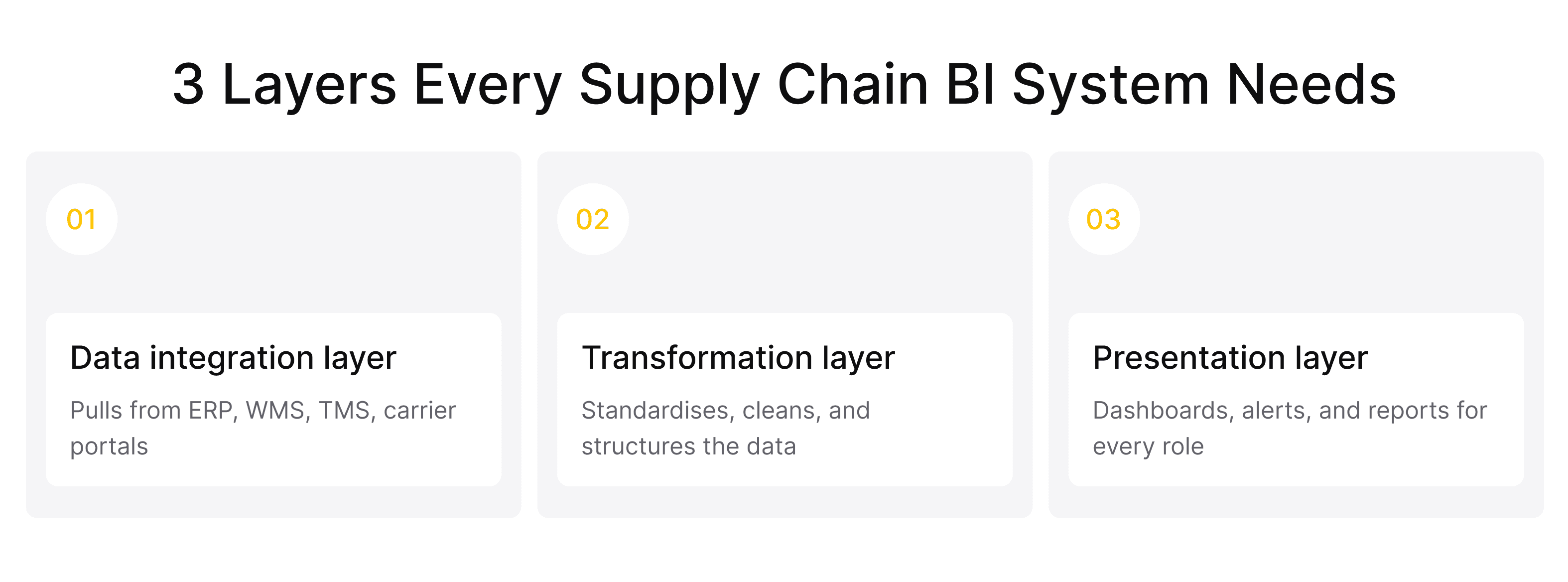
It typically involves 3 core components: a data integration layer that pulls from your existing systems, a transformation layer that standardizes everything, and a presentation layer — dashboards, alerts, reports — that surfaces insights for different roles. Simply put: you're replacing gut feel with evidence.
Key Business Intelligence Capabilities for Supply Chain Teams
Real-time visibility across logistics and warehousing
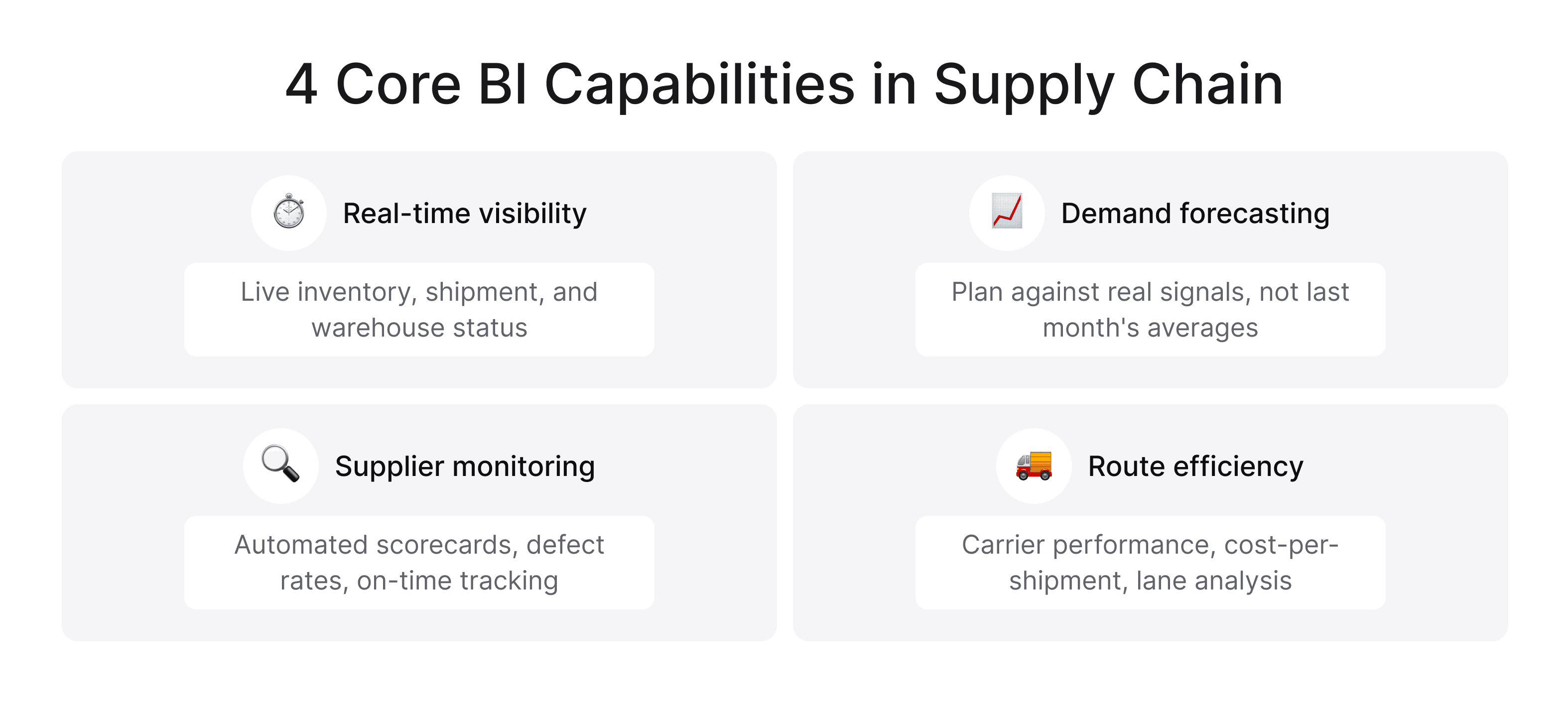
One of the most immediate wins from logistics business intelligence is simply knowing what's happening right now. Where is that shipment? How many units are actually on-shelf? Is the warehouse picking pace on track for today's dispatch window?
Real time business intelligence in supply chain analytics makes this possible by pulling live feeds from your WMS, carrier APIs, and IoT sensors into one view. No end-of-day reports. This also shapes how you design operational analytics dashboards — the right layout determines whether your team uses them or ignores them.
Demand forecasting and inventory optimization
Overstocking ties up capital. Understocking kills customer experience. Business intelligence for supply chain teams helps you walk that line more precisely by feeding historical sales data, seasonal patterns, and external signals into forecasting models.
Instead of ordering based on last month's averages, your team can plan against more sophisticated demand signals — promotional calendars, regional trends, and supplier lead time variability. The result is inventory that's leaner, better positioned, and less prone to expensive corrections.
Supplier performance monitoring and risk signals
Most companies track supplier performance inconsistently. Business intelligence in logistics fixes this with continuous, automated scorecards — on-time delivery, defect rate, fill accuracy. When a supplier starts slipping, you see it before it becomes a crisis, not after.
 Click to expand
That's the difference between reactive vendor management and a proactive supply chain software development strategy built around real signals.
Transportation and route efficiency analysis
Logistics transportation business intelligence brings carrier performance data, route analytics, and cost-per-shipment breakdowns into one place — rather than scattered across three platforms and a shared inbox. Your transport team gets the data to make better carrier selections and model the cost impact of different fulfillment scenarios.
Where Supply Chain Business Intelligence Creates Measurable Impact
Procurement and vendor management
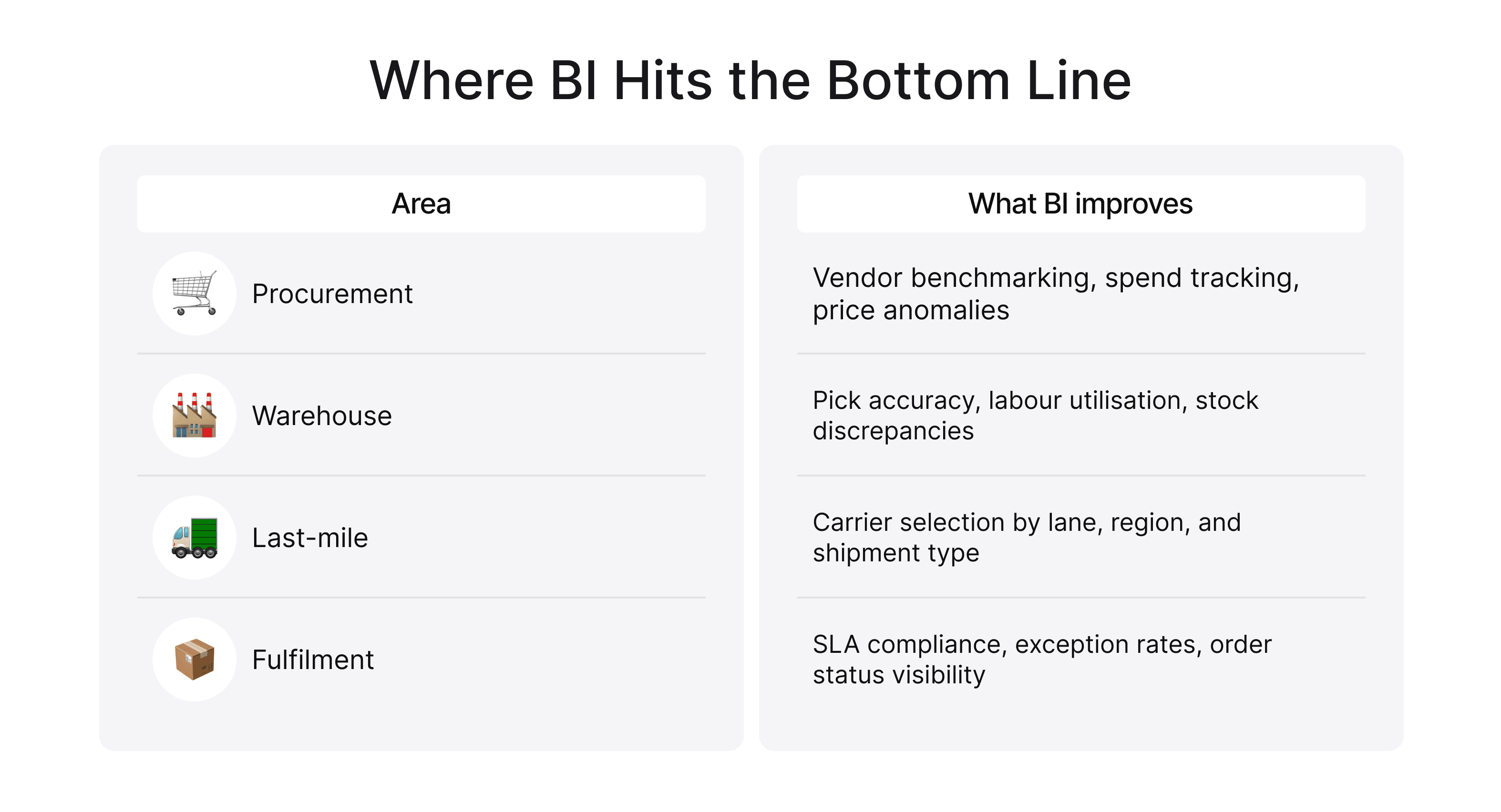
Procurement teams using supply chain business intelligence tools can benchmark vendors, spot price anomalies across contracts, and track spend by category in real time. This gives negotiators actual leverage and gives managers early warning when costs are drifting in the wrong direction.
Business intelligence in logistics industry adds another layer here: when you can see supplier performance data alongside procurement spend, you stop making decisions based on price alone and start factoring in reliability, lead time consistency, and risk exposure.
Warehouse operations and stock control
Warehouse BI dashboards track pick accuracy, labor utilization, dock-to-stock times, and stock discrepancies. For high-volume operations, even a 2–3% improvement in pick accuracy adds up fast.
Business intelligence supply chain data also helps identify which warehouse zones consistently underperform and gives you the context to understand why, rather than just chasing symptoms.
 Click to expand
Last-mile delivery and carrier selection
Last-mile is expensive, and it's where customer experience is made or broken. Business intelligence in transport and logistics helps you evaluate carrier performance by lane, region, and shipment type, so carrier selection decisions are based on actual data rather than long-standing preferences or a salesperson's promises.
Teams that embed this into their AI integration in business workflows can go further, modeling likely delivery outcomes before the shipment even leaves the warehouse.
Customer order fulfilment and SLA compliance
Business intelligence logistics gives customer service and operations teams a shared view of order status, exception rates, and SLA performance by customer segment. When a key account's on-time delivery rate starts dropping, you catch it before they call you. Ask any ops lead, and they'll tell you that matters more than almost anything else.
Supply Chain BI Metrics and KPIs Worth Tracking
Inventory turnover, fill rate, and carrying cost
These three metrics together tell the story of your inventory health. Turnover shows how efficiently the stock is moving. Fill rate shows whether you're meeting demand when it arrives. Carrying cost shows what that inventory is actually costing you to hold.
Business intelligence in logistics industry platforms should surface all three automatically, segmented by SKU, category, or location — not buried in a monthly report that nobody reads until it's too late to act.
On-time delivery rate and lead time variance
On-time delivery is the obvious metric. But lead time variance is often more useful — it shows how predictable your supply chain actually is. A supplier with an average lead time of 7 days looks very different from one with an average lead time between 4 and 12 days.
Tracking this variance continuously flags suppliers whose reliability is deteriorating before it causes disruption. This is also where real time business intelligence in supply chain analytics earns its place — static weekly reports simply can't catch a drift that's happening day by day.
Not sure where to start?
We can help you figure out what's actually slowing you down and what to build first.
Supplier reliability score and defect rate
Supplier reliability scores combine multiple signals — on-time rate, documentation accuracy, defect rate, and response time for exceptions — into a single, comparable metric. For teams managing 50+ suppliers, logistics business intelligence software that automates this scoring saves significant manual effort and creates a far more defensible basis for vendor decisions.
The data your dedicated software developers connect to these scoring systems matters too — the more sources feeding the model, the more accurate the picture.
How to Build a Business Intelligence System for Supply Chain
Building a BI system for the supply chain is better understood as a layered capability you develop over time. Here's a realistic roadmap.
Step 1 — Audit your data sources
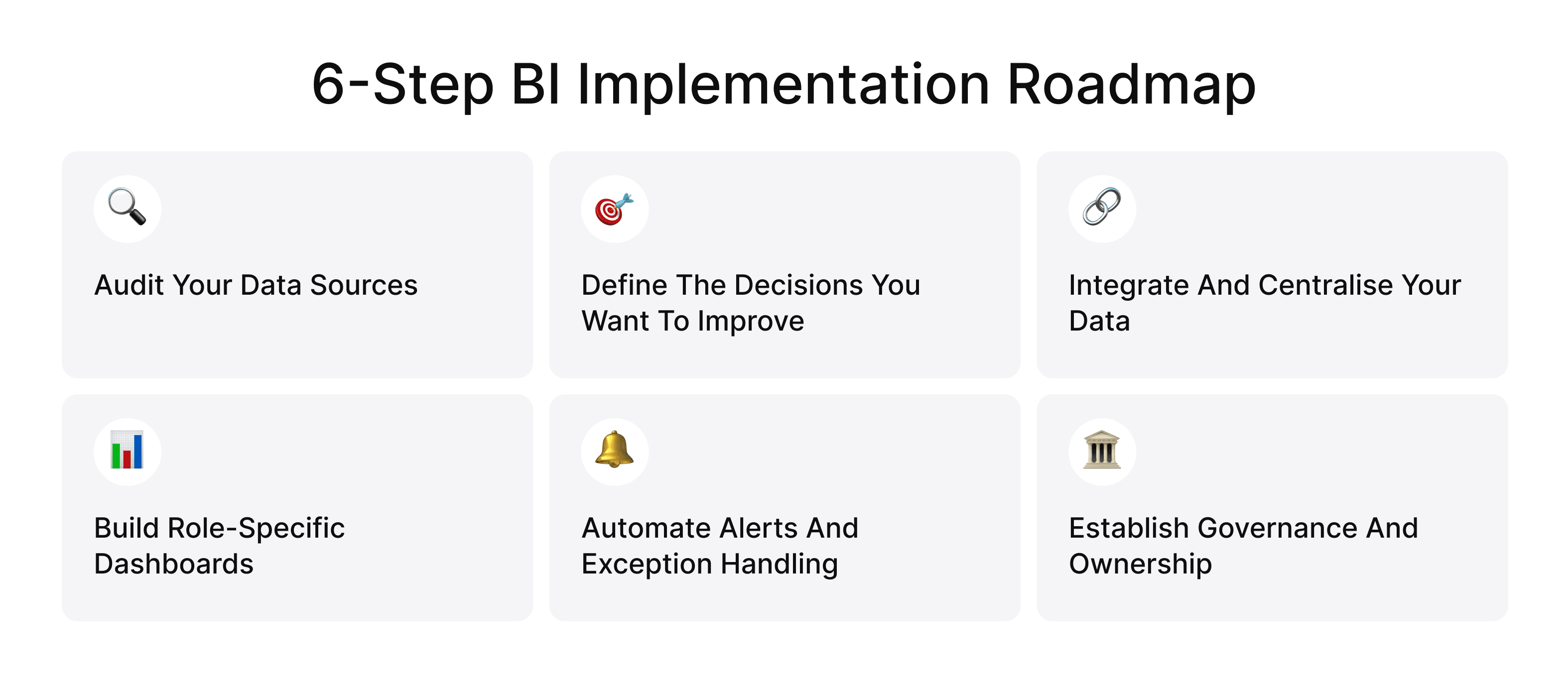
Map where your data actually lives. ERP, WMS, TMS, carrier portals, spreadsheets — list them all, understand what each contains, and identify the gaps. You'll likely find that the same concepts are defined differently across systems.
Step 2 — Define the decisions you want to improve
What questions do your managers ask that currently take hours to answer? What weekly reports does nobody fully trust? Start there. Business intelligence supply chain management implementations that skip this step tend to end up with dashboards that look impressive and get ignored.
Step 3 — Integrate and centralise your data
You need pipelines that pull data from multiple systems, standardize it, and store it in a location your BI tools can query reliably. Teams working with cloud infrastructure engineers can design this layer to scale without becoming a maintenance burden as data volumes grow.
 Click to expand
Step 4 — Build role-specific dashboards
A warehouse manager and a CFO need very different views of the same underlying data. Design for the specific decisions each role needs to make, and test with real users rather than just IT stakeholders.
Step 5 — Automate alerts and exception handling
Dashboards are passive. Alerts are active. Configure your BI system to notify the right people when thresholds are crossed — a shipment overdue, a defect rate spiking, or inventory dropping below safety stock. This is where supply chain management business intelligence starts delivering value in daily operations rather than just in weekly reviews.
Step 6 — Establish governance and ownership
Someone needs to own the data definitions, maintain the pipelines, and manage access. Without this, BI systems drift — definitions change, dashboards go stale, and teams stop trusting the numbers.
Teams that want custom-built solutions often partner with companies like Incora, which build custom supply chain software designed around specific operational workflows rather than generic platform features. For the infrastructure layer, a well-designed scalable analytics infrastructure means your BI system won't buckle the moment data volumes increase or new sources need connecting.
Common Challenges When Implementing BI in Logistics and How to Solve Them
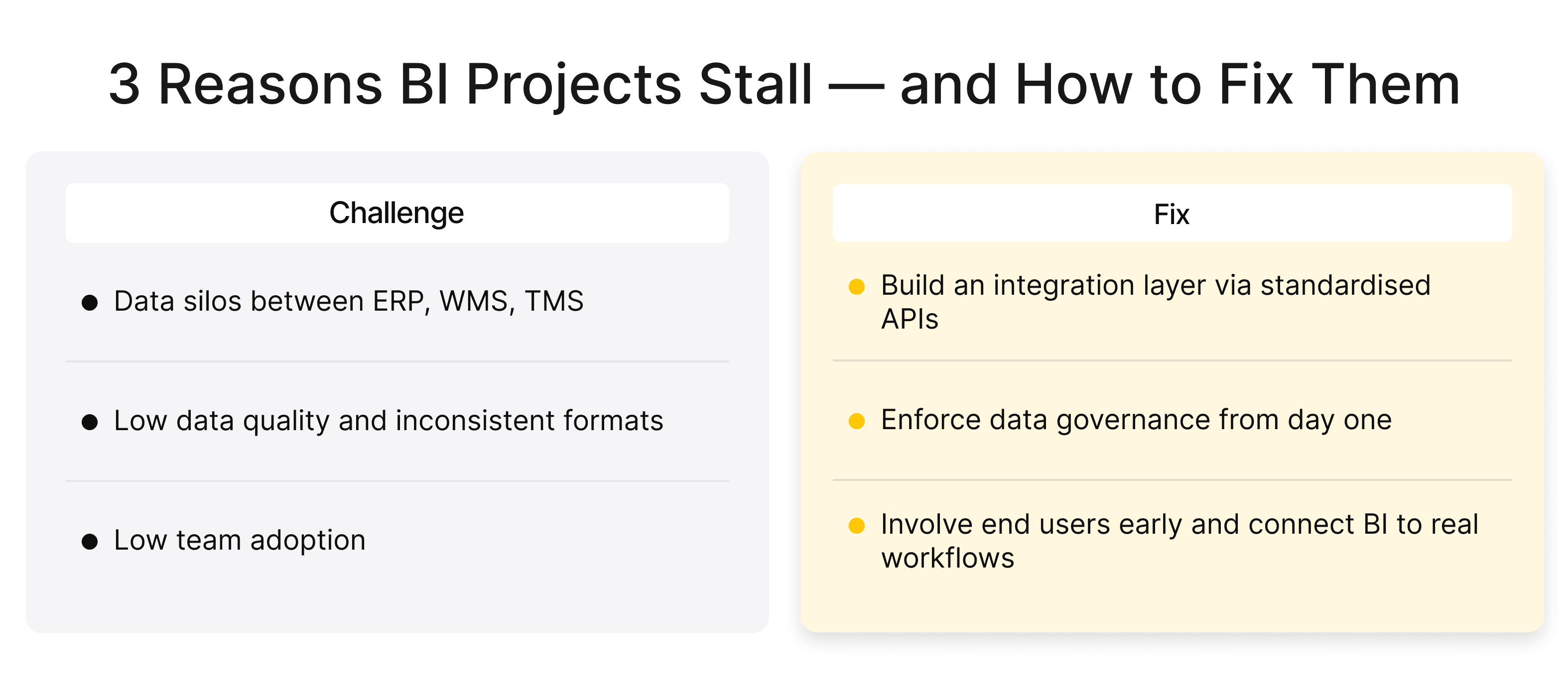
Data silos between ERP, WMS, and TMS systems
This is the most common blocker. Your ERP tracks financials and purchasing. Your WMS tracks inventory movements. Your TMS tracks shipments. Each system has its own data model and its own quirks.
Business intelligence in supply chain only works well when you bridge these silos, which means building integration middleware that keeps data flows clean and consistent. The solution is rarely a full system replacement — often it's an integration layer that lets existing systems communicate through standardized APIs.
Business intelligence logistics teams that take this route typically get to a working integration faster and with less disruption to ongoing operations.
Low data quality and inconsistent reporting formats
Even once you've connected your systems, you'll find that the same data means different things in different places. Fixing this requires proper data governance: agreed definitions, quality checks at ingestion, and a clear audit trail. It's not glamorous work, but it's the foundation on which everything else sits. Skipping it is the single most common reason BI projects fail to deliver.
Team adoption and change management
You can build a technically excellent BI system and have it ignored within three months. If the dashboards don't reflect how your team actually works, if the metrics aren't the ones people are accountable for, if training is a one-time event rather than an ongoing process, adoption collapses.
 Click to expand
Supply chain business intelligence delivers value only when people actually use it. The fix involves end users earlier in the design process, connecting BI outputs to real workflows, and building the habit of data-driven review into regular team rhythms.
Final Thoughts: Turning Supply Chain Data Into a Competitive Advantage
BI capability in the supply chain is an operational maturity play. The companies that get the most value from it aren't necessarily the ones with the most sophisticated tools. They're the ones who've clearly defined the decisions they want to improve, built systems that surface the right data at the right time, and created a culture where those insights are actually used.
The data your supply chain generates every day is already an asset. When done well, business intelligence for supply chain turns operational data into a genuine source of competitive advantage — one that compounds over time as your models improve, your data quality rises, and your team builds the habit of making decisions based on evidence.
FAQ
What is the role of business intelligence in supply chain management?
Business intelligence in supply chain management provides teams with structured, real-time insight into procurement, inventory, logistics, and fulfillment performance. It replaces manual reporting with automated data pipelines and visual dashboards, enabling faster, more accurate decision-making across the entire operation.
How does BI improve inventory management and demand forecasting?
By integrating sales history, supplier data, and demand signals into a unified model, BI platforms help teams forecast more accurately and optimize stock levels. This reduces both overstocking and stockouts, directly improving cash flow and service levels.
What data sources are typically used in supply chain BI?
Common sources include ERP systems, warehouse management systems, transport management systems, carrier APIs, procurement platforms, and customer order management systems. The richer the integration, the more valuable the insights.
How is business intelligence different from supply chain analytics?
Logistics business intelligence typically focuses on historical and current-state reporting — what happened and where you stand now. Supply chain analytics refers to predictive and prescriptive modeling — what's likely to happen next and what actions to take. In practice, modern BI platforms increasingly blend both capabilities.
What tools are commonly used for supply chain business intelligence?
Popular platforms include Microsoft Power BI, Tableau, Looker, and Qlik. For more complex environments with custom integration requirements, organizations often build bespoke business intelligence in supply chain layers on top of cloud data warehouses like Snowflake, BigQuery, or Redshift.


YOU MAY ALSO LIKE


Get in Touch
Got no clue where to start? Why don't we discuss your ideas?

