



By Bohdan Vasylkiv
- CEO & Co-Founder
What Is an RFI in Construction? A Complete Guide
Discover what RFI stands for in construction, why it matters, how the process works from submitting a request to resolving it on-site. Includes key examples.
Key Takeaways
- An RFI is a formal written request to clarify drawings, specs, site conditions, or scope.
- RFIs are formal contract documents, so the paper trail matters in claims and disputes.
- Good RFIs are specific, include visuals, and suggest a possible answer.
- Average industry response time is around 9 to 12 days. Faster wins schedule.
- Volume kills email workflows. Centralized software keeps the log alive.
Nothing on paper ever survives first contact with the jobsite. Drawings conflict, specs go silent on something critical, and the soil refuses to behave the way the geotech report promised. When that happens, the team needs a clean, formal way to ask a question and get an answer they can build on. That tool is the rfi construction process.
Honestly, RFIs are one of the most powerful documents on any project, yet teams treat them like inbox clutter. This guide breaks down what an RFI actually is, who sends it, how the process flows, what should be in the form, and how to keep your workflow from sinking under the volume. You will also see where common mistakes hide and how modern tools quietly eliminate them.
RFI Meaning in Construction: More Than Just a Question
So what is an rfi in construction, really? Simply put, it is a formal written request from one project party (usually the general contractor) to another (usually the architect or engineer) asking for clarification, additional information, or a decision. The keyword is formal. A quick text to your architect asking which way a beam runs does not count. A logged, dated, tracked document with a unique number does.
Bottom line: an RFI exists so questions get answered on the record, by the right person, before something gets built wrong. The contractor gets cover for their decisions, the designer gets to clarify intent, and the owner gets a paper trail.
What Does RFI Stand For in Construction?
RFI stands for Request for Information. The term has been around since the 1980s, when project documentation began to be formalized through the AIA and other industry bodies.
In a request for information construction context, the word "information" covers a lot of ground. A dimension, a material substitution, a code interpretation, a missing detail, a conflict between 2 drawings. The form stays the same. Get an answer, in writing, that you can build on.
How RFIs Fit Into the Broader Construction Communication System
An rfi in construction never lives alone. It sits inside a stack of formal documents that together create the project record: drawings, specs, submittals, change orders, daily reports, punch lists, and RFIs. Each one has a job.
Think of it this way. Submittals confirm what you plan to install. Change orders adjust the contract. Daily reports document what happened. The construction snag list tracks small defects awaiting repair before handover. RFIs sit upstream of all of that. They are the questions that need answers before you can submit, change, or install anything correctly.
When the communication system works, RFIs flow in, get answered fast, and the build keeps moving. When it breaks, every trade waits on someone else.
Not sure where to start with your RFI workflow?
We can help you figure out what's actually slowing you down and what to build first.
Who Sends and Who Receives a Construction RFI?
To really grasp the rfi meaning in construction, you need to know who sits on each side of the conversation. RFIs move up the project hierarchy: from the people doing the work toward the people who designed it or signed the contract. The exact path shifts depending on the delivery model (design-bid-build, design-build, CM at risk).
The Contractor's Perspective
The general contractor (GC) sends most RFIs. Their team (superintendents, PMs, foremen) is the first to notice when something on paper does not match what they see. They are also legally on the hook to build per the contract documents, so if those documents are unclear, they need a written answer before they proceed.
Subcontractors generate RFIs, too, but they route them through the GC instead of going directly to the architect. This keeps one source of truth and prevents the design team from getting hammered by parallel questions from a dozen trades.
The Architect's and Engineer's Responsibility
On the receiving end, you find the architect of record or the engineer of record, depending on the question. Their job is to interpret their own documents, fill in gaps, and provide a binding answer. A typical rfi in construction is routed to the discipline that owns the issue, then back through the architect for the official response.
Response time matters more than most designers admit. Contracts often spell out a window of 7 to 14 days. Miss it repeatedly, and you become a contributing cause of schedule delays, which shows up in claims later.
How Owners and Project Managers Are Involved
Owners rarely respond to RFIs themselves, but they often need to review them. Anything related to finish substitutions, value engineering, or code-related cost impacts may require owner sign-off. Owner's reps and third-party PMs frequently sit in the routing path on larger commercial and public projects.
On complex jobs, a dedicated PMO often acts as a clearinghouse: logging entries, assigning them, chasing overdue responses. The construction rfi meaning really shows up here. It is a tracked workflow item with owners, deadlines, and a status.
Situations That Typically Trigger a Construction RFI
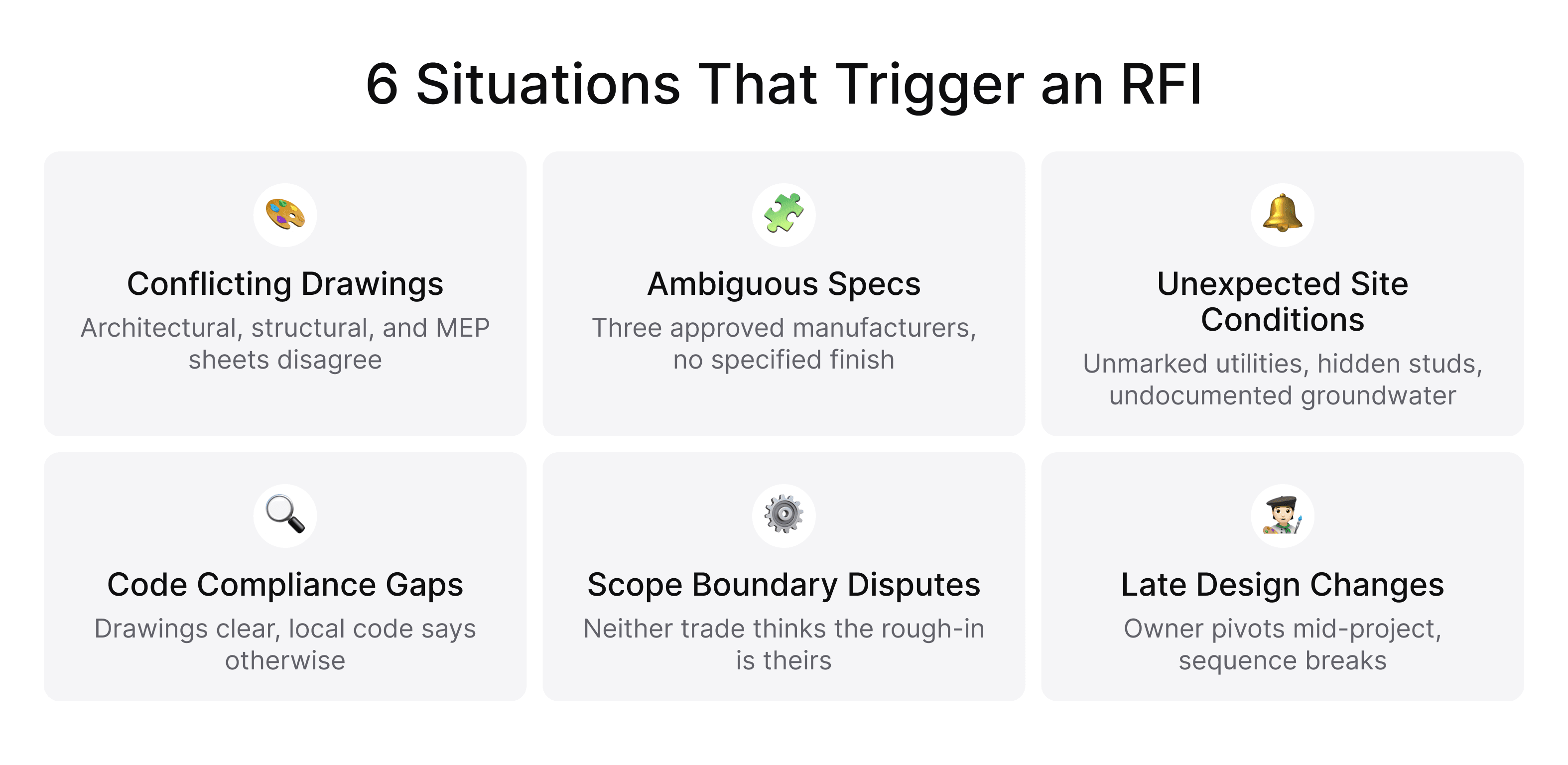
Not every question deserves an RFI, and we will come back to that. Plenty do, though. Most RFIs in construction fall into a handful of repeating patterns. If you have worked on more than 2 or 3 projects, you have seen all of these.
Conflicting or Incomplete Construction Drawings
The classic trigger. The architectural plan shows a wall in one location. The structural drawing places a column where the wall should be. The mechanical drawing routes ductwork through what the structural sheet calls a continuous beam: 2 sheets, 2 different stories.
These conflicts are caught during shop drawing review, or (more painfully) when the trade tries to install something and realizes it physically cannot be installed. Either way, you need a definitive answer about which version wins.
 Click to expand
Ambiguous Material or Product Specifications
Specifications are supposed to tell you exactly what to install. In practice, they sometimes list 3 acceptable manufacturers, fail to specify a finish, or call out a product discontinued 2 years ago. Ordering the wrong material is one of the most expensive mistakes on a project.
Pricing accuracy ties into this directly. A well-built BOQ in construction depends on specs being unambiguous, because every line item in the bill of quantities ties back to a specific product. When the spec is fuzzy, the price is a guess, and that guess shows up as a change order 3 months later.
Unexpected Site Conditions
Open the trench, find an unmarked utility. Strip the finish off a wall, and discover the studs sit somewhere else. Pour foundations and hit groundwater, the geotech report never mentioned. Existing conditions are where projects get humbled.
This is where real-time construction site visibility pays for itself. When the field team can document what they actually see, geotagged and timestamped, the RFI writes itself. You stop arguing about what was there and simply show the design team a photo with coordinates.
Code Compliance and Regulatory Gaps
Sometimes the drawings are clear, but the local code says something different. The egress width on the plan fails the latest IBC adoption in that jurisdiction. The energy code requires a higher R-value than the spec calls for. The contractor will not install something that fails inspection, so they kick it back as an RFI. In what is rfi in construction terms, this is one of the cleanest use cases.
Scope Boundary Disputes
2 trades, both think the other handles the rough-in. Or neither does. These gaps show up at the seams between disciplines: mechanical and plumbing, electrical and low-voltage, and concrete and structural steel. An RFI forces written clarification of where one scope ends and the next begins.
Schedule-Impacting Design Changes
When the owner or design team introduces a change mid-project, a request for information construction document often goes out first, before any change order paperwork moves. The contractor needs to know whether the change is real, what it covers, and how it affects sequencing. The RFI captures that conversation, so the eventual change order has a paper trail.
How the Construction RFI Process Works Step by Step
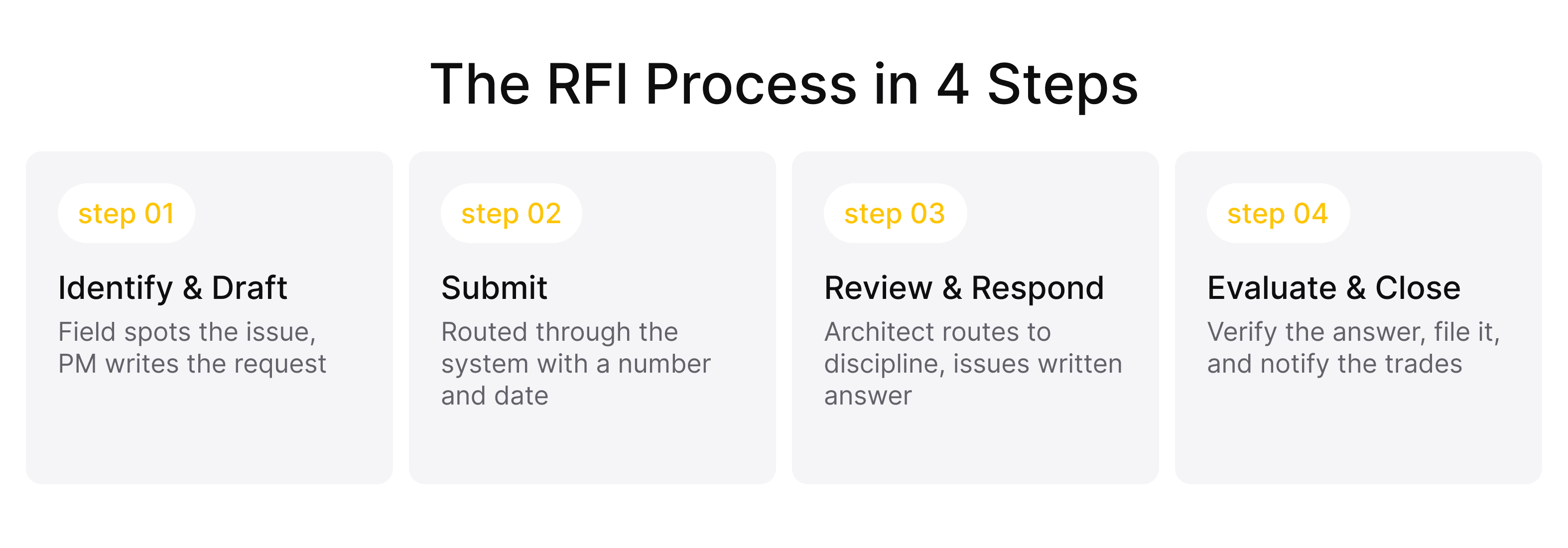
The mechanics of an RFI in construction are simpler than people make them out to be. 4 basic steps, and most of the trouble teams hit comes from rushing through one or skipping it entirely.
Step 1: Identifying the Issue and Drafting a Clear Request
It starts with someone in the field, usually a superintendent or foreman, spotting the issue. They flag it to the project engineer or PM, who decides whether it really needs an RFI or can be resolved with a quick call. If formal is the right call, the project engineer drafts it.
A good draft does 3 things. State the question in 1 or 2 sentences. Points to the specific drawings, specs, or contract sections involved, with page and sheet numbers. Proposes a solution when one exists. The proposed solution part is what separates a useful RFI from a time waster, and arguably, it is what gives the rfi meaning in construction, any teeth. A question without a suggested answer reads like a complaint.
Step 2: Submitting the RFI Through the Right Channel
The days of faxed RFIs are mostly gone, though you would be surprised. On modern projects, RFIs flow through construction document management software that handles routing, version control, and the audit trail. The submitter clicks a button. The system stamps it with a number, a date, and a recipient list.
 Click to expand
Whatever the channel, consistency is the key. Every RFI on a project should travel through the same pipe. If half of them live in the official system and half sit in someone's inbox, the project has 2 logs, and neither is complete.
Step 3: Review, Routing, and Official Response
Once submitted, the RFI lands with the design team, usually the architect first, who decides whether to answer directly or route it to the right consulting engineer. The relevant discipline drafts the response, the architect reviews it for design intent, and the official answer goes back out.
This is the step that drags most often. A simple question that should take a day drags on for 2 weeks because it sits in someone's inbox, waiting for a meeting. The fix is process discipline: hard deadlines, automatic escalation, visibility into what is overdue.
Step 4: Evaluating the Answer and Closing the RFI
The answer comes back. The contractor's team reviews it. Does it actually resolve the question? Does it imply cost or schedule? If yes, a change order or schedule adjustment kicks off. If no, the RFI gets marked closed in the log, the response gets filed against the relevant drawings or specs, and the affected trades get notified.
Closing the loop matters. An rfi in construction that gets answered yet never reaches the people doing the work is barely better than one that was never answered. Build notification into the closeout, not as an afterthought.
What Every Construction RFI Document Must Include
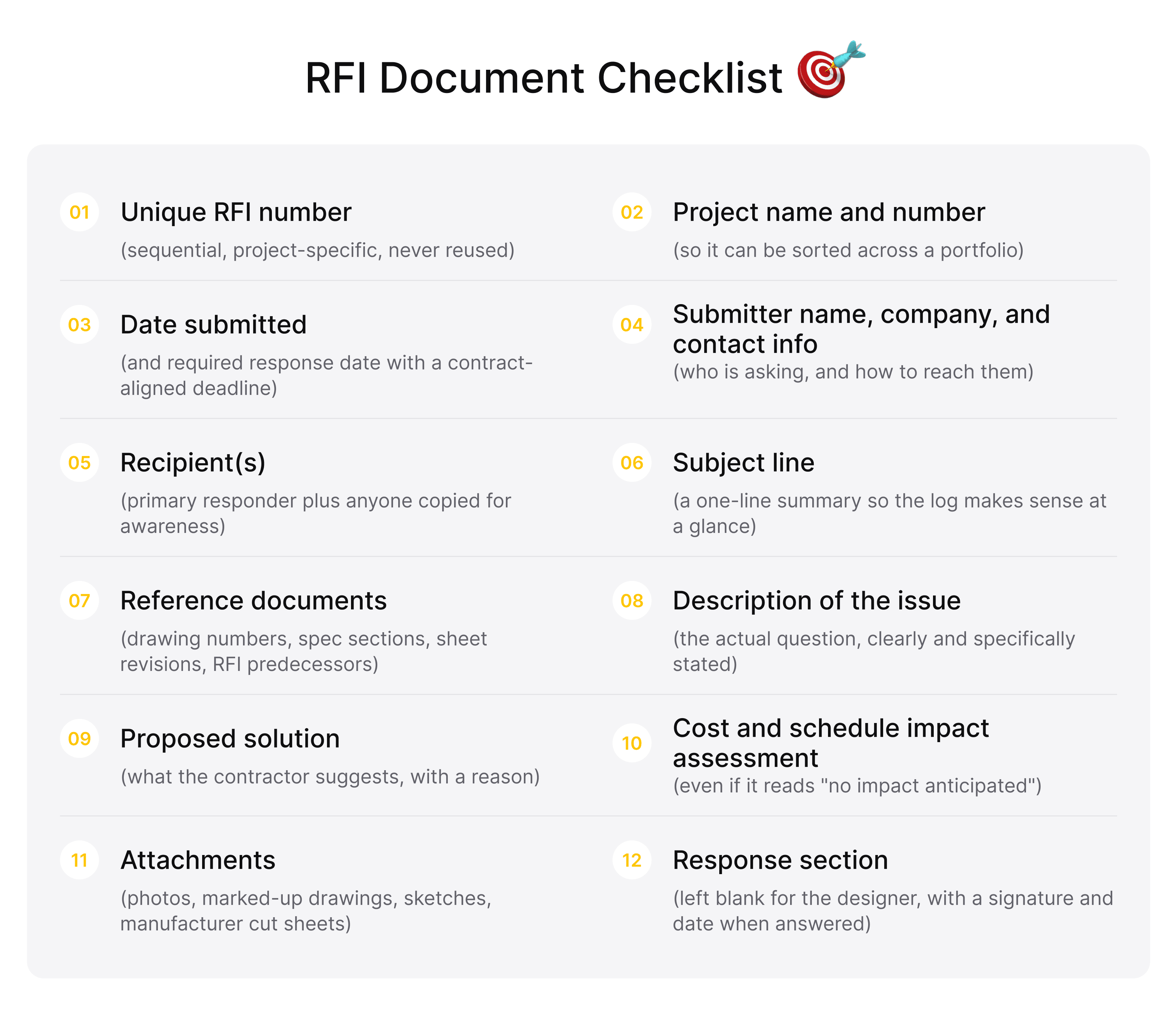
Every rfi construction template you will see looks a little different, yet the core fields stay essentially universal. If your RFI is missing one of these, expect it to come back unanswered. Or worse, answered incorrectly because the responder lacked context.
Here is the checklist of what a complete RFI document should contain:
 Click to expand
Treat this list as the bare minimum, since blanks invite ambiguity and ambiguity invites the wrong answer. If anyone on your team is still unclear on what is an rfi in construction, this checklist is the practical answer: an RFI is only as useful as the information it carries, so fill in every field every time.
RFI vs. Submittal, Change Order, RFP, and RFQ
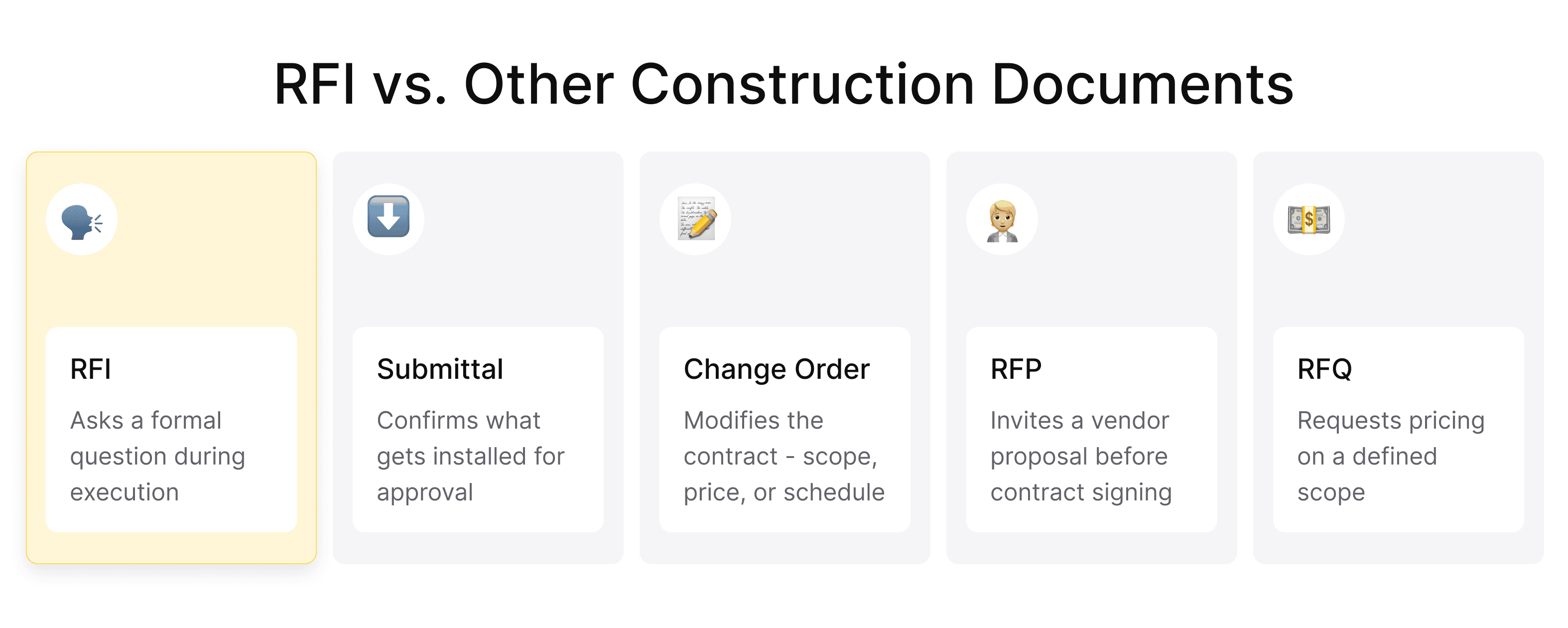
People mix these up all the time, and honestly, the acronyms do not help. The difference matters, though, because using the wrong document at the wrong time creates contractual headaches. The meaning of rfi construction is narrower than most people think. It is just a question. Once you start proposing a change, negotiating a price, or selecting a vendor, you are in a different document entirely.
RFI vs. Submittal
An RFI asks a question. A submittal answers one. Specifically, the question "Is this product, material, or assembly approved for installation?" Submittals include shop drawings, product data, samples, and mock-ups. They flow from the contractor to the designer for review and approval before the item gets installed. The two documents often interact (you might RFI to clarify a spec, then submit a product based on the answer), though they remain distinct.
RFI vs. Change Order
An RFI gets you information. A change order modifies the contract — adjusting scope, price, or schedule — and requires formal owner approval.
The 2 often appear in sequence: an RFI uncovers an issue, the answer requires a contract change, and a change order follows. Skip the change order after an RFI that authorizes added work, and you end up doing work you never get paid for.
 Click to expand
RFI vs. RFP and RFQ
These 2 come from procurement. An RFP (Request for Proposal) invites a vendor to propose a solution with pricing. An RFQ (Request for Quotation) requests pricing for a defined scope. Both happen before contracts are signed. A request for information construction document, on the other hand, occurs after the contract is signed, during execution: a different document, a different stage, a different audience.
The Real Cost of Unmanaged RFIs on a Construction Project
Industry studies have been putting numbers on this for years, and the picture is ugly. The average commercial project generates somewhere between 200 and 600 RFIs in construction over its lifecycle. In a hospital, a data center, or a stadium, that number can climb into the thousands. Multiply that by an average response time, and the math gets nasty fast.
Navigant Construction Forum's often-cited research pegged the cost of processing a single RFI at around $1,080 in labor alone, with average response times north of 9 days. On a project with 400 RFIs, that is roughly $432,000 just to administer them, before accounting for any delays, rework, or claims that follow.
The most expensive failure modes are these:
- Lost RFIs submitted through a channel nobody monitors, answered eventually, after the work has moved on.
- Duplicate RFIs were filed because 2 trades asked the same question separately, with no central log to check.
- Stale answers that were right when issued, then contradicted by a later drawing revision nobody flagged.
- Verbal overrides given on a Zoom call instead of in writing, leaving no record when the dispute surfaces.
- Schedule fog where the PM cannot tell whether a missed milestone belongs to the trade or the designer.
Every one of these is preventable. None of them is preventable with email alone. Teams serious about controlling cost on RFIs in construction treat the log as a real-time operational tool, not a quarterly compliance exercise.
Best Practices for Handling Construction RFIs Effectively
Teams that handle RFIs well just apply a small number of disciplines. Most of these are common sense, though on a chaotic jobsite, common sense gets crowded out fast. Here is how to keep your rfi in construction process from becoming the bottleneck.
Write Specific, Solution-Oriented Requests
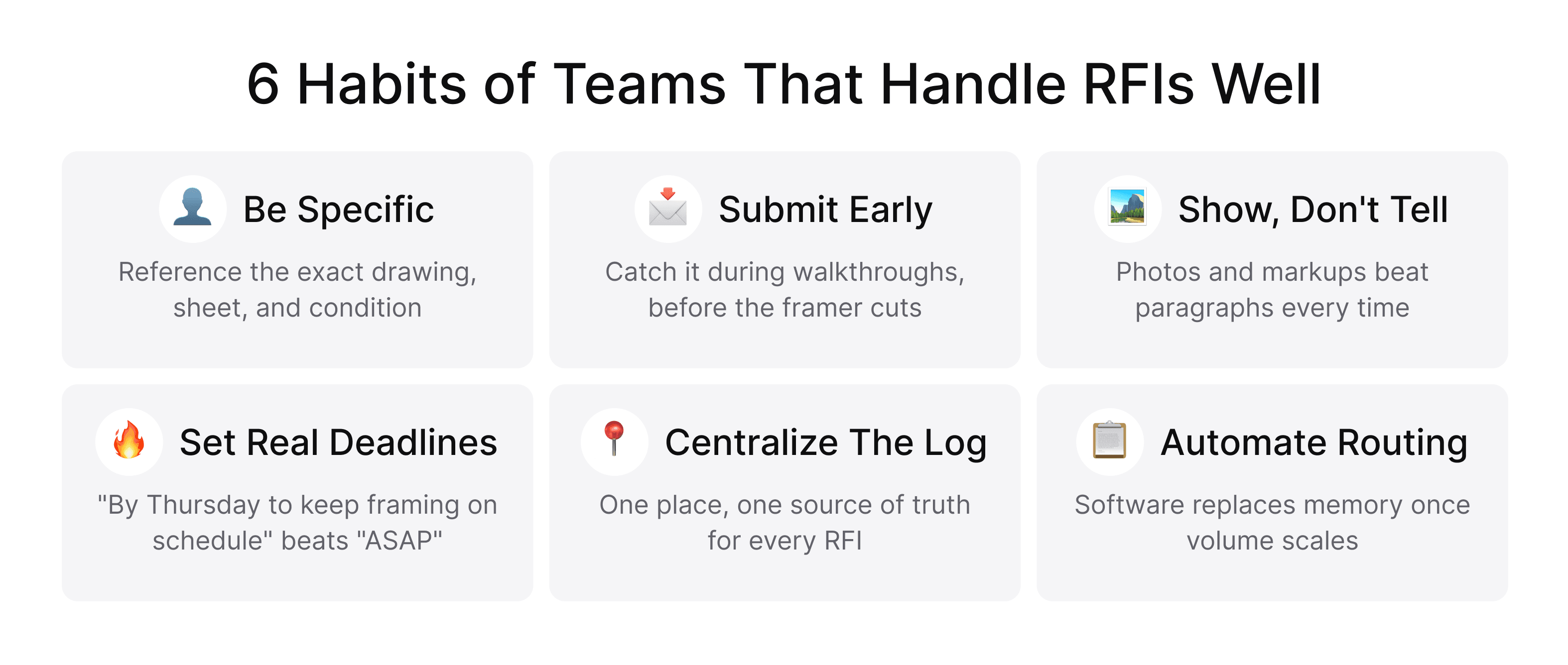
Vague questions get vague answers. "What do we do about the wall?" wastes a week. "Drawing A-301 shows a gypsum board return at door 142 that conflicts with the masonry wall on S-201; we propose continuing the masonry to the underside of the slab." gets answered in a day. Every rfi in construction benefits from that level of precision.
Submit RFIs Early, Before Work Begins
The cost of resolving an issue rises sharply once work is in progress, and astronomically once it is complete. An RFI submitted during preconstruction is essentially free. An RFI submitted after the concrete is poured will involve a saw. Build RFI review into your shop drawing and pre-installation processes, well before the framer cuts studs.
Group Related Questions Into One RFI
5 questions about the same piece of equipment go into one RFI with 5 numbered sub-questions. Easier to track, easier to answer, easier to file. Avoid bundling unrelated questions just to keep the count down. Group by topic, never by convenience.
Always Include Visual Documentation
Photos. Marked-up drawing snippets. Annotated PDFs. Whatever the question, there is almost always a way to show it that beats describing it. A photo of the actual condition, with arrows and labels, eliminates 90% of the back-and-forth that text-only RFIs generate.
Set Realistic Response Deadlines Upfront
For anything blocking immediate work, flag a specific deadline: "Response needed by Thursday to keep framing on schedule." Define escalation too: who gets notified at 48 hours overdue, who escalates to the owner within a week.
 Click to expand
Keep a Centralized RFI Log
One place, one source of truth: number, subject, submitter, recipient, dates, status, attachments. A well-maintained log is the difference between an rfi construction process that runs itself and one that runs the project into the ground.
Use Software to Automate Routing and Tracking
Spreadsheets break once you cross a couple of hundred RFIs or run several projects in parallel. The fix is purpose-built software, and the trick is selecting the right construction management platform that matches your team's actual workflow.
If off-the-shelf tools do not fit, custom software becomes a viable option. Teams like Incora build construction-specific platforms tailored to how your projects run: RFI workflows that mirror your contracts, integrations with accounting and scheduling, and role-based access. When you need extra engineering capacity to ship faster, a team extension model plugs in alongside your in-house IT. Either way, your rfi construction workflow should never depend on one person remembering to follow up on emails.
When You Should NOT Submit an RFI in Construction
Here is a question that does not get asked enough. When is an RFI the wrong tool? Knowing what is a rfi in construction also means knowing when it is the wrong move. Submitting one in the wrong situation wastes the design team's time, clogs your log, and trains everyone to take RFIs less seriously.
Skip the RFI when:
- The answer is already in the contract documents. If 5 minutes with the specs would resolve it, do that instead. RFIs cannot replace reading the drawings.
- It is a means and methods. How you build something (sequence, tools, labor) is the contractor's responsibility. Designers will not tell you how to do your job.
- You are really requesting a change. If you want to substitute a material to save money, that is a value-engineering proposal or a change request.
- It is a casual coordination question. If your electrician needs to know where the plumber's chase lands, that is a coordination meeting.
- You are using it as leverage. RFIs filed as a paper-trail tactic rather than genuine questions get spotted quickly, and the relationship erodes.
The bar for filing one should be: this is a real question; I checked the documents; I cannot resolve it myself; and the answer affects what gets built.
Final Takeaway
The meaning of rfi in construction has barely shifted in forty years, yet the way successful teams handle them has. The fundamentals stay the same (a clear question, a documented answer, a paper trail), though the tools look different, the volume runs higher, and the cost of getting it wrong has climbed.
If there is one thing to take away, it is this. Treat the rfi construction process as infrastructure rather than paperwork. The teams that win on schedule and budget are the ones who get their RFIs answered fast, route them cleanly, and never lose track of one. Get the workflow right, and the project gets easier. Get it wrong, and no amount of field hustle will save you.
FAQ
What does RFI stand for in construction?
RFI stands for Request for Information. To answer the common follow-up: What does rfi stand for in construction? Specifically, it is the same acronym used in IT procurement and government contracting, applied here to project execution.
What is the purpose of an RFI in construction?
The purpose of an rfi in construction is to resolve ambiguities in the contract documents (drawings, specifications, and scope) before they cause problems in the field. It also creates a written record of who asked what, who answered, and when, which protects everyone if a dispute surfaces later.
How long does an RFI response typically take?
Contracts usually set a window of seven to fourteen calendar days. In practice, industry averages hover around 9 to 12 days, though urgent field questions often come back faster. Slow responses are a leading cause of schedule slip on RFIs in construction, which is why deadlines and escalation paths need to live in the contract and run through software.
Are RFIs considered legal or contract documents?
Yes. Once submitted and answered, an rfi in construction becomes part of the project's contract record and can be referenced in disputes, claims, and litigation. The RFI interprets and supplements the contract, and courts treat it accordingly.
Who is responsible for responding to a construction RFI?
On most projects, the architect of record is the primary responder, though they routinely route technical questions to the appropriate consulting engineer (structural, mechanical, electrical, civil) who drafts the answer. The actual rfi construction meaning in your project depends partly on the delivery method, since design-build, for instance, shifts these responsibilities around.


YOU MAY ALSO LIKE




Get in Touch
Got no clue where to start? Why don't we discuss your ideas?

