



By Bohdan Vasylkiv
- CEO & Co-Founder
What Is Procurement in Construction? Methods, Process, and Systems Explained
What is procurement in construction? Learn the definition, main procurement methods, the 9-step process, key documents and how to pick a procurement system.
Key Takeaways
- Procurement in construction is how you get the right materials, labor, and services to the site at the right price and time.
- Your delivery method determines who carries the risk, so choose it before you choose vendors.
- Most delays start early, with fuzzy specs, slow submittals, and long-lead items nobody tracked.
- Connected tools beat spreadsheets, but only when data actually flows between them.
Imagine a switchgear package arriving 8 weeks late. The electricians have nothing to install, the schedule starts slipping, and everyone on site wants to know who dropped the ball.
In most cases, nobody did anything dramatic. The order went out a little late, a submittal sat in someone’s inbox for a couple of weeks, and nobody tracked the lead time. Each of these is a small slip, but together they can cost you a month and a lot of money.
All of that falls under procurement. If you’ve been wondering what is procurement in construction and why it gets blamed for so many blown schedules, this guide will help you sort it out.
We’ll walk through what construction procurement covers, the main delivery methods, the step-by-step process, and the tools that make it less painful.
What Is Procurement in Construction?
Here’s a plain construction procurement definition: it’s the process of planning, sourcing, buying, and managing everything a project needs to get built, from materials and equipment to subcontractors and professional services.
Placing orders is only one part. Procurement also covers how you package the work, select bidders, compare bids, and track deliveries until you pay the final invoice.
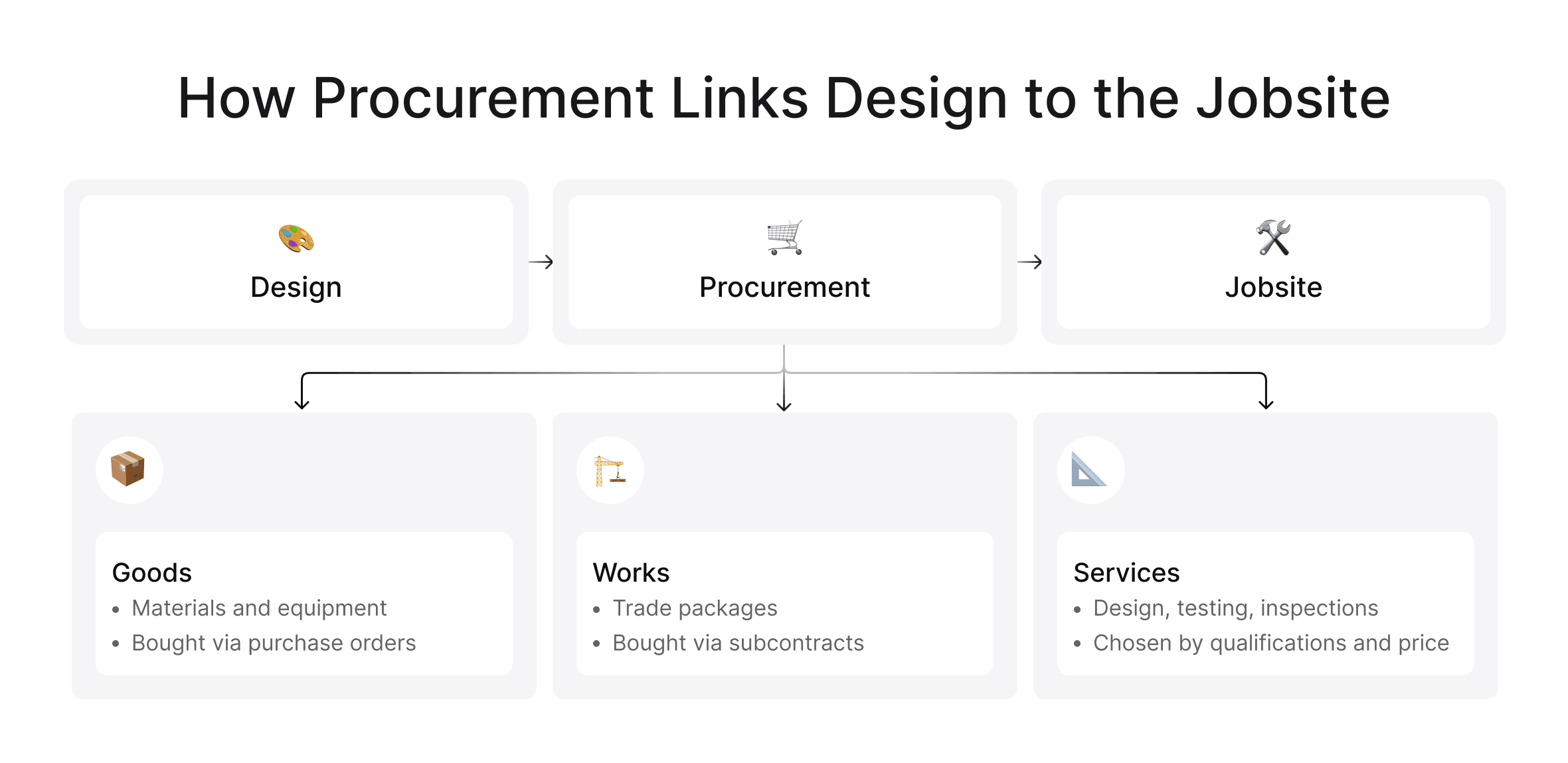
Think of it as the bridge between design and the jobsite. It sits right in the middle of the wider construction process, connecting what the architect drew with what the crew installs.
So the short answer to what is procurement in construction is this: it’s the work of turning drawings and specs into real materials, real people, and real contracts while keeping the budget under control.
What Construction Procurement Covers: Goods, Works, and Services
A useful procurement definition in construction splits everything you buy into three buckets:
- Goods: concrete, rebar, windows, HVAC units, electrical gear, rented equipment.
- Works: the actual building, usually done by contractors and subs, like framing, roofing, or MEP.
- Services: design, engineering, surveying, testing, and inspections.
This split matters because each bucket gets bought differently. Goods usually go through quotes and POs, work needs bids and subcontracts, and services are often selected based on qualifications as much as price.
 Click to expand
Procurement vs. Purchasing vs. Materials Management
People often use these terms interchangeably, but each covers a different part of the job.
- Procurement is the big picture: strategy, sourcing, vendor selection, contracts, and risk.
- Purchasing is the transaction: issuing a PO, confirming the price, paying the bill.
- Materials management is what happens after the buy: receiving, storing, and moving materials on site.
When you treat procurement in construction as just purchasing, you skip the planning, and that’s usually how projects end up paying rush fees.
Why Procurement Matters in the Construction Industry
Materials and subcontracted work usually make up the biggest share of a project’s cost. That’s why even small improvements in how you buy show up right in your margin.
It’s also why procurement in construction industry projects gets more attention than it used to. The supply chain swings of the past few years showed many contractors that a missed order date can hurt more than a bad bid.
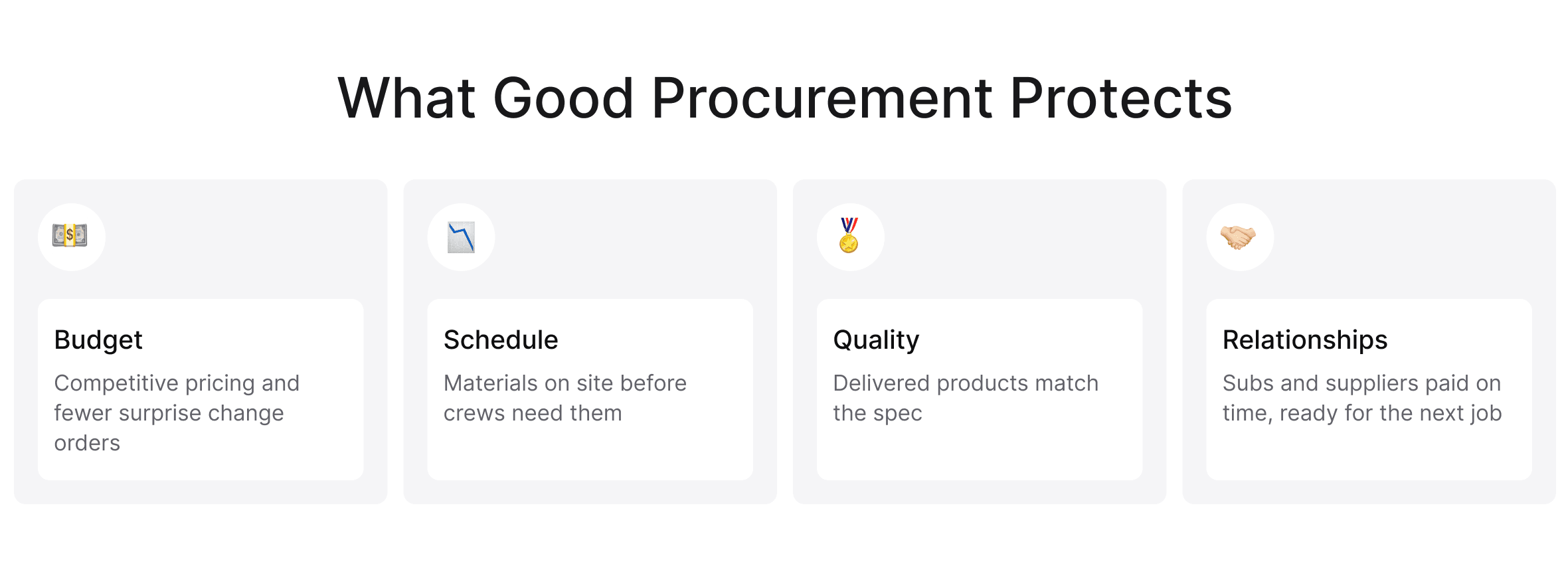
Good procurement protects 4 things at once:
- Your budget, through competitive pricing and fewer surprise change orders.
- Your schedule, by getting materials on site before crews need them.
- Your quality, by making sure what arrives matches the spec.
- Your relationships, because subs who get paid on time show up for you next time.
 Click to expand
There’s also a risk side. Every contract you sign shifts risk to someone, whether that’s you, the sub, the supplier, or the owner, so smart construction procurement is really risk management.
Who Is Responsible for Construction Procurement?
The answer depends on the delivery method, but in practice, many people are involved.
- The owner sets the budget, picks the delivery method, and sometimes buys major equipment directly.
- The design team writes specs and reviews submittals.
- The general contractor or CM runs most of the buying: bids, subcontracts, POs, and expediting.
- Subcontractors buy materials within their own scope.
- Suppliers deliver and (ideally) stick to their lead times.
On bigger jobs, construction procurement management sits with a dedicated procurement manager or buyer. On smaller ones, it’s often the PM juggling it next to everything else.
That’s also why people give such different answers when you ask them what is construction procurement. An estimator thinks about bids, a superintendent thinks about deliveries, and accounting thinks about invoices. Each is right because they’re looking at the same chain from different angles.
Procurement Systems in Construction: The Main Methods
A procurement system in construction is the overall model that defines who designs, who builds, how they’re hired, and how risk is split between them.
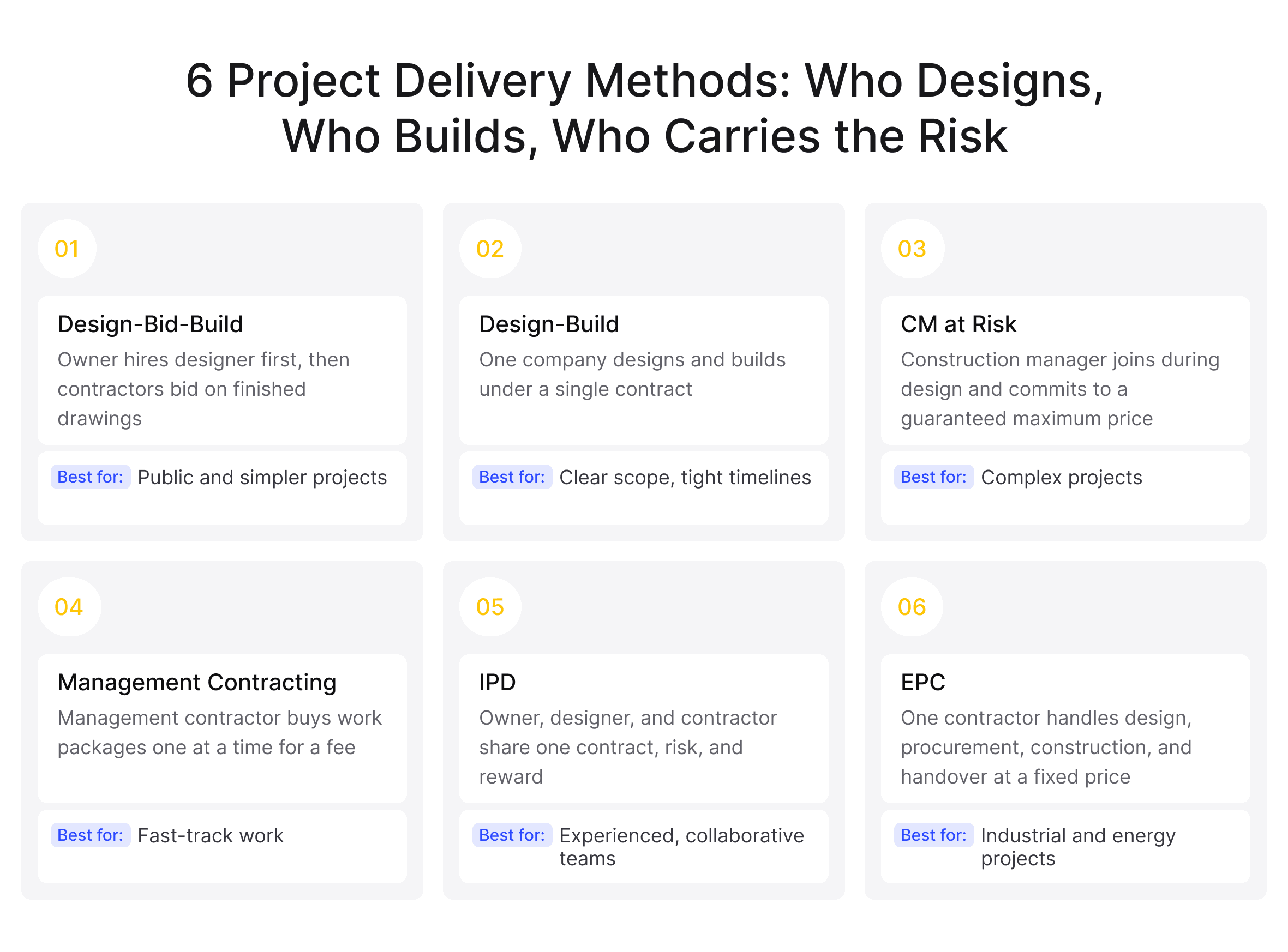
There are several procurement methods in construction, and each one fits certain projects and owners better than others. Here are the ones you’ll see most often in the US.
Traditional Procurement (Design-Bid-Build)
The owner hires a designer, the design gets finished, and then contractors bid on the complete drawings, with the lowest qualified bidder usually winning the job.
It’s predictable and transparent, which is why public owners like it. On the downside, it’s slow because construction can’t start until design is complete. Separate contracts for the designer and the builder also tend to turn drawing gaps into change orders and finger-pointing.
Design and Build (Design-Build)
One company handles both design and construction under a single contract.
It’s usually faster because design and construction overlap, and there are fewer disputes between the architect and the contractor. The trade-off is control, since the owner has less say over design details once the contract is signed.
 Click to expand
Construction Management and CM at Risk
Here, the owner brings in a construction manager early, often during design, to advise on cost, constructability, and buying strategy.
This approach comes in two versions. In CM agency, the CM is an advisor and the owner holds the trade contracts. In CM at Risk, the CM takes on those contracts and commits to a guaranteed maximum price (GMP). This way, you get builder input early and price certainty later.
Management Contracting
The owner hires a management contractor for a fee, and that contractor subcontracts all the work packages, one at a time.
Work can start before design is finished, which helps on fast-track projects. However, the owner carries more cost risk, because the final price isn’t known until the last package is bought.
Integrated Project Delivery (IPD)
IPD brings the owner, designer, and contractor into a single multi-party agreement from day one. They share risk and reward, and profit depends on how the whole project performs.
With the right team, IPD reduces blame and encourages joint problem-solving. It requires a lot of trust, experienced partners, and strong collaboration tools, so it’s still less common than other methods.
EPC and Public-Private Partnerships
EPC stands for engineering, procurement, and construction. One contractor handles everything from design to commissioning and hands over a working facility, usually for a fixed price. You’ll most often see it in power plants, refineries, and other industrial projects.
Public-private partnerships (P3s) work differently. A private partner finances, builds, and often operates a public asset, like a toll road, and gets paid back over many years.
How to Choose the Right Construction Procurement Method
Choosing between procurement methods in construction comes down to a few honest questions:
- How fast do you need to finish? For speed, look at design-build or CM at Risk.
- When do you need price certainty? Early fixed price points to design-build or EPC.
- How much design control do you want? Design-bid-build gives the owner the most.
- How complex is the project? Complex work benefits from early contractor input.
- Are there public bidding rules? Many public owners must use competitive bidding.
Here’s a quick side-by-side:
Try not to overthink the choice. No delivery model will fix a bad scope or an unrealistic schedule, so pick the one that fits your risk appetite and focus on running it well.
The Construction Procurement Process Step by Step
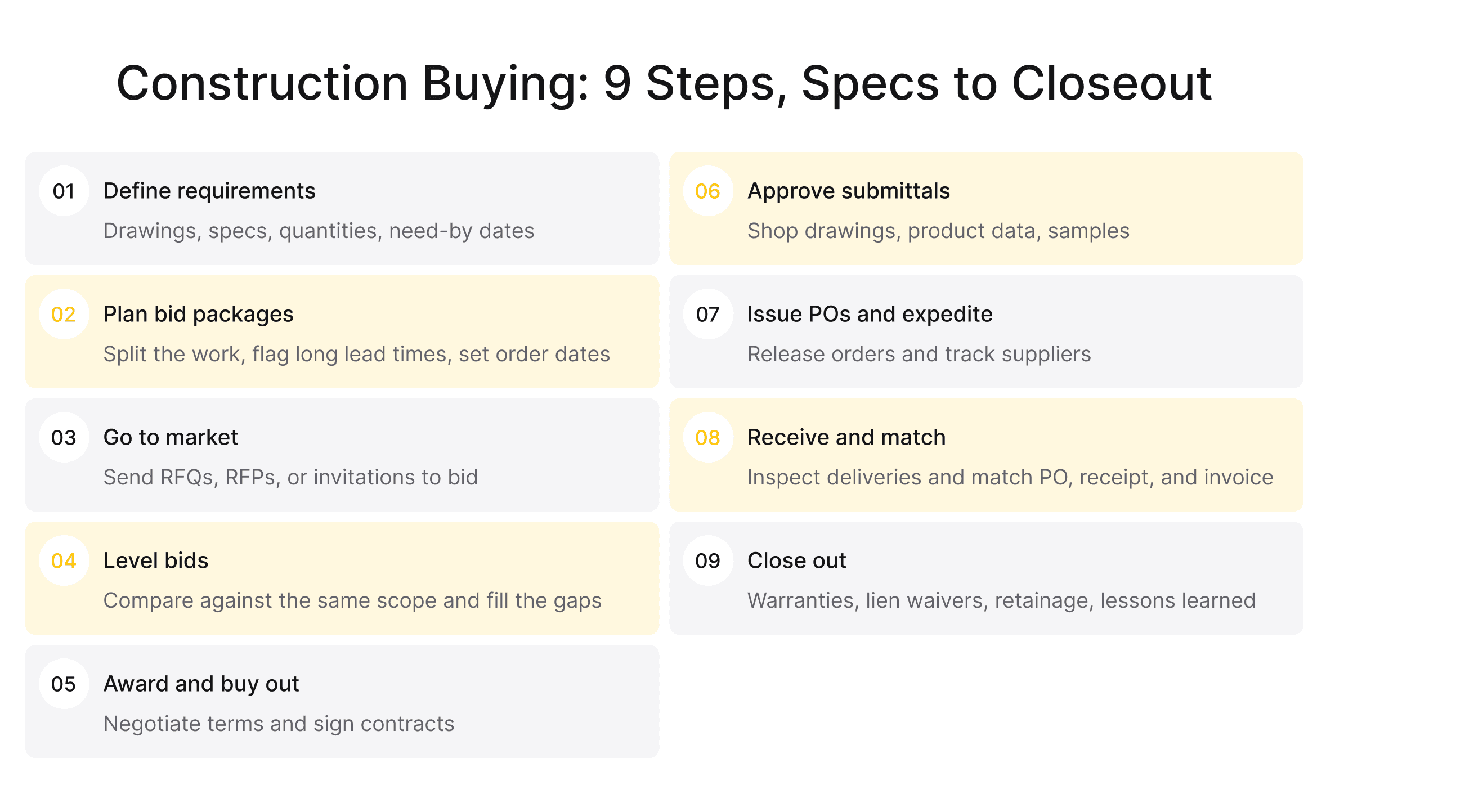
Once you set the delivery method, day-to-day buying begins. The construction procurement process varies by company, but the core steps look roughly the same everywhere.
1. Define Requirements and Specifications
Everything starts with knowing exactly what you need: drawings, specs, quantities, quality standards, and need-by dates.
Vague specs cause a lot of pain later. If a spec says “or equal” without explaining what counts as equal, you can expect arguments down the line.
2. Build the Procurement Strategy and Package Plan
Next, split the work into bid packages and decide what to buy first. Which packages have long lead times? What will you buy directly, and what will subs supply?
Map it all against the schedule so you know the latest safe order date for each package.
3. Issue RFQs, RFPs, or Invitations to Bid
An RFQ works when you mostly care about price. An RFP works when you’re also weighing approach and qualifications. An invitation to bid is for formal, often public, competitive bidding.
Give bidders complete documents and a realistic deadline. You should also expect questions, which usually arrive as RFIs. If you’re fuzzy on how those work, here’s our explainer on what is an RFI in construction.
4. Evaluate and Level Bids
Bids rarely line up neatly. One sub might exclude cleanup, another might assume overtime, and a third might quietly skip a whole spec section.
Bid leveling helps you compare them fairly. You line every bid up against the same scope, fill in the gaps, and often the lowest number on paper turns out to be more expensive in reality. Also check each bidder’s capacity, safety record, and past performance.
5. Award Contracts and Complete the Buyout
Once you’ve picked a winner, you negotiate the final terms and sign the contract. Doing this across all packages is called the buyout.
The buyout shifts the construction procurement process from planning to real commitments. It’s also where you learn whether your estimate was realistic, so track savings and overruns against budget.
 Click to expand
6. Manage Submittals and Approvals
Before anything gets fabricated, the design team has to approve shop drawings, product data, and samples.
This step can quietly kill a schedule. A submittal that sits for three weeks and gets rejected can push fabrication by a month. Set clear review times in your contracts and track every submittal against its required-by date.
7. Issue Purchase Orders and Expedite
With approvals in hand, you release POs, and the clock starts on fabrication and delivery.
Then comes expediting, which is a fancy word for staying on top of suppliers. A construction procurement log helps a lot here: one place that shows every item, its PO, status, lead time, and expected delivery.
8. Receive, Inspect, and Match Invoices
When materials arrive, someone checks quantities and condition against the PO. Flag damaged items right away, before the crew opens the crate two weeks later and finds the problem.
Accounting then runs a three-way match between the PO, the receiving record, and the invoice. It may feel boring, but it’s the step that catches duplicate invoices and overbilling.
9. Close Out Procurement
At the end of the project, collect warranties, O&M manuals, and final lien waivers; close out POs and subcontracts; and settle retainage.
After that, quickly review which suppliers delivered and what took longer than planned. Good procurement in construction improves from job to job when you actually write those lessons down.
Key Construction Procurement Documents
These are the documents that matter most:
- Procurement plan: your strategy, package list, and who owns what.
- Bid packages: drawings, specs, scope sheets, and contract terms.
- RFQs, RFPs, and ITBs: the requests that kick off bidding.
- Contracts, subcontracts, and purchase orders: the legal and financial backbone.
- Submittal and procurement logs: status, lead times, and need-by dates.
- Delivery tickets, invoices, change orders, and lien waivers: the money trail.
Keeping these connected is half the battle. When the PO lives in one system, the submittal in another, and the delivery ticket in someone’s truck, nobody sees the full picture. That disconnect is one of the most common reasons construction procurement falls apart.
Procurement Planning for Long-Lead Items
Some items take months to arrive. Switchgear, transformers, generators, elevators, curtain wall, and custom HVAC units are common culprits. Some electrical gear has recently had lead times of a year or more.
You can’t treat these like regular orders, so here’s how to plan for them:
- Flag long-lead items during design development, before the drawings are final.
- Work backward from the install date to find your latest order date.
- Use early release packages or owner-direct purchases to lock in production slots.
- Keep a backup plan, like pre-approved alternates.
Anyone who has worked in procurement in construction industry roles for a while will tell you the same thing: long-lead items are where schedules are won or lost.
Common Challenges in Construction Procurement
Even well-run teams hit the same snags, but most are predictable.
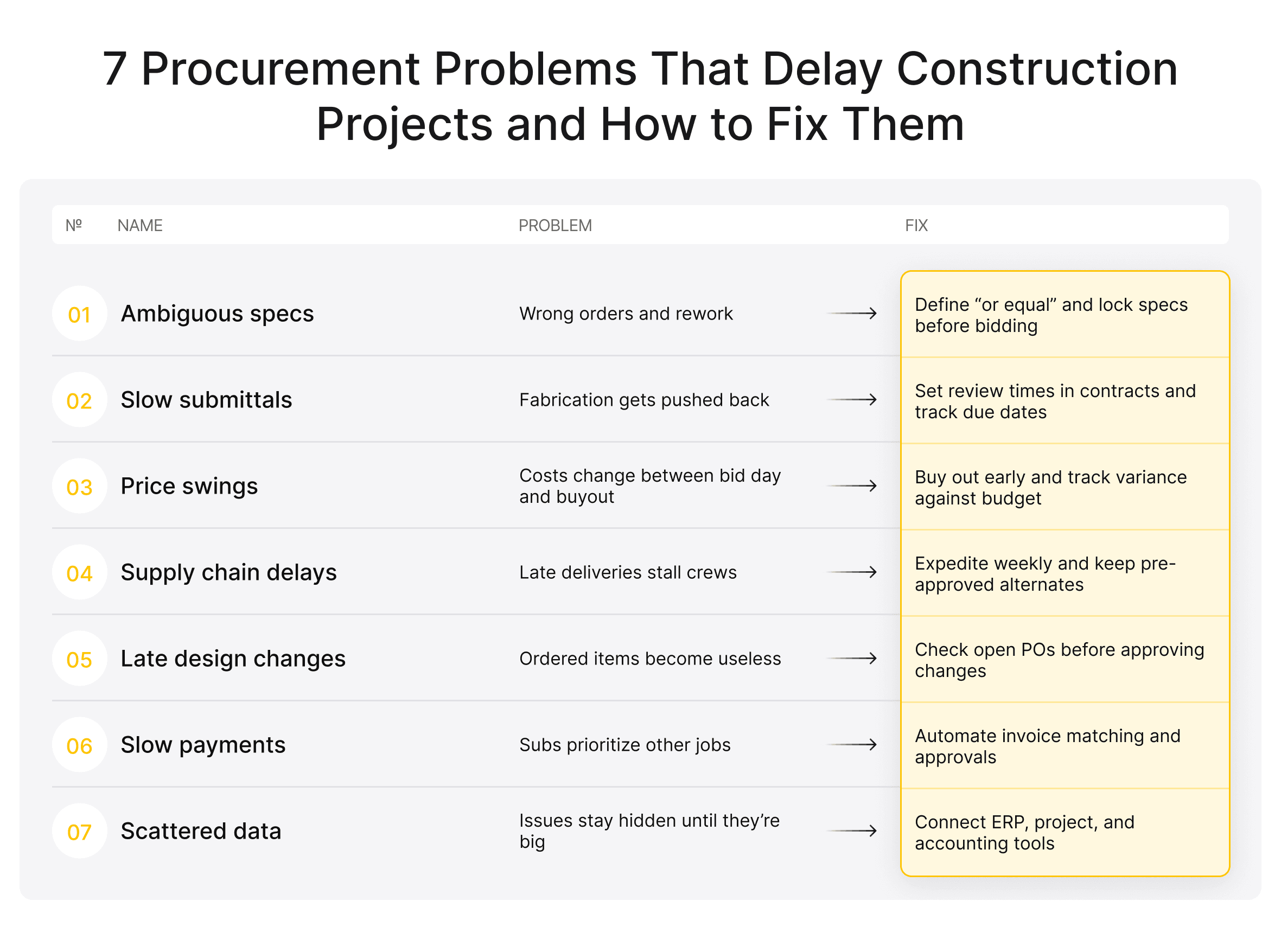
- Ambiguous specs that lead to wrong orders and rework.
- Slow submittals that push back fabrication.
- Price swings between bid day and buyout.
- Supply chain disruptions and factory delays.
- Late design changes that make ordered items useless.
- Slow payments that push subs to prioritize other jobs.
- Scattered data: POs in the ERP, submittals in email, delivery dates in a spreadsheet.
That last one makes all the others worse. When the construction procurement process runs on email threads and manual re-entry, small issues stay hidden until they’re big ones.
 Click to expand
In most cases, the fix is to remove manual steps. That’s where construction business process automation earns its keep: routing approvals, generating POs from approved bids, flagging late submittals, and matching invoices without anyone squinting at three PDFs.
Construction Procurement KPIs to Track
A few well-chosen numbers will show you where procurement is working and where it needs attention. These metrics are worth watching:
- Buyout variance: actual contract values vs. budget.
- On-time delivery rate: orders that arrive by the need-by date.
- Submittal cycle time: days from submission to approval.
- Supplier performance: quality and on-time rate by vendor.
- Invoice exceptions: how often the three-way match fails.
Pick a few that match your biggest pain points.
The tricky part is that this data usually lives in different tools. Your ERP has POs, your project platform has submittals, and accounting has invoices. Without construction software integrations, even a simple KPI dashboard means someone has to stitch spreadsheets together every week, and nobody enjoys that.
This is one area where procurement in construction industry teams are catching up fast, and more of them now pull procurement data automatically from the tools they already use.
Construction Procurement Software and Systems
For a long time, procurement ran on spreadsheets, email, and phone calls. That works for a few jobs, but once you’re juggling several projects, spreadsheets start to break down. That’s when construction procurement software starts paying for itself, keeping bids, POs, submittals, and deliveries in one place.
What a Connected Procurement System Looks Like
A good procurement system in construction can be made of several tools, as long as they’re connected to each other. In practice, that looks like this:
- Estimating feeds budgets and bid packages.
- Contract and PO data flows straight into your ERP.
- Submittal status links to the procurement schedule.
- Field teams log deliveries on a phone, and the PO updates automatically.
- Invoices auto-match against POs and receiving records.
The idea is simple: you enter data once, and it moves where it needs to go.
Off-the-Shelf Tools vs. Custom Procurement Workflows
Off-the-shelf platforms are a solid place to start. They’re quick to set up and cover the workflows most contractors share.
The trouble starts when your process doesn’t match theirs. Maybe you self-perform trades, run multiple entities, or need to connect a legacy ERP the vendor doesn’t support. Then you either bend your process to fit the tool or keep side spreadsheets next to it.
That’s where custom work makes sense. In many cases, you can keep your current platform and build around it by connecting tools, filling gaps, and automating what your team still does by hand.
At Incora, that’s the kind of work we do every day. Our team handles construction software development for contractors and owners who’ve outgrown generic tools, from custom procurement modules to integrations that get your existing stack talking. The goal is to cut manual work, so your team spends its time on decisions instead of data entry.
Not sure where to start with procurement automation?
We can help you figure out what's actually slowing you down and what to build first.
Where AI Fits in Construction Procurement
AI is starting to show up in procurement in construction, and some uses are already practical:
- Reading spec books and pulling out items and quantities.
- Flagging scope gaps and exclusions during bid leveling.
- Extracting data from invoices, quotes, and delivery tickets.
- Predicting delays based on supplier history.
AI is great at reading documents and spotting patterns, but it needs clean, connected data to work well. If your data is scattered across inboxes, fix that first. AI built on messy data just gives you wrong answers faster.
Final Takeaway
If someone asks you what is procurement in construction, you can tell them: it’s the work that decides whether materials and people show up when they should, at the price you planned.
Pick the right delivery method, nail your specs, keep an eye on long-lead items, and get your data connected. Do that, and construction procurement will stop being the thing everyone blames when a schedule slips.
FAQ
What is procurement in construction in simple terms?
In simple terms, procurement is the process of getting everything a construction project needs, including materials, equipment, subcontractors, and professional services, at the right price, quality, and time. It covers planning what to buy, choosing suppliers, signing contracts, and tracking every delivery until the final invoice is paid.
What are the stages of procurement in construction?
The construction procurement process usually has 9 stages: defining requirements, planning the procurement strategy, issuing RFQs or bids, leveling bids, awarding contracts, managing submittals, issuing purchase orders and expediting, receiving deliveries and matching invoices, and closing out. The exact order can shift slightly depending on the delivery method.
What are the three main types of procurement in construction?
The 3 main procurement methods in construction are design-bid-build, design-build, and construction management (including CM at Risk). They differ in who designs, who builds, and who carries the cost risk. Management contracting, IPD, and EPC are also common, mostly on complex or industrial projects.
What is the difference between procurement and purchasing in construction?
Procurement is the full strategy: planning, sourcing, selecting vendors, negotiating, and managing contracts, while purchasing is the single step of ordering and paying for goods. Put simply, procurement in construction decides what to buy and from whom, and purchasing places the actual order.
What does a construction procurement manager do?
A construction procurement manager plans the buying strategy, runs bids, negotiates with suppliers and subcontractors, manages contracts and purchase orders, and tracks long-lead items. It’s one of the most cross-functional roles in procurement in construction industry companies, because it connects the office, the field, and the supply chain.
What is a procurement system in construction?
A procurement system in construction is the delivery model that defines who designs the project, who builds it, how each party is hired, and who carries which risks. Common examples include design-bid-build, design-build, CM at Risk, and IPD, each balancing speed, cost certainty, and owner control differently.


YOU MAY ALSO LIKE




Get in Touch
Got no clue where to start? Why don’t we discuss your idea?

