



By Bohdan Vasylkiv
- CEO & Co-Founder
Top Construction Software Companies to Know in 2026
Compare the top construction software companies of 2026, from off-the-shelf platforms to custom builders — plus how to choose the right fit.
Key Takeaways
- Off-the-shelf tools are fast to buy, though they can feel rigid and add up per seat.
- Building from scratch fits you well, yet it costs the most and takes the longest.
- A ready-made core plus custom pieces gives you speed and fit at a fair price.
- Pick a partner for their construction know-how, integrations, and clear pricing.
Construction runs on thin margins and tight schedules. The software you choose can keep a project moving or quietly hold it back. So it pays to choose well.
The market is busy, and the names all sound alike. This guide walks you through the top construction software companies you'll meet in 2026. You'll see which ones you buy off the shelf, which ones you hire to build, and how to spot the right fit for your team. Contractor, owner, or subcontractor, the goal is the same. Find software that fits the way you already work.
What Construction Software Development Companies Actually Do
In plain terms, construction software development companies build the tools that run a jobsite and the office behind it. Some sell a finished product you pay for monthly. Others build software around the way your team already works.
A ready platform is live today and easy to start. A construction software development partner shapes the software to your estimating, scheduling, and field work. Both help. They just suit different projects and budgets. The right call comes down to how standard your workflow is, and how much you're willing to bend it.
There's a wide range of tools here, from simple bidding apps to full ERP systems. If you want the lay of the land first, skim the main types of construction software before you compare vendors.
How We Ranked the Top Construction Software Companies
We skipped the logo contest. We looked at what holds up once a real project starts.
A few things mattered most. Real construction depth. Clean integrations with your ERP, accounting, and field apps. Fair, clear pricing. And a track record you can check. Plenty of construction tech companies shine in a demo and stumble on a live job, so we leaned on fit.
That's why our shortlist of top construction technology companies mixes ready platforms with custom builders. Different teams need different things.
Top Construction Software Development Companies in 2026
Here are 10 teams worth knowing. Each card shows the focus, the tech, and how you work together so that you can match them to your situation fast. Some you buy. Some you hire to build. The best construction software companies come in both shapes.
1. Incora — Best for Custom Construction & PropTech Platforms
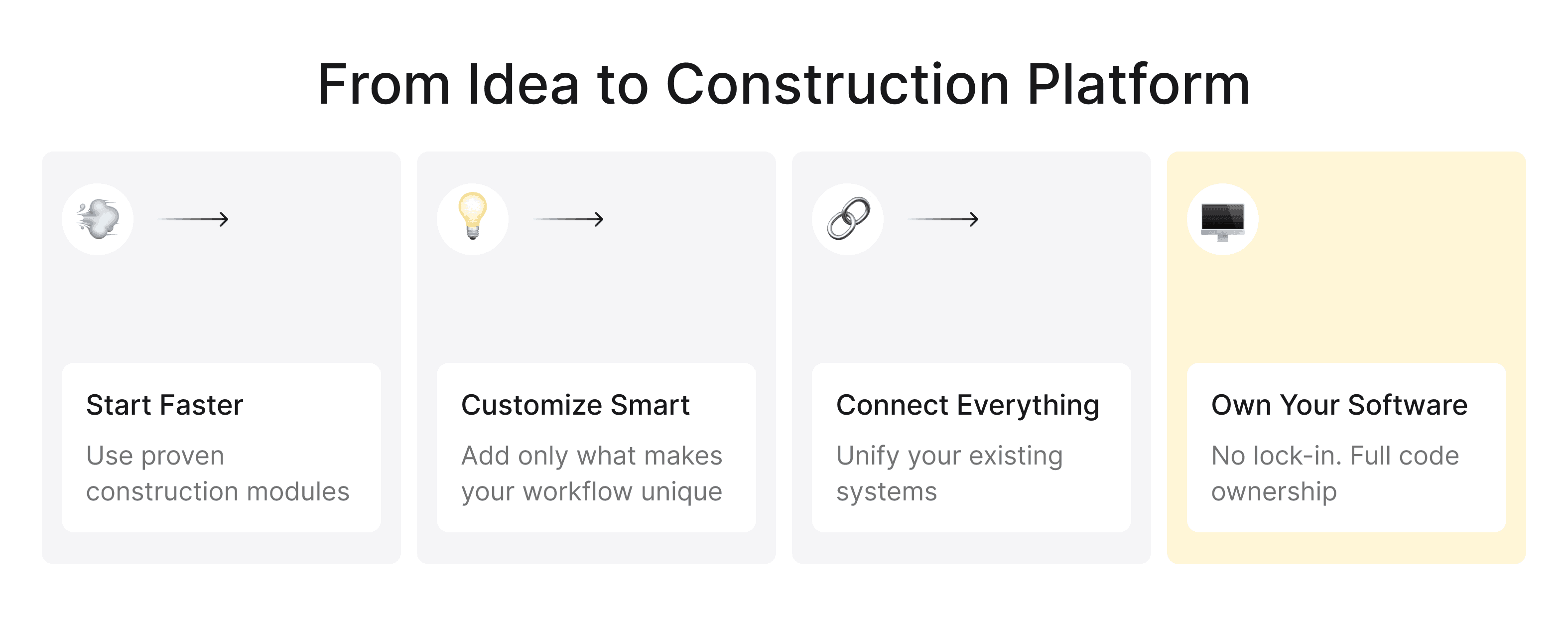
Incora is a construction software development company, and we build custom platforms for contractors, owners, and PropTech teams. The clever part is how we start. Instead of a blank page, we reuse proven construction modules and add custom work only where your business is different. You launch faster and pay less than a full custom build, and you skip the bloat of a generic platform.
Here's what you get: a fixed scope, a fixed price, and full ownership of the code. No per-seat fees. No lock-in. Behind that sit years of construction projects, a stack of case studies, and reviews from teams who've shipped with us. If you want custom software development services shaped around your crews, this is the team to beat.
 Click to expand
Here's where we're different in practice. When an off-the-shelf platform can't match your workflow, you usually pay for a workaround or learn to live without the feature. We just build that exact piece. When a from-scratch shop quotes a year and a heavy budget, we start from a proven core and cut both the time and the cost. And when your tools refuse to talk to each other, we connect them into one source of truth. Same job, fewer trade-offs.
2. Procore
Procore is one of the biggest names in construction, and for good reason. Budgets, scheduling, RFIs, and field collaboration all live in one place, which large contractors lean on every day. It's built for scale, though, so smaller crews often pay for parts they rarely use, and you shape your process around it. Great for big commercial teams that want one hub. If your workflow is lean or unusual, a build that bends to you tends to fit better.
3. Autodesk Construction Cloud
Autodesk Construction Cloud shines when design and BIM sit at the center of your work. It links models to the field and plugs straight into Revit, so design-led teams get a lot from it. Outside that world, it can feel heavier and pricier than you need. A good fit for architects and BIM-first GCs; a contractor who mainly needs budgets and field data can usually run lighter.
4. Buildertrend
Buildertrend is a fast, simple start for home builders and remodelers. Scheduling, client chat, and finances sit in one app. It runs on a fixed feature set, so it's happiest with standard residential work and gets tight as you scale. A strong first tool for smaller crews. When you outgrow the template, custom work is usually the next step.
5. Intellectsoft
Intellectsoft is a custom shop with construction experience, from field apps to enterprise systems. When you want a fully bespoke build and have the budget, they deliver. Since projects usually start from scratch, timelines and costs run higher. If you'd rather skip rebuilding everything from zero, a proven-core approach reaches the same place faster and for less.
6. ScienceSoft
ScienceSoft is a long-running IT services firm with strong engineering and a structured, well-documented process. If you value a formal engagement, that's a strength. As broad generalists, though, they're less specialized in construction than a domain-first team, and the pace can feel corporate. For jobsite-heavy work that has to move fast, a construction-focused team usually feels closer to the ground.
7. Trimble Construction One
Trimble Construction One ties office, field, and data together, with deep roots in surveying and hardware. Layout and machine-control crews get a lot out of it. It's designed as a full ecosystem, though, so it gets pricey and complex if you only want a slice. Best suited to heavy-civil and infrastructure teams that will use the whole stack, and less so if you need just a couple of targeted tools.
8. Fieldwire
Fieldwire is a focused tool for the field. Plans, tasks, and coordination run straight from a phone, and crews take to it fast. Its scope stays on the field, so the office side lives in separate tools you connect yourself. It works best as a field layer beside your other systems, and you'll still want something to tie them together.
9. Oracle Aconex
Oracle Aconex is excellent at document control on large, complex jobs, and for mega-projects that paper trail is gold. It's enterprise-grade. That also brings cost and setup time that smaller jobs rarely justify. Built for big programs and owners, and usually more than a mid-size contractor needs.
10. Chetu
Chetu is a big, flexible developer that spins up teams fast across many industries. For extra hands on a clear scope, they're a handy option. Because they work across so many verticals, deep construction context can vary between teams. Great for scaling capacity; for domain-heavy work, a construction-first team gives you more certainty.
Leading Off-the-Shelf Construction Software Platforms (Procore, Autodesk, Buildertrend)
Let's give the ready-made crowd credit. Procore, Autodesk, and Buildertrend are popular for good reason. You sign up, onboard, and you're running the same week. For standard workflows, that speed is hard to beat.
The catch shows up later. These construction technology companies sell one product to everyone, so you pay for features you'll never open, and rolling out the whole crew can take months. When your process is different, you end up bending it to fit.
Most large construction tech companies also charge per seat, which climbs as you grow. Easy to buy, then. A little trickier to live with once your team stops being average.
Construction Software Companies at a Glance: Comparison Table
Here's a quick look at how these construction software companies compare on focus, model, and how you engage. Treat it as a starting point for your shortlist.
How to Choose the Right Construction Software Development Partner
Choosing a partner comes down to fit more than flash. The best construction software companies rarely win on the demo. They win because they match how you build. Here's what to check.
Construction-Domain Expertise
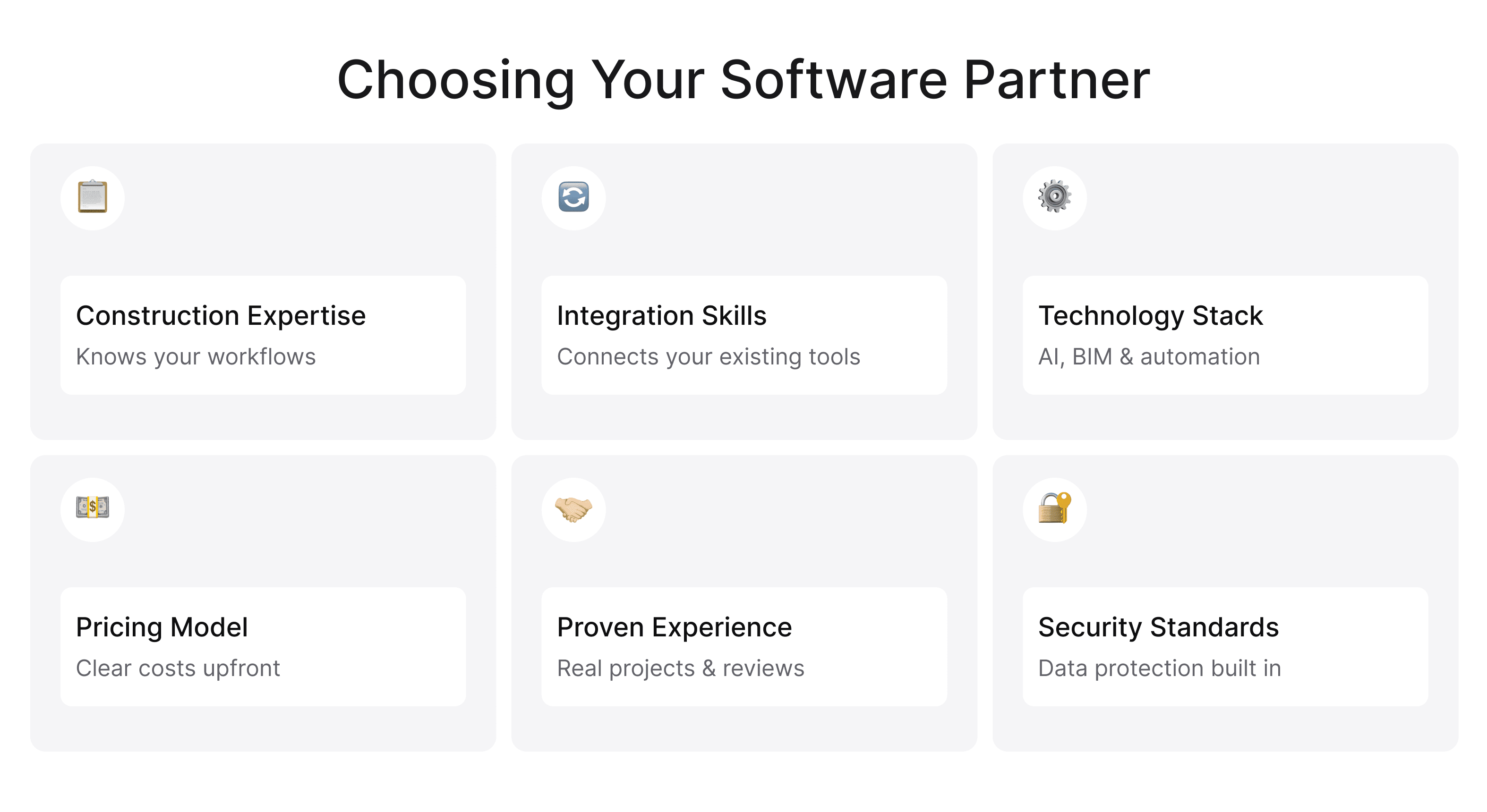
Coding skill and construction skill are two different things. You want a team that already knows change orders, retainage, RFIs, and how a schedule slips. Ask what they've shipped in construction. The construction software development companies worth hiring can talk jobsites, from bidding all the way to construction site inspection, with ease.
Technology and Integration Capabilities
Your new tool has to work with what you already run. Look for real integration experience across ERP, accounting, scheduling, and field apps, plus modern extras like AI forecasting, IoT, and BIM.
This is where we come in at Incora. We build custom features on a proven core and wire them into the systems you already use, so data updates once and shows up everywhere.
 Click to expand
Strong construction technology companies treat integrations as the main event. One clean source of truth beats 3 that quietly disagree.
Engagement Models and Pricing
How you work together matters as much as the price. Some teams sell licenses, some bill by the hour, some quote a fixed price. If you want people who feel like part of your company, a dedicated development team can join your process and stay with the product. Look for clear pricing you can understand before work starts.
Portfolio, Reviews, and Security
Ask for case studies with real numbers, then read a few independent reviews. Check security properly too. Role-based access, audit trails, encryption, and regular testing should all come standard. The good top construction technology companies build that in from day one. A short reference call with a past client will tell you more than any brochure.
Custom Build vs. Off-the-Shelf: Which Path Fits Your Project
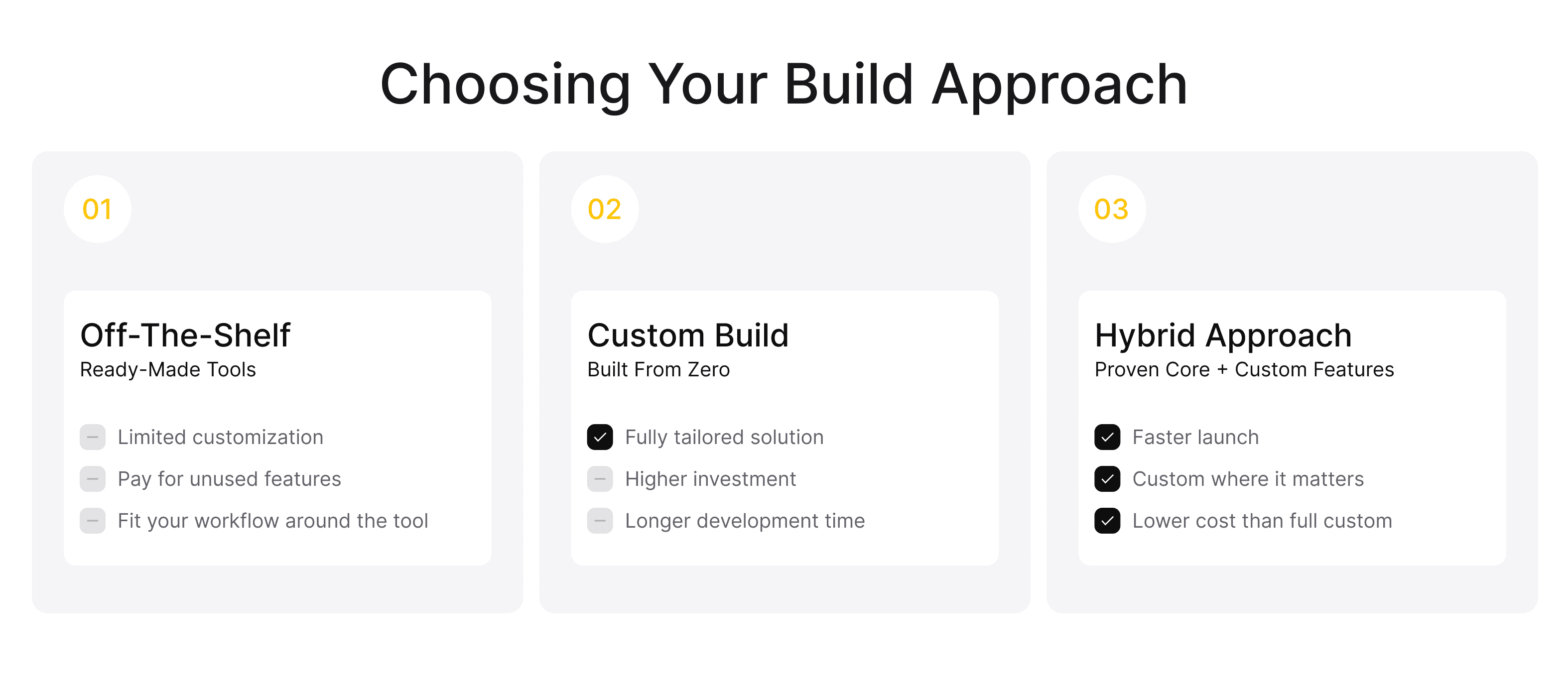
This is the real decision, so let's keep it simple. You've got 3 routes.
Off-the-shelf is fast and familiar, and you fit your process to the tool. Full custom fits you perfectly, and it costs the most and takes the longest. The middle path reuses a proven construction core and adds custom work only where you differ.
That middle path is the sweet spot for most teams, and it's the model we built Incora around. Standard workflow? Buy it. Doing something no product supports, with budget to match? Go full custom. For everyone in between, the hybrid wins.
 Click to expand
Picture a mid-size GC running estimating in one app, accounting in another, and the field on paper. A hybrid pulls those together, and you skip paying for a hundred features nobody opens.
Quick gut check. If you're typing the same figure into 3 tools and it never lines up, a construction companies software platform built around your workflow will pay for itself fast.
Why Construction Teams Partner With Incora
So why do teams keep choosing us? We pair real construction know-how with a model that respects your budget and your timeline.
We build with local construction partners and test on live job sites, so features hold up in the field. You get a fixed price, full code ownership, and AI only where it saves real time, like cost forecasting and document capture. And we stay on after launch for support and steady improvements.
Not Sure If It's the Right Fit?
Book a quick call, and we'll walk you through what's possible for your business.
Our track record does the talking: a shelf of case studies, client reviews, and years on real construction jobs. Among construction software companies that promise the world, that mix of domain depth, fair pricing, and a proven core is rare.
Final Takeaway
Here's the short version. The top construction software companies fall into two groups. Ready platforms you buy, and custom teams who build. Platforms win on speed. Custom wins on fit.
The hybrid model often beats both on value. So choose on how your team really works, what you need to connect, and how you like to engage. Get that right, and the software just quietly does its job.
FAQ
What are the top construction software companies?
There's no single winner. The best setup is usually a mix, built around a custom core. That's Incora's sweet spot: proven construction modules plus custom work made for your team. Procore covers all-in-one management, but it's priced for scale. Autodesk owns design and BIM, but it's overkill for most contractors. Buildertrend is an easy start for residential, but you outgrow it fast. Bottom line: the construction software companies that fit you best are the ones built around your workflow, not someone else's.
What's the difference between construction software and construction software development companies?
Construction software is the finished product you subscribe to, like Procore. Construction software development companies build the software around your own processes instead. One you rent. The other you own and shape.
How much does it cost to build custom construction software?
It depends on scope, integrations, and user roles. In the US, a focused first module usually runs $25,000 to $50,000, and a full platform lands between $50,000 and $150,000 or more. A hybrid build keeps costs lower, since you reuse a proven core and pay only for the custom parts.
Should I buy off-the-shelf or build custom construction software?
Buy when your process is standard, and you need something today. Build when your workflow is unique and worth the investment. For most teams, a hybrid wins: proven modules for the common work, custom pieces where you're different.
How do I choose a construction software development company?
Weigh construction expertise, integrations, engagement model, security, and location. Ask for case studies with real numbers, read a few independent reviews, and check they can describe your jobsite back to you. That's how you find the construction software companies worth hiring.


YOU MAY ALSO LIKE


Get in Touch
Got no clue where to start? Why don't we discuss your ideas?

