



By Bohdan Vasylkiv
- CEO & Co-Founder
What Is Construction Materials Management?
Learn how construction materials management improves procurement, warehouse operations and jobsite efficiency. Explore challenges and software solutions.
Key Takeaways
- Construction materials management covers everything from procurement planning to on-site distribution and waste tracking.
- Poor material management in construction is one of the leading causes of project delays and budget overruns in the construction industry.
- Technology — from RFID tracking to BIM integration — is reshaping how teams handle inventory management of construction materials.
- Custom software built around your workflows can outperform generic platforms when your projects have unique complexity or scale.
Walk onto any active construction jobsite, and you'll find the same problem playing out in different forms: materials in the wrong place, arriving at the wrong time, or going missing altogether. Behind most of these situations is a process that was never properly designed.
Construction materials management is the discipline that addresses this. It's about making sure the right materials are available, in the right quantity, at the right time and place, without overspending or creating waste. In practice, it's one of the most complex logistical challenges in any capital project.
This guide breaks down how it works, why it matters, and what well-run teams are doing differently when it comes to construction material management.
What is Construction Materials Management?
Construction materials management is the end-to-end process of planning, procuring, storing, tracking, and using building materials across a project lifecycle. It spans everything from early-stage budgeting and supplier negotiations to last-mile delivery on the jobsite.
Material management in construction is a coordinated set of processes connecting your procurement team, warehouse staff, project managers, and field crews. When it works well, projects run on schedule and within budget. When it breaks down, you get delays, cost overruns, and a lot of pointing fingers.
The scope varies depending on project size. A small residential build might manage materials through a shared spreadsheet and a few phone calls. A large commercial or infrastructure project could involve hundreds of suppliers, multiple warehouses, and thousands of line items tracked in real time. Either way, the underlying logic is the same.
Why is Materials Management Important
Materials typically account for 50–70% of a construction project's total cost. That's the majority of your budget, and yet many construction firms still treat construction material management as an afterthought.
Effective material management in construction industry projects directly impacts cost, schedule, and quality. When materials are ordered accurately and delivered on time, crews stay productive. When inventory is properly tracked, you avoid both shortages and the expensive problem of overordering. When quality checks are built into receiving processes, defective materials get caught before they're installed.
Supply chain disruptions, price volatility, and lead time uncertainty have become standard operating conditions. Strong construction material management gives your team the visibility to respond quickly when something goes wrong.
Why Poor Materials Management Costs Construction Projects More Than You Think
Industry research consistently shows that construction projects lose significant value to poor materials practices: excess inventory that ties up cash, emergency orders that carry premium pricing, and idle crews waiting on delayed deliveries.
Consider what happens when concrete is poured before reinforcement materials arrive, or when specialty hardware has to be ripped out because the wrong spec was ordered. These are everyday realities on projects without a proper system in place.
The cost of getting construction site materials management wrong goes beyond the budget line. Schedule pressure, rework, team frustration, and strained supplier relationships all follow, and they compound over time.
5 R's of Materials Management
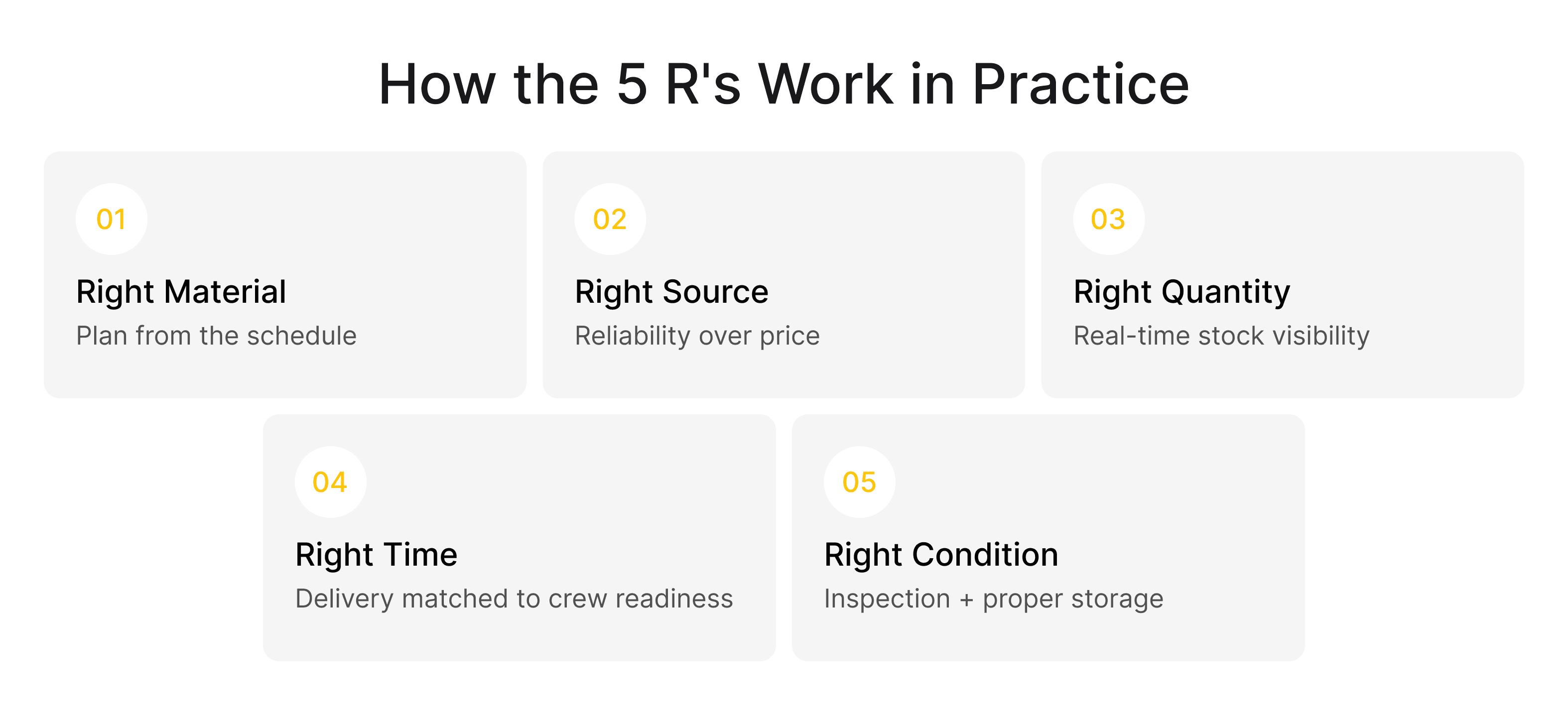
The 5 R's framework is a useful mental model for how construction materials management is structured. Each "R" represents a principle that should guide your material decisions throughout a project.
Material Requirements Planning (MRP)
The right material starts with the right plan. Material requirements planning means working backward from your project schedule to determine what you'll need, in what quantities, and when — so materials arrive when crews are ready to use them. A robust planning process also anticipates variance: lead times change, specs get revised, and a buffer needs to be built in without defaulting to overordering.
 Click to expand
Procurement and Supplier Coordination
The right source is about more than finding the cheapest vendor. Construction material procurement involves evaluating suppliers on reliability, lead times, quality track record, and flexibility. Single-source dependencies create real exposure, so building relationships with qualified alternates gives you both negotiating leverage and supply chain resilience. You can read more about how this fits into broader construction IT services strategy and digital procurement workflows.
Warehouse and On-Site Inventory Control
The right quantity means knowing exactly what you have — in the warehouse and on the jobsite — at any given moment. Proper inventory management of construction materials requires organized storage locations, clear labeling, regular cycle counts, and a single source of truth for stock levels.
Delivery Tracking and Logistics
The right time is where logistics meets execution. This involves scheduling deliveries around crane availability, laydown space, and crew readiness. Teams that have implemented real-time construction site mapping tools coordinate deliveries much more precisely, reducing site congestion and costly waiting time.
Material Quality Control
The right condition means materials that meet spec when they arrive and stay that way in storage. This includes receiving inspections, proper storage conditions, and traceability back to the supplier if issues surface during or after installation.
The Construction Materials Management Process
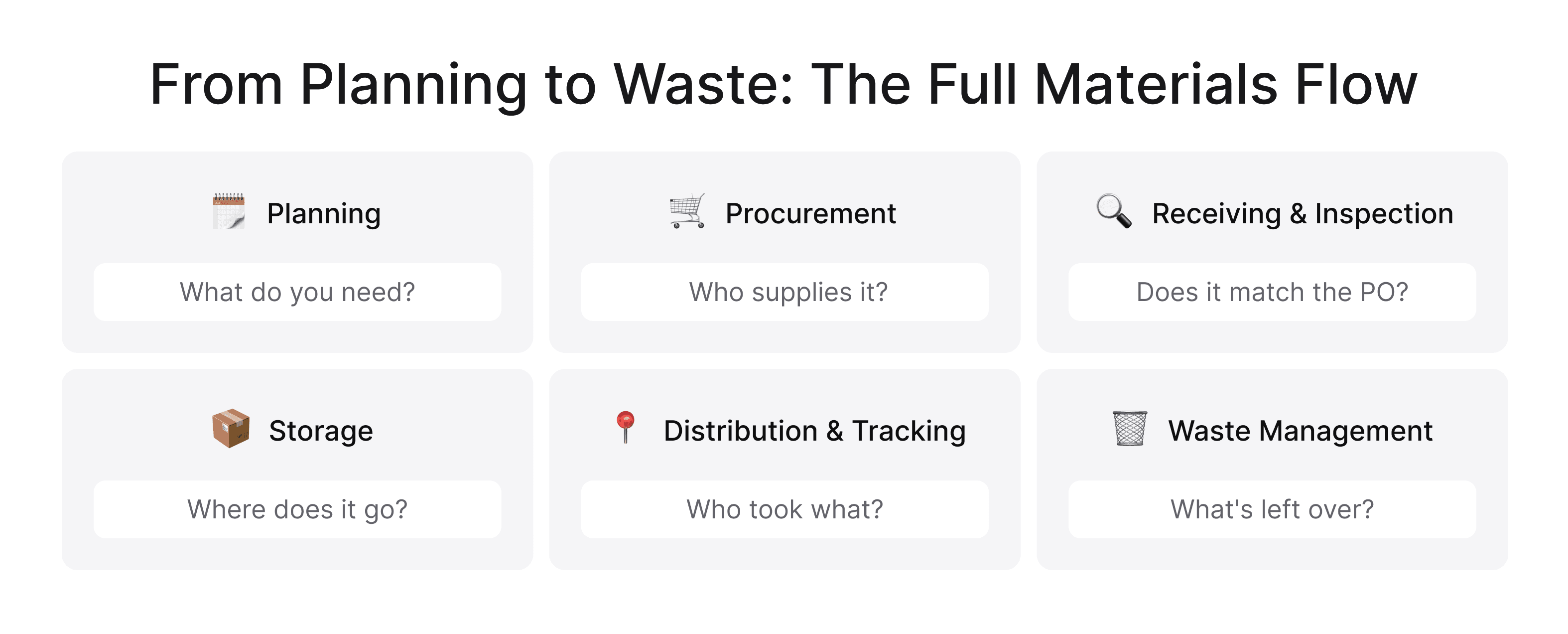
Here's how the full process flows from project kickoff to closeout.
Planning Material Requirements
Everything starts with the bill of materials (BOM). This document — ideally derived directly from your design drawings and BIM model — specifies every material needed, in the exact quantities required. Good planning at this stage prevents most downstream problems.
Sourcing and Procurement
Once requirements are defined, procurement teams go to market. This involves issuing RFQs, evaluating bids, negotiating contracts, and establishing delivery schedules. Construction material procurement decisions made here lock in your cost baseline and supply commitments for the project.
 Click to expand
Receiving and Inspection
When materials arrive, they need to be checked against the purchase order: quantity, spec, condition. This step is often rushed, but it's your last checkpoint before materials enter the supply chain. A damaged batch caught at receiving is far less expensive than one caught after installation.
Storage and Inventory Management
Materials need to be stored properly and tracked continuously. This means organized laydown areas, clear bin locations, documented stock levels, and a process for issuing materials to crews. The goal of good material management in construction is complete clarity about what's on hand.
Material Distribution and Usage Tracking
As materials move from storage to the work face, they should be tracked: who took what, when, and for which work package. This visibility feeds cost reporting, helps identify waste, and supports accurate forecasting for remaining work. Construction materials and management systems that track usage in real time give project managers a significant advantage.
Waste Management and Disposal
Every project generates material waste — off-cuts, damaged goods, over-ordered stock. How you handle this affects both your cost and your sustainability profile. Progressive firms track waste by material type and use that data to refine future procurement quantities.
Key Challenges in Managing Construction Materials
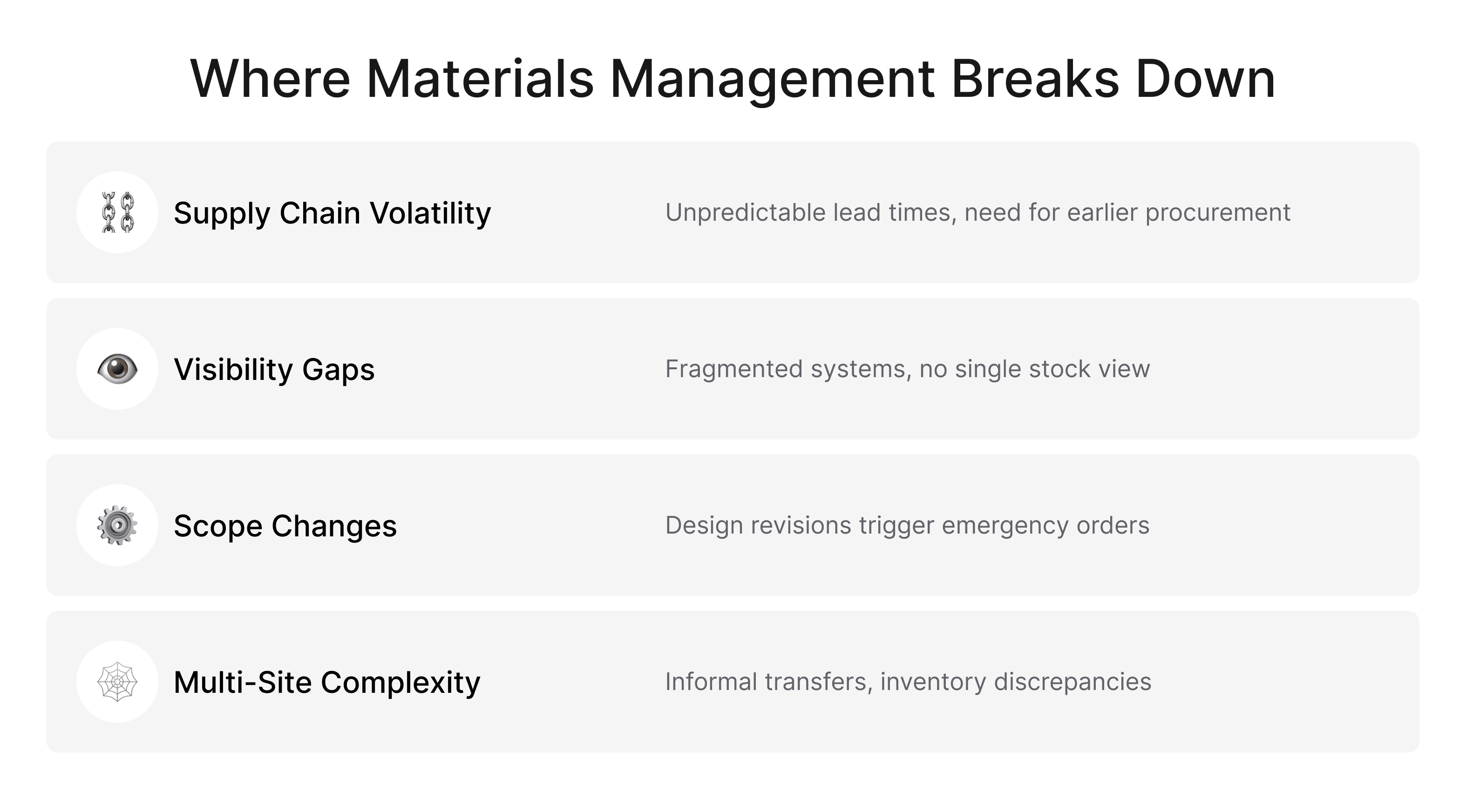
Material management construction teams face a consistent set of problems, regardless of project type or size.
Supply chain volatility tops the list. Lead times that were once predictable have become unreliable across many material categories. Managing this requires earlier procurement decisions and stronger supplier relationships than most teams are used to maintaining.
Visibility gaps are equally common. When field crews, warehouse staff, and procurement teams work from different systems — or no systems at all — the result is fragmented information and poor coordination. Nobody knows what's actually in stock.
 Click to expand
Scope changes compound everything. Design revisions mid-project can invalidate procurement already in progress, require returns, or trigger emergency orders at premium pricing. Without a system connecting design changes to material requirements, these impacts go unmanaged.
Multi-site complexity adds another layer. Managing materials across multiple simultaneous job sites is exponentially harder than managing them in a single project. Materials get transferred between sites informally, creating accounting problems and inventory discrepancies that are difficult to untangle.
Construction Materials Management Best Practices
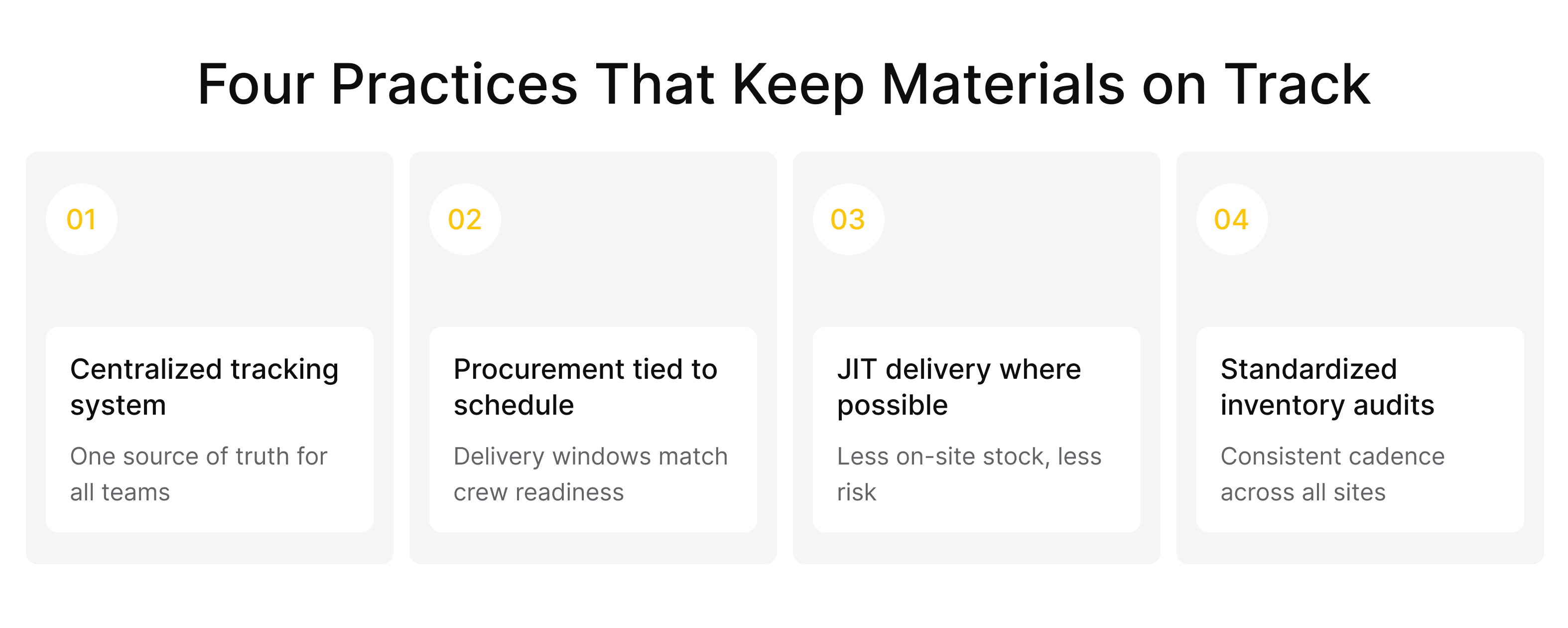
Build a Centralized Material Tracking System
The single biggest improvement you can make is consolidating all material data into one system. Whether you use a specialized platform or a properly configured ERP, the goal is a single source of truth that procurement, warehouse, and field teams all work from. Without centralization, you're coordinating across silos, and silos lose materials.
A management software development partner can help you design and build a centralized system that maps to your actual workflows rather than forcing your team to adapt to generic software logic.
Align Procurement With Project Schedule
Material orders should be tied directly to the construction schedule, with delivery windows matched to when crews will actually need the materials. This requires closer collaboration between the project management team and the procurement function than most organizations currently have.
If your procurement calendar and your Gantt chart live in separate systems and are reconciled manually, you have a gap that will eventually cause a problem.
Implement Just-in-Time (JIT) Delivery Where Possible
JIT delivery minimizes the amount of material stored on-site at any given time, reducing theft risk, storage costs, and site congestion. It requires tight coordination with suppliers and accurate scheduling, but the payoff is a cleaner, more efficient jobsite.
JIT works well for predictable, short-lead-time materials. High-lead-time items and materials subject to supply volatility still need buffer stock. Apply it selectively.
 Click to expand
Standardize Inventory Audits Across Job Sites
Inventory audits should follow a defined schedule and a consistent process across all locations. Regular counts help maintain accurate inventory records, while standardized procedures ensure data remains reliable and comparable between sites. Effective warehouse construction materials management depends on this consistency.
How to Measure Materials Management Performance: KPIs to Track
If you're not measuring it, you're not managing it. Here are the key performance indicators that actually matter for construction materials management:
- Material cost variance — actual spend versus budget, tracked by material category.
- Stockout rate — how often materials run out before the next delivery, causing crew downtime.
- Excess inventory ratio — value of materials on hand beyond what's needed for the next scheduled work packages.
- On-time delivery rate — percentage of supplier deliveries arriving within the scheduled window.
- Material waste rate — waste generated as a percentage of total materials consumed.
- Procurement cycle time — how long it takes from purchase request to material receipt.
Tracking these consistently gives leadership an early warning system for problems before they become budget casualties.
Technology's Role in Construction Materials Management
The technology available for construction material management has advanced significantly in recent years, and the firms adopting it are pulling ahead on project efficiency and cost control.
RFID and Barcode Tracking
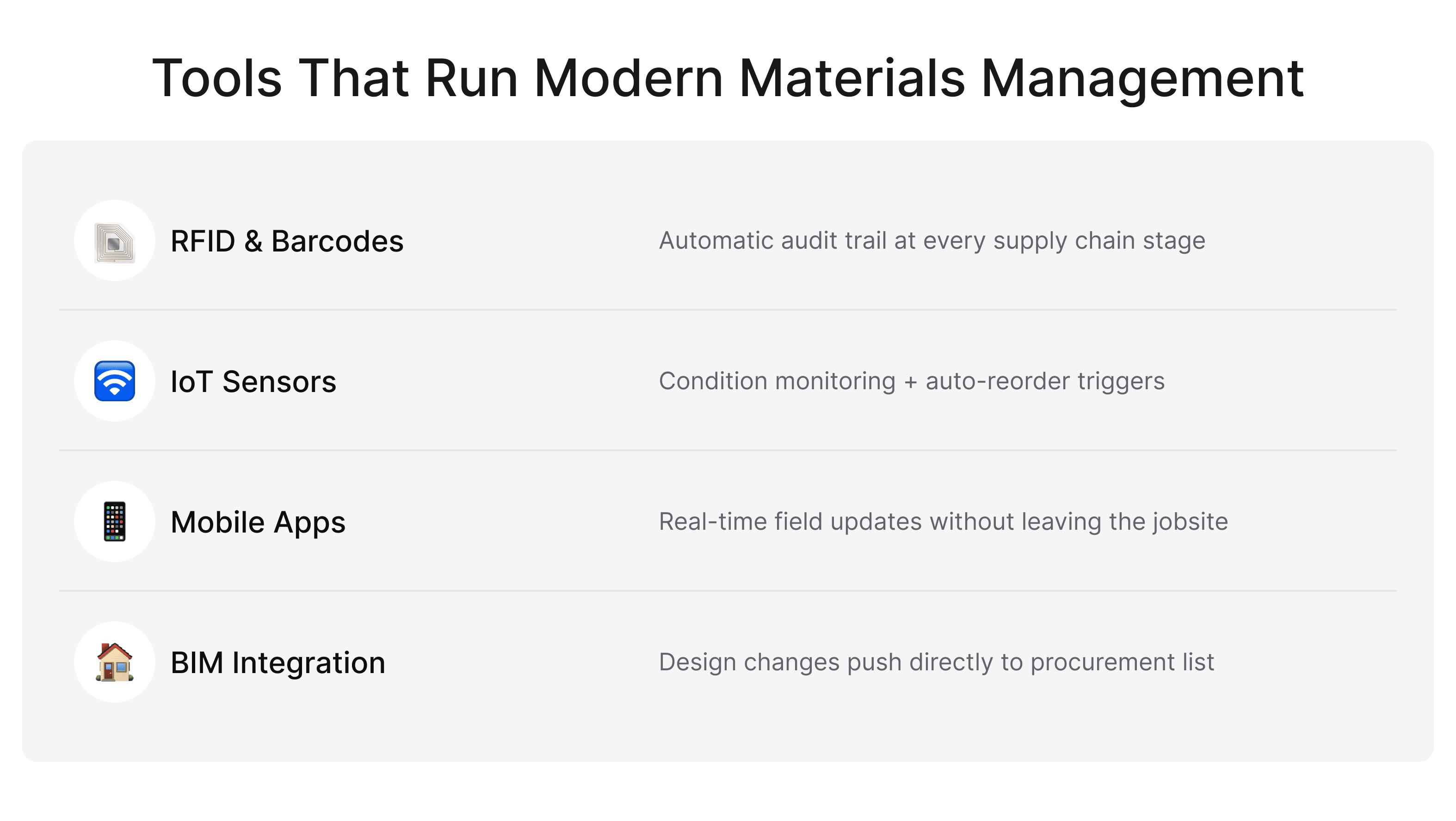
RFID tags and barcodes allow individual materials or pallets to be scanned at each stage of the supply chain — at the supplier warehouse, on delivery, at receiving, and as they move through the jobsite. This creates an automatic audit trail without relying on manual data entry, which is where most tracking systems break down.
The data feeds directly into inventory systems, giving managers accurate stock levels without physical counts. You can learn more about how this intersects with construction innovations and technology, and how top firms are deploying these tools at scale.
IoT Sensors and Smart Inventory Monitoring
IoT sensors go beyond tracking location — they monitor conditions. Temperature and humidity sensors in material storage areas can alert teams when concrete admixtures, adhesives, or other sensitive materials are at risk of degradation. Weight sensors in storage bins can automatically trigger reorders when stock falls below a threshold.
This kind of monitoring reduces the burden on staff while improving data accuracy. It's also a practical application of business process automation services in a construction context.
 Click to expand
Mobile Apps for Field Teams
Field crews shouldn't have to trek back to a site office to report material usage or request a delivery. Mobile apps connected to the central materials management system let foremen update inventory in real time, flag shortfalls, and confirm deliveries from their phone. The result is faster data and fewer errors from lag time.
BIM Integration for Material Planning
When your BIM model is linked to your procurement system, design changes automatically propagate to the material requirements list, ensuring your procurement team always works from current quantities. This kind of integration requires developers who understand both the construction domain and enterprise software architecture. If you're looking to hire ERP developers with construction-sector experience, that combination of domain knowledge and technical depth is worth seeking out.
Construction Materials Management Software: What to Look For
The market for material management software for construction is broad — from large ERP platforms with construction modules to lightweight jobsite-specific tools. The right choice depends on your project complexity, team size, and existing tech stack.
Capabilities that actually matter:
- Real-time inventory visibility across all storage locations and job sites
- Purchase order management tied to project schedules
- Supplier and contract management with performance tracking
- Mobile access for field teams and delivery confirmation
- Integration with accounting, ERP, and project management tools
- Configurable reporting and KPI dashboards
Off-the-shelf platforms often require you to fit your operations to their logic rather than the other way around. For firms with complex or specialized workflows, this is where custom development becomes a serious conversation.
Incora builds custom systems designed around how your teams actually work. Whether you're integrating with an existing ERP, building a standalone platform, or layering AI automation services onto manual processes, a custom solution gives you control that packaged construction materials management software rarely offers.
Common Mistakes to Avoid in Construction Materials Management
Overordering Materials
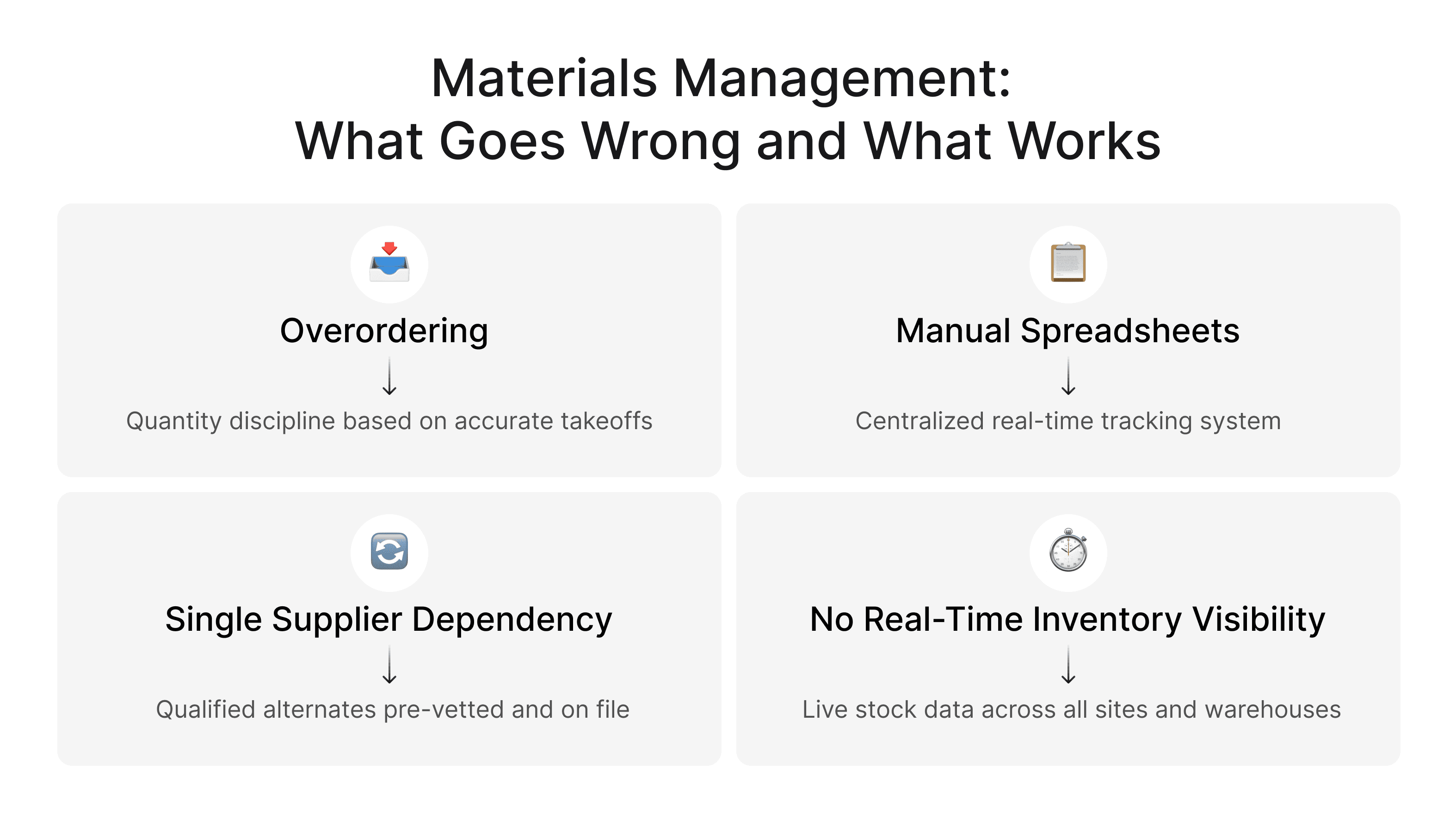
Overordering feels like a safe strategy — you'd rather have too much than run out. The problem is that excess material ties up capital, creates storage challenges, increases the risk of theft and damage, and often ends up as waste. Disciplined quantity management, informed by accurate takeoffs and real usage data, is a more effective approach than cushioning every order.
Relying on Manual Spreadsheets
Spreadsheets don't update in real time, they don't connect to your other systems, and they break down the moment two people try to edit the same file. If your material tracking still lives primarily in Excel, you have a meaningful upgrade waiting to happen.
 Click to expand
Poor Supplier Diversification
Depending on a single supplier for critical materials is a risk that often goes unnoticed until a disruption hits. Construction material procurement strategy should include qualified alternates for every key material category — pre-vetted, with pricing benchmarks on file — so you can pivot quickly if your primary source fails to deliver.
Lack of Real-Time Inventory Visibility
When project managers don't know what's on hand, they make conservative decisions: ordering more, stockpiling materials, avoiding risk. Real-time visibility changes the decision-making environment. When you know exactly what you have and where it is, you can operate leaner and respond faster. This is the core argument for investing in proper construction materials management software.
The Future of Construction Materials Management
The direction is clear: more automation, more data, and tighter integration between design and procurement.
AI-powered demand forecasting is emerging as a practical capability — systems that learn from historical project data to predict material requirements more accurately than manual estimates. This is particularly valuable for material categories with long lead times or significant price volatility.
Drone-based inventory counting and autonomous delivery are gaining traction, and material management software for construction will need to keep pace — integrating with field hardware and processing real-time data streams. Sustainable materials management is also shifting from a differentiator to a compliance requirement: tracking embodied carbon, managing material certifications, and minimizing waste are increasingly mandated by clients and regulators.
Not sure where to start with construction materials management?
We can help you figure out what's actually slowing you down and what to build first.
Material management construction practice will continue evolving toward tighter ERP and BIM integration — where the full project data model, from design to procurement to closeout, lives in connected systems rather than isolated tools.
Final Takeaway
Construction materials management is a core driver of project performance — affecting cost, schedule, quality, and your ability to adapt when conditions change.
The firms doing it well share a few traits: real-time visibility into their inventory, procurement tightly connected to their project schedule, and technology that reduces the burden of manual tracking. They treat materials data as something to be analyzed and improved, not just recorded.
If your current approach relies heavily on spreadsheets, phone calls, and individual expertise, the gap between you and well-run competitors is real — and it shows up on every project.
FAQ
What is the difference between material management and procurement in construction?
Procurement covers sourcing, purchasing, and supplier management — getting materials under contract and delivered. Material management in construction encompasses the entire lifecycle: planning, procurement, receiving, storage, distribution, tracking, and waste. Procurement is one subprocess within the larger system.
What software is used for construction materials management?
Common platforms include Procore, Autodesk Construction Cloud, Oracle Primavera, and various ERP systems with construction modules. Construction materials management software requirements vary significantly by company size and project type, which is why custom solutions are increasingly popular for firms with complex or specialized needs.
How does inventory management work on a construction site?
On-site inventory management typically involves designated storage areas with organized bin locations, a check-in/check-out process for materials, regular stock counts, and a system for recording material usage by work package. In more advanced setups, RFID or barcode scanning automates much of this tracking and feeds directly into construction materials management systems.
What are the biggest risks in construction material supply chain?
The major risks include supplier concentration, lead-time volatility, price fluctuations in commodity materials, quality inconsistencies, and logistics disruptions. Effective material management in construction helps address these challenges through diversified sourcing, early procurement, quality inspection protocols, and real-time tracking.


YOU MAY ALSO LIKE


Get in Touch
Got no clue where to start? Why don't we discuss your ideas?

