



By Bohdan Vasylkiv
- CEO & Co-Founder
How Artificial Intelligence Transforms ERP Systems
Learn how AI in ERP automates routine tasks, enhances data analysis, and enables proactive decision-making. Explore generative & agentic AI use cases.
Key Takeaways
- AI turns ERP from a record-keeping system into a real-time decision-making engine.
- Modern platforms use ML, NLP, RPA, generative AI, and agentic AI, each solving different operational problems.
- Successful implementation starts with clean data and clearly defined use cases, not technology choices.
- ROI from AI-enhanced ERP is measurable only when implementation is phased and tied to real business goals.
Enterprise resource planning software has been around for decades. For most of that time, it was essentially a very expensive filing system. It stored data, tracked transactions, and generated reports. What it couldn't do was interpret patterns, automate decisions, or adapt dynamically. That's changing fast. Today, AI in ERP is reshaping what enterprise software can actually do: record what happened, predict what's coming, automate repetitive tasks, and surface insights that would otherwise take hours to uncover.
If you're evaluating whether to bring AI for ERP into your environment, this guide breaks it down clearly. A practical look at what works, what doesn't, and what it takes to get there.
What Is AI in ERP and Why Does It Matter Now?
AI for ERP means embedding machine intelligence, learning algorithms, language models, and automation engines directly into the systems that run your business. It's the difference between a system that tells you what your inventory level is and one that tells you it'll run out in 11 days, suggests a reorder quantity, and flags a supplier whose lead times have been slipping.
Why now? 3 things converged: cloud ERP made it feasible to process large volumes of operational data in real time, open-source AI frameworks significantly lowered the barrier to entry, and businesses began generating more structured data than any team could realistically analyze. For a broader view of how this fits into enterprise strategy, the AI integration in business guide is a useful starting point.
The difference between AI, ML, and automation in ERP context
These terms are often used interchangeably, even though they serve different purposes. Automation handles rule-based tasks; machine learning identifies patterns and makes predictions; and AI includes ML, language understanding, and reasoning. Most ERP vendors group all 3 under the AI ERP label, so it's important to understand which technology is actually driving the feature.
Core AI Technologies Built Into Modern ERP Platforms
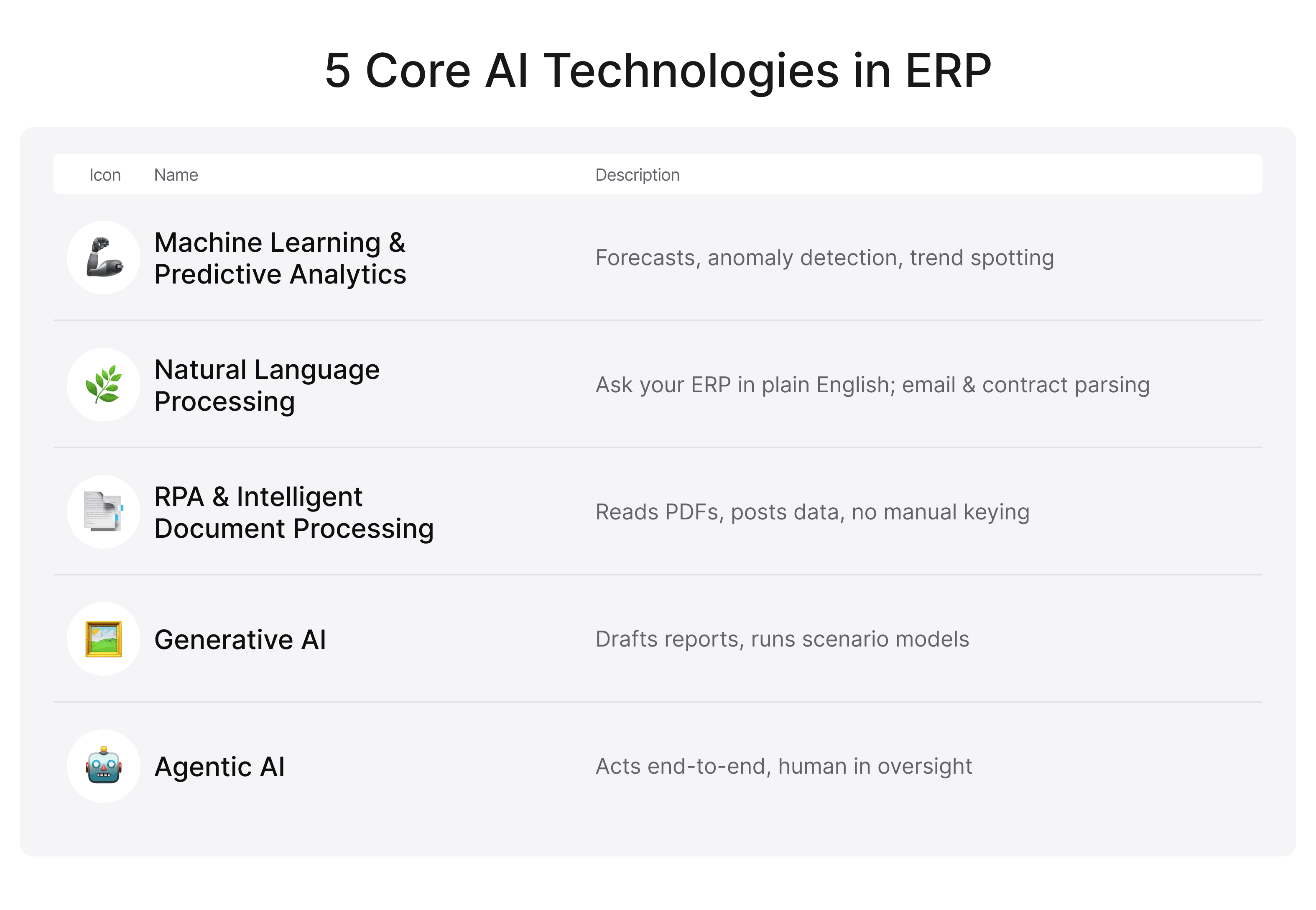
Machine learning and predictive analytics
Machine learning is the workhorse of AI in ERP systems. It powers demand forecasting, cash flow modeling, and anomaly detection. With enough historical data, ML models can identify patterns teams would likely miss manually. Poor-quality data remains a major risk, since inaccurate inputs lead to unreliable predictions. This is why data readiness and governance matter before implementation begins.
Natural language processing and conversational ERP interfaces
NLP lets users interact with ERP through plain language, asking "What were our top-performing SKUs in Q1?" and getting an answer without building a report. More advanced NLP enables automated contract analysis, sentiment parsing from CRM data, and multilingual support across global operations. It's one of the clearest examples of artificial intelligence and ERP working together to reduce friction without requiring big technical change on the user side.
Robotic process automation and intelligent document processing
RPA bots handle structured, repetitive tasks: data entry, invoice matching, payroll processing. When combined with AI automation services like OCR and document intelligence, they can also process unstructured inputs such as PDFs, scanned invoices, and handwritten forms, routing them into ERP workflows automatically. The result is less manual handling, fewer entry errors, and faster processing cycles.
 Click to expand
Generative AI in ERP: from report drafting to scenario modeling
Generative AI in ERP is still maturing, but the early applications are genuinely compelling. Think AI-drafted financial narratives, auto-generated supplier communications, and scenario-planning outputs that model a 15% cost increase across your entire supply chain. Some platforms now let users describe a report in plain English and have the system generate it with no SQL required. What makes generative AI in ERP significant is that it shifts who can access complex data insights, putting that capability in the hands of business users rather than analysts alone.
Agentic AI in ERP: the shift from copilots to autonomous operations
The most significant shift on the horizon is agentic AI in ERP. Unlike copilot-style systems that mainly suggest and assist, these systems can autonomously complete multi-step tasks across ERP modules, trigger procurement when stock reaches a threshold, reschedule production after supplier delays, and escalate exceptions only when human review is required. The gap between concept and production deployment is closing faster than many enterprises expect.
How AI Works Inside ERP Systems: A Process-Level Breakdown
Understanding how does AI work in ERP systems at the process level helps you identify where the real gains are and where the risks concentrate. Here's a breakdown across the core ERP domains.
AI in financial management and automated close
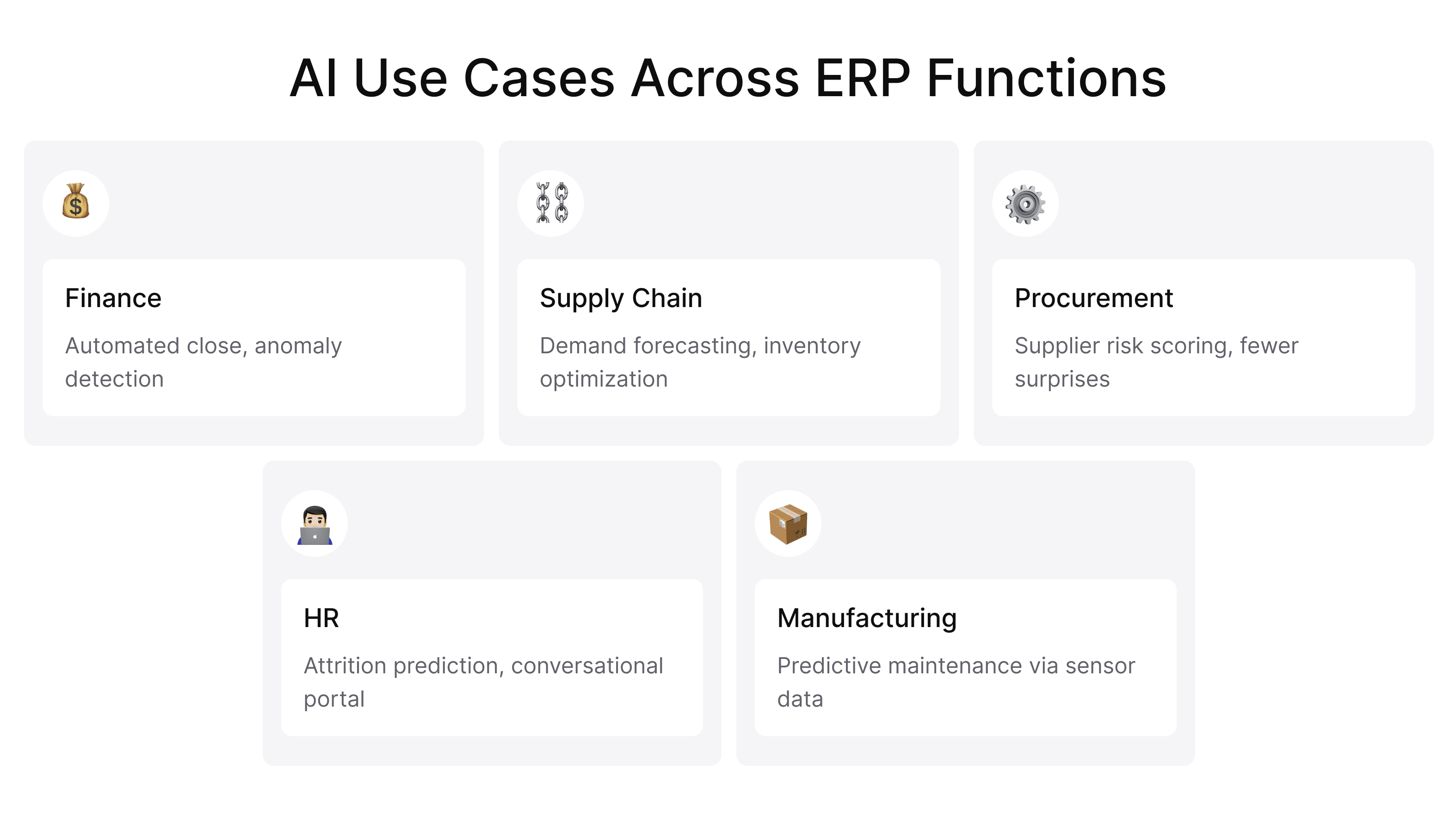
AI cuts financial close cycles from weeks to days through continuous transaction matching, automated reconciliation, and anomaly flagging. Add predictive cash flow forecasting, and you have a finance function that's ahead of the curve rather than perpetually catching up.
AI-driven demand forecasting and inventory optimization
AI in ERP systems enables forecasting that layers in external signals such as weather data, competitor pricing, and social trends on top of historical sales. For businesses carrying significant inventory, even a 10-15% improvement in forecast accuracy translates into real working capital gains. Connecting this to business process automation workflows turns forecast outputs into automatic replenishment actions with no manual handoff required.
 Click to expand
Procurement intelligence and supplier risk scoring
ML models continuously score suppliers on delivery performance, quality metrics, and financial stability, then surface that intelligence when a buyer is making a sourcing decision. One of the most underestimated AI and ERP use cases in practice, and one that delivers fast, measurable value when implemented well.
HR and workforce planning
AI enables prediction of attrition risk, intelligent job matching, and automated onboarding workflows. Workforce models can simulate the impact of hiring timelines on project delivery or flag teams where burnout risk is climbing, giving HR better information to act on.
Predictive maintenance in manufacturing
Sensors feed real-time equipment data into the ERP, and ML models detect patterns that precede failures, triggering maintenance work orders before a breakdown occurs. Planned maintenance is always cheaper than unplanned downtime.
Examples of AI in ERP Delivering Business Results
Here's where it gets concrete. These AI in ERP examples show what the technology looks like in actual production environments.
Unilever: AI forecasting in supply chain operations
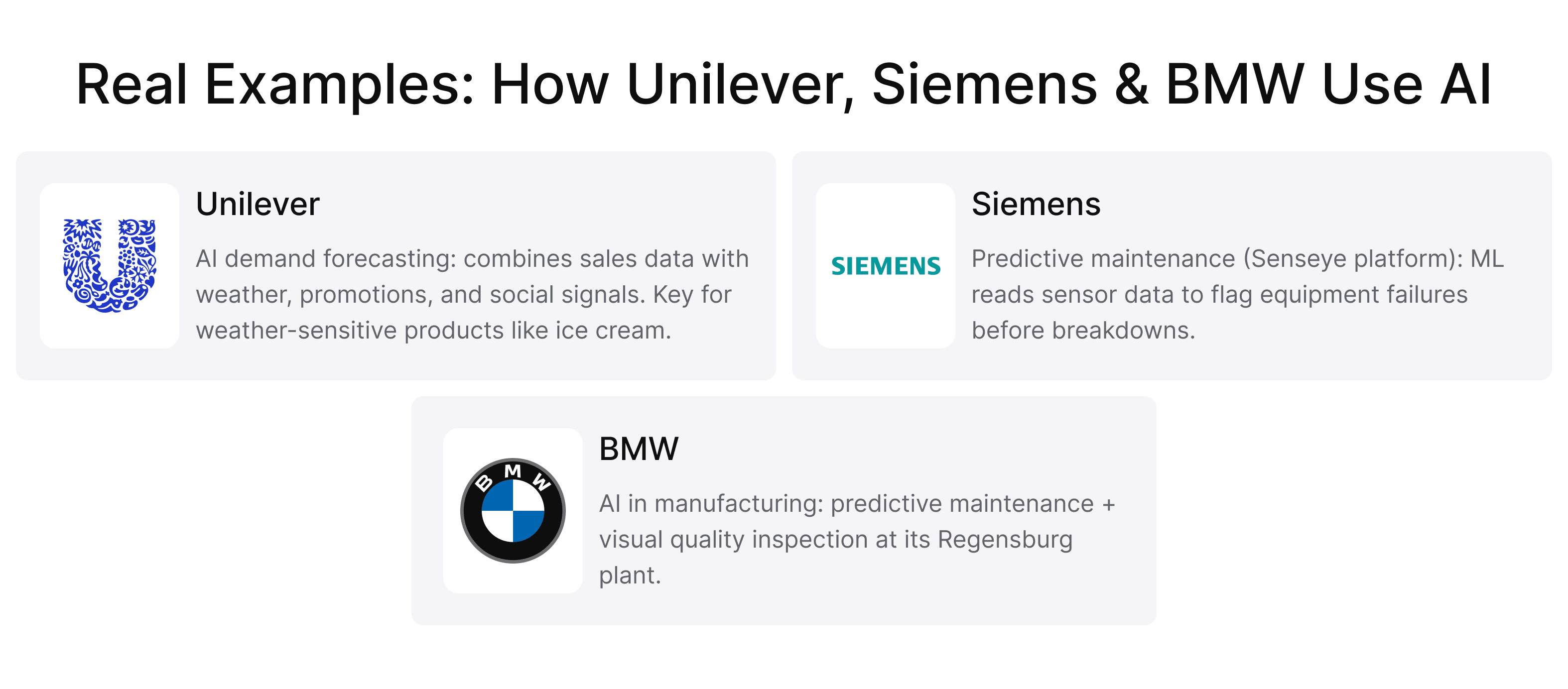
Unilever uses AI-driven forecasting across its supply chain to improve demand planning and inventory management. The company combines historical sales data with external signals — promotions, regional trends, weather conditions, and social listening insights — to respond faster to market changes. This kind of AI in ERP matters most in weather-sensitive categories like ice cream, where accuracy directly drives production and replenishment. Businesses building similar systems often hire ERP developers who understand both operational workflows and data architecture.
Siemens: predictive maintenance and anomaly detection
Siemens uses AI-powered predictive maintenance to monitor industrial equipment and catch potential failures before breakdowns happen. Through its Senseye platform, machine learning models analyze sensor and operational data to flag abnormal equipment behavior and guide maintenance planning. These systems already run in manufacturing environments where reducing unplanned downtime is critical to keeping production lines moving.
 Click to expand
BMW: AI-powered manufacturing operations
BMW applies AI for ERP connected manufacturing operations across predictive maintenance, quality inspection, and production monitoring. At its Regensburg plant, machine learning models analyze conveyor and sensor data to detect anomalies before failures interrupt production. The company also runs AI-based visual inspection systems that improve quality control and reduce manual review on the line.
Key Business Benefits of Integrating AI Into Your ERP
Operational efficiency and cost reduction
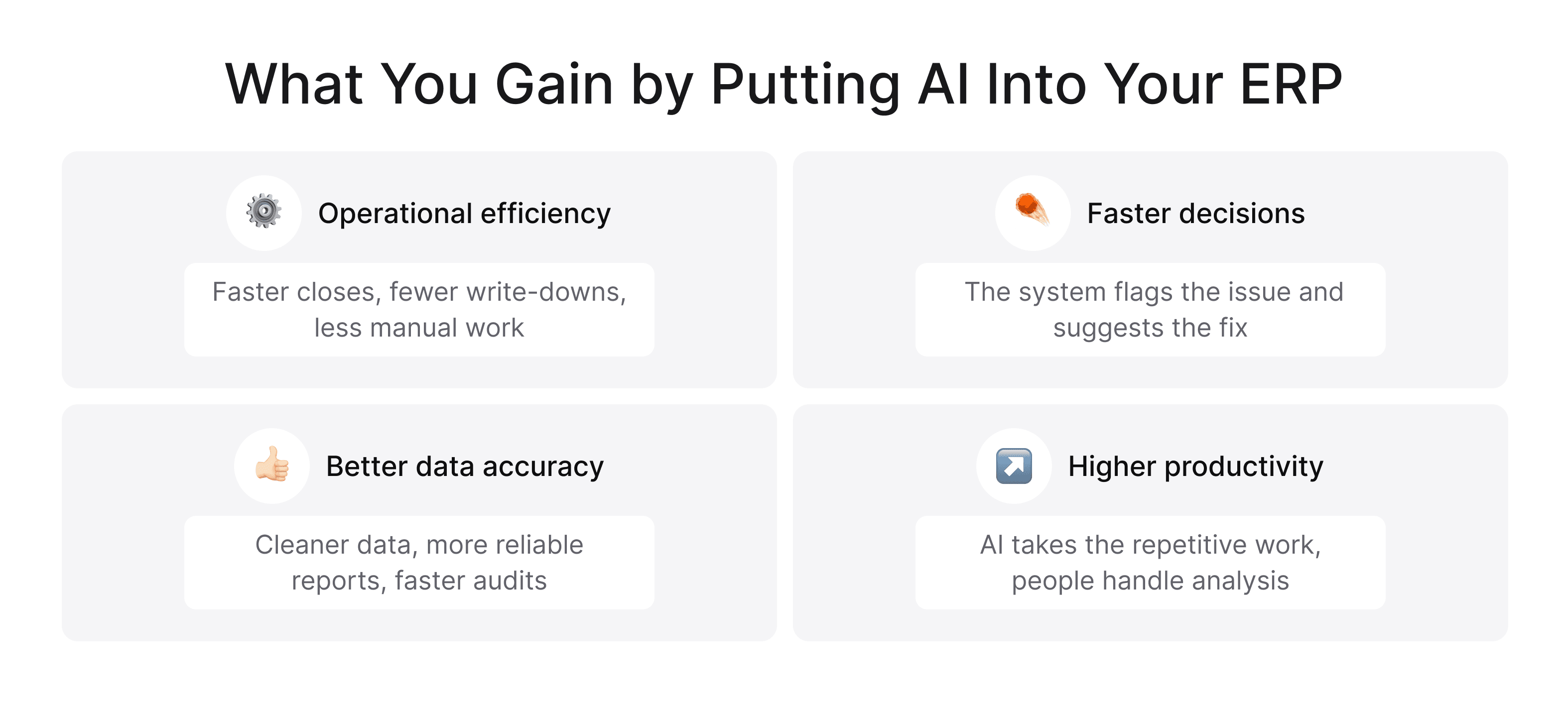
The case for artificial intelligence ERP adoption is well-documented. Automated invoice processing, intelligent scheduling, and ML-driven inventory management reduce both labor and processing costs and, more importantly, reduce decision-making latency across every department.
Smarter decisions across departments
When a demand planner can ask a natural-language question and get a real-time answer instead of waiting for a BI report, decisions happen faster across the organization. AI ERP systems make operational insights more accessible across departments and closer to day-to-day operations.
Improved data accuracy
Knowing how is AI used in ERP to reduce errors matters practically. AI catches data entry mistakes before they propagate, flags duplicate records, and validates inputs against historical patterns. In compliance-heavy industries, this is as much risk management as it is efficiency. Companies operating across multiple regions benefit most, since data inconsistencies across entities are among the most costly ERP problems in practice.
 Click to expand
Employee productivity through intelligent automation
When AI and machine learning in ERP automation handle document processing and routine exceptions, teams spend more time on analysis, planning, and decision-making. In many organizations, this shift becomes one of the most valuable long-term benefits.
Challenges and Hidden Risks
Data quality problems that break AI models
AI doesn't fix data problems. It amplifies them. An ML model trained on inconsistent ERP data produces confident, precise, and wrong predictions. Before investing in AI capabilities, invest in data governance. Standardize master data, establish stewardship processes, and audit quality across your ERP modules. It determines whether the model is useful at all.
Change management and user adoption barriers
Intelligent ERP capabilities lose value when users don't trust the system behind them. Teams need to understand why recommendations appear, what data supports them, and where human oversight still applies. Without that clarity, employees ignore automated suggestions and return to manual workflows. Training and transparency are essential for adoption.
Security, compliance, and AI governance
Who is accountable when AI in ERP makes a wrong procurement decision? How do you audit an AI-generated financial narrative for compliance? These questions need explicit policies before deployment. Building on a custom ERP environment requires teams who understand both the data architecture and the compliance requirements from day one.
How to Implement AI in ERP
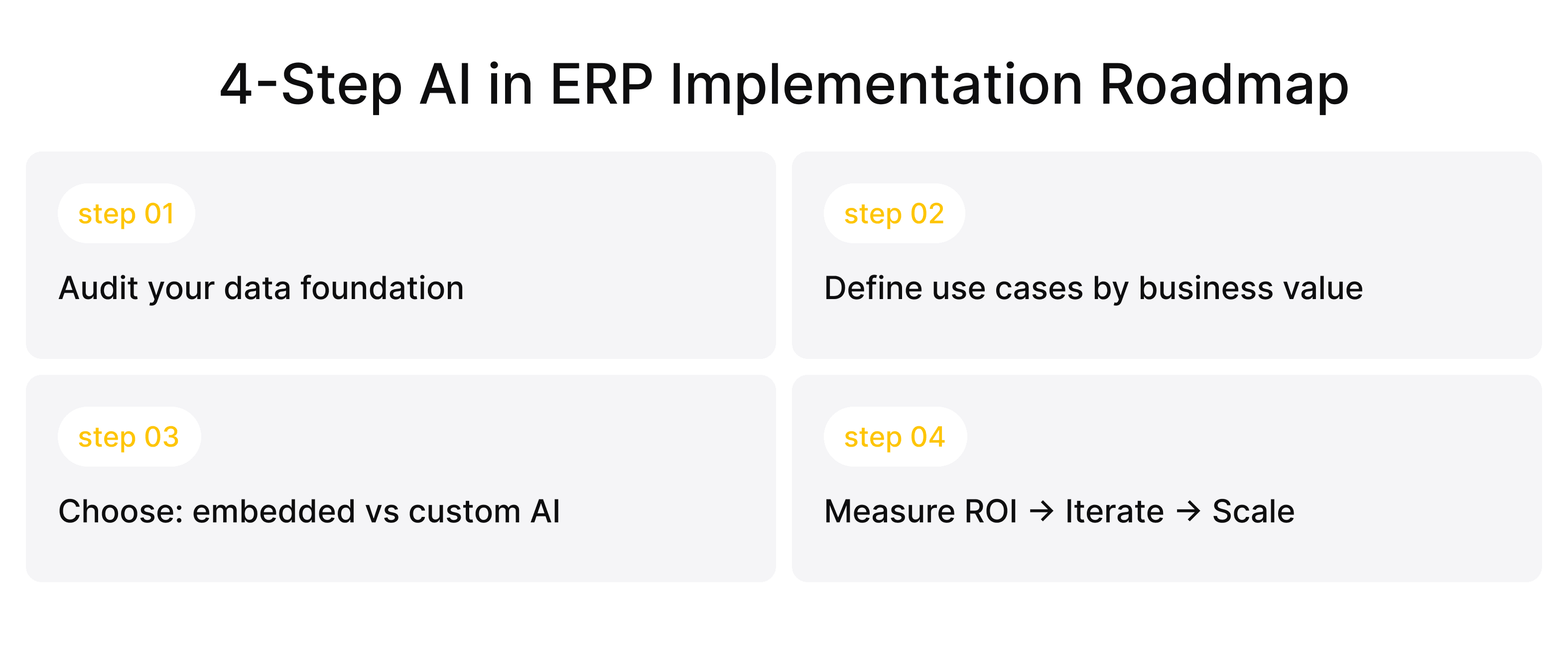
Step 1: Audit your data foundation
Before selecting technology, assess your data. Map flows across ERP modules, identify quality gaps, and prioritize remediation in areas tied to your target use cases. No AI layer fixes a broken data foundation underneath it.
Step 2: Define use cases by business value
Start with a specific operational problem and work backward to the AI capability that addresses it. ERP with AI delivers value when the goal is concrete. "Reduce invoice processing time from 5 days to 1 day" is a real goal. "Use AI to improve operations" is not. The clearer the use case, the faster you see ROI.
Step 3: Choose between embedded AI and a third-party layer
Major platforms, including SAP Joule, Microsoft Copilot for Dynamics 365, and Oracle AI in Fusion Cloud, include native AI in ERP software features worth evaluating. When your ERP is heavily customized or runs on a niche-industry platform, a third-party AI layer via an API often offers greater flexibility. That's where custom ERP development expertise becomes relevant, particularly when standard embedded options don't match your process architecture.
 Click to expand
Step 4: Measure ROI and scale gradually
Set baseline metrics before launch. Start with one use case, one business unit, and expand based on demonstrated results. Phased approaches consistently outperform big-bang rollouts.
The Future of AI in ERP: Agentic Systems and What's Next
The next generation of AI and ERP integration is about systems that act rather than systems that advise. Large language models are beginning to serve as the reasoning layer atop structured ERP data, enabling natural-language querying and cross-module orchestration that would have required extensive custom development just two years ago.
Agentic AI in ERP takes this further. The system detects a condition, a demand spike, a supplier risk signal, a budget threshold and executes a response without waiting for human initiation. The constraint today is organizational rather than technological. Autonomous systems require clear decision boundaries, escalation rules, and governance frameworks. Building those requires both technical depth and domain knowledge, which is why teams that pair Python developers for AI integration with ERP domain expertise tend to move faster in this space.
Not sure where to start with AI in ERP?
We can help you figure out what's actually slowing you down and what to build first.
Final Takeaway
Artificial intelligence in ERP is already reshaping how companies manage operations, automate decisions, and respond to change. The organizations achieving the strongest results are usually the ones that start with a clearly defined operational problem, build a reliable data foundation, and gradually expand implementation based on measurable outcomes.
At Incora, we build custom AI and ERP solutions tailored to specific operational contexts, matching the right architecture to the right problem, whether that's an embedded AI layer, a third-party integration, or a fully custom build.
The ERP systems that will define the next decade are the ones that learn, adapt, and act. Getting there is a deliberate process. The trajectory is clear, and the tools are available.
FAQ
What is the difference between AI and traditional ERP automation?
Traditional automation follows explicit rules, is deterministic, and human-configured. AI for ERP learns from data, adapts to new patterns, and handles situations the original rule-writer didn't anticipate. It extends automation into areas where static rules simply aren't sufficient.
Which ERP systems have the most advanced AI capabilities?
SAP S/4HANA with Joule AI, Oracle Fusion Cloud ERP, and Microsoft Dynamics 365 currently lead. SAP excels in manufacturing and supply chain AI, Oracle in financial AI and predictive analytics, and Microsoft integrates tightly with the Azure AI ecosystem. The right choice depends heavily on your industry and process priorities.
How does AI improve supply chain management in ERP?
Through smarter demand forecasting that incorporates external signals, supplier risk scoring, automated reordering, and real-time exception management. ERP with AI in supply chain is one of the most mature application areas and one of the fastest to show measurable ROI.
Is AI in ERP suitable for small and mid-sized businesses?
Increasingly yes. Cloud ERP has made AI for ERP accessible without the costs of enterprise-level infrastructure. SMBs should focus on use cases with sufficient data history. Invoice automation and demand forecasting are reliable starting points.
What are the biggest risks of implementing AI in ERP?
Poor data quality, inadequate change management, and unclear governance. All three are manageable, but they need attention from the outset of the project.
How long does it take to see ROI from AI in ERP?
For well-scoped use cases, measurable ROI typically appears within 3 to 6 months. Broader programs across multiple modules take 12 to 18 months. Data readiness and the speed of user adoption are the main variables.


YOU MAY ALSO LIKE



Get in Touch
Got no clue where to start? Why don't we discuss your ideas?

