This site uses cookies to improve your user experience. Read our Privacy Policy




By Tetiana Stoyko
- CTO & Co-Founder
How We Build AI Tools to Simplify Construction Contract Review and Risk Detection
AI construction contract review that scans contracts in minutes, flags hidden risk, and helps construction teams replace slow, manual reviews.
Construction projects live and die by their construction contracts. But manually reviewing them is time-consuming, and errors are costly.
That's why we built AI tools that handle the heavy lifting, scanning contracts in minutes, spotting risks before they become problems, and turning what used to take hours into seconds of actual work.
In this article, we'll walk you through exactly how we approach AI construction contract review, what problems it solves, and why construction companies are shifting away from the old way of doing things.
Whether you're a project manager tired of missing critical clauses or a legal team drowning in document volume, this is for you.
The Problem: Why Traditional Contract Review Doesn't Work Anymore
The Hidden Cost of Manual Review
Let's start with the reality: reviewing construction contracts manually is slow, expensive, and inherently flawed.
A typical construction contract runs 15–50 pages. It's full of complex legal language, nested conditions, and clauses that interact in ways that aren't always obvious on a first read.
When your team reviews these documents manually, they rely on consistency, attention to detail, and memory.
Over a long day or across multiple projects, human reviewers tire. They miss things:
- A vague payment term slips through.
- A liability clause doesn't match your company's standard.
- A missing insurance requirement doesn't surface until there's a problem on site.
The cost isn't just the hours spent reading. It's the downstream impact:
Disputes that could have been prevented, scope creep that wasn't caught early, and payment issues that drag on for months.
What Construction Teams Actually Need
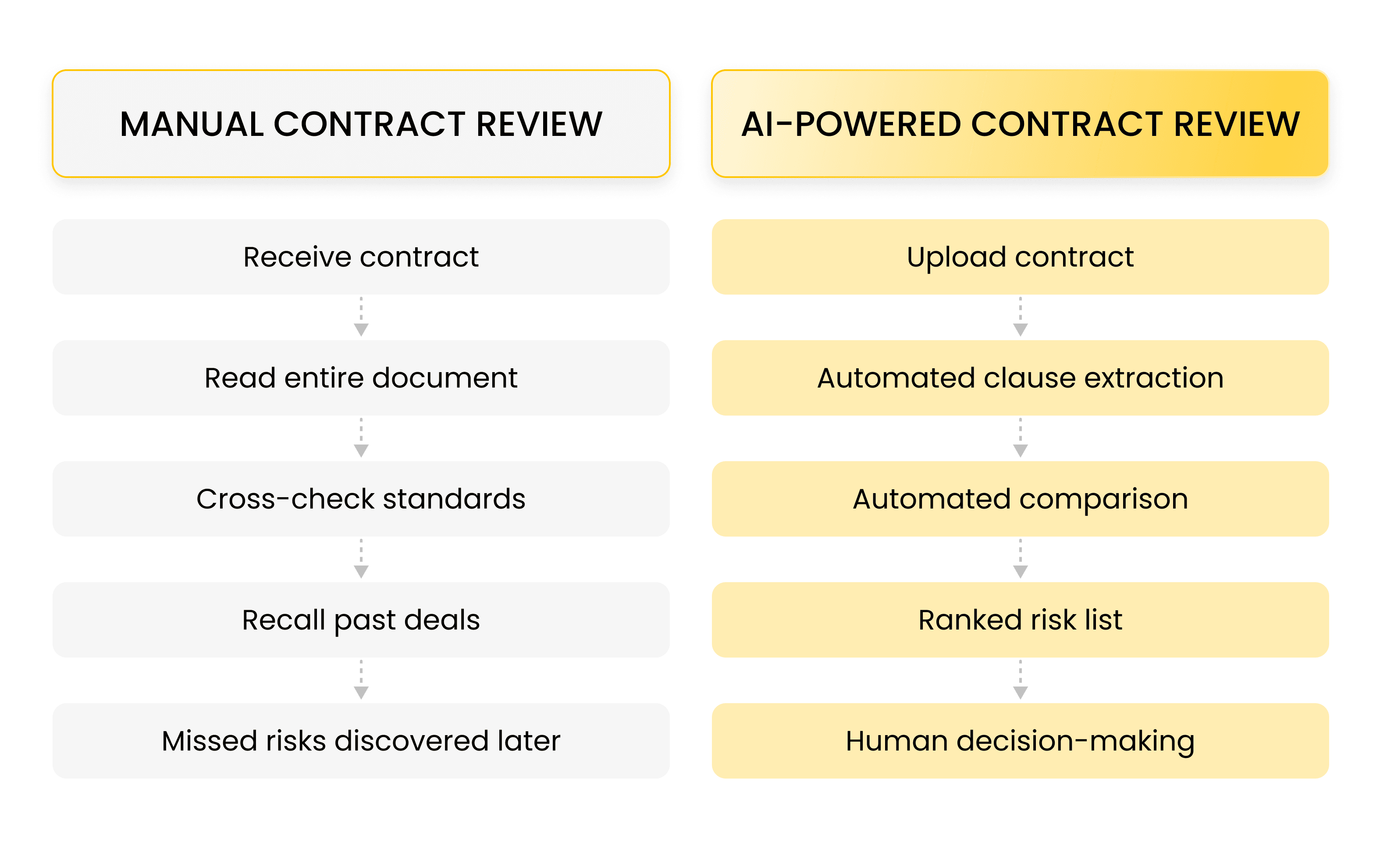
Construction contract analysis used to mean sitting down with a contract, highlighter in hand, comparing it against your internal standards and past deals.
It's thorough, but it's manual. In the construction industry, where projects move fast and timelines are tight, slow review processes create bottlenecks.
What teams really needed was a way to handle contract reviews that's:
- Fast: Review and flag issues in minutes, not days
- Consistent: Apply the same standards to every contract, every time
- Comprehensive: Catch the small details that matter
- Focused: Tell your team exactly what needs attention so that they can negotiate rather than search
That's what modern AI can do. But getting there required rethinking how we approach the entire process.
 Click to expand
The Solution: How AI Powers Better Contract Analysis
What AI Actually Does in Contract Review
When we built our AI construction contract review tools, we set a simple goal: AI automation in business routine tasks so people could focus on the essentials.
Here's what that means in practice.
Our system uses natural language processing, a branch of AI that teaches computers to understand human language the way lawyers and project managers do, to read and interpret construction contracts.
But it doesn't just skim the surface. It understands contract structure, recognizes clauses, interprets their meaning in context, and compares them against your company's standards and past negotiations.
Think of it like this: instead of a human sitting down and manually comparing a new subcontractor agreement against ten past agreements and your internal playbook, the AI does that comparison instantly.
It highlights where the new contract deviates from your standards, flags potentially risky clauses, and explains what those deviations mean in plain English.
The Technology Behind the Magic
Three core technologies enable a modern contract review solution.
Natural Language Processing (NLP) teaches the system to understand legal language.
Construction contracts use specific vocabulary, recurring clause structures, and dense nested language. NLP lets the AI parse that language and extract meaning.
When it sees "Contractor shall indemnify and hold harmless the Owner from and against all claims," the system understands what that sentence obligates the contractor to do.
Machine Learning (ML) finds patterns.
When we feed the system thousands of construction contracts, it learns what clauses typically look like, what variations are normal, and what patterns tend to signal risk.
It understands that vague payment terms often lead to disputes. It knows that the absence of force majeure language creates exposure.
These patterns let it flag issues that match historical risk patterns.
Automated Comparison does what your team used to do manually.
Our systems compare each new contract against your company's templates, your jurisdiction's standard terms, and past agreements you've negotiated.
It spots deviations instantly and explains what changed.
Together, these technologies transform construction contract analysis from a manual, time-consuming process into a scalable process.
Building Risk Detection Into the Process
 Click to expand
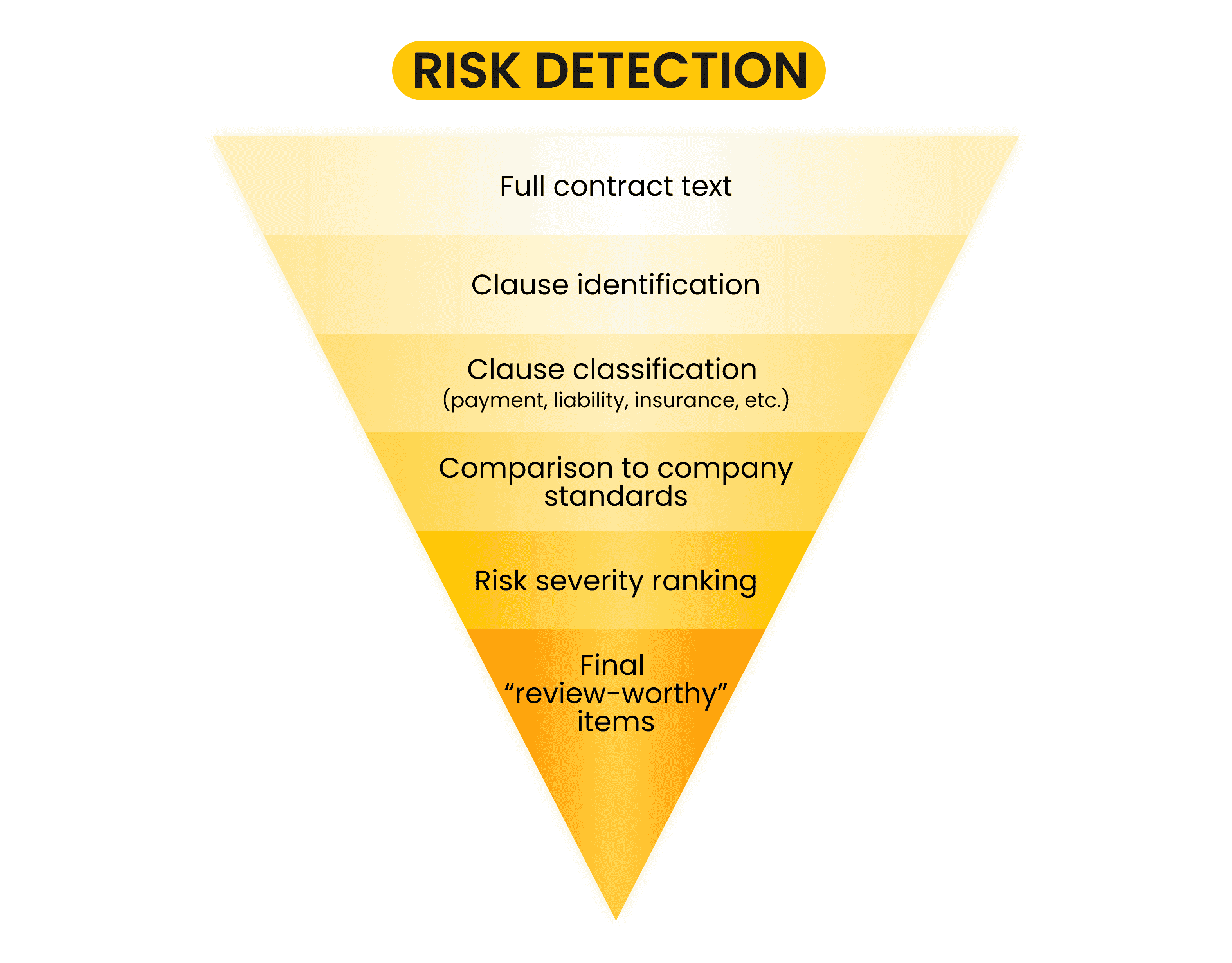
The real power emerges when you add risk detection to document analysis.
Risk detection starts with understanding your playbook.
Every construction company has standards: payment terms, insurance thresholds, indemnity language, liability caps, and dispute-resolution processes.
When we set up IT solutions for construction, we first codify those standards into the system.
We create a risk framework that defines what's acceptable, what's a warning sign, and what's a deal-breaker.
Once that framework is in place, the AI doesn't just identify clauses. It evaluates them against your standards.
A payment term that deviates from your norm gets flagged.
Missing insurance language gets highlighted. Liability language that conflicts with your standards gets called out.
The system ranks these findings by severity, so your team focuses on the high-impact issues first.
The result: instead of a team member spending four hours reviewing construction contracts, they spend 20 minutes addressing the specific risks the AI identified.
Why Construction Is a Perfect Use Case for AI
Construction Contracts Are Complex, Standardized, and Repetitive
Construction projects involve layers of agreements: prime contracts, subcontracts, purchase orders, change orders, equipment leases, and insurance agreements.
Each one follows patterns. Each one contains risks. But they're also sufficiently different that pure template matching doesn't work.
That combination, structured language with meaningful variations, is precisely what AI does well.
The system learns the structure, recognizes variations, and understands which variations matter.
The Stakes Are High, and Mistakes Are Expensive
Unlike some industries where contract terms are relatively standardized, construction legal documents often include custom language, bespoke terms, and project-specific conditions.
A missed clause in a $5M subcontract isn't a minor oversight; it's a potential exposure that could affect project profitability, timeline, or safety.
Our AI construction contract review system was built specifically for this reality. It's not a generic document analyzer.
It understands construction terminology, common construction risks, and the specific obligations relevant to construction agreements.
Multiple Stakeholders, Competing Interests
A typical construction project has general contractors, subcontractors, material suppliers, equipment vendors, consultants, and sometimes multiple tiers of subs.
Each brings their own contract form. Each has slightly different terms.
Construction contract analysis must address that complexity.
One vendor might offer 30-day payment terms; another might demand 60-day terms.
One sub might accept a standard limitation of liability; another might push back.
The AI identifies these patterns across all contracts, enabling your team to determine which negotiations matter most.
Regulatory and Jurisdictional Complexity
Construction projects operate under local codes, building permits, safety regulations, and environmental rules.
These vary significantly by jurisdiction. A contract term that is valid in Texas may violate regulations in New York.
Our AI Compliance Agent for Construction can be configured for specific jurisdictions, flagging location-specific non-compliance risks.
How We Actually Build and Deploy AI Contract Review Tools
Step 1: Understand Your Company's Standards
Before any AI can work, we need to understand what "good" looks like for your company.
That means sitting down with your team to document:
- What payment terms do you typically accept?
- What insurance minimums are non-negotiable?
- How do you usually structure indemnity language?
- What liability caps are standard for your projects?
- What's your approach to change order language, dispute resolution, and delay penalties?
This becomes your playbook. It's the foundation for everything the system will do next.
Step 2: Teach the System Your Standards
We load your playbook into the system.
The AI learns what "normal" looks like for your company. We also train it on your historical contracts: past agreements you've successfully negotiated, so it learns from your patterns.
This is where machine learning does heavy lifting. The system doesn't just follow rules; it learns from examples.
If your company typically negotiates 45-day payment terms, the system knows that's your baseline.
If you consistently push back on broad indemnity language, the system learns to flag that pattern in new contracts.
Step 3: Deploy and Refine
Once the system is live, it reviews construction contracts as they come in. It flags potential issues, extracts key terms, and compares each contract against your playbook.
Your team reviews the flagged items and makes decisions.
But here's the important part: the system learns from your decisions.
When your team says "this deviation on liability language is fine" or "that payment term doesn't work," the system updates its understanding.
Over time, it gets better at distinguishing between issues that actually matter for your company and false positives.
What AI Catches That Humans Miss
 Click to expand
Pattern Recognition at Scale
Humans are good at careful, deep analysis of individual documents. But they struggle with pattern recognition across hundreds or thousands of documents.
AI excels at this. Run 50 subcontractor agreements through an AI construction contract review system, and it will identify patterns:
- Supplier A always tries to include broad indemnity language.
- Supplier B consistently pushes for 60-day payment terms.
- Supplier C's contracts are missing force majeure clauses.
Those patterns matter. They reveal negotiation patterns, risk concentrations, and opportunities for standardization.
Consistency
Human reviewers vary. One person might flag vague scope language; another might miss it. One might consistently catch missing insurance minimums; another might overlook them.
AI construction contract review applies the same standards every time. That consistency reduces risk and improves comparability across projects.
Speed
A thorough manual review of a complex construction contract takes hours. AI does it in minutes. That's not just about hours saved; it's about cycle time. When your legal team can review contracts faster, your projects start faster, and your company closes deals faster.
Depth
Human reviewers of legal documents typically focus on a few key areas—payment terms, liability, insurance, and major clauses. They might skim the rest. AI reviews every clause. It catches details in schedule items, definitions, and cross-references that humans might miss.
Building Trust in AI-Powered Contract Analysis
AI Isn't Replacing Lawyers. It's Making Them Better.
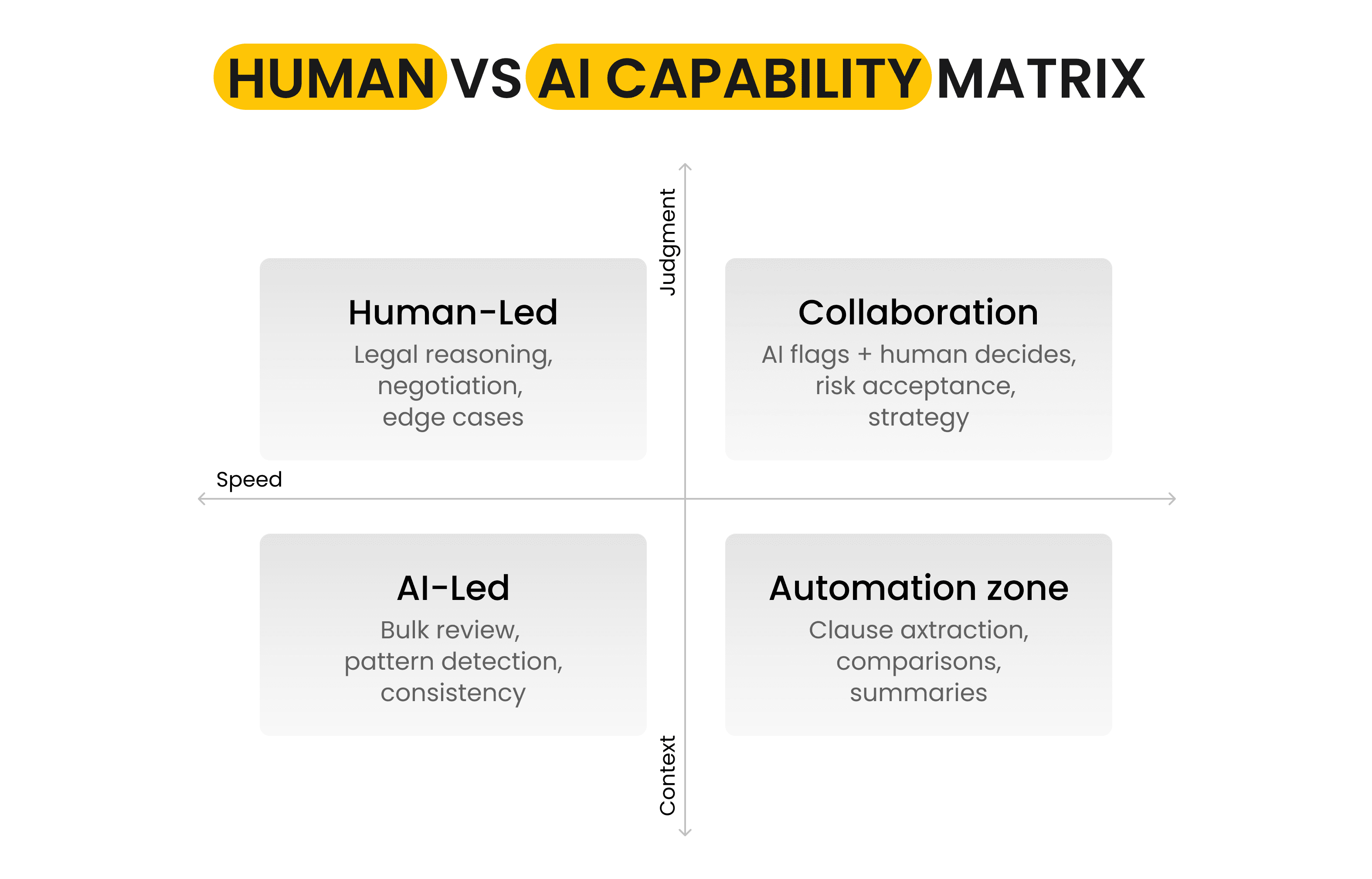
This matters: our contract review solution doesn't remove humans from the process. It changes their role. Instead of spending hours reading and comparing, your legal team spends time on judgment calls, negotiation, and risk assessment.
An AI system tells you, "This liability clause is broader than your company standard." A lawyer decides whether that deviation is acceptable for this particular project, this specific vendor, and this particular risk profile.
The AI does the heavy lifting. Humans make the calls.
Transparency and Explainability
When our AI flags an issue, it explains why. It doesn't just say "risk detected." It says something like "This payment term is 60 days, but your company standard is 45 days. This increases working capital exposure by approximately $X." It explains the reasoning, so your team can evaluate the risk themselves.
The Process for Getting Started With AI Contract Review
 Click to expand
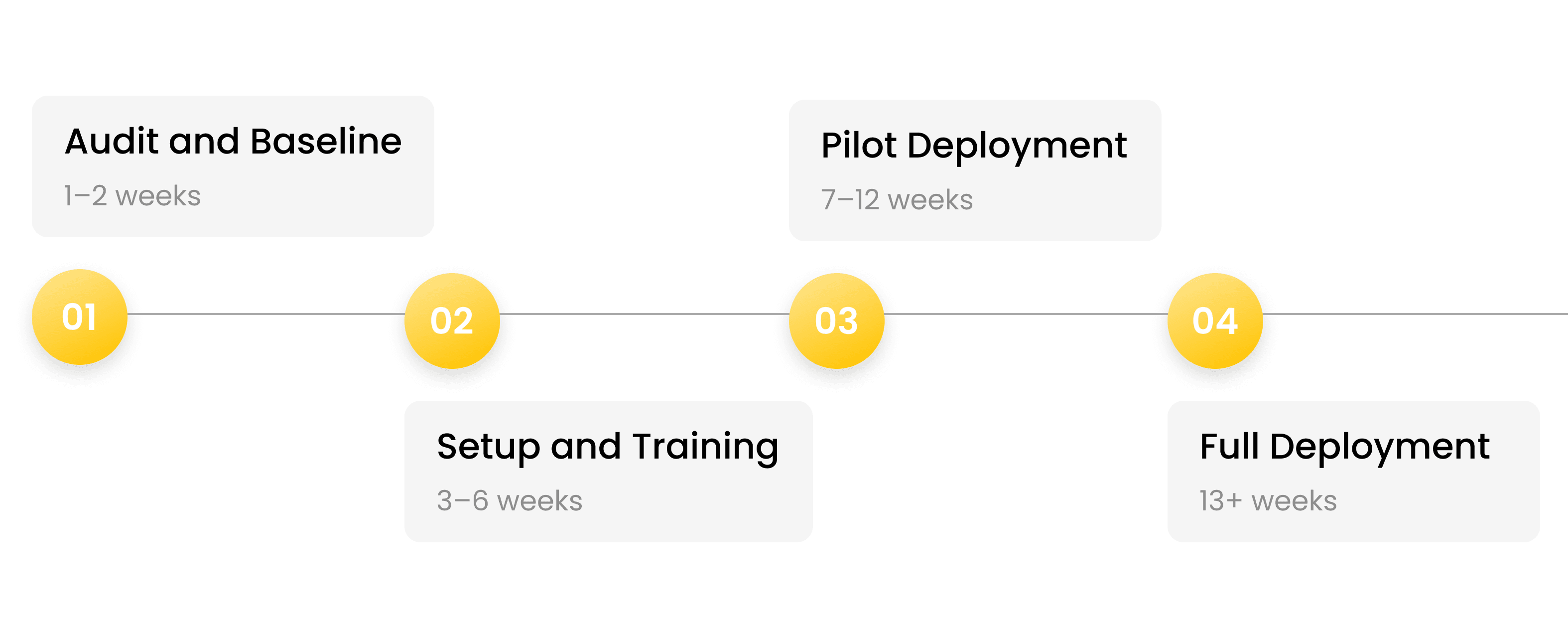
Phase 1: Audit and Baseline (Weeks 1-2)
Review your existing contracts and document your company standards. Identify 10–20 representative agreements that show the range of what you do. These become training examples.
Phase 2: Setup and Training (Weeks 3-6)
Load your playbook, standards, and training contracts into the system. Spend time configuring your risk framework and jurisdiction-specific rules. Run initial tests on pilot contracts.
Phase 3: Pilot Deployment (Weeks 7-12)
Deploy the system on new contracts as they come in. Your team reviews the AI's findings and provides feedback. The system learns from your decisions.
Phase 4: Full Deployment (Week 13+)
Integrate the system into your standard workflow. Reviewing new contracts is a standard step in your contracting process, with AI performing the initial analysis and your team making the final decisions.
The Construction Industry Is Finally Ready
For years, AI in legal/contracts was either too expensive, too unreliable, or too complicated to deploy. That's changed.
Modern language models, cheaper computing, and industry-specific tools have made AI-powered construction contract analysis practical and accessible.
The Cost-Benefit Math Works
 Click to expand
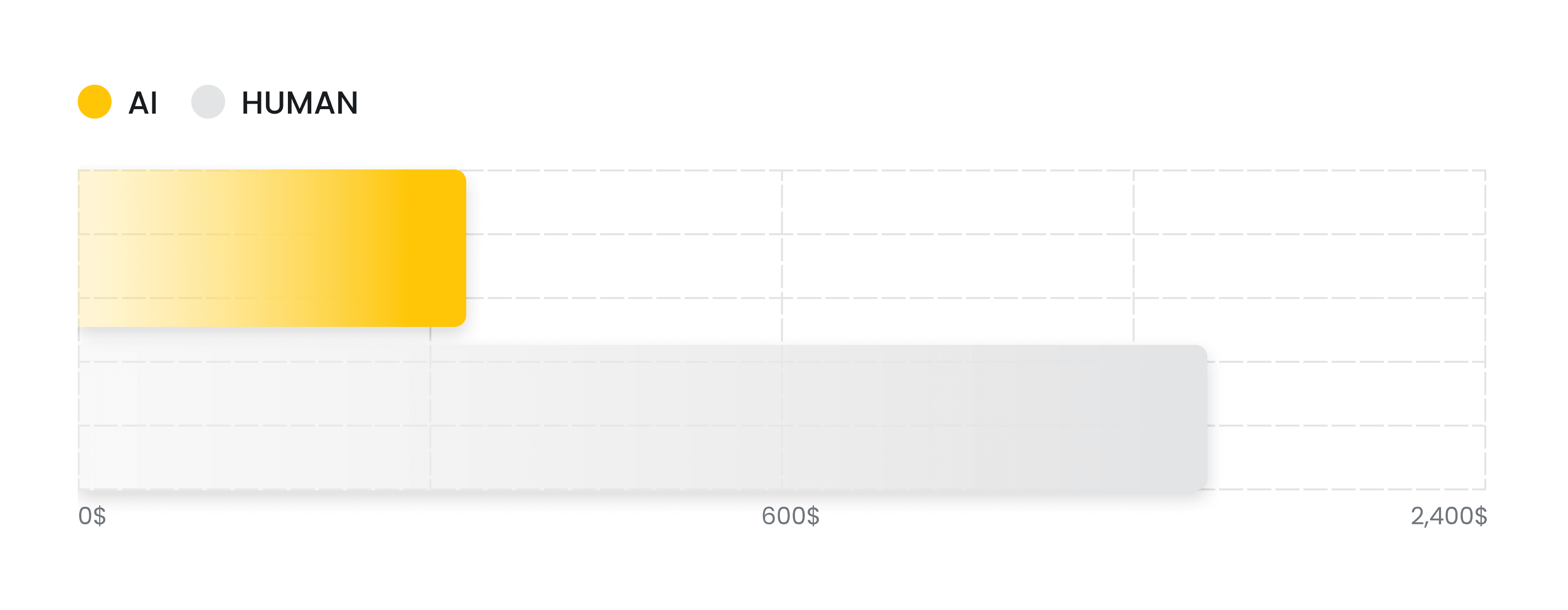
A legal professional costs approximately $150-$300 per hour. That same professional, reviewing a complex contract in detail, spends 4-8 hours.
That's $600 to $ 2,400 in labor costs per contract. Add in the risk of missed clauses, and the cost of errors runs much higher.
An AI contract review solution costs a fraction of that per review and gets faster (and more thorough) with each use. The return on investment is measurable.
Competition Is Pushing Faster Cycles
Modern construction moves faster. Owners want faster timelines. Contractors need to quote and mobilize quickly.
Subcontractors are under pressure to win and execute fast. Companies that can review and negotiate contracts faster have a competitive advantage.
Final Thoughts: Why This Matters for Your Business
 Click to expand
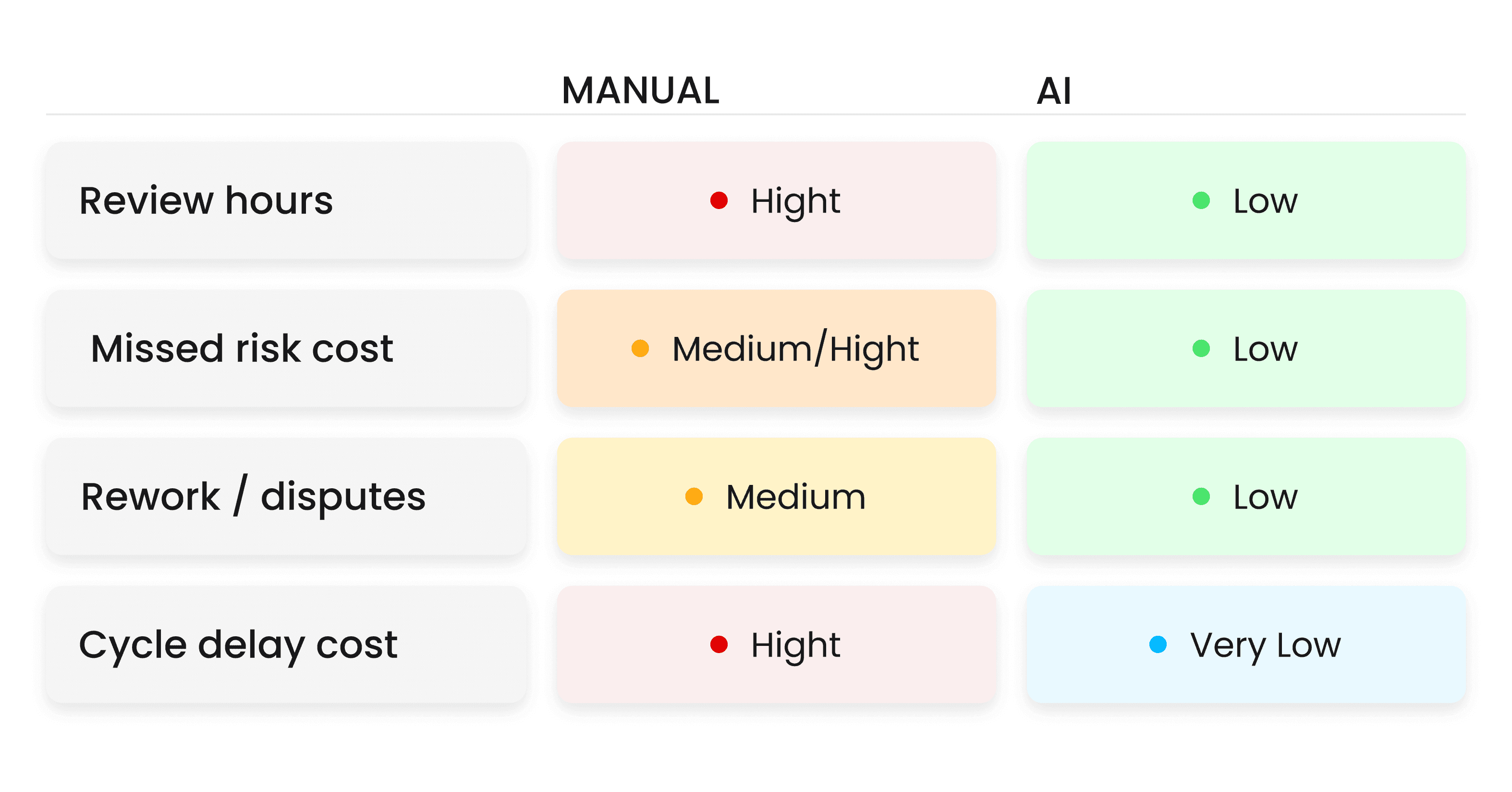
Construction contract review is foundational work. It's also tedious, high-stakes, and error-prone. For years, construction teams accepted that as the cost of doing business.
AI changes that. When reviewing construction contracts becomes faster, more consistent, and more thorough, project teams move faster.
Legal teams can focus on strategy rather than document review. Risk decreases.
That's what we've built our AI construction contract review tools to deliver. Not magic, just intelligence applied to a real, expensive problem.
If you're managing construction contracts, evaluating contract review process options, or looking for a way to handle legal documents more efficiently, the time to explore AI contract analysis is now.
The technology is real, the benefits are measurable, and your competitors are already moving.
FAQ
What is AI construction contract review?
AI construction contract review uses artificial intelligence to automatically read, analyze, and compare construction contracts. It identifies key clauses, flags risks, and highlights deviations from company standards in minutes instead of hours, helping teams focus on negotiation and decision-making rather than manual review.
How does AI detect risk in construction contracts?
AI detects risk by analyzing contract language using natural language processing and comparing it against predefined standards, historical contracts, and known risk patterns. It flags issues like unfavorable payment terms, missing insurance requirements, overly broad indemnity clauses, and jurisdiction-specific compliance gaps.
Can AI replace lawyers in construction contract review?
No. AI does not replace lawyers or contract professionals. It automates repetitive tasks like clause extraction, comparison, and pattern detection, while humans retain control over legal judgment, negotiation strategy, and final risk decisions. AI supports better decisions — it doesn’t make them.
What types of construction contracts can AI review?
AI construction contract review tools can analyze a wide range of agreements, including prime contracts, subcontracts, purchase orders, change orders, equipment leases, and vendor agreements. They work best on contracts with structured legal language and recurring clause patterns.
How accurate is AI construction contract review?
When trained on construction-specific language and company standards, AI can review contracts with high consistency and accuracy. While it may still require human validation for edge cases, AI often catches issues humans miss—especially across large volumes of contracts—due to fatigue or time pressure.
How long does it take to implement AI contract review for construction teams?
Most implementations follow a phased approach and take several weeks. Initial setup involves defining company standards and training the system on historical contracts. Once deployed, teams can start reviewing new contracts immediately, with accuracy improving over time as the system learns from feedback.


INSIGHTS


Get in Touch
Got no clue where to start? Why don’t we discuss your idea?


