



By Bohdan Vasylkiv
- CEO & Co-Founder
Cost Control in the Construction Industry: A Complete Management Guide
Cost Control in Construction: Complete Management Guide
Key Takeaways
- Cost control keeps a project's actual spend aligned with its approved budget and flags issues before they become problems.
- Most overruns trace back to a few predictable culprits: weak estimates, scope creep, loose change orders, and slow reporting.
- A strong plan combines accurate estimating, a locked cost baseline, and a realistic contingency reserve.
- Real-time tracking software turns budget data from a monthly autopsy into a daily steering tool.
Every construction project starts with a number that everyone agrees on. Then reality shows up. Material prices jump, a drawing gets revised, a subcontractor slips a week, and suddenly that tidy budget is a moving target.
Cost control in construction is how you keep that target from running away from you. Done right, it’s the difference between a profitable job and one that quietly bleeds margin for months. This guide walks through what it actually involves, why it matters, and how modern construction cost management turns guesswork into something you can steer.
What Is Cost Control in the Construction Industry?
Simply put, cost control is the ongoing process of measuring what a project is actually spending against what it was supposed to spend, then acting on the gap. It's not a one-time budget exercise. It runs from the first estimate to the final closeout.
Here's the thing: in the cost control in construction industry context, the numbers move constantly. Labor, materials, equipment, and overhead all shift week to week, so the discipline is less about setting a budget and more about defending it.
Cost Control vs. Cost Management: Key Differences
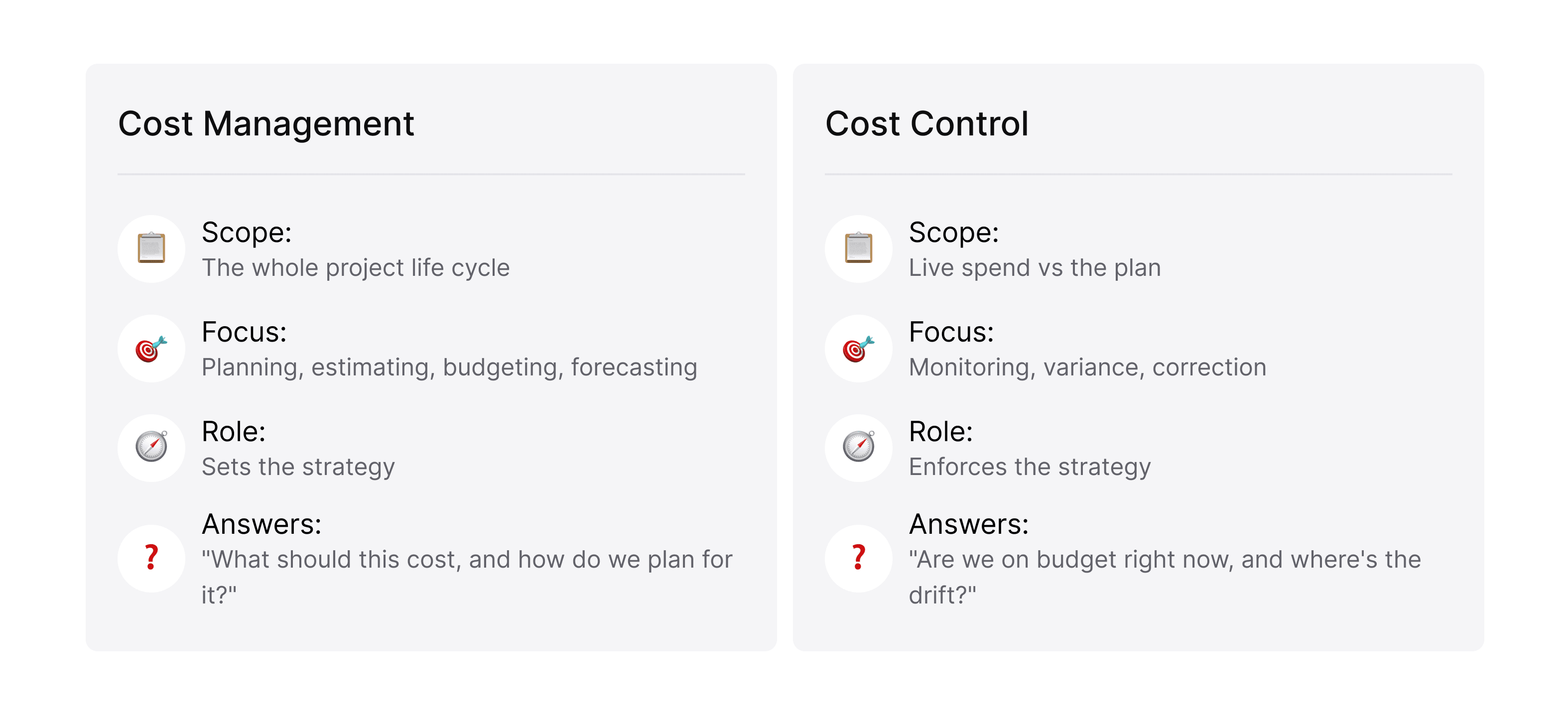
People use these terms interchangeably, but they aren't the same thing. Cost management in construction is the wider umbrella. It covers planning, estimating, budgeting, and forecasting, basically every decision that touches money across the project life cycle.
 Click to expand
Construction cost control is the narrower, hands-on piece: monitoring spend in real time and correcting course when actuals drift from the plan. Bottom line, management sets the strategy and control enforces it.
Who Bears Responsibility for Construction Cost Control?
Honestly, it's a shared job, and that's where things go wrong. The owner sets the budget appetite. The project manager owns the day-to-day decisions. Estimators, quantity surveyors, and the finance team all touch the numbers.
On larger jobs, cost control in construction management typically falls to a dedicated cost manager or controller who reports directly to leadership. When nobody clearly owns it, small variances pile up unnoticed until they're a crisis.
Why Cost Control in Construction Projects Matters
Margins in construction are thin, often in the single digits, so there's almost no room to absorb surprises. Strong cost control in construction projects protects that margin, but it does more than that. It keeps cash flow predictable, builds trust with owners and lenders, and gives you the data to bid the next job more accurately. That said, the cost of getting it wrong is what really gets people's attention.
Financial Impact of Cost Overruns: Industry Data
Large projects overrun budgets at a startling rate. Industry studies have long found that major capital projects run well over their original estimates, with delays compounding the damage. The reason is rarely one big mistake. It's dozens of small ones that go uncorrected. Disciplined cost management of construction projects is what catches those small leaks before they merge into one expensive flood that swallows the contingency and then the profit.
How Poor Cost Control Affects Project Timelines and Stakeholders
Money problems become schedule problems fast. Run short on cash, and you delay material orders, lose subcontractors to other jobs, and stall progress. Weak cost control in construction also erodes relationships. Owners stop trusting your reports, lenders tighten terms, and your team spends more time defending numbers than building.
And here's why that matters: reputation in this industry travels, and a project known for overruns follows a contractor into the next bid.
Core Components of a Construction Cost Management Plan
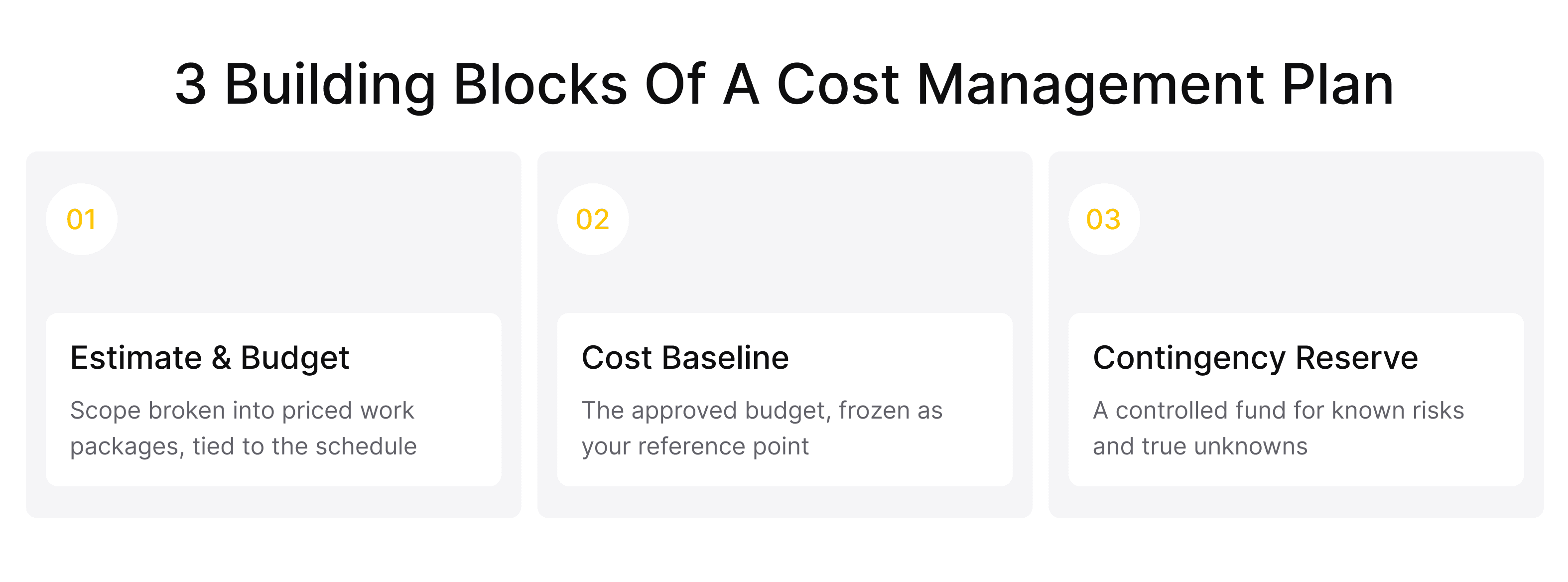
A good plan isn't a fat binder nobody opens. It's a working document that defines how money will be estimated, tracked, and reported. A practical cost management plan for construction project work spells out who approves what, how often costs are reviewed, and what triggers escalation. 3 pieces sit at its core.
Cost Estimation and Budgeting
Everything downstream depends on the estimate. Break the scope into measurable work packages, price each one, and roll them up into a budget tied to the schedule. Don't forget indirect costs. The general conditions in construction line, things like site supervision, temporary facilities, and insurance, are where rough estimates quietly go wrong. Solid construction cost management starts with an estimate detailed enough to measure against later.
Cost Baseline and Approved Budget
Once the estimate is approved, it becomes your baseline, the locked reference point you compare every future actual against. Without a baseline, "over budget" is just an opinion. Effective cost management in construction projects depends on freezing this number and only changing it through a formal process. If the baseline shifts every time someone wants more money, it stops meaning anything.
 Click to expand
Contingency Reserve Planning
No estimate is perfect, so you plan for the gap. A contingency reserve covers known risks, while a separate management reserve handles the genuine unknowns. The trick is treating contingency as a controlled fund, not a slush account. Mature construction project cost management tracks every draw against contingency so you always know how much cushion is left and what ate the rest.
Construction Cost Control Process: Stage-by-Stage Breakdown
Cost control looks different at each phase of the job. Treating it as one continuous activity, rather than a year-end reckoning, is what separates teams that hit budget from teams that hope to.
Pre-Construction
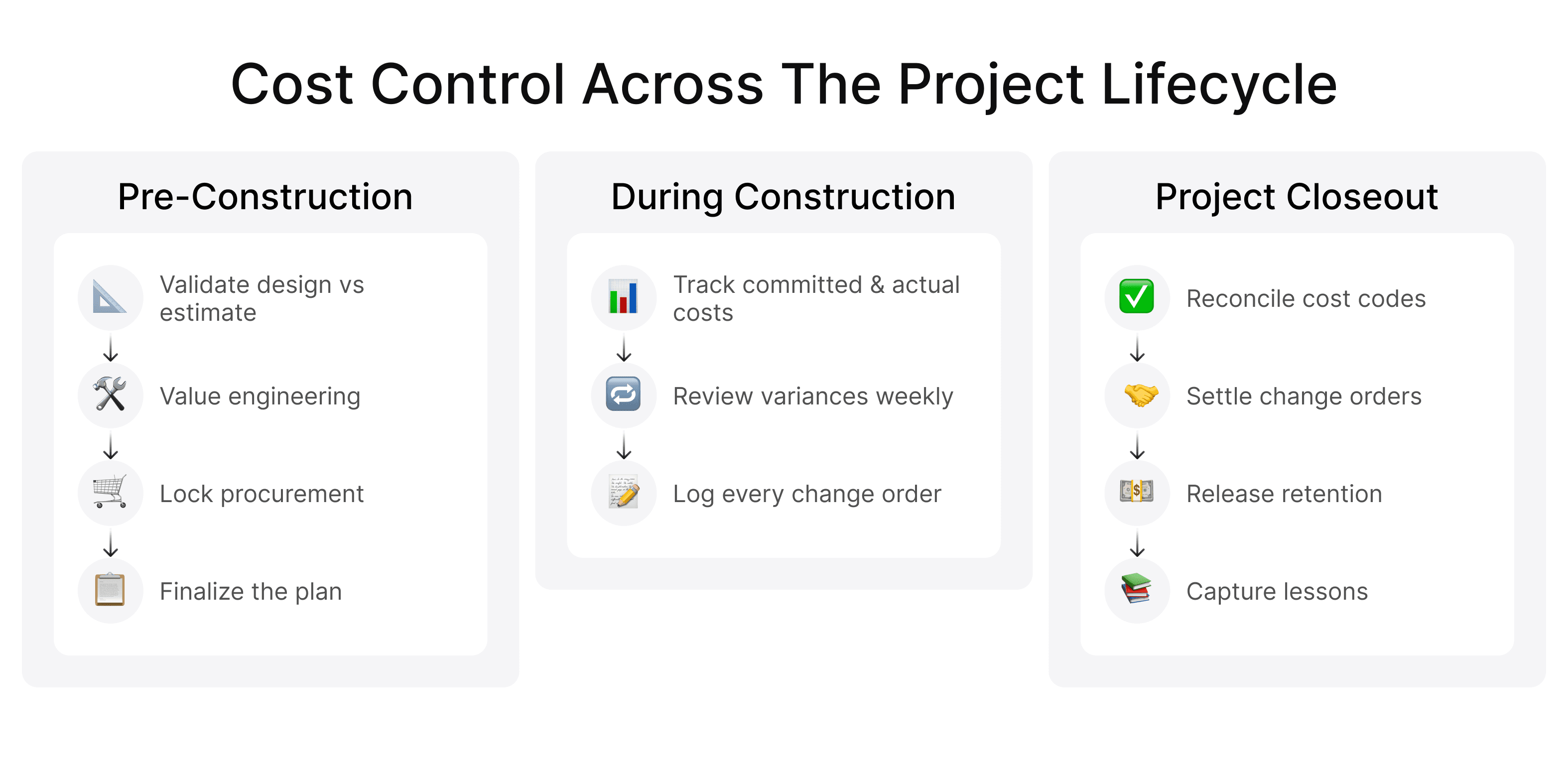
This is where you win or lose the budget, before a single shovel hits dirt. Validate the design against the estimate, conduct value engineering, lock in the procurement strategy, and finalize the plan. A clear cost management plan for construction project delivery, built here, gives the field team a budget they can actually defend, rather than one that was optimistic from day one.
During Construction
Now it's about rhythm. Track committed and actual costs, compare them to the baseline, and review variances on a fixed cadence, weekly or biweekly, not whenever someone remembers. Strong cost discipline during this phase leans on fast, accurate field data: approved time sheets, delivered quantities, and logged change orders. The faster the data, the earlier you catch drift.
 Click to expand
Project Closeout
Closeout is more than final invoices. Reconcile every cost code, settle outstanding change orders, release retention, and capture lessons learned. Good cost management construction projects practice treats the final cost report as fuel for the next estimate. The job you just finished is the best data you'll ever have for pricing the next one accurately.
7 Proven Cost Control Strategies for Construction Projects
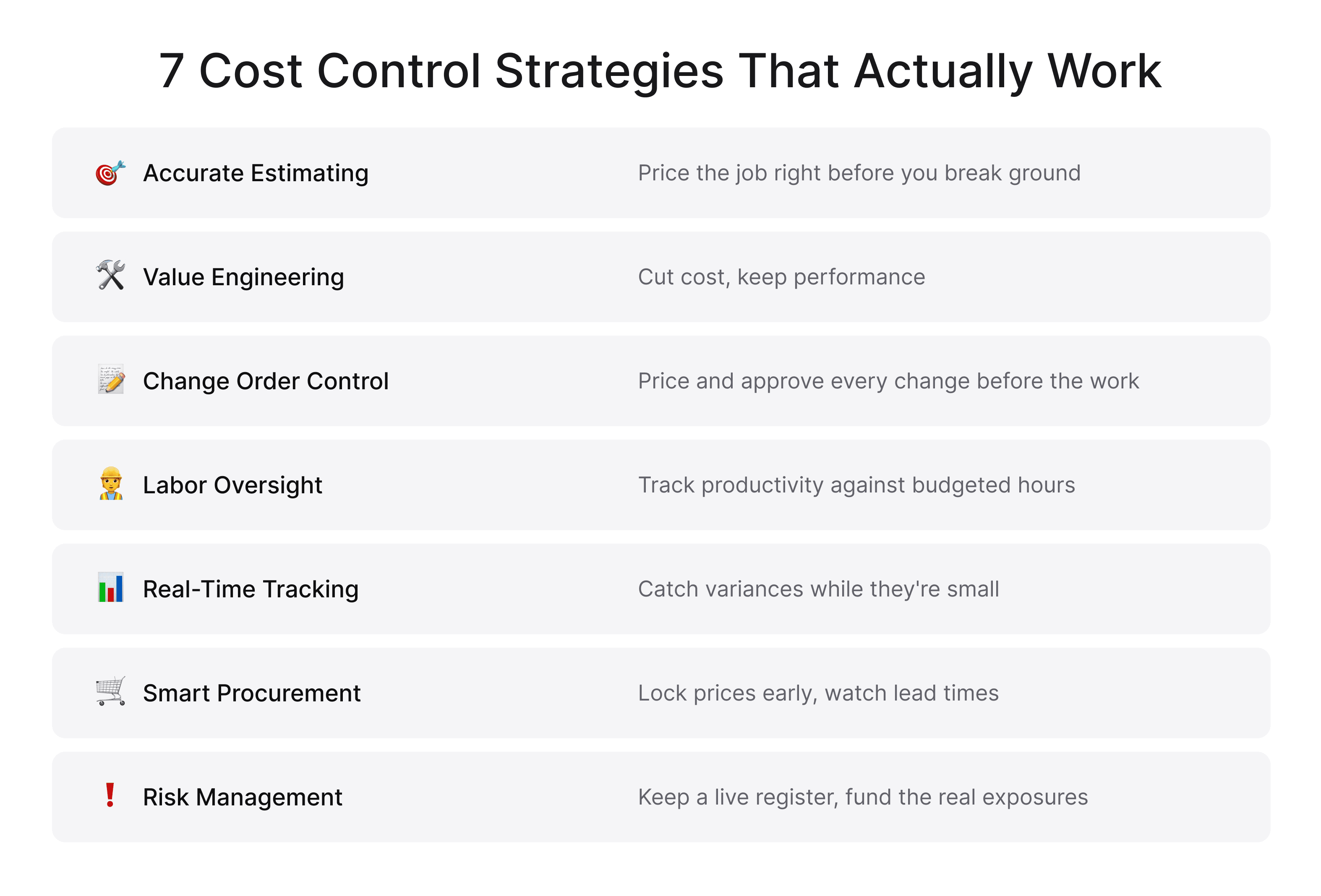
There's no single trick that keeps a job on budget. It's a stack of habits. These seven do the heavy lifting for cost control in construction projects of almost any size, and most of them cost little more than discipline to implement.
1. Accurate Cost Estimation Before Breaking Ground
Garbage in, garbage out. If the estimate is wrong, every report afterward measures progress against a fantasy. Use historical data from past jobs, current supplier pricing, and detailed quantity takeoffs. Strong construction cost management rests on an estimate you'd be comfortable signing your name to, not a round number meant to win the bid.
2. Value Engineering Without Cutting Corners
Value engineering means finding cheaper ways to hit the same performance, not quietly downgrading quality and hoping nobody notices. Swap a specified material for a lower-cost equivalent, simplify a detail that adds labor without adding value, or resequence work to reduce equipment rental time. Do it early, with the design team in the room, so changes don't ripple into rework later.
3. Proactive Change Order Management
Change orders are where budgets quietly hemorrhage. Every change needs to be priced, approved, and logged before the work happens, not negotiated after the fact when you've lost all leverage. Tight construction cost control treats the change order log as a living record, so the approved budget always reflects reality instead of last month's assumptions.
 Click to expand
4. Labor and Subcontractor Cost Oversight
Labor is usually the least predictable line on the job. Track productivity against your estimated rates, watch overtime, and hold subs accountable to their contracted scope. Effective cost management construction means catching a crew that's trending 15% over budgeted hours in week three, while you can still adjust, not discovering it at closeout when the money's already gone.
5. Real-Time Budget Tracking and Variance Reporting
If your cost data is a month old, you're driving by looking in the rearview mirror. Real-time tracking shows committed costs, actuals, and forecasts the moment they change. This is where construction project cost management shifts from reactive to proactive: you see the variance forming and act on it, rather than explaining it after the budget's already blown.
6. Smart Procurement and Supplier Price Monitoring
Materials are volatile, so timing and relationships matter. Lock prices early where you can, buy in coordinated bulk, and keep an eye on lead times that can force expensive substitutions. Tapping into innovation in construction industry practices, like data-driven procurement and supplier dashboards, sharpens cost management of construction projects by replacing gut-feel purchasing with numbers.
7. Continuous Risk Assessment and Mitigation
Risk and cost are joined at the hip. Keep a live risk register, assign owners, and price the realistic exposures into contingency. Strong cost control in construction industry settings means revisiting that register regularly, because a weather delay, a permit holdup, or a supplier going under all show up as cost long before they show up as a line item you planned for.
Common Cost Overruns in Construction and How to Prevent Them
Most overruns aren't mysteries. They're the same handful of problems repeating across the industry. Knowing the usual suspects is half the battle for protecting cost control in construction projects before they spiral.
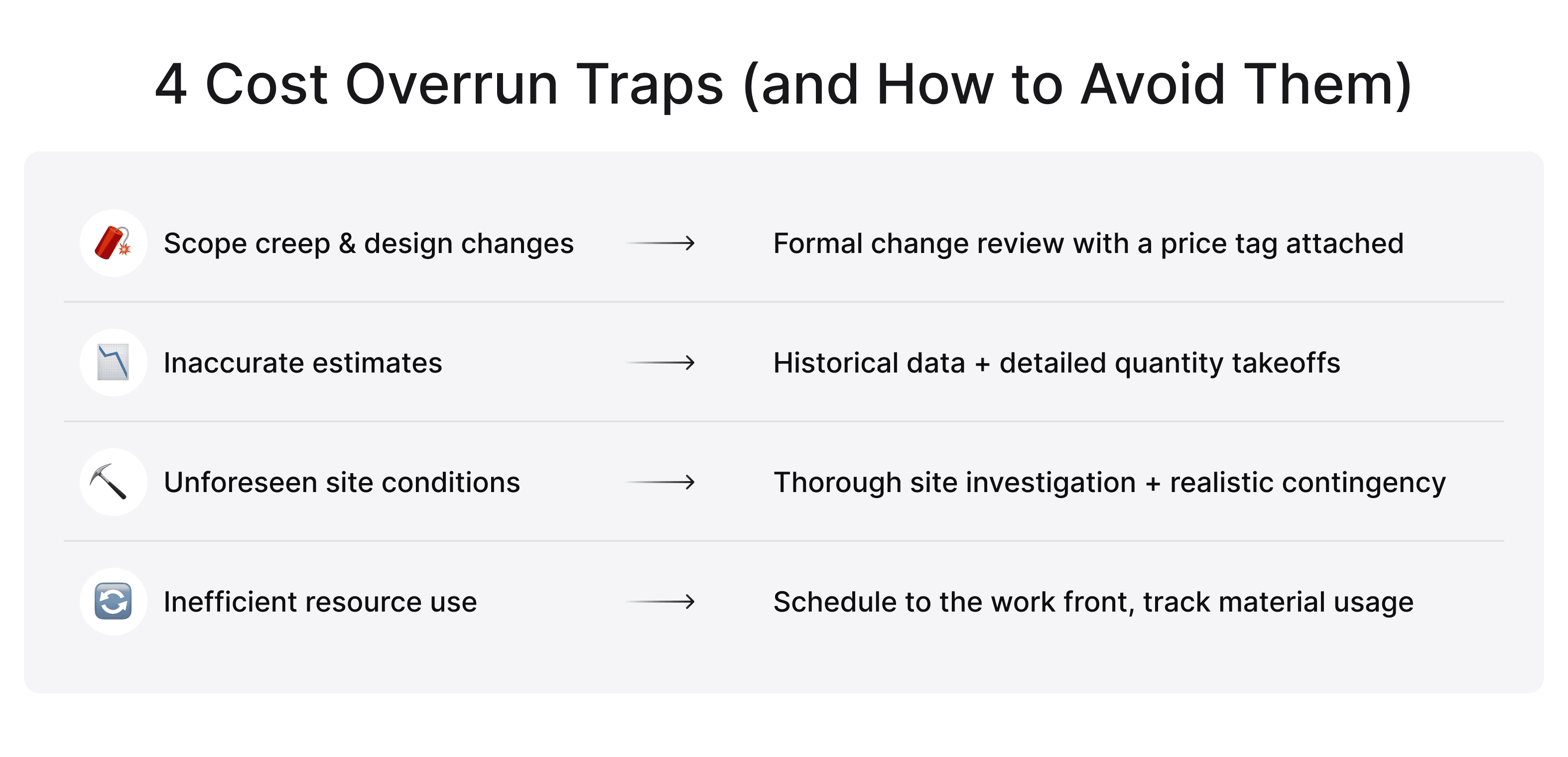
Scope Creep and Design Changes
"While we're at it" is the most expensive phrase in construction. Small additions feel harmless until they've quietly added 10% to the budget. The fix is process: every scope change goes through formal review with a price tag attached before approval. Disciplined construction cost management makes the cost of each "small" change visible the moment it's requested.
 Click to expand
Inaccurate Initial Estimates
If the starting number was wrong, no amount of tracking saves you. Estimates go bad from rushed takeoffs, missing scope, optimistic productivity assumptions, or ignoring escalation. Better cost management in construction relies on real historical data and detailed breakdowns rather than round numbers, and it accounts for escalation for projects that span volatile pricing periods.
Unforeseen Site Conditions and Delays
You dig and find rock, contaminated soil, or utilities nobody mapped. These surprises are partly unavoidable, but thorough site investigation and a realistic contingency soften the blow. Good cost control in construction assumes something will go sideways underground and plans for it, rather than pretending the site survey told you everything.
Inefficient Resource and Material Management
Idle crews, double-handled materials, equipment sitting unused, and waste from poor coordination all drain budgets without anyone deciding to spend the money. Tightening cost management construction here means scheduling resources against the actual work front and tracking material usage against estimates, so that waste shows up as a number rather than disappearing into overhead.
Cost Control Systems in Construction: Choosing the Right Approach
How you track costs is as important as deciding to track them. The right cost control systems in construction depend on project size, complexity, and how many people who need the same numbers at once. As innovation in construction industry reshapes the field, more teams are moving off spreadsheets and onto connected platforms that update in real time.
Manual Tracking vs. Dedicated Cost Control Software
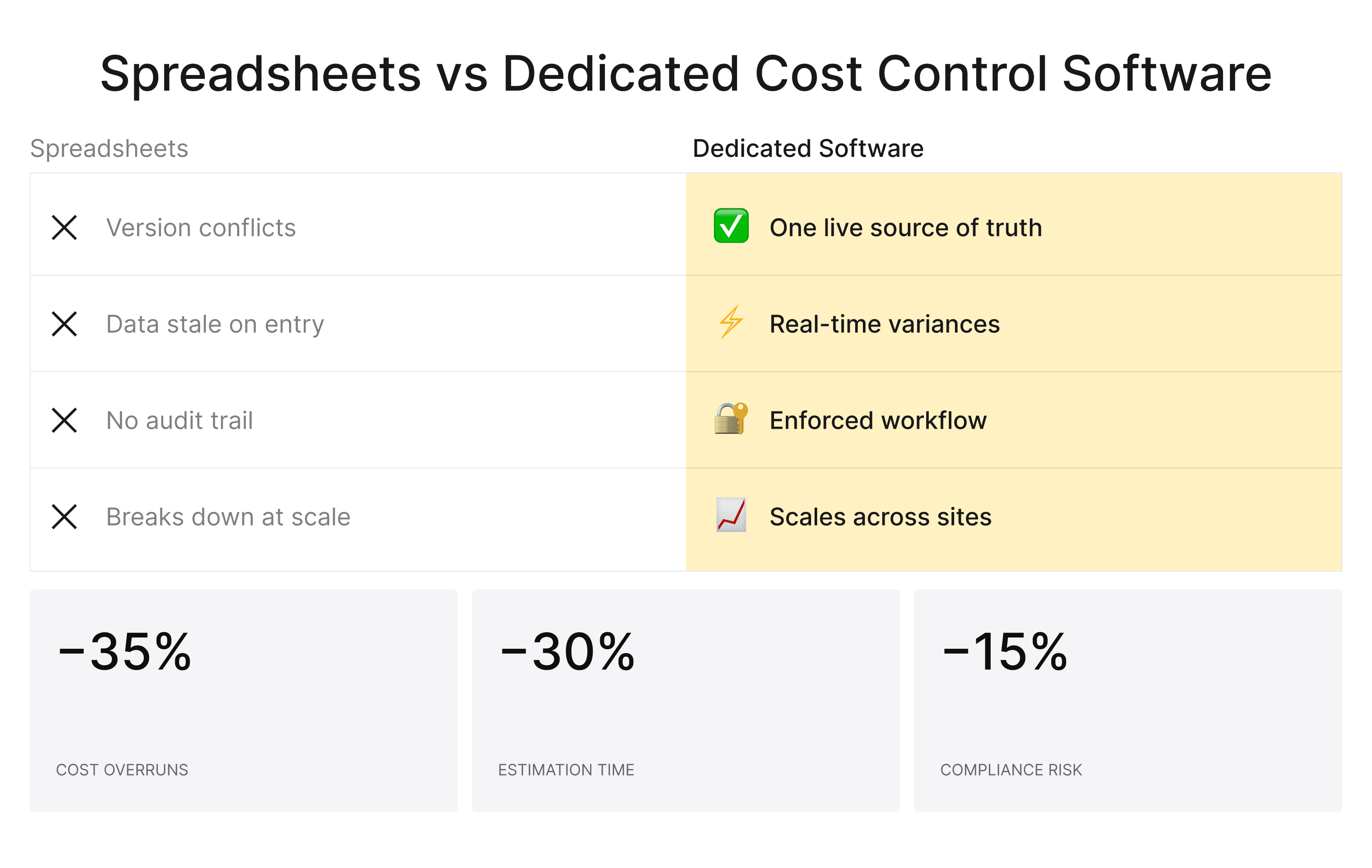
Spreadsheets are cheap and familiar, and for a tiny job, they're fine. But they break down fast: version conflicts, broken formulas, and data that's stale the moment it's typed. Dedicated cost control systems in construction centralize the data, enforce processes, and let everyone see the same live numbers. The question usually isn't whether to upgrade, but when the manual approach starts costing more than the software.
 Click to expand
Key Features to Look for in Construction Cost Management Software
Look for real-time budget-versus-actual tracking, change order workflows, forecasting, and integration with your accounting and scheduling tools. Strong construction cost management software also handles role-based access and clean reporting for owners and lenders. Off-the-shelf tools cover the basics, but teams with unusual workflows often turn to custom software development to fit the system to how they actually work.
How Software Reduces Budget Overruns in Practice
The payoff is speed and visibility. When a cost variance appears on the same day rather than next month, you act while it's still small. Tight budget and cost control in construction gets easier when commitments, actuals, and forecasts live in one place and feed the schedule. Integrating cost tools with finance systems, often with help from experienced ERP developers, removes the manual re-keying that introduces errors and lag.
How Incora Helps Construction Companies Build Smarter Cost Control Systems
Off-the-shelf tools rarely match how a specific contractor runs its jobs, and that mismatch is where data slips through the cracks. At Incora, we build software that fits the way your team already works. One of our cases is a good example: for a client we built an AI-powered construction estimation platform that pulls real-time and historical data to sharpen cost projections, and it cut their project cost overruns by 35%. That same hands-on approach shapes our broader custom construction software development work, with cost data, schedules, and field reporting finally talking to each other.
In practice, that means connecting estimating, budgeting, and field tracking into one source of truth, so cost control in construction management stops depending on someone manually stitching spreadsheets together at month-end. Our work also spans dashboards that surface variances instantly, integrations that sync cost and accounting data, and platforms that make cost management in construction projects measurable in real time.
Not sure where to start with cost control??
We can help you figure out what's actually slowing you down and what to build first.
Whether you need a focused tool or a full platform, our engineers and ERP developers can scope it to your budget and your reality. The aim is simple: give your team numbers they trust early enough to act on, the way that platform freed its client's specialists from roughly a third of their manual estimating time. Robust construction cost management is ultimately a data problem, and that's exactly what custom-built systems are good at solving.
Final Thoughts
Strong cost discipline comes down to knowing where the money is going early enough to make good decisions. Get the estimate right, lock a baseline, track relentlessly, and put a price tag on every change before the work starts. That's the whole game. Good construction cost control rewards teams that make the habit part of their daily work, so the numbers stay current long before the monthly report lands.
The contractors who consistently hit budget earn it through routine. They've made cost management in construction a daily habit, supported by tools that provide up-to-date numbers and a process everyone follows. Start with the fundamentals, then let better systems do the heavy lifting as your projects grow in size and complexity.
FAQ
What is the difference between cost control and cost management in construction?
Cost management is a broad discipline: planning, estimating, budgeting, and forecasting across the whole project. Cost control is the active part of that work, monitoring real spend against the plan and correcting drift early. Put simply, budget and cost control in construction is the day-to-day enforcement arm of the wider management strategy.
What are the main causes of cost overruns in construction projects?
5 recurring causes: inaccurate initial estimates, scope creep, poorly managed change orders, unforeseen site conditions, and inefficient use of labor and materials. A frozen baseline, a formal change process, realistic contingency, and fast reporting prevent most of them.
How do you create a cost management plan for a construction project?
5 steps: build a detailed estimate broken into work packages, approve it as your baseline, define how costs are tracked and who approves changes, set a fixed review cadence for variances, and add a contingency reserve with clear escalation triggers.
What cost control systems are most effective for large-scale projects?
On large or multi-site jobs, dedicated platforms outperform spreadsheets. Prioritize real-time tracking, change order workflows, forecasting, and integration with accounting and scheduling. Many large contractors go custom, so cost, schedule, and field data share one source of truth.
How does real-time tracking improve budget and cost control in construction?
It closes the gap between when a cost happens and when you find out. You catch a variance the day it forms and fix it while it's small and cheap. That early visibility is the biggest practical advantage software brings to staying on budget.


YOU MAY ALSO LIKE


Get in Touch
Got no clue where to start? Why don't we discuss your ideas?

