



By Bohdan Vasylkiv
- CEO & Co-Founder
Construction Quality Control: How to Plan, Run, and Digitize QC on Every Project
How construction quality control works: QA vs QC, who owns it, a step-by-step QC process, what a QC plan must include, and the software behind it.
Key Takeaways
- Construction quality control proves the work matches the drawings and specs.
- QA sets the rules before work starts, and QC checks the result while it's still cheap to fix.
- The working process runs from acceptance criteria to ITPs, three-phase control, NCRs, and closeout.
- Software pays off when inspections, photos, and defects live in one trusted record.
If you've spent any time on a jobsite, you know the feeling. The work looks done, the crew has moved on, and then somebody notices the rebar spacing is off or the waterproofing stops two inches short. And what really stings is that a five-minute check a few days earlier would have caught it.
That, in short, is what quality control in construction is for: finding problems while they still cost an hour to fix, not a week and an awkward phone call.
So in this guide, we'll walk through how it works in practice, from turning specs into checks to getting the whole thing off paper.
What Is Construction Quality Control?
Construction quality control is the set of inspections, tests, and reviews that confirm finished work meets the contract documents. It happens on site while the work is happening, and it always leaves a record: passed, failed, or fixed.
Think of it this way. The drawings tell you what to build, and the specs tell you how well. QC is how you answer the question every owner eventually asks: "How do you know?"
It's also one piece of something bigger. Construction quality management covers policies, planning, training, and lessons learned, and QC is the part that gets its boots dirty.
Quality Control vs. Quality Assurance in Construction (QA/QC Explained)
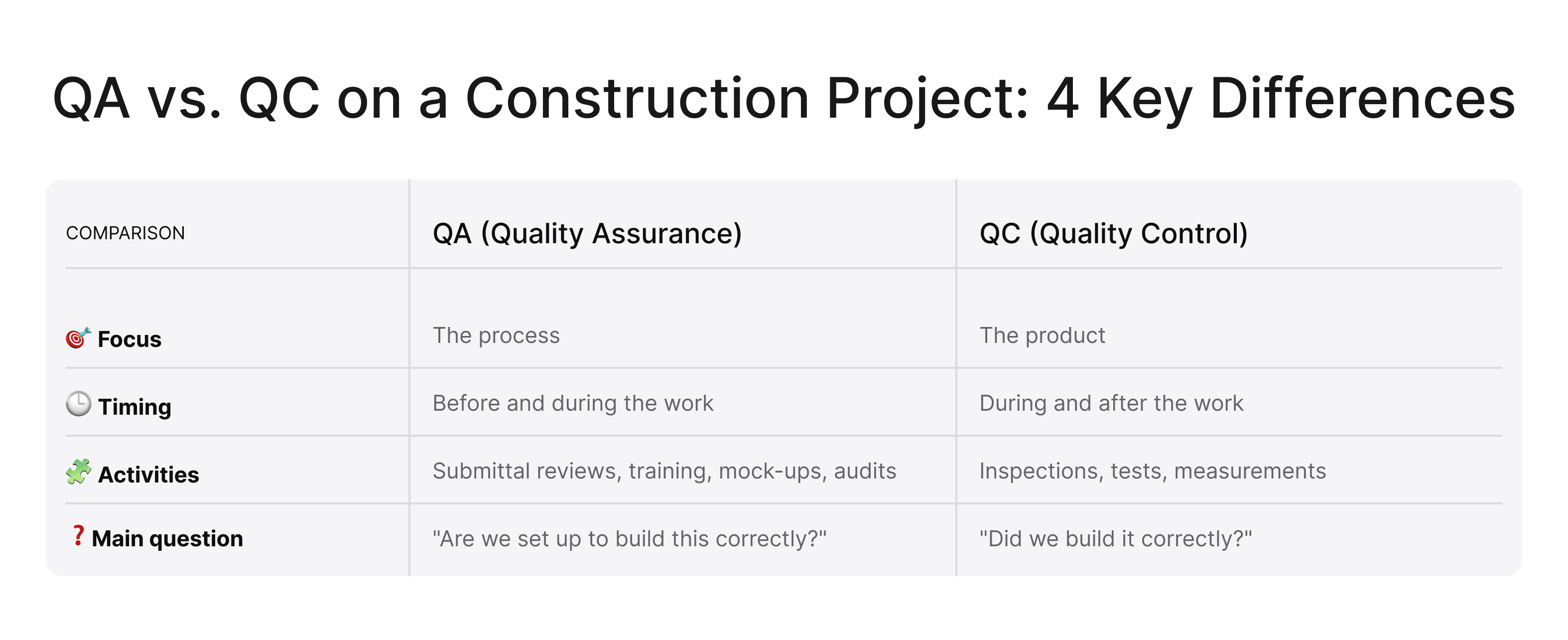
Put simply, QA is about the process, and QC is about the product. Quality assurance sets up the conditions for good work before anyone picks up a tool, while quality control checks the work once it's in place.
In practice, construction quality assurance asks, "Are we set up to build this correctly?" QC, on the other hand, asks, "Did we build it correctly?" It's the slump test, the torque check, and the walk through the rough-in before the drywall goes up.
 Click to expand
The distinction matters because the two fail differently. If you skip quality assurance in construction, your inspectors keep finding the same defect on every floor. And if you skip QC, nobody notices at all until the owner does.
Why Quality Control in Construction Pays for Itself
QC pays for itself because fixing work costs far more than checking it. Every defect you catch before the next trade covers it up saves labor, materials, and schedule time. The return never shows up as revenue, though. It shows up as money you didn't lose.
So let's look at where quality control in construction projects actually protects your margin.
Rework: The Line Item Nobody Budgets For
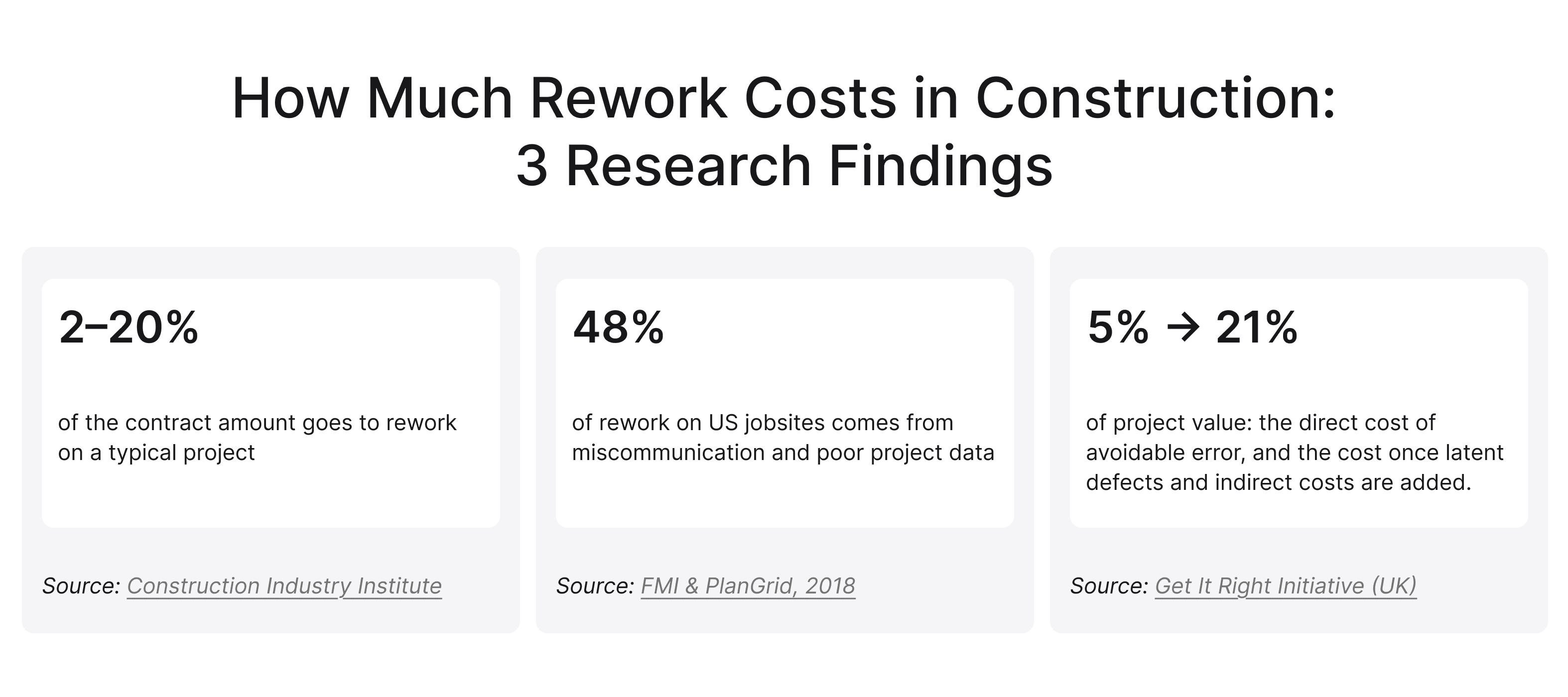
Rework is the obvious place to start, because it's the cost everyone feels and almost nobody plans for. According to the Construction Industry Institute, rework costs between 2% and 20% of the contract amount on a typical project. That's a huge spread, and some teams stay near the bottom of it on purpose.
What's interesting is where it comes from. We tend to blame workmanship, but more often the crew did exactly what they were told, and what they were told was out of date or incomplete. In other words, nobody did bad work. They did the wrong work, well.
That's why early checks matter so much. A mistake caught on the first section of a wall takes ten minutes to fix, whereas the same mistake found three trades later means tearing out their work too.
Callbacks, Warranty Claims, and Liability After Handover
Unfortunately, the defects you miss don't disappear. They wait. A leaking window head shows up in the first heavy rain, long after your crew has left, and the bill is bigger than most people assume. The UK's Get It Right Initiative puts the direct cost of avoidable error at about 5% of project value, and closer to 21% once latent defects and indirect costs are counted.
This is where good records pay you back. Solid quality control in construction leaves you with dated photos, test results, and sign-offs, so when a claim lands two years later, you just open the file.
 Click to expand
Faster Closeout and Earlier Retention Release
Closeout drags when quality problems pile up at the end. If you've inspected as you go, however, the final walkthrough is short, and the owner has fewer reasons to hold your retainage.
Seen that way, good quality management in construction is a cash flow issue too. You hand over, you get paid, and you move on.
Who Is Responsible for Quality Control in Construction
The general contractor carries the main responsibility for on-site QC, usually through a dedicated QC manager. That said, the owner and designers set the standard, and every subcontractor is responsible for their own work.
So who is responsible for quality control in construction when something goes wrong? Usually the contract spells it out, and the roles split like this.
Owner and Design Team: Defining What "Good" Means
It starts with the owner, who decides what they're paying for, and the designers, who turn that into drawings and specs. If those documents are vague, no amount of inspection will save you later. Speed matters too, because a late answer to an RFI in construction often means the crew has already built from the old detail.
Many owners also run their own construction quality assurance program, with an owner's rep, special inspectors, or a commissioning agent verifying your checks.
General Contractor and the QC Manager
Day to day, though, quality belongs to the GC. On larger jobs, a QC manager writes the plan, schedules inspections, tracks deficiencies, and has the authority to stop work. That last part matters more than it sounds, because a QC manager who can't stop work is really just a note-taker.
When the same superintendent pushes the schedule and judges the quality, the schedule usually wins. Good construction quality control needs someone whose job is to say "not yet."
Subcontractors, Suppliers, and Third-Party Testing Labs
Subs do most of the building, so naturally they do most of the first-line checking too. A foreman who inspects their own crew's work before calling for inspection saves everyone a wasted trip. Suppliers and labs fill in the rest with mill certs, product data, and independent test results.
The Construction Quality Control Process, Step by Step
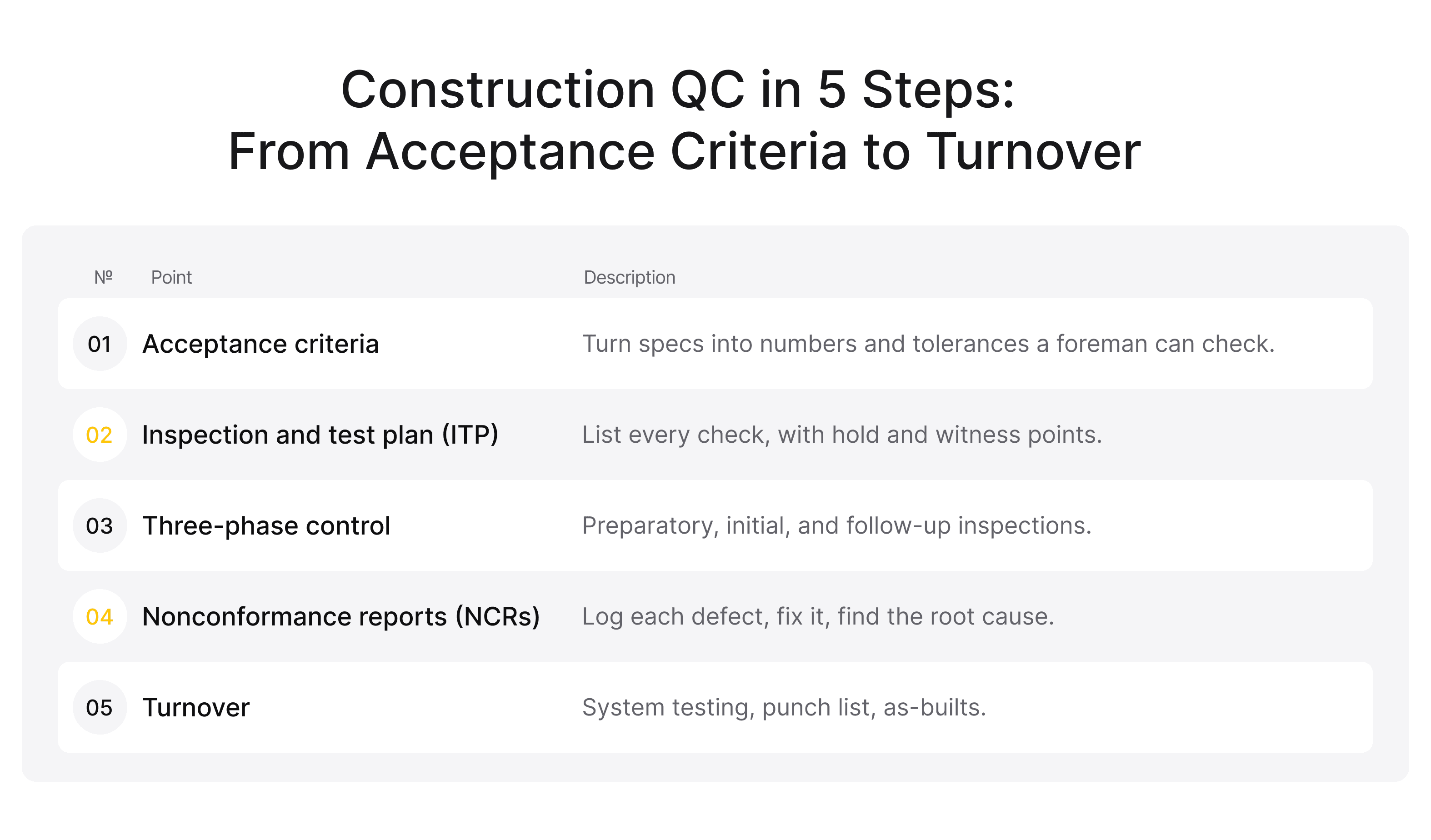
The QC process has five steps: define acceptance criteria, build an inspection and test plan, run three-phase control, log and close nonconformances, and verify at turnover. Each step feeds the next.
Interestingly, most quality control procedures in construction fail because they start at step three. Somebody shows up with a checklist, but nobody ever agreed on the pass mark.
Turn Specifications Into Measurable Acceptance Criteria
Designers write specs for contracts, but crews need something simpler: a number, a tolerance, or a photo of what "right" looks like. "Install per manufacturer's instructions" isn't a check, for example, whereas a stated fastener spacing is.
It's honestly the least glamorous part of quality control in construction, and probably the most valuable. If your foreman can't tell pass from fail in thirty seconds, the criterion isn't finished yet.
 Click to expand
Build an Inspection and Test Plan With Hold and Witness Points
Once you know what "pass" means, you need to decide when to check it. That's the job of an inspection and test plan, or ITP, which lists what gets inspected, when, by whom, and what record it produces.
Two terms matter most here. A hold point stops the work, full stop. You can't go further until the named person inspects and signs, as with rebar before a pour. A witness point is softer: you notify the inspector, and if they don't show up, you carry on and document it yourself.
Each line in the ITP is really a scheduled construction site inspection, so place them with care. Too many hold points and the job crawls. Too few, and things get buried.
Run Three-Phase Control: Preparatory, Initial, Follow-Up
Three-phase control is how you run that plan on site. The method comes from US federal work, where the Army Corps of Engineers and NAVFAC require it, and it works just as well on private jobs.
- Preparatory phase. Before a feature of work starts, review the specs, submittals, and ITP with the crew.
- Initial phase. Inspect the first portion of work closely with the foreman to set the standard.
- Follow-up phase. Check daily that the work keeps matching what you approved.
The real beauty of three-phase construction quality control is the timing. You catch the misunderstanding on the first ten feet of wall, not the last thousand.
Log Nonconformances and Close the Loop
Even so, something will fail. That's fine, and honestly it's a sign that people are looking.
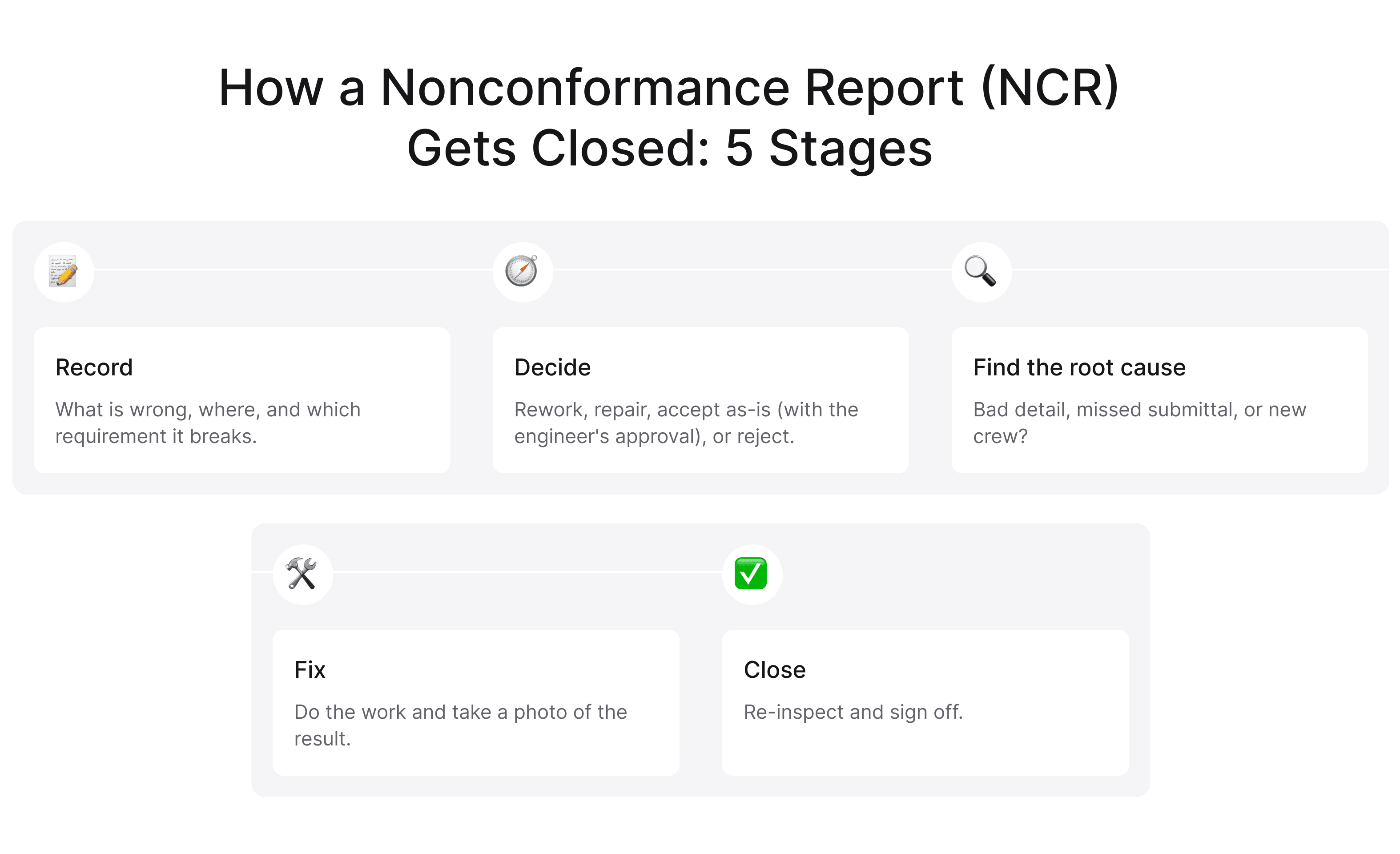
A nonconformance report (NCR) records what was wrong, where, and against which requirement. From there, it needs a decision: rework, repair, accept as-is with the engineer's approval, or reject. Then comes the part people tend to skip: the root cause. Without it, you'll be writing the same NCR again next month.
 Click to expand
On quality control in construction projects, think of an open NCR as a debt, and track each one to closure with a photo of the fix.
Verify at Turnover: Punch List, Testing, and As-Builts
Finally, at turnover, you prove that everything works together through system testing, commissioning, final inspections, and as-builts.
You'll also walk the building and write up the punch list, the small leftover items to finish before final payment. If your QC worked, that list is short and mostly cosmetic.
How to Write a Construction Quality Control Plan
A QC plan is a project-specific document that explains who checks what, when, against which standard, and how to record it. In other words, it turns your general quality policy into instructions for one job.
A good construction quality control plan is short enough that people actually open it. If yours is ninety pages of boilerplate from the last job, the field team will ignore it, and frankly, they'll be right to.
What Every QC Plan Must Include
Whether you call it a QC plan or a quality management plan for construction project teams, the core contents stay the same:
- Roles and authority: who runs QC and who can stop work.
- Work features: the scopes under three-phase control.
- Submittals: how you review and track them.
- ITPs and testing: checks with hold and witness points.
- Nonconformances: how you log, fix, and close them.
- Records: daily QC reports and where they live.
- Closeout: punch list, commissioning, and turnover documents.
Scaling the Plan to Project Type and Delivery Method
Of course, a tenant fit-out doesn't need the same plan as a hospital, so scale it to the risk. Ask what would hurt most if it failed, and put your hold points there: structure, waterproofing, fire stopping, life safety.
Delivery method matters too. On design-build, you own the design, so quality assurance in construction starts with your own drawings.
Construction Quality Control Checklist by Project Phase
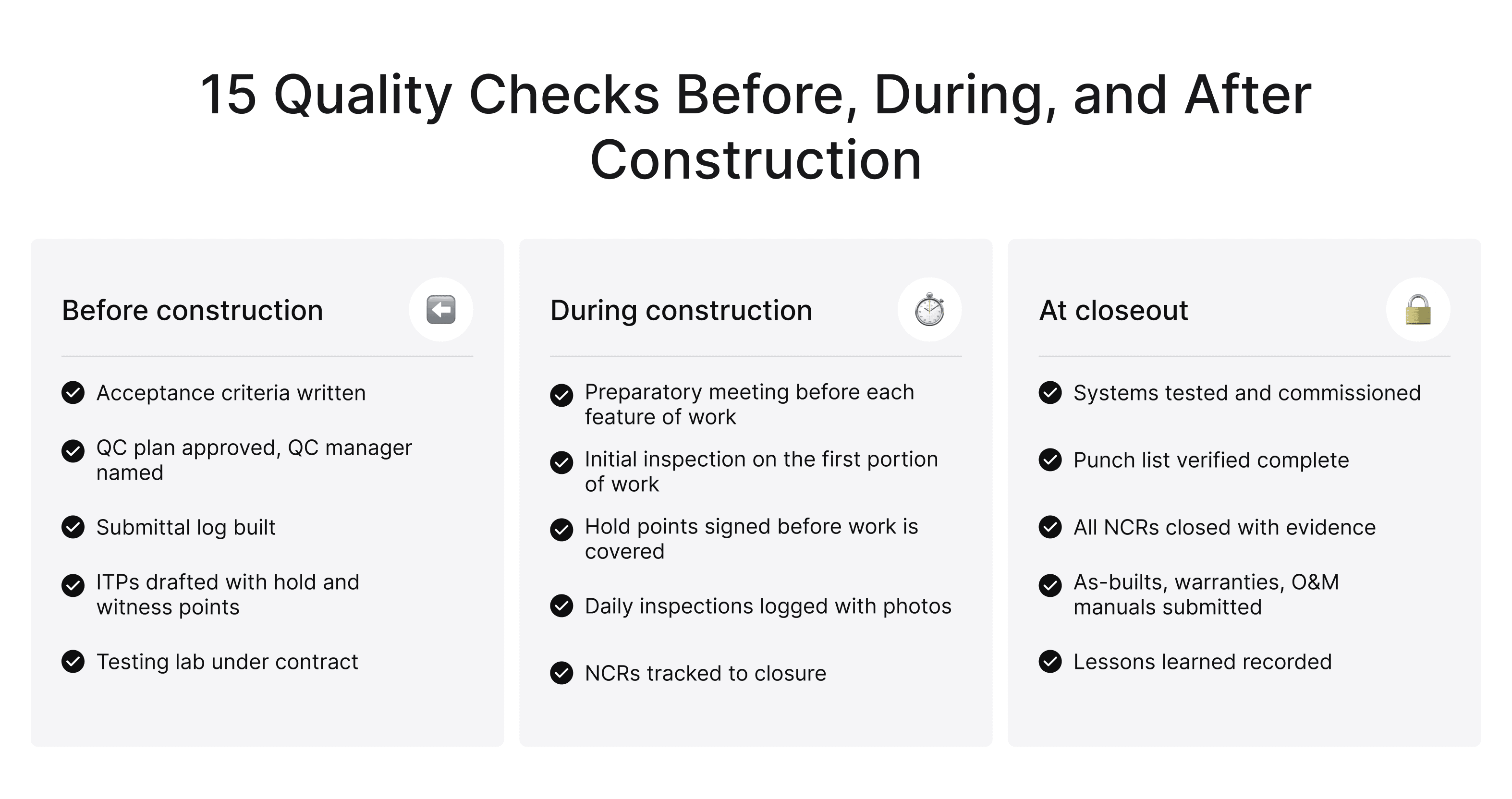
A phase-by-phase QC checklist keeps the basics from slipping through: one set of checks before work starts, one during construction, and one at closeout.
Here's a construction quality control checklist you can copy and adjust.
Preconstruction
- Acceptance criteria written for each feature of work
- QC plan approved and QC manager named
- Submittal log built, long-lead items flagged
- ITPs drafted with hold and witness points
- Testing lab and special inspectors under contract
During construction
- Preparatory meeting held before each new feature of work
- Initial inspection done on the first portion of work
- Hold points signed before work gets covered
- Daily follow-up inspections logged with photos
- NCRs opened, assigned, and tracked to closure
Closeout
- Systems tested and commissioned
- Punch list walked, assigned, and verified complete
- All NCRs closed with evidence
- As-builts, warranties, and O&M manuals submitted
- Lessons learned recorded for the next job
Want it on your phone or on the trailer wall? Save the image below.
 Click to expand
Quality Metrics Worth Tracking
Track a handful of numbers that tell you whether work passes the first time and how fast problems get fixed. Five or six are plenty, because any more than that and nobody looks at them.
Metrics are what turn a pile of inspections into construction quality management. One failed check is an event, whereas twenty from the same trade is a pattern you can act on.
- First-time pass rate: inspections that pass without a re-inspection.
- NCRs by trade and root cause: where problems cluster.
- Average days to close an NCR: whether issues get fixed or parked.
- Rework cost as a share of contract value: the number your CFO cares about.
- Punch items at substantial completion: a report card for the whole process.
Where Construction Quality Control Breaks Down
QC usually breaks down in three places: checklists completed without a real inspection, records scattered across devices, and design changes that never reach the crew. None of these are about skill. They're about how information moves.
The numbers back this up. A 2018 study by FMI and PlanGrid found that miscommunication and poor project data cause 48% of all rework on US jobsites, roughly $31.3 billion that year.
So failures of quality control in construction look much the same from job to job, which is actually good news, because it means they're fixable.
Checklists That Get Ticked, Not Checked
You've almost certainly seen this one: twenty boxes, all ticked, same pen, same minute. The form is complete, and it tells you nothing.
The fix is to ask for evidence. Real construction quality control needs something attached to every answer, whether that's a photo, a measurement, or a location on the drawing.
Photos and Reports Scattered Across Phones and Inboxes
The next one is just as familiar. The superintendent has four hundred photos on his phone, the QC manager keeps a spreadsheet, and the sub emailed a PDF to somebody who has since left the company. Everything exists, in other words, and yet nothing can be found.
That's exactly the gap quality management software for construction was built to close, by keeping one record per inspection, tied to a location, with photos attached.
Spec Changes That Never Reach the Field
Then there's the version problem. A revision gets issued on Tuesday, the crew builds from the old set on Thursday, and your inspector checks against whichever version is on their tablet. AI construction drawing review tools help by comparing revisions and flagging what changed, so the update reaches the field before the work does.
Construction Quality Control Software: What It Should Actually Do
QC software should let your team plan inspections, record results in the field, track defects to closure, and report on it all without retyping anything. If it only digitizes a paper form, it's just a nicer clipboard.
Put another way, good construction quality control software makes the right thing easy.
Must-Have Features for the Field and the Office
In the field, speed wins. Your foreman needs to open a checklist, take a photo, pin it to the drawing, and sign, ideally in under a minute and without a signal.
That's why the best quality management software construction teams can buy is simply the one their crews actually open. Look for these basics first:
- Mobile checklists that work offline
- Photos and markups pinned to the plan
- ITP templates with hold points that block the next step
- NCR workflows with assignees and due dates
- An audit trail of who signed what, and when
Integrations That Keep QC Data From Becoming Another Silo
Quality data becomes far more useful once it talks to everything else. So before you pick quality control software for construction, check what it connects to: project management, document control, scheduling, BIM, and ERP.
Ideally, lessons flow back into planning as well. We used that idea in an AI construction planning platform that reviews estimates against historical project data and surfaces recurring mistakes.
Where AI Already Helps: Drawing Review, Photo Defect Detection, Compliance Checks
AI is already useful in three fairly narrow jobs, and none of them replace an inspector.
The first is drawing review, where models compare revisions and flag clashes or missing details. The second is photos, where computer vision flags visible defects for a human to check. The third is compliance, where an AI compliance agent for construction checks submittals and field records against specs and codes.
One fair warning, though. AI in construction quality control software is only as good as the data it runs on, so if your inspections live in six places, start by fixing that.
Off-the-Shelf QMS or a Custom Quality Management Layer?
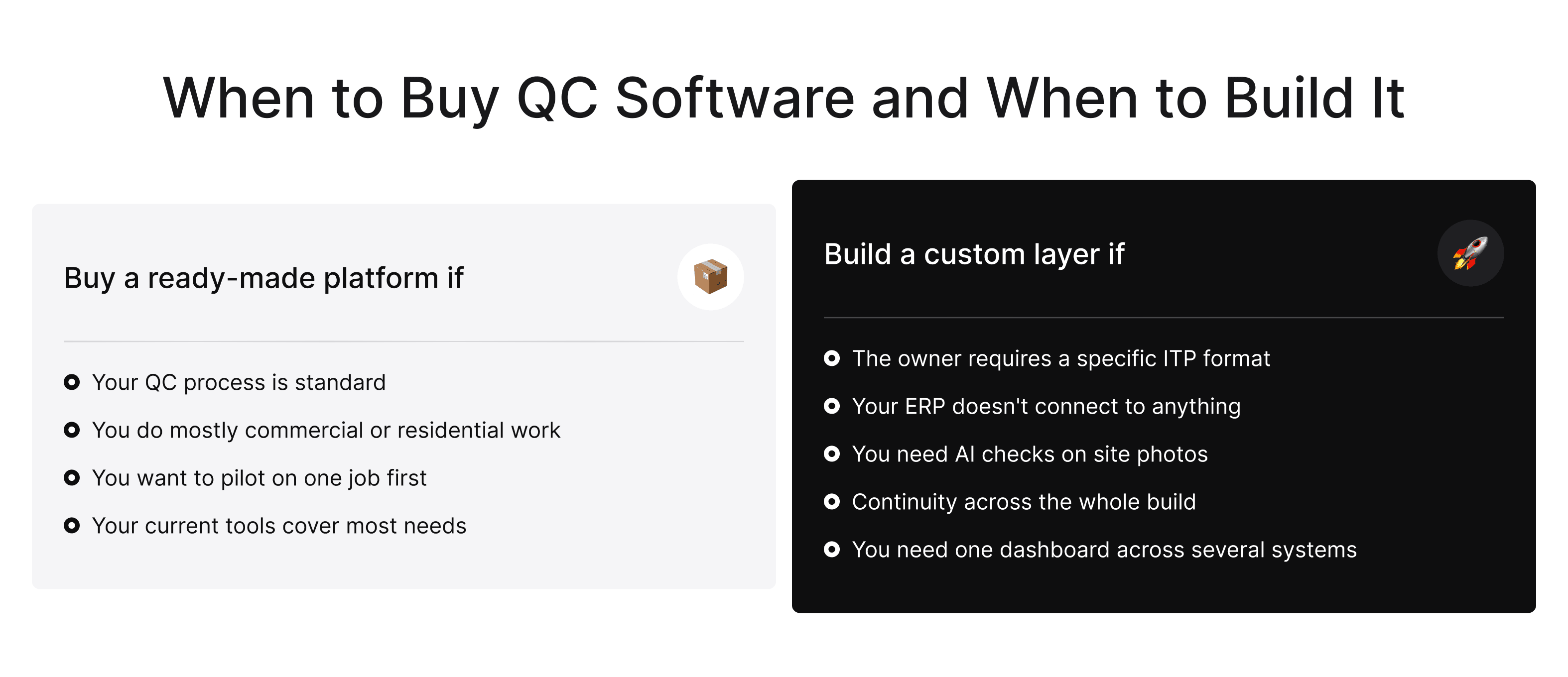
Buy off-the-shelf when your process is fairly standard and your current tools cover most of it. Build a custom layer when your workflow, integrations, or reporting don't fit what vendors sell.
Either way, choosing construction quality management software is less about features and more about fit.
When a Ready-Made Platform Is Enough
If you run mostly commercial or residential work with a typical QC process, a ready-made platform will take you far. Off-the-shelf quality management software for construction also gets you moving quickly: you can pilot it on one job, see what your team actually uses, and decide later whether you need more.
 Click to expand
When a Custom Layer Makes Sense
Sometimes, though, the standard tool fights you. Maybe your owner demands a specific ITP format, or your ERP is older than your interns, and nothing connects to it. That's when a custom layer earns its cost, because you keep the platform you have and add only what's missing.
This is the kind of work Incora does. As a construction software development company, our team builds custom modules and integrations around the tools you already use, so your construction quality control software fits your process and not the other way round.
Not sure where to start with digitizing your QC process?
We can help you figure out what's actually slowing you down and what to build first.
Final Takeaway
In the end, good QC doesn't mean more inspections. It means the right checks at the right moment, with a record you can trust. So define what "pass" means, put hold points where mistakes get buried, and close every NCR.
Do that, and construction quality control stops feeling like a cost. It becomes the reason your phone stays quiet after handover.
FAQ
What is quality control in construction?
Quality control in construction is a five-step process of inspecting and testing built work to confirm it matches the drawings, specs, and codes. The steps are acceptance criteria, an inspection and test plan, three-phase control, nonconformance reports, and turnover checks. Each step leaves a documented record.
What is the difference between QA and QC in construction?
The difference is focus and timing: construction quality assurance manages the process before and during the work, while QC checks the product during and after it. QA covers submittal reviews, training, mock-ups, and audits. QC covers inspections, tests, and measurements. In short, QA prevents defects, and QC finds them.
Who is responsible for quality control on a construction site?
The general contractor is responsible for quality control on a construction site, usually through a QC manager who has the authority to stop work. Subcontractors are responsible for their own work. The owner and design team define the standard, and third-party labs and special inspectors verify the results independently.
What should a construction quality control plan include?
A construction quality control plan should include seven sections: roles and authority, work features, submittals, inspection and test plans with hold and witness points, nonconformance handling, records, and closeout. It should be written for one specific project and finished before mobilization, so the field team can actually use it.
What is a hold point in construction quality control?
A hold point is a mandatory stop where work can't continue until a named person inspects and signs off. It's placed before work gets covered, such as rebar before a concrete pour. A witness point is softer: the inspector is notified, but work may proceed if they don't attend.
What software is used for construction quality control?
3 types of construction quality control software are in use: project management suites with quality modules, standalone inspection apps, and custom-built tools. Whichever you choose, it should handle offline mobile checklists, photos pinned to drawings, NCR tracking, and an audit trail. Integrations with scheduling and document control matter too.


Get in Touch
Got no clue where to start? Why don’t we discuss your idea?

