



By Bohdan Vasylkiv
- CEO & Co-Founder
Warehousing Pick and Pack: The Complete Guide to Smarter Fulfillment Operations
Learn how warehousing pick and pack works — process flow, picking methods, costs, and WMS software to optimize your fulfillment operations.
Key Takeaways
- Pick and pack is order-level fulfillment: picking and packing the exact items for each order, rather than storing goods in bulk.
- The flow runs receive, pick, pack, ship, and returns, and small inefficiencies compound fast at volume.
- Your picking method should match the order volume and SKU count rather than habit or history.
- Custom software integrates inventory, orders, carriers, and analytics, reducing errors and enabling you to scale.
Your customers never see your warehouse. But they feel every mistake that happens inside it: a wrong item, a box that lands 3 days late, a refund you never planned for. Each one quietly chips away at the trust you paid good money to earn.
That's the high-stakes reality of warehousing pick and pack, and it's where fast-growing brands quietly win or lose. This guide breaks down how the process works, which picking method fits your business, what it really costs, and where the right software turns daily chaos into a smooth, scalable operation. Let's dig in.
What Is Warehousing Pick and Pack?
Pick and pack is a fulfillment method in which a worker or a robot selects the exact items for a customer's order and packs them for shipment. It's a simple idea, yet a world away from standard warehousing. For eCommerce and DTC brands especially, it's the difference between a five-star unboxing and a one-star review.
Traditional warehousing is about storage: holding pallets and shipping bulk quantities to a few destinations. Warehousing pick and pack flips that. You're sending many small, unique orders to many individual doorsteps, maybe 500 different item combinations in a single day. That's exactly why accuracy, speed, and software decide whether you stay profitable.
The Pick Pack and Ship Process: How It Works
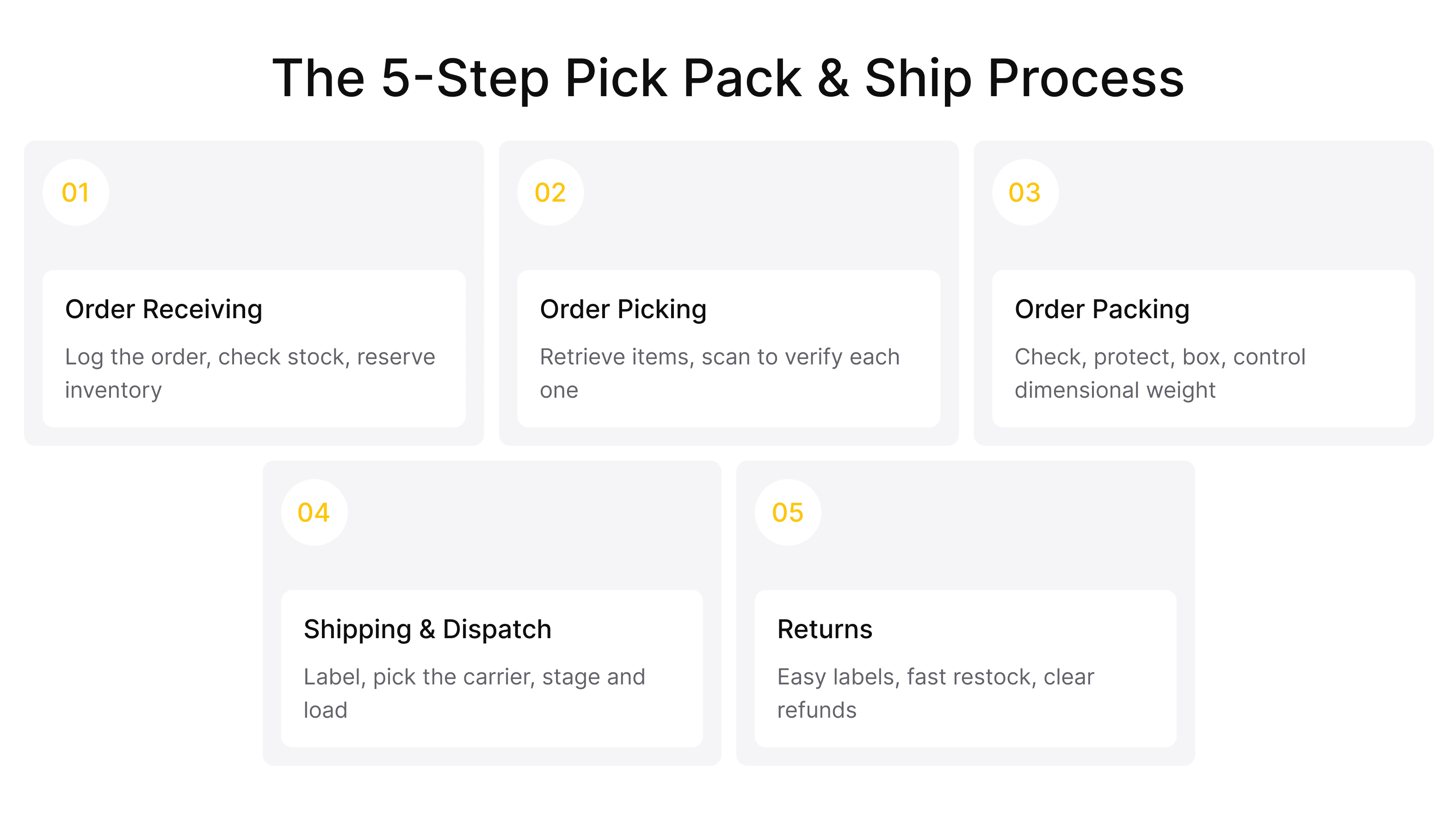
The pick pack and ship process runs in 5 stages, and each one hands off to the next. No single step is complicated. The danger lies in compounding: a two-second delay per pick, times thousands of orders, quietly drains your margin.
Step 1: Order Receiving and Inventory Sync
It starts the second an order lands. Your system logs it, checks stock in real time, and reserves the inventory so 2 people can't buy the last unit. Get this tight, and everything downstream runs clean. Get it wrong, and you're staring at oversells and backorders.
Step 2: Order Picking
Now someone retrieves the items from the shelves. This is the most labor-heavy and error-prone step of them all. The paper lists the work, but scanners that verify each item against the order work far better. The picking method you choose here largely determines your speed and accuracy.
Step 3: Order Packing
Picked items are brought to a packing station for inspection, protection, and boxing. Smart packing guards the product and keeps dimensional weight down, and here's why that matters: carriers charge by size and weight, so good packaging protects your margin on every order.
 Click to expand
Step 4: Shipping and Dispatch
Each order gets a label, a carrier, and a tracking number. Ideally, your software picks the cheapest compliant carrier and prints the label in one click. Then it's staged, scanned, and loaded, and the customer's clock starts the moment that tracking email hits their inbox.
Step 5: Returns and Reverse Logistics
Returns come with the territory, especially in eCommerce. A clean reverse flow, with easy labels, fast restocking, and clear refund rules, turns an annoyance into a reason people buy again. Ignore it, and returns become a silent budget killer. In the U.S., return rates on online orders can run 15–30%, so a sloppy process here scales into serious money.
How to Optimize Your Pick Pack and Ship Process Flow
Tightening your pick pack ship process flow means killing friction between those 5 stages. Shorten pick paths. Move fast sellers closer to packing. Automate the handoffs with a warehouse management system so no one rekeys data. When each stage feeds the next without a pause, throughput climbs — no extra hires required.
Warehouse Picking Methods: Choosing the Right Strategy
Picking eats most of your labor time and causes most of your errors. There's no universal "best" method — it depends on your order volume, SKU count, and layout.
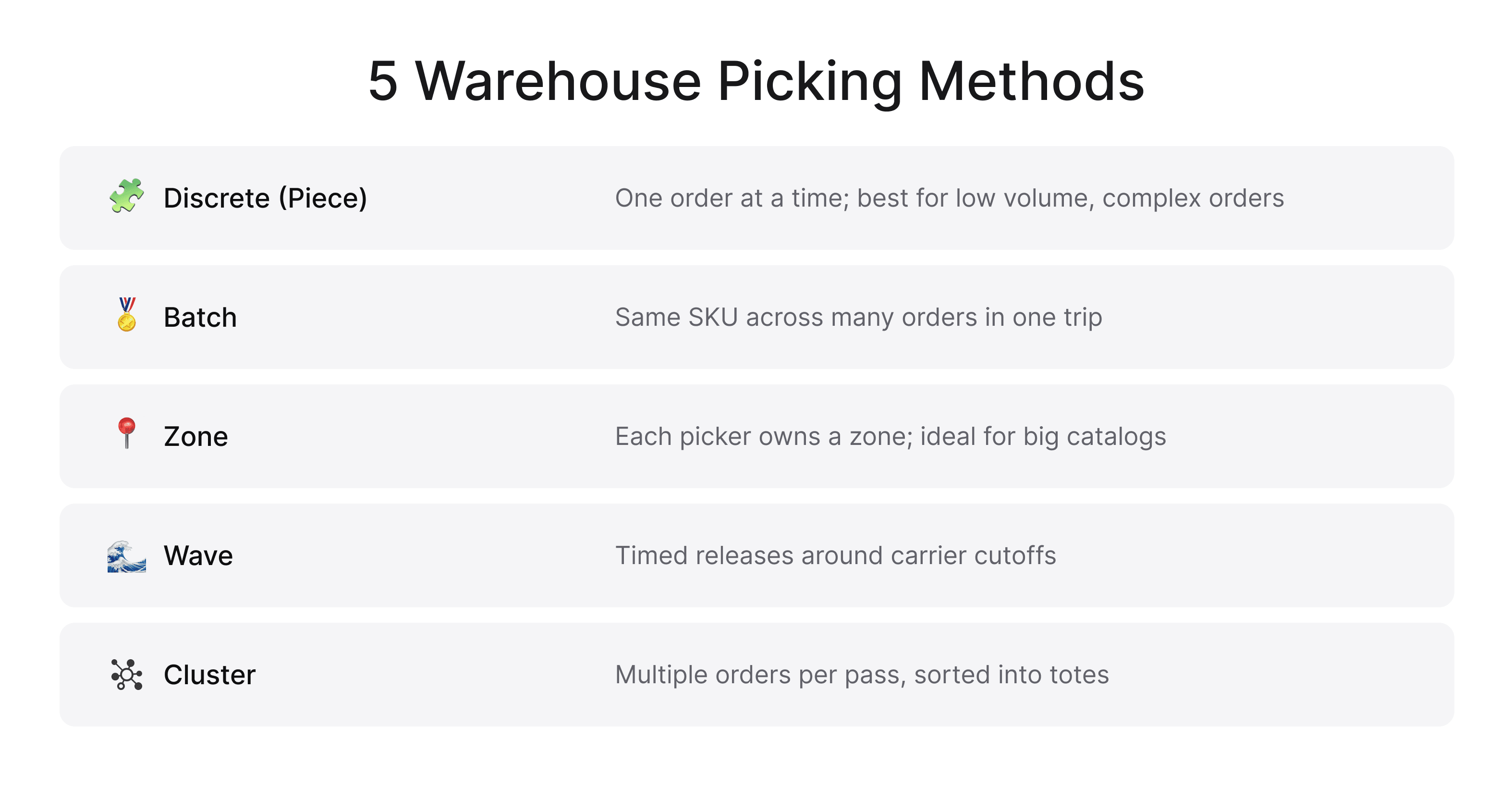
Here's a quick comparison, then the details.
Discrete (Piece) Picking
One picker, one order, one item at a time. It's the simplest approach and tough to botch, which makes it ideal for low-volume or complex custom orders. The catch: it's slow at scale, with lots of walking for very few items.
Batch Picking
A picker grabs the same SKU for several orders on a single trip. If 10 people ordered the same mug, you would pick all 10 at once. It sharply reduces walking time when many orders share common items.
Zone Picking
The floor is split into zones, each owned by a picker. Orders move zone to zone — by hand or conveyor — collecting items along the way. It's a winner in big warehouses with large catalogs, since pickers master their patch and stop crisscrossing the floor.
Wave Picking
Orders are released in scheduled "waves" timed to carrier pickups or shift changes. It's less about how you pick and more about when — a layer of coordination that keeps dispatch on schedule.
Cluster Picking
One picker fills several orders at once, sorting items into separate totes as they go. Think batch picking with the sorting done up front. It's a great fit for growing eCommerce brands with steady multi-item orders. As order counts climb, it's often the upgrade that buys a growing team the most time.
 Click to expand
How to Select the Best Picking Method for Your Business
Start with your data: average order size, SKUs per order, and where your volume spikes. Low volume with complex orders? Go discrete. High volume with repeat SKUs? Batch or cluster. Big catalog and floor? Zone.
Most teams blend methods, and a smart pick and pack process flow often uses 2 or 3, depending on the order. Tools like AI warehouse automation can even assign the right method order by order.
Pick and Pack Warehousing Costs: What to Expect
Let's talk money. Pick and pack warehousing costs are usually split into receiving, monthly storage, per-order pick fees, per-extra-item fees, packaging, and shipping.
As a U.S. benchmark, many 3PLs charge roughly $2.50–$5.00 to pick and pack a basic one-item order, plus about $0.25–$0.75 per extra item. Storage typically runs per pallet or cubic foot, per month.
What moves those numbers? Volume (more orders usually mean lower per-order rates), SKU complexity, packaging, kitting, and returns. When you compare quotes, watch the add-ons — special packaging, rush handling, long-term storage fees.
Model total cost per order shipped, not per line item, and you'll skip most nasty surprises. Put simply, the lowest headline rate doesn't always mean the lowest bill.
Pick Pack and Ship Operations: Best Practices to Follow
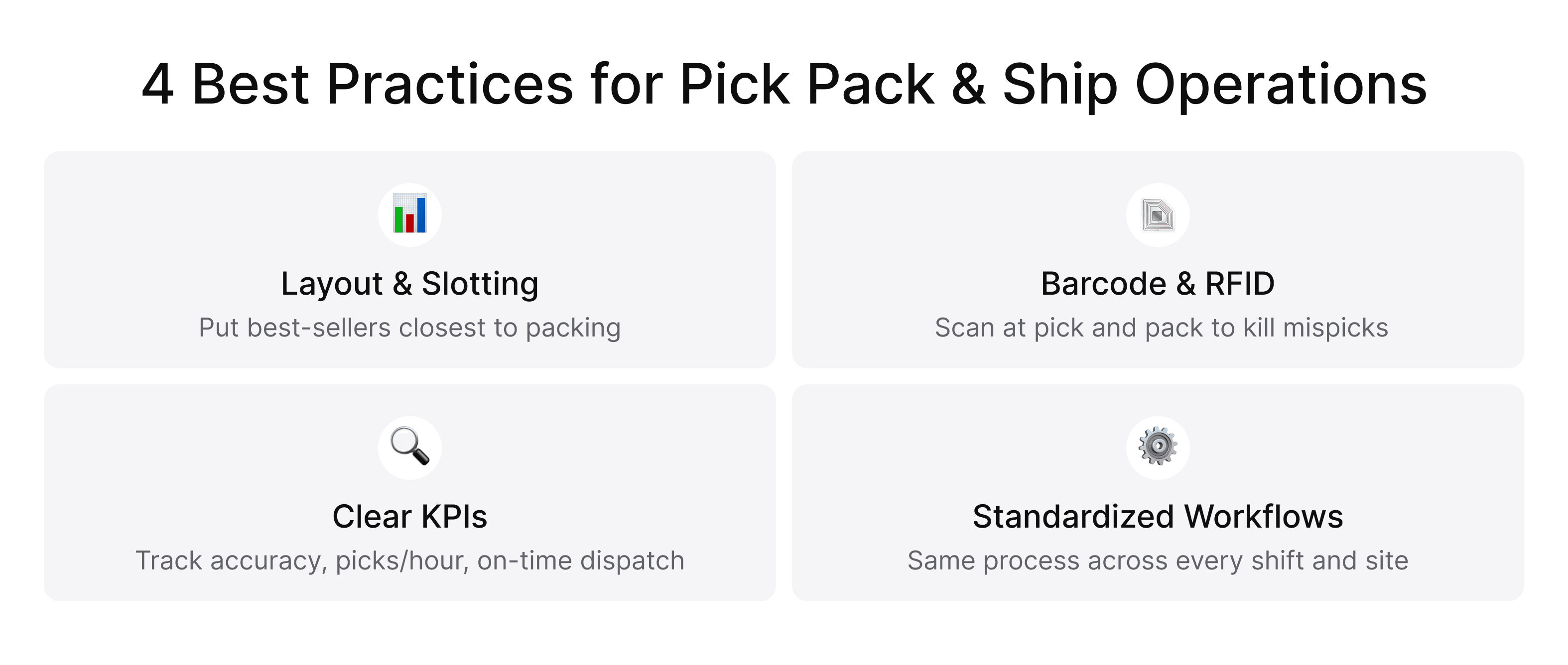
Strong pick pack and ship operations aren't one big heroic move — they're small disciplines done consistently. These 4 are where I'd start.
Optimize Warehouse Layout and Slotting Strategy
Put best-sellers closest to packing and at waist height, and group items people often buy together. Slotting sounds dull, but a smart layout slashes pick travel time — and travel time is where much of your pick pack ship process flow quietly gets wasted.
Use Barcode Scanning and RFID for Error Prevention
Eyes miss things; scanners don't. A scan at pick and again at pack catches mispicks before they ship. RFID goes further, reading many tags at once without line of sight.
The result: fewer wrong shipments, fewer returns, and far fewer apology emails. For high-volume operations, that accuracy gain often pays for the hardware within a single season.
Set Clear KPIs and Accuracy Benchmarks
You can't improve what you don't track. Watch order accuracy, picks per hour, on-time dispatch, and cost per order. Set targets, review them weekly, and post them on the floor. When teams can see the numbers, the numbers get better.
 Click to expand
Standardize Workflows Across Shifts and Locations
If your night shift packs differently from your day shift, quality turns into a coin flip. Document the standard way to pick, pack, and handle exceptions, then train everyone on it. Consistency is what lets you scale across warehouses without quality slipping.
Why Pick Pack and Ship Software Is a Game-Changer
You can run a small shop on spreadsheets and grit. But there's a ceiling. Past a few hundred orders a day, manual coordination cracks — and that's where pick pack and ship software pays off. It links your channels, inventory, picking, packing, and carriers into a single flow, so data moves rather than being retyped 5 times.
The best systems don't just digitize your steps — they remove some entirely. Orders route themselves, pick lists optimize, and labels print on their own. Pair that with real business process automation, and your whole back office gets noticeably lighter.
Key Features of Effective Pick Pack and Ship Software
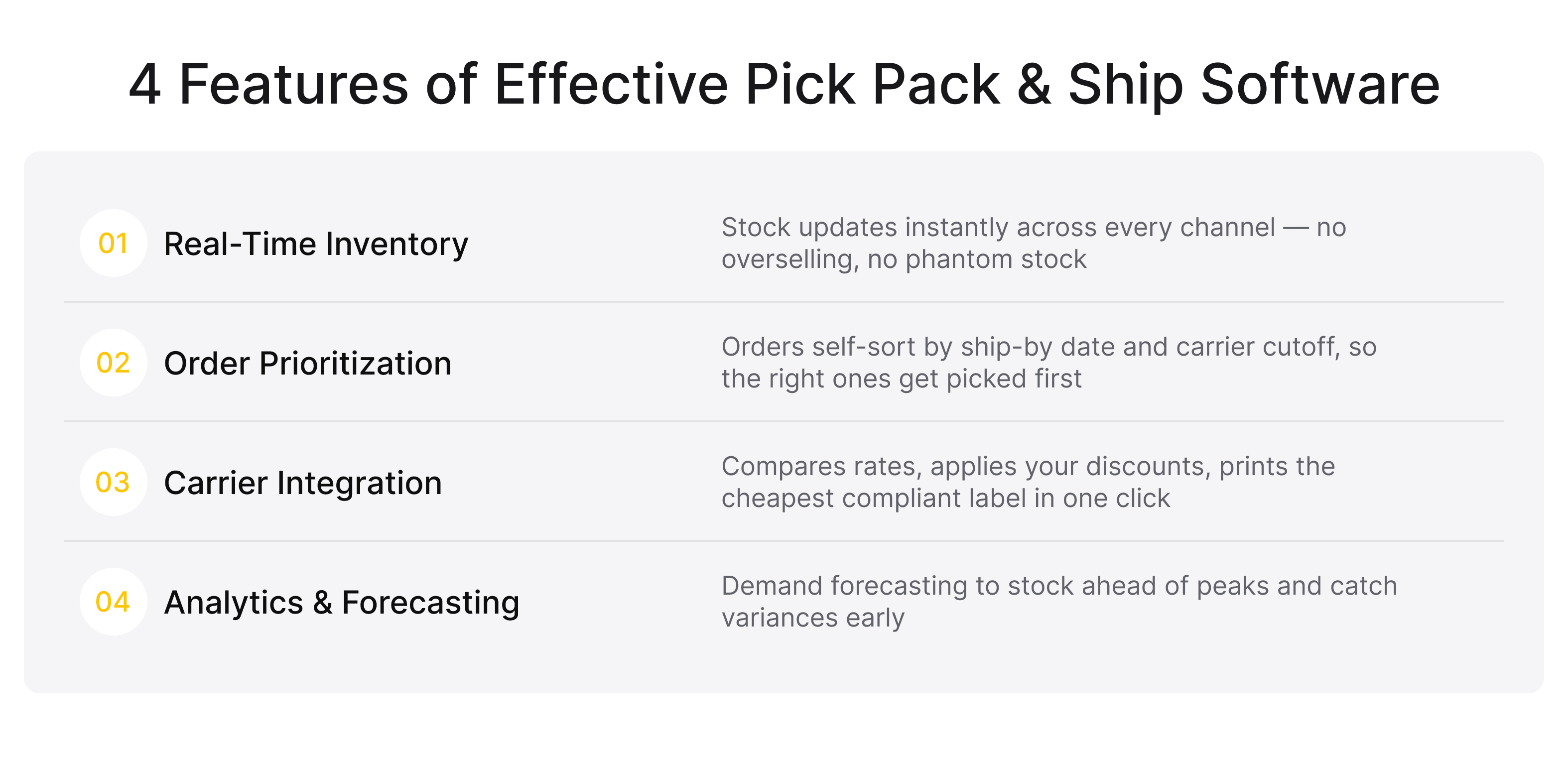
Buy it or build it, these are the features that actually move the needle. A capable pick pack and ship software platform should nail all 4. The real edge of building custom is that each of these bends to your process — instead of forcing your process to bend to someone else's template.
Real-Time Inventory Management
Every stock move updates instantly across every channel. No overselling, no phantom stock, no midnight reconciliation. This is the foundation on which everything else sits. With custom software, you also define how stock syncs across your exact channels and 3PL locations.
Order Management and Prioritization Engine
Orders should sort themselves by ship-by date, service level, and carrier cutoff, so the right ones get picked first. A rush order at 2 p.m.? It jumps the queue — no spreadsheet required. Custom logic lets you encode your own priority rules, not whatever presets shipped in the box.
 Click to expand
Carrier Integration and Automated Label Printing
The system compares carrier rates, applies your negotiated discounts, picks the cheapest compliant option, and prints the label in one click. Across thousands of orders, that adds up to real savings. And because it's built for you, it plugs into the exact carriers and regional couriers you actually use.
Analytics, Reporting, and Demand Forecasting
Good software shows what happened; great software shows what's coming. Demand forecasting helps you staff and stock ahead of peaks like the holiday rush, rather than scrambling through them. Predicting demand even a little better means less capital tied up in dead stock.
That's exactly where solid supply chain management software earns its keep. A tailored build reports on the metrics your business actually cares about, not a fixed dashboard someone else designed.
Common Pick Pack and Ship Operations Challenges
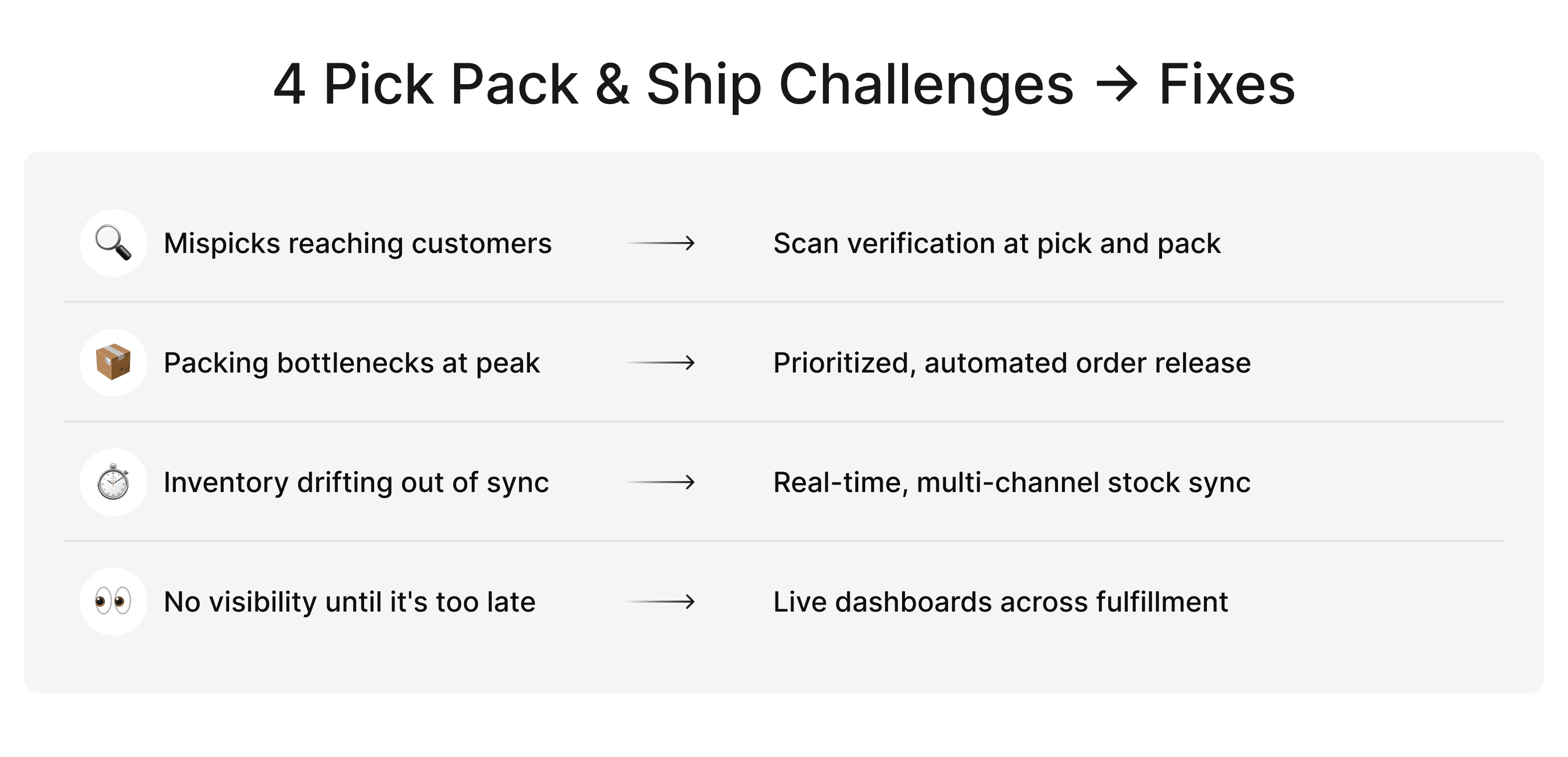
Even sharp teams hit the same walls: mispicks reaching customers, packing bottlenecks at peak, inventory drifting out of sync, and no real visibility until a problem has already cost you.
Most pick pack and ship operations struggle because the tools can't keep pace with volume — a systems problem, not a people problem.
The frustrating part? Your team is usually working hard; they're just fighting the tools instead of the workload. And that's fixable.
How Custom WMS Software Solves These Challenges
Off-the-shelf tools are fine until your workflow doesn't fit their template. That's the moment custom software stops being a luxury: it's built around how you actually operate, rather than the other way around.
Eliminating Manual Errors with Automated Workflows
Scan-verified, automated workflows remove the exact moments humans slip: manual entry, guesswork, that "pretty sure this is right" feeling. Build the rules once, and the system enforces them every time. That's warehousing pick and pack with the error rate designed out.
 Click to expand
Scaling Pick Pack and Ship Operations with Software
Growth breaks manual systems; software absorbs it. When you scale by adjusting configuration instead of adding headcount, an order spike becomes a good day, not a five-alarm crisis.
The setup that handles 500 orders can handle 5,000 with the same logic. That's what protects your margins during peak season instead of quietly eroding them.
Seamless Integration with eCommerce and ERP Platforms
Your fulfillment engine shouldn't sit on an island. Tight integration with your storefront, marketplaces, and back office keeps data flowing end-to-end. Connecting solid supply chain software to your ERP gives you one source of truth instead of 5 that constantly disagree.
Real-Time Visibility Across the Fulfillment Chain
See every order's status live, from click to doorstep, and you catch problems while they're still small. Visibility turns reactive firefighting into calm, proactive control — and keeps customers in the loop instead of chasing you.
How Incora Designs Custom Warehouse Software Solutions
Incora is a software development and integration team that builds warehouse systems around how your operation runs. Each engagement starts with discovery — mapping your exact pick pack and ship process and locating where accuracy or throughput breaks down.
From there, the team builds the WMS and OMS modules you need, integrates them with your storefront, carriers, and ERP, and ships in testable phases.
Where inventory and finance must align, Incora's ERP developers tie fulfillment into accounting, so orders, costs, and stock reconcile automatically.
Not sure where to start with pick and pack?
We can help you figure out what's actually slowing you down and what to build first.
Why Partner with Incora for Your Warehousing Software?
Choosing a development partner comes down to who understands warehouse operations before writing code. Incora spends the first weeks inside your process — reviewing order data and ranking fixes by payback.
The build then targets those points directly: scan verification to cut mispicks, smarter order release to clear packing bottlenecks, and carrier automation to speed dispatch.
After launch, the team tunes the system against live data — refining slotting, adding channels, and expanding capacity as volume climbs. The outcome is measurable: higher pick accuracy, faster order-to-ship, and a platform that scales with the business.
Final Takeaway
Warehousing pick and pack is simple to define and demanding to run well. What separates operations that scale from ones that stall is consistent pick accuracy, efficient packing, on-time dispatch, and software that removes the friction between them. Measure where orders slow down, fix the costliest bottleneck first, and let proven technology carry the rest.
FAQ
What is the difference between pick and pack and standard warehousing?
Standard warehousing is about bulk storage and shipping large quantities to a few destinations. Pick and pack is order-level fulfillment — selecting specific items for individual orders and packing them for shipment. One holds inventory; the other gets the right items out the door, one order at a time.
How much does pick and pack warehousing cost per order?
A basic single-item order usually runs about $2.50–$5.00 to pick and pack, plus roughly $0.25–$0.75 per extra item, on top of storage and shipping. Your pick and pack warehousing costs depend on volume, SKU complexity, packaging, and returns — so model total cost per order shipped rather than any single fee.
What is the best software for pick pack and ship operations?
The best platform is the one that fits your workflow. Off-the-shelf tools handle standard setups well; custom systems win when your processes are unique or you're scaling fast and need tight integration. Match the software to how you actually operate, not to a feature checklist someone else wrote.
How can I improve pick pack and ship operations efficiency?
Start with layout and slotting, add barcode or RFID scanning, set clear KPIs for accuracy and speed, and standardize workflows across shifts. Then automate the handoffs with software. Small, steady improvements to your pick pack and ship operations compound into big gains over time.


YOU MAY ALSO LIKE


Get in Touch
Got no clue where to start? Why don't we discuss your ideas?

