



By Bohdan Vasylkiv
- CEO & Co-Founder
Product Traceability: From Batch Records to a Live Digital Thread
What product traceability is, how traceability systems work, and how to build digital traceability software that scales across your supply chain.
Key Takeaways
- Product traceability lets you reconstruct a product's history in minutes, not days.
- Regulators, retailers, and auditors increasingly expect accessible, lot-level records.
- A working traceability setup has 5 layers: identity, capture, events, data, and access.
- Most companies don't need to replace everything they already use. They need to connect the gaps between existing systems.
Nobody thinks much about traceability until a problem lands on someone's desk. A complaint comes in, a lab result raises a concern, or a regulator asks which lots contained a specific ingredient. Suddenly, 3 people are searching through spreadsheets to answer one question: where did this go?
That scramble has a real cost. It takes hours to reconstruct basic information, can make a recall broader than necessary, and puts pressure on customer relationships.
Here's what product traceability looks like when it actually works. If you're still mapping options broadly, our roundup of supply chain software ideas is a good place to start.
What Is Product Traceability? A Working Definition
So, what is product traceability? Simply put, it's your ability to answer 2 questions about a product: where did every input come from, and where did it go?
The formal product traceability definition describes following a product through stages of production and distribution. In practice, that means reconstructing its history from records when needed.
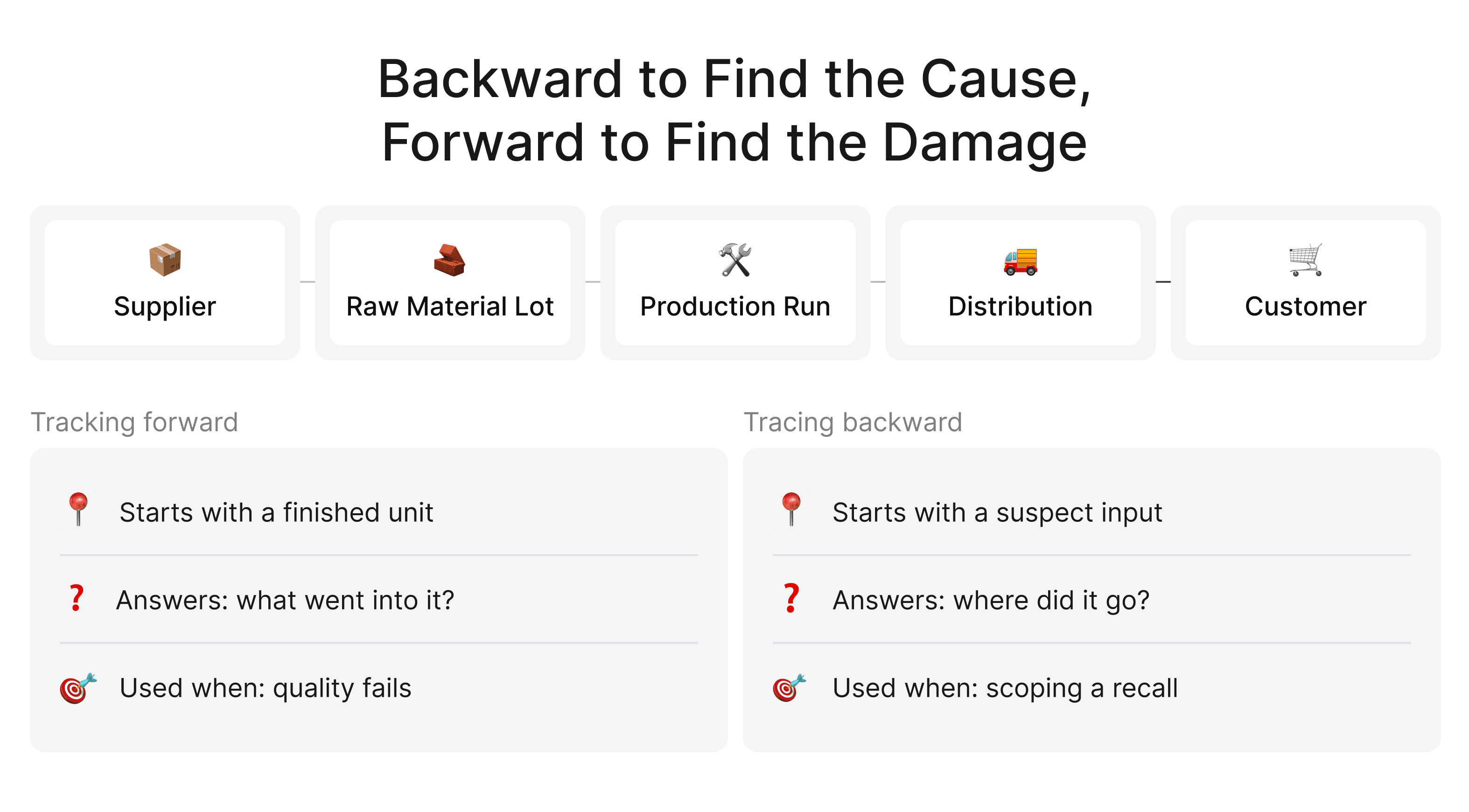
Tracking Forward, Tracing Backward
Tracing backward starts with a finished unit and moves upstream: which material batch, supplier lot, or production run was involved. Tracking forward moves downstream: which orders, pallets, customers, or stores received it. You need both directions when investigating a defect or planning a recall.
 Click to expand
Traceability vs. Tracking vs. Supply Chain Transparency
Tracking tells you where something is now. Traceability tells you where it has been and what it was made from. A company may know where a truck is and still have limited visibility into which material batch is inside the shipment.
Lot, Batch and Item-Level: How Granular Should You Go?
Lot-level traceability works well for many bulk products, while item-level serialization gives you more precise recall and warranty information. The right level depends on the product, risk, and cost of capturing the data.
Why Product Traceability Moved From Paperwork to Product Strategy
So why is product traceability important enough to sit in a board deck now? Because customers, regulators, and business partners increasingly expect evidence that you can actually produce.
The 24-Hour Recall Window
The FDA's Food Traceability Rule requires covered businesses to provide relevant records within 24 hours of an FDA request. The rule is currently subject to a congressional directive preventing FDA enforcement before July 20, 2028.
That 24-hour records window is only the starting point. The faster your team can reconstruct the chain, the faster it can scope the recall and identify affected products.
Rules Already on the Books: FSMA 204, DSCSA, UFLPA, EU Digital Product Passport
FSMA 204 requires covered businesses to maintain key data elements associated with critical tracking events for foods on the Food Traceability List.
The Drug Supply Chain Security Act (DSCSA) establishes electronic tracing requirements across the US pharmaceutical supply chain.
The UFLPA also makes upstream supply chain evidence important for companies importing goods subject to its forced-labor presumption.
In the EU, Digital Product Passport requirements are arriving in stages. For certain batteries, the DPP becomes mandatory from 18 February 2027. For construction products, the European Commission's indicative timeline puts the delegated act in Q2 2027. Manufacturers' obligations follow about 18 months later, once the act enters into force.
Margin Leaks Traceability Exposes
Compliance may get the budget approved, but operational value keeps the project useful. Once you can connect a defect to a supplier lot, production shift, or machine, scrap and rework become problems you can investigate rather than monthly averages.
The traceability of products through your own plant can therefore support quality, supplier management, and margin protection at the same time.
What Enterprise Buyers and Auditors Now Ask You to Prove
Large retailers increasingly build traceability requirements directly into supplier programs. Walmart, for example, requires food suppliers to provide Advance Shipping Notices containing relevant Key Data Elements. Food pallets must carry an SSCC-18 barcode linked to the ASN, while cases must use a barcode such as GS1-128 to transmit sufficient traceability data. Walmart's requirements for FSMA-eligible food products took effect August 1, 2025.
The expectation is practical: can you provide the required information in a machine-readable format when a customer asks for it?
Anatomy of a Product Traceability System
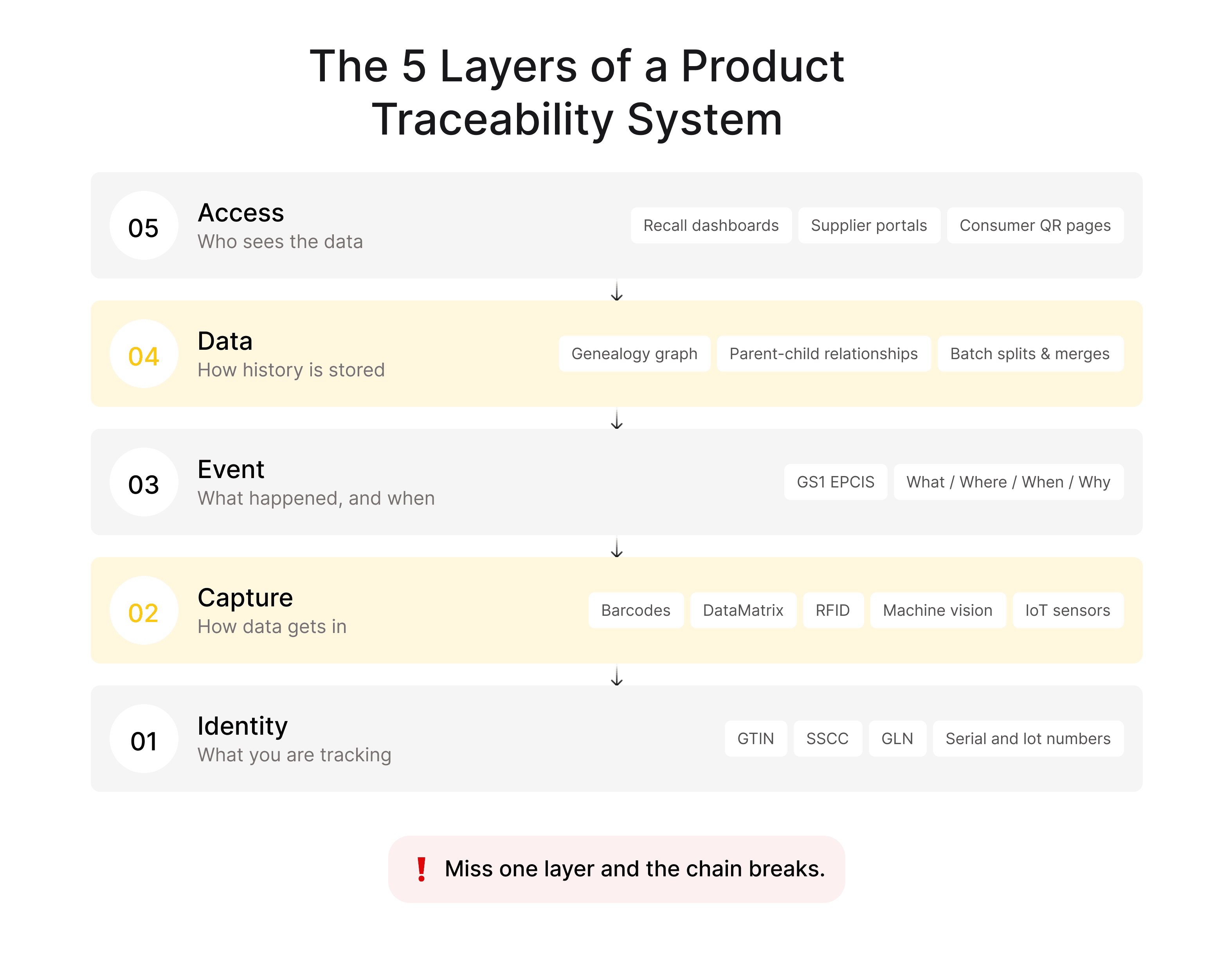
A working setup has 5 layers, from product identification to making its history available.
Identity Layer: GTIN, SSCC, Serial Numbers and GS1 Standards
Nothing works until the things you're tracking have consistent identities. GTINs identify products, SSCCs identify logistics units, and GLNs identify locations and business entities.
Capture Layer: Barcodes, DataMatrix, RFID, Machine Vision, IoT
This is where data enters the system. Barcodes, DataMatrix, RFID, machine vision, and IoT can all play a role depending on the workflow.
The best capture method is the one that produces reliable data without adding unnecessary work for operators.
Event Layer: EPCIS and the What / Where / When / Why Record
Traceability is built around events as much as objects. GS1 EPCIS provides a standard structure for describing what happened, when and where it happened, and the business context behind the event.
 Click to expand
Data Layer: A Genealogy Graph, Not a Spreadsheet
Inputs merge into batches, batches split into production runs, and finished goods are divided across shipments and customers. Those relationships form the core of product genealogy.
A serious product traceability system needs to represent these parent-child relationships clearly, so teams can move from a material batch to the products and customers connected to it.
Access Layer: Dashboards, Supplier Portals and Consumer QR Pages
Quality teams may need a recall dashboard, suppliers may need a portal for submitting data, and customers or inspectors may need selected product information through QR codes.
Internal, Chain and End-to-End: Choosing Your Traceability Scope
Scope is a budget decision as much as a technical one. Most product traceability programs work better when they start with the highest-risk or highest-value part of the chain.
Internal (Production) Traceability on the Shop Floor
This is the foundation. Solid production traceability connects work orders with inputs, equipment, operators, production events, and outputs.
Supplier-Side Traceability and the Tier-2 Blind Spot
Tier 1 gives you a name on an invoice. Information about material origin, forced-labor exposure, counterfeit components, or contaminated inputs may sit further upstream.
Start with the materials where upstream visibility carries the greatest operational or regulatory risk.
End-to-End Traceability Across Partners
End-to-end traceability means the product history survives handoffs between companies. The challenge is agreeing on what data gets shared, in what format, and who owns it.
The Technology Stack Behind Digital Product Traceability
Digital product traceability brings together several technologies, each solving a different part of the process. Choosing the right product traceability technology depends less on the feature list than on where your data actually breaks today.
Automated Data Capture vs. Manual Scanning
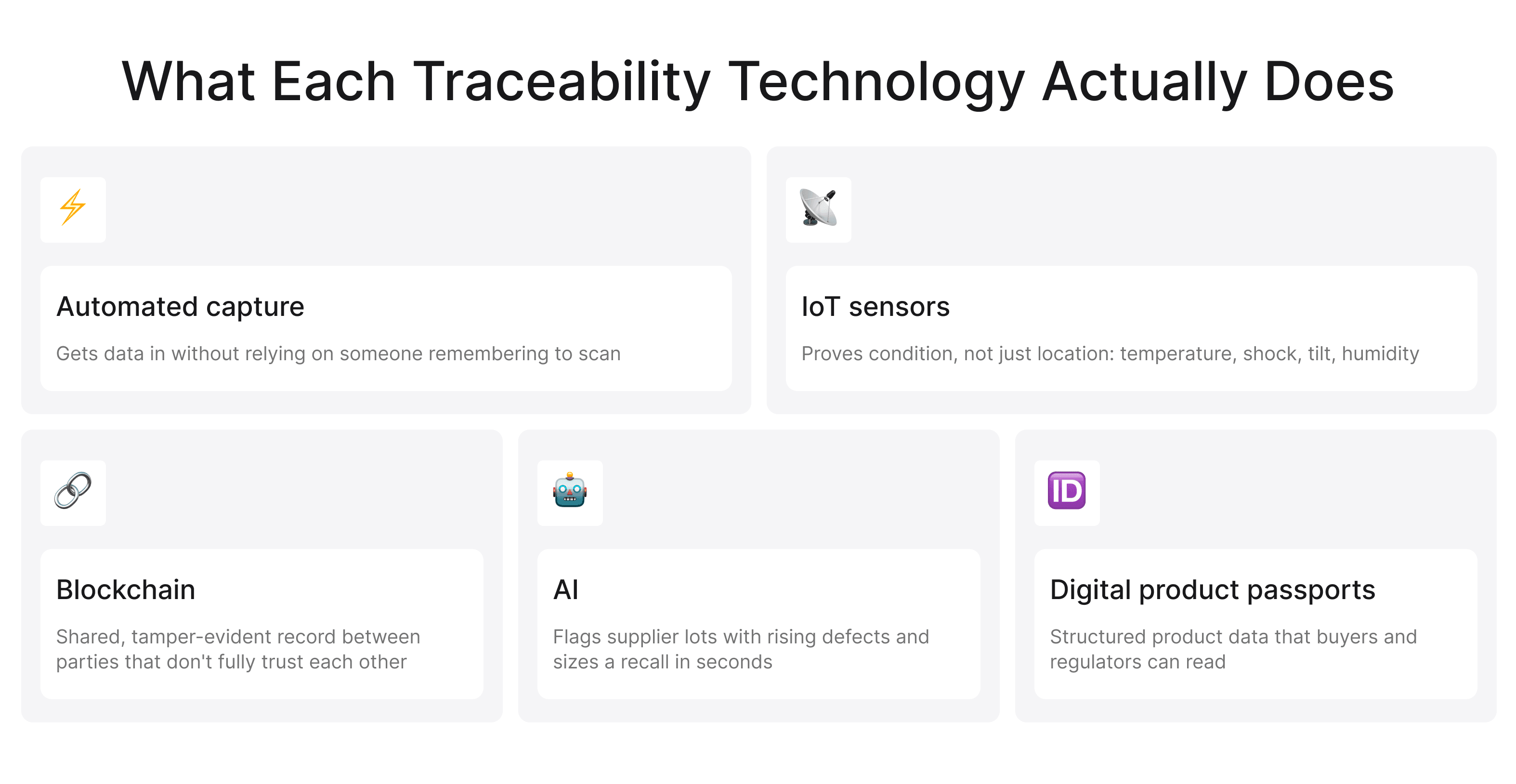
Manual scanning works well for controlled workflows, although repeated scanning becomes harder to manage as volume increases. Automated product traceability can move more of that work into fixed scanners, machine vision, weigh-and-log stations, or direct machine integration.
This is also a natural business process automation opportunity when repetitive manual steps create delays or inconsistent data.
IoT and Sensor Data for Cold-Chain and Condition Proof
For some products, location is only part of the story. Temperature, shock, tilt, humidity, and other sensor readings can become part of the traceability record.
 Click to expand
Where Blockchain Genuinely Helps - and Where It Doesn't
Blockchain can make sense when independent parties need a shared, tamper-evident record for provenance, certificates, or chain of custody.
It does not fix poor data capture at the source. If incorrect information enters the system, blockchain preserves it. Our deeper piece on blockchain in logistics looks at where the technology can provide practical value.
AI for Anomaly Detection and Recall Scoping
Once traceability events are connected, AI can help identify patterns that are difficult to spot manually. Models can flag supplier lots associated with rising defect rates or help determine which products may be affected by a particular event.
Digital Product Passports: What to Build Now
The EU requirements are arriving in stages, while the underlying data foundations are already becoming clear. Persistent product IDs, structured product attributes, and controlled access can make future requirements easier to support.
Digital Product Passports are coming next. The European Commission's indicative timeline puts the delegated act for construction products in Q2 2027, with manufacturer obligations expected roughly 18 months after the act enters into force.
Buy, Configure or Build: Choosing Product Traceability Software
There's no universally right answer. The choice depends on your existing systems and how closely your process fits the available software.
What ERP, MES and QMS Modules Already Cover
ERP can handle lot numbers and inventory, MES can capture shop-floor genealogy, and QMS can store quality records.
The gap is often between these systems. A real product traceability system needs to connect the relevant records so users can follow a product history without manually combining reports.
Off-the-Shelf Traceability Solutions and Where They Hit a Ceiling
Packaged product traceability solutions work well when your process follows a standard model and fits the software's data structure.
The ceiling appears with rework loops, split-and-merge batches, legacy systems, or partners using different formats. At that point, the issue is usually the fit between the software and your process.
Signals Your Case Needs a Custom Traceability Platform
A few signals are worth paying attention to:
Your traceable unit doesn't match the vendor's data model. You need to trace across 3 or more unintegrated systems. Major customers require different data formats. Your team keeps spreadsheets to patch gaps in the software.
If 2 or more are true, custom product traceability software may be worth evaluating. A short software development consulting engagement can help determine whether you need configuration, integration work, or a custom platform.
Cost Drivers and a Realistic Budget Range
The main cost drivers are traceability granularity, capture points, legacy integrations, number of facilities, and external partners.
A focused single-plant pilot can land in the tens of thousands, while a multi-site platform with supplier portals and complex integrations can move into six figures. Starting with MVP development around one line or product family keeps the first investment focused.
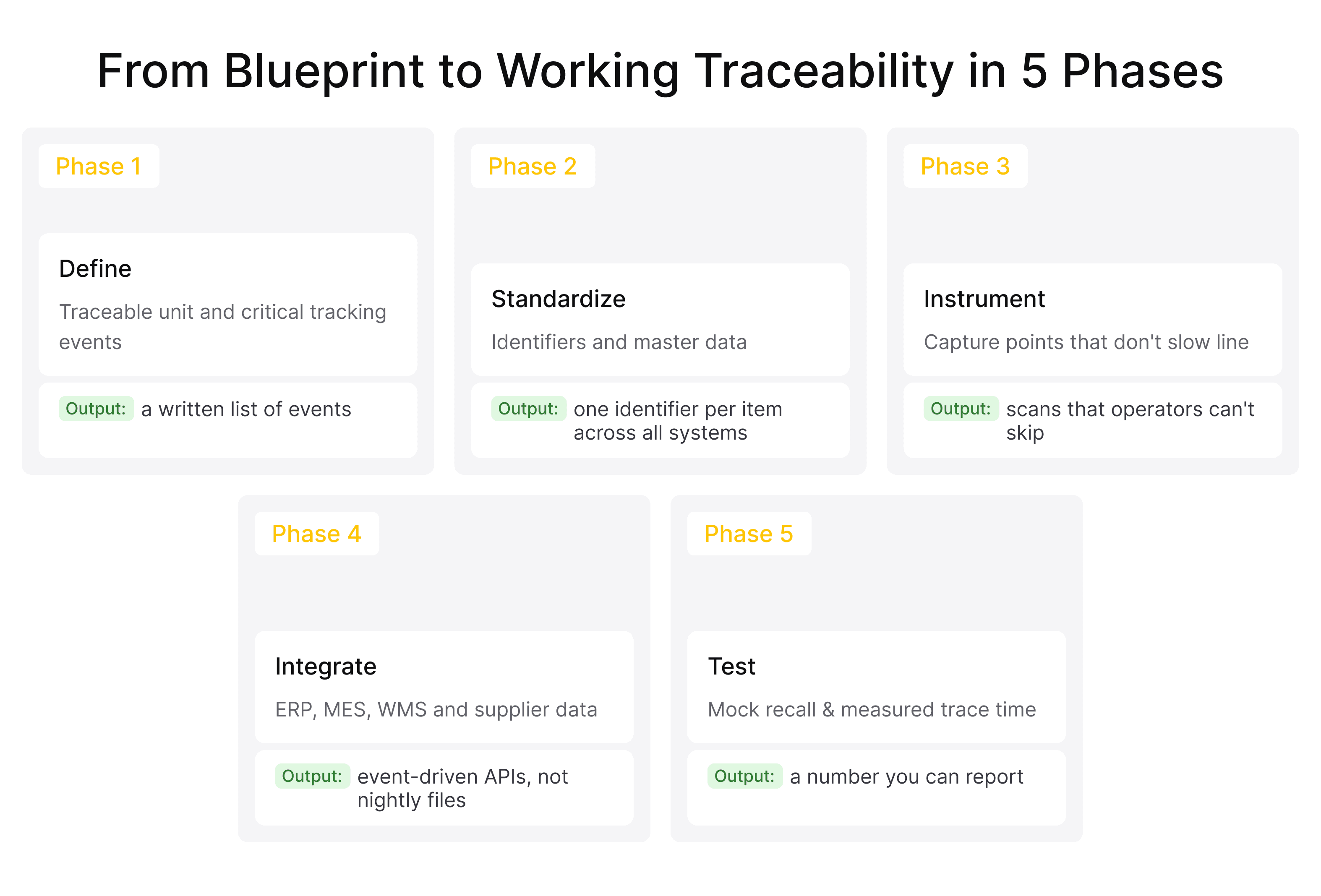
How to Implement Product Traceability: A Five-Phase Rollout
If you're wondering how to implement product traceability, the sequence matters.
Phase 1. Define the Traceable Unit and Critical Tracking Events
Decide what you're tracking and when its state changes. Receiving, transformation, inspection, packing, and shipping may all become critical tracking events depending on the process.
Phase 2. Standardize Identifiers Before You Write Code
If your ERP calls it Item Code, the plant calls it Part No., and your supplier uses something else, integrations will struggle. Standardize identifiers and clean up master data first.
Phase 3. Instrument Capture Points Without Slowing the Line
Every additional scan adds time. Where manual scanning creates unnecessary friction, fixed readers, machine vision, or direct machine integration can capture the same information with less operator involvement.
 Click to expand
Phase 4. Integrate ERP, MES, WMS and Supplier Data
Connect production events, inventory movements, and supplier information so the product history can move across systems. Event-driven APIs can reduce reliance on periodic file exchanges. Many of the capabilities covered in our guide to supply management software features become more useful once these systems share data.
Phase 5. Run a Mock Recall and Measure Trace Time
Pick a finished lot, identify every relevant input and downstream recipient, and record how long the process takes. The gaps you find usually tell you more than another round of feature planning.
Product Traceability by Industry: What Actually Changes
The 5 layers stay broadly the same. The traceable unit, regulations, and business risks change.
Food and Beverage
Short shelf life, fast-moving lots, allergens, and retailer requirements make traceability especially important. One common challenge is connecting several raw material lots to a finished batch.
Pharma and Medical Devices
Serialization, product genealogy, and regulatory records are central here. DSCSA requires electronic tracing for applicable pharmaceutical products, while medical devices use UDI.
Automotive and Aerospace
Safety-critical parts may require heat numbers, production parameters, machine and operator information, calibration records, and inspection results. Strong production traceability supports recalls, warranty investigations, and supplier quality management.
Construction Materials and Prefab
For construction manufacturers, disconnected data makes traceability hard to manage. A precast panel may need links to its concrete batch, reinforcement lot, curing records, and final project location. Fabricated steel may need connections between the original heat number, mill certificate, and installed component. Pulling one of these histories together usually means searching across several systems.
The EU's revised Construction Products Regulation (EU) 2024/3110 raises the bar. From 8 January 2026, the Declaration of Performance and Conformity must cover certain environmental characteristics, including Global Warming Potential, for relevant products. Digital Product Passports for construction products come next.
Connecting this data takes more than linking a few systems. It requires an understanding of how construction businesses actually manage materials, production, documentation, and project data. That is the work we have been doing with construction partners for years, on projects such as Riel, which reports 40% better process efficiency, and BuilderPlan.ai, which cut cost overruns by 35%. Most of the value comes from connecting what already exists, and that is where product traceability technology earns its place here.
Apparel and Consumer Goods
Origin, forced-labor exposure, supplier visibility, and product information are key concerns. The UFLPA can require companies to trace certain materials further upstream, while QR codes can link product identities to selected origin and manufacturing information.
Metrics That Prove Your Traceability System Works
You need numbers to know whether the system works. Trace time shows how long it takes to identify inputs and downstream recipients. Trace completeness shows how much of the product history you can reconstruct without a manual gap.
Data capture accuracy and missing-event rates are useful too. Together, these measures show whether product traceability is becoming a reliable operational capability rather than another reporting system.
Turning a Traceability Blueprint Into Working Software
A good traceability model still has to work with the systems and workflows people use every day.
At Incora, we build custom product traceability software around the systems a business already relies on. That can include ERP, MES, WMS, QMS, supplier systems, and operational tools, with the data model designed around actual production and traceability requirements. It's the same API-first approach we took on the logistics platform we built, where over 150 online store chains needed shipping tools that would drop into whatever system they were already running.
We start by understanding the existing processes and systems before deciding what needs to be built. Proven construction modules can cover the parts that already have a clear solution, while custom development is used where the business has specific requirements that existing software cannot address.
Not sure where to start with digital product traceability?
We can help you identify the gaps in your current systems and decide what is worth integrating, configuring, or building.
This approach gives companies a practical starting point without rebuilding everything from scratch. The result is product traceability solutions built around the way the business already works, with clear scope and only the custom functionality that adds real value.
Final Takeaway
Product traceability has become a practical business capability that helps companies respond to recalls faster, protect margins, and provide customers with evidence about where products and materials came from.
Start with one product family, define the traceable unit, standardize identifiers, connect the critical data, and run a mock recall. The results will show you where the next investment makes sense.
FAQ
What is product traceability in simple terms?
It's the ability to reconstruct a product's history: what went into it, where and when it was made, what happened during production, and where it was delivered.
What is the difference between traceability and tracking?
Tracking tells you where something is or its current status. Traceability gives you a broader history of where it has been, what it is made from, and which products or customers it is connected to.
Which industries are legally required to trace their products?
Requirements vary by product and jurisdiction. Food, pharmaceuticals, and medical devices have significant traceability requirements, while batteries and construction products are also moving toward more structured product information requirements under EU rules.
How much does it cost to build a product traceability system?
It depends on granularity, integrations, capture methods, facilities, and external systems. A focused product traceability system covering one plant can start in the tens of thousands, while a multi-site platform can cost considerably more.
How long does it take to implement product traceability?
A focused pilot on a single line or product family can take several weeks to a few months. Larger rollouts with multiple facilities and supplier onboarding take longer, with master data and integrations often determining the timeline. Choosing the right product traceability software approach early can help keep the implementation focused.


YOU MAY ALSO LIKE



Get in Touch
Got no clue where to start? Why don't we discuss your ideas?

