



By Bohdan Vasylkiv
- CEO & Co-Founder
Warehouse Slotting: Types, Best Practices, and How Slotting Optimization Software Works
Warehouse slotting explained: fixed vs random, macro vs micro, the data and algorithms behind slotting optimization, and how to build it into your WMS.
Key Takeaways
- Slotting decides where each SKU lives, and that choice directly shapes your pick travel and labor costs.
- There's no universal best slot map; the right setup depends on your order profile, which keeps changing.
- Good slotting starts with clean data, well before you move a single pallet.
- You can extend your WMS, buy a standalone tool, or build a custom engine, and each path has its own trade-offs.
A warehouse building can stay the same for years, but the orders moving through it rarely do. That gap is exactly what warehouse slotting is for.
In practice, it's deciding where each product should live so pickers walk less, errors drop, and your busiest items stay within easy reach.
Plenty of teams treat slotting as a one-time setup, and that's usually where the trouble starts. It works far better as something you tend to over time.
With the right software behind it, warehouse slotting keeps costs in check and the operation running smoothly even as demand shifts underneath you.
So let's walk through it properly: what slotting actually is, the main types, how the algorithms work, and how to decide whether to buy or build.
What Is Warehouse Slotting?
At its simplest, slotting means assigning each SKU to a specific location based on how it behaves; in other words, how often it's picked, how big it is, what it tends to ship with, and how it needs to be stored.
If you've ever wondered what is warehouse slotting in plain terms, that's the whole idea: the right product, in the right place, for the right reason.
The slotting meaning in warehouse operations really comes down to one goal, and it's a practical one. You want to shrink the distance and effort between a picker and the items they reach for most.
Fast movers belong somewhere easy to grab; slow movers can sit farther out of the way.
Most people searching for what is slotting in warehouse management just want a quick definition, but the ripple effects are worth noticing. Done well, slotting touches throughput, accuracy, safety, and even how fast a new hire gets comfortable on the floor.
Slotting vs. Warehouse Layout vs. Zoning vs. Picking Strategy
These 4 terms get tangled together constantly, so it helps to pull them apart.
Layout is the building's fixed structure: the racks, aisles, and dock doors. Zoning divides that floor into areas, usually by product type or equipment. Picking strategy is how your team gathers orders, whether that's single, batch, wave, or zone picking.
Slotting lives inside all of that. It simply decides which SKU goes into which slot, which is why slotting in warehouse projects can lift performance without you moving a single wall.
What Bad Slotting Actually Costs
Here's the frustrating part: poor slotting is expensive, but the cost rarely announces itself. Pickers walk farther. Popular items drift up to high shelves while slow stock hogs the convenient spots. And congestion piles up in the same few aisles, shift after shift.
Since travel can eat a large chunk of a picker's day, inefficient warehouse slotting quietly means paying people to spend more time walking.
Picture a mid-size operation with forty pickers. If each one loses just 10 extra minutes a shift reaching badly placed items, that's roughly six and a half hours of paid labor gone every day.
Over a year, that adds up to a serious number, and that's before you even count mispicks, congestion, and peak-season overtime.
Types of Warehouse Slotting
There isn't one correct way to approach warehouse slotting. Most operations blend a few methods depending on their products, their space, and the shape of their orders.
These are the ones worth knowing.
Fixed Slotting vs. Random Slotting
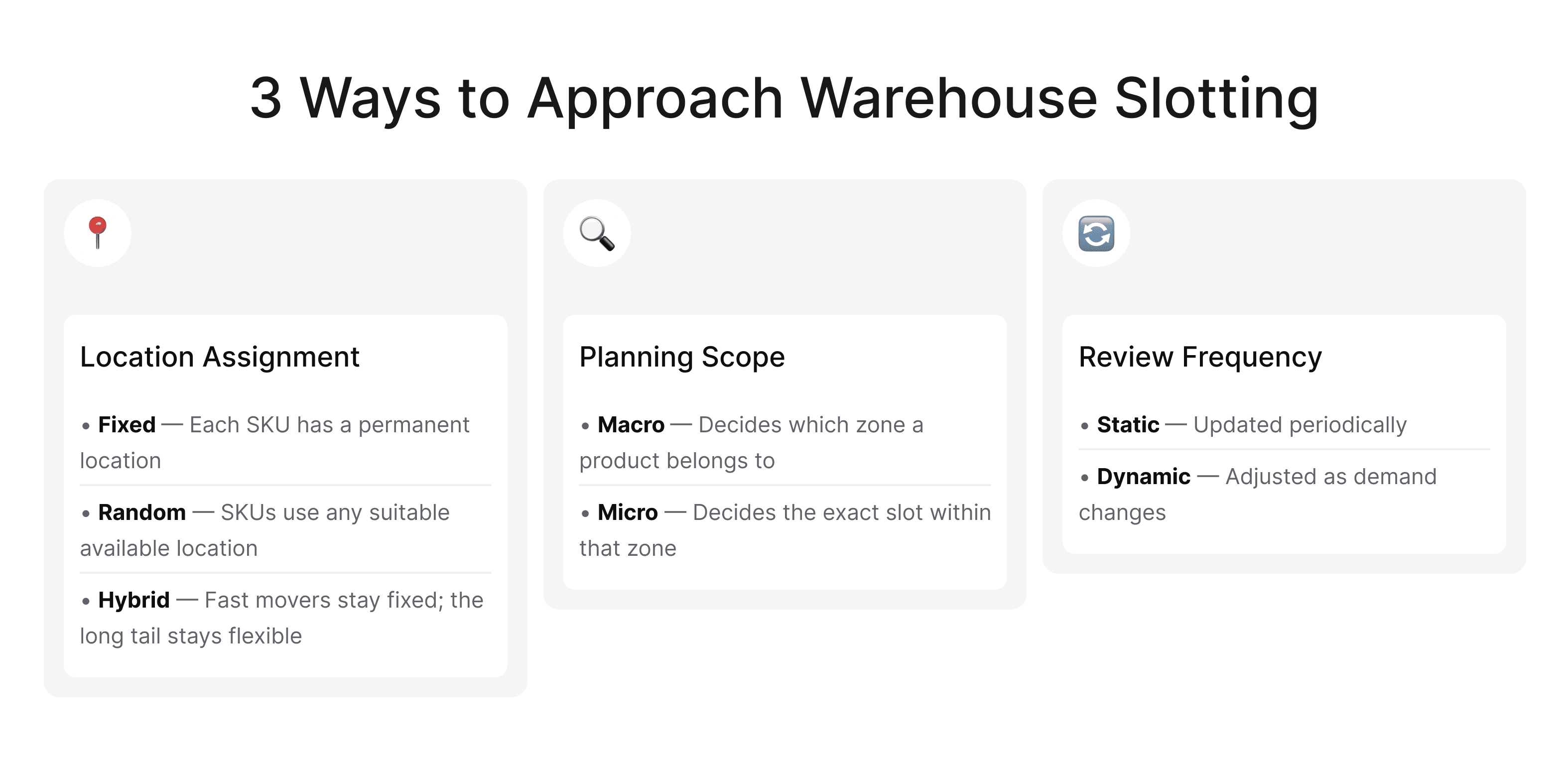
Fixed slotting gives every SKU a permanent home. It's predictable, quick to learn, and genuinely handy when pickers know the place by heart.
The catch is space, since a slot can sit empty whenever that item runs out of stock.
Random, or dynamic, slotting takes the opposite approach. The system drops items wherever there's room and tracks where they landed, using space more efficiently but leaning much harder on your WMS to keep locations accurate.
Unsurprisingly, most real-world warehouse slotting setups end up somewhere in the middle.
A rough rule of thumb helps here. A stable catalog with experienced pickers tends to do fine on fixed slots, while a shifting SKU mix or tight space usually favors random, as long as your system stays reliable.
Many teams simply run fixed slots for top movers and random for the long tail, and that hybrid is often the sweet spot.
 Click to expand
Macro Slotting vs. Micro Slotting
Macro slotting is the big-picture call: which zone or area a whole product family belongs in. Think fast movers near shipping, bulk stock toward the back.
Micro slotting zooms in from there, deciding the exact shelf, bin, or pick face inside that zone. This is where slotting optimization in warehouse operations gets detailed, matching item size, weight, and pick frequency to the right slot.
The order matters, though. If a product family sits in the wrong zone to begin with, even flawless micro slotting won't rescue the travel time. Get the zone right first, then fine-tune the spots within it.
Static vs. Dynamic (Continuous) Slotting
Static slotting gets reviewed now and then, maybe once a quarter. Dynamic, or continuous, slotting adjusts as demand moves, sometimes weekly or even daily.
Dynamic clearly sounds better, but more changes also mean more labor, so the real trick is updating often enough to stay sharp without endlessly shuffling pallets.
This is where live data earns its place. It's a big reason IoT in warehouse management pairs so naturally with dynamic slotting, keeping the slot map honest about what's actually happening on the floor.
The Data Warehouse Slotting Optimization Runs On
Every good slotting system rests on the same foundation, and it's not the racks. It's the data.
To slot well, you need a handful of ingredients: order history, pick frequency per SKU, item dimensions and weight, storage rules, and product affinities, meaning which items tend to be ordered together.
Feed that in clean, and warehouse slotting optimization can make genuinely smart recommendations. Feed it something messy, and it will cheerfully automate your worst habits instead.
The specifics are what trip teams up. You want velocity measured in pick lines rather than units, accurate cube dimensions and weight, and handling rules like stackability, hazmat class, and temperature zone.
You also want a rolling window of order-line data so seasonal swings stay visible instead of dissolving into a yearly average.
The strongest systems pull all of this from your WMS and ERP automatically, so the map reflects today rather than last year's guesses. That's the moment warehouse slotting stops being a spreadsheet chore and starts paying for itself.
Where the Data Usually Breaks
Most data problems are almost boringly common. Dimensions go missing or wrong. Pick frequency gets logged in units when it should be pick lines. Seasonal spikes flatten out when you average over too long a stretch.
And these gaps have teeth. A slot map built on bad dimensions might confidently send an oversized item to a slot it can't physically fit.
So before you optimize anything, make sure the numbers underneath are trustworthy.
How Slotting Optimization Algorithms Work
You don't need a math background to follow this, and understanding the logic pays off when you're choosing or building a warehouse slotting optimization tool.
Most systems mix several of the approaches below rather than betting on just one.
ABC / Velocity-Based Slotting (Pareto)
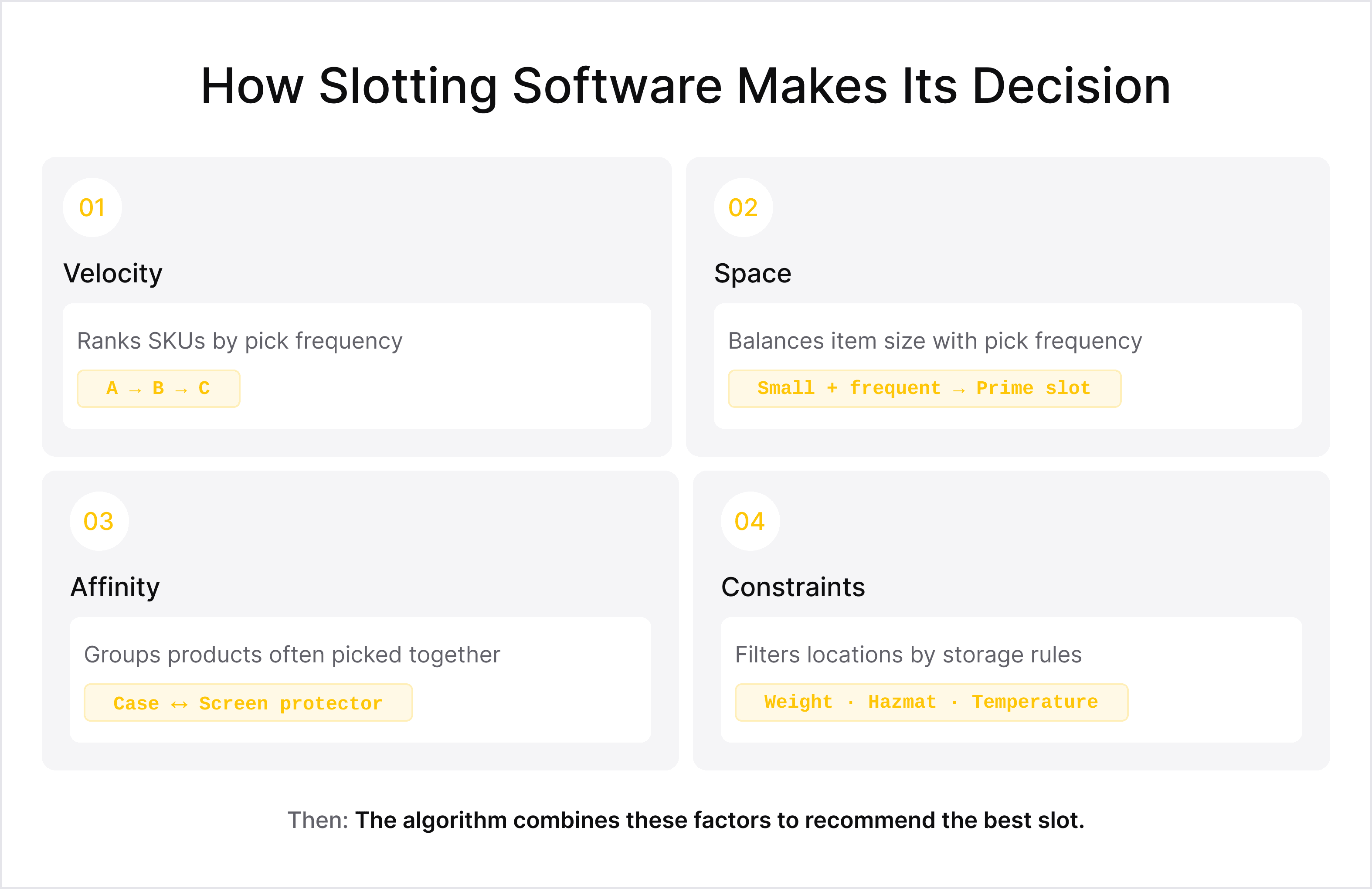
This is the classic, and for good reason. SKUs get ranked by how often they're picked. Your A items, the ones driving the bulk of pick activity, land in the most convenient spots, while B and C items move progressively farther away.
A quick example makes it concrete. Say 2,000 SKUs generate your daily picks; a smaller slice will account for most of the action.
Move those high-velocity items closer to packing, and you've already trimmed a real chunk of wasted travel before touching anything more advanced. It's simple, it works, and it still anchors most warehouse slotting strategies.
Cube-per-Order Index (COI)
COI brings item size into the picture. It weighs how much space something takes up against how often it's ordered, so small, frequently picked items can claim prime locations while bulky, slow-moving ones drift outward.
The reasoning is refreshingly intuitive. A tiny part picked hundreds of times a week has clearly earned convenient space; a big box picked once a week hasn't. COI captures that physical footprint in a way plain velocity ranking often misses.
 Click to expand
Affinity and Order-Batch Optimization
Affinity slotting looks at what gets ordered together. If a phone case and a screen protector show up in the same order 70% of the time, placing them side by side cuts the distance a picker has to cover.
This is where slotting optimization in warehouse operations starts feeling almost predictive. Rather than judging each SKU on its own, it reads the patterns in your orders and shortens the overall picking path because of them.
Constraint-Based Optimization, Heuristics and ML
Real warehouses come with rules, and plenty of them. Hazmat items may be restricted to certain spots. Heavy products can't go up top. Cold goods have to stay in the cold zone.
Constraint-based optimization respects all of that while still hunting for an efficient layout.
For bigger operations, heuristics and machine learning can weigh thousands of possible arrangements and learn from real pick data, which is where warehouse slotting optimization gets genuinely powerful, especially when off-the-shelf tools can't cope with the complexity.
That said, fancier isn't automatically better. If the floor team can't see why an item moved, they'll quietly stop trusting the tool.
The best systems pair strong optimization with clear reasoning, because when people understand the logic, they actually follow it.
Warehouse Slotting Best Practices
Theory only takes you so far. What really counts is how warehouse slotting behaves on a live floor, so here are 5 practices worth building around.
1. Fix the Data Before You Touch the Racks
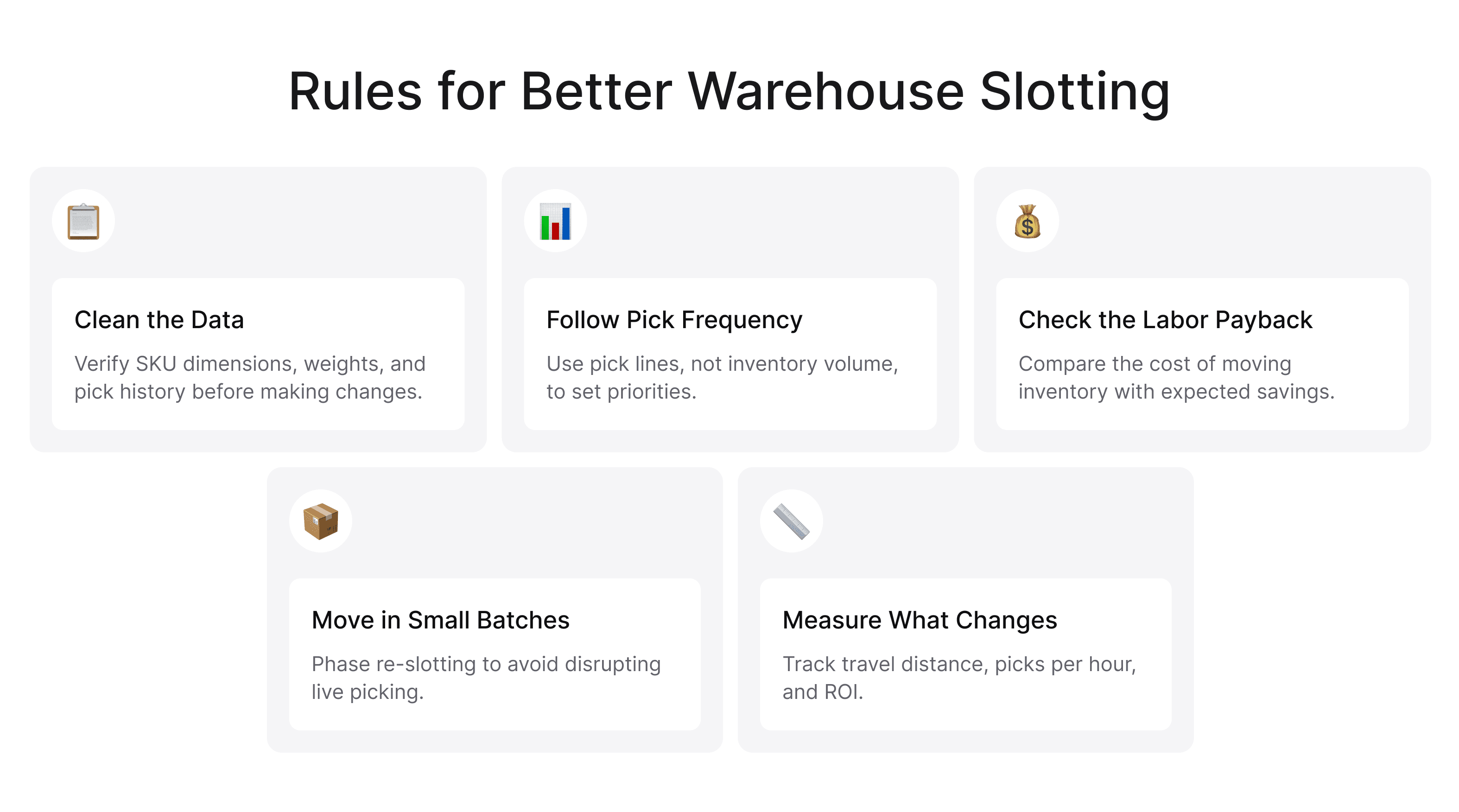
Start by cleaning your SKU master, verifying dimensions, and confirming your pick history is accurate.
A brilliant algorithm running on bad data just makes bad decisions faster. It's the least glamorous step in the whole project, and skipping it isn't really an option.
2. Slot Against Pick Lines, Not Inventory Volume
A pallet that hasn't moved in months shouldn't earn a prime spot just for being large. Look instead at how often a location actually gets visited, and let pick lines, not raw stock levels, tell you where demand really sits.
That single shift in thinking untangles a surprising number of sluggish warehouse slotting setups.
The reason volume misleads is subtle but important. Holding a lot of something says nothing about how often a picker walks over to grab it. Pick lines say exactly that, which is why they're the better guide.
 Click to expand
3. Model the Labor Impact Before You Move a Pallet
Every re-slot spends labor now to save labor later, so it deserves a quick sanity check first. Before committing, estimate how many moves are involved, how many hours they'll take, and how fast the savings pay that back.
Good software shows you this up front, which means you can let the numbers, not a hunch, make the call.
4. Set a Re-Slotting Cadence and Phase the Moves
Pick a rhythm that suits your operation, perhaps monthly reviews with bigger moves each quarter, then phase the changes so they never disrupt live picking.
Smart warehouse slotting optimization flags what to move and when, letting you nudge things continuously instead of bracing for one painful overhaul a year.
Phasing is the part teams underestimate. Dropping fifty moves onto the floor mid-shift creates chaos nobody asked for.
Spread the same work across slower periods, group it by aisle, and handle it in small batches, and suddenly the whole thing feels manageable.
5. Measure the Right KPIs
Watch pick travel distance, lines picked per hour, slot utilization, and re-slotting ROI. If a number doesn't say something useful about labor or space, it probably isn't worth chasing.
Strong warehouse slotting lives and dies on these metrics, so watch how they move after each adjustment.
Benefits of Warehouse Slotting Optimization
So what do all these moving parts actually add up to? Quite a bit, as it turns out.
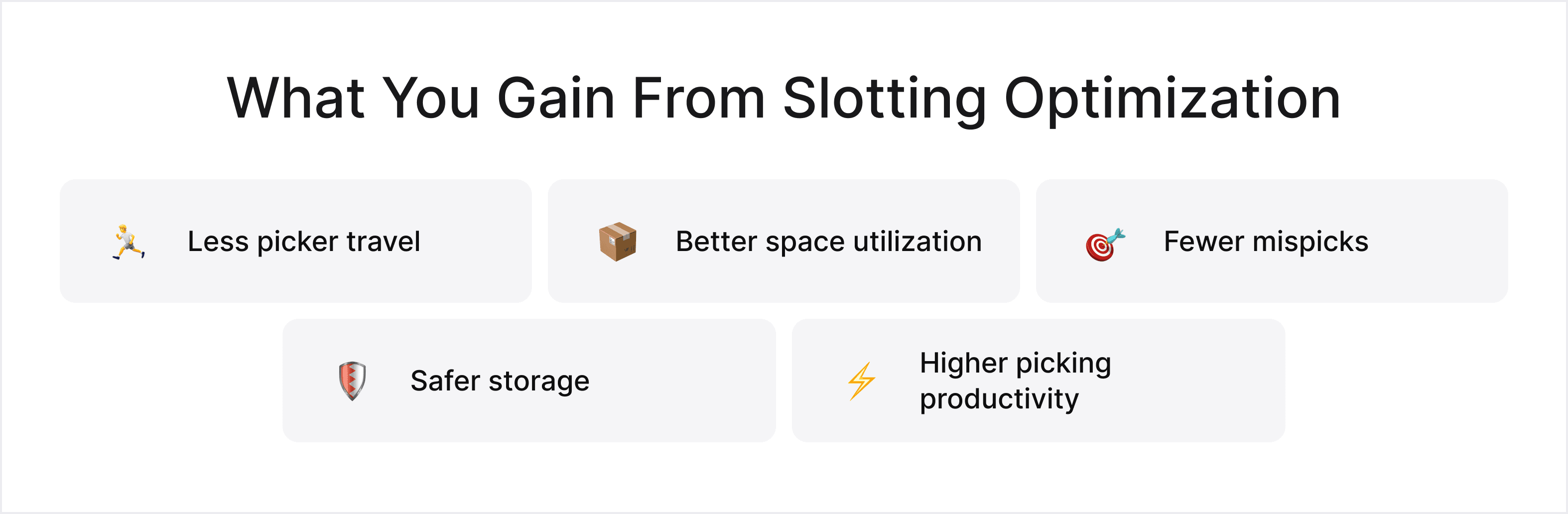
The most obvious win is less travel time, which translates into more orders picked per hour with the same team.
Better space utilization can also push back an expensive expansion, logical placement trims mispicks, and putting heavy or hazardous items where they belong makes the floor safer to work on.
Done consistently, warehouse slotting optimization simply squeezes more out of the building you already have. That's the quiet beauty of good slotting in warehouse design: the same footprint, noticeably more throughput.
 Click to expand
It also nudges everyday decisions toward being data-driven rather than gut-driven, a theme we dig into further in our breakdown of supply chain management software features.
The ROI is often easier to justify than people expect. Trim pick travel by even fifteen percent and that recovered time flows straight into more orders per hour at the same headcount.
Because labor is one of the highest recurring costs in picking, the payback often arrives in months rather than years, and as long as you keep the map current, those gains keep compounding.
Slotting Software: Native WMS Module vs. Standalone Tool vs. Custom Build
When you're ready to get serious about slotting, 3 main paths open up, and each fits a different kind of situation.
Native WMS Slotting
Most modern warehouse management software ships with some slotting features built in. The obvious appeal is convenience, since it's already wired into your data and workflows.
The limitation is depth: native modules handle basic ABC ranking comfortably, but complex constraints or true optimization often call for something more.
Standalone Slotting Tools
Dedicated tools go further, with stronger algorithms, richer simulation, and sharper visualization.
The trade-off is integration, because you'll have to connect the tool to your WMS and keep the data in sync, which adds cost and another system to manage. For complex slotting in warehouse operations, though, that extra muscle can easily be worth it.
Custom-Built Slotting Engine
A custom build makes sense when your operation has unusual storage media, strict compliance demands, or a scale that off-the-shelf tools simply can't handle.
You get full control over the logic and can shape the system around how you actually work. This is where custom software development earns its keep, letting your slotting logic reflect the specific rules and priorities that make your operation yours.
It's only fair to name the cost, of course. Custom means a bigger upfront investment and a longer timeline than flipping on a native module.
But when slotting genuinely shapes your competitive edge, owning that logic gives you room to adapt as the business evolves, and for the right operation, that flexibility pays for itself many times over.
How to Choose: A 6-Question Checklist
6 honest questions usually settle it.
- How many SKUs and orders are you handling?
- How complex are your storage rules?
- Does your WMS already slot well enough?
- Do you have clean, trustworthy data?
- What's your budget and timeline?
- And how unusual is your operation, really?
Answer those without flattering yourself, and the right path tends to reveal itself.
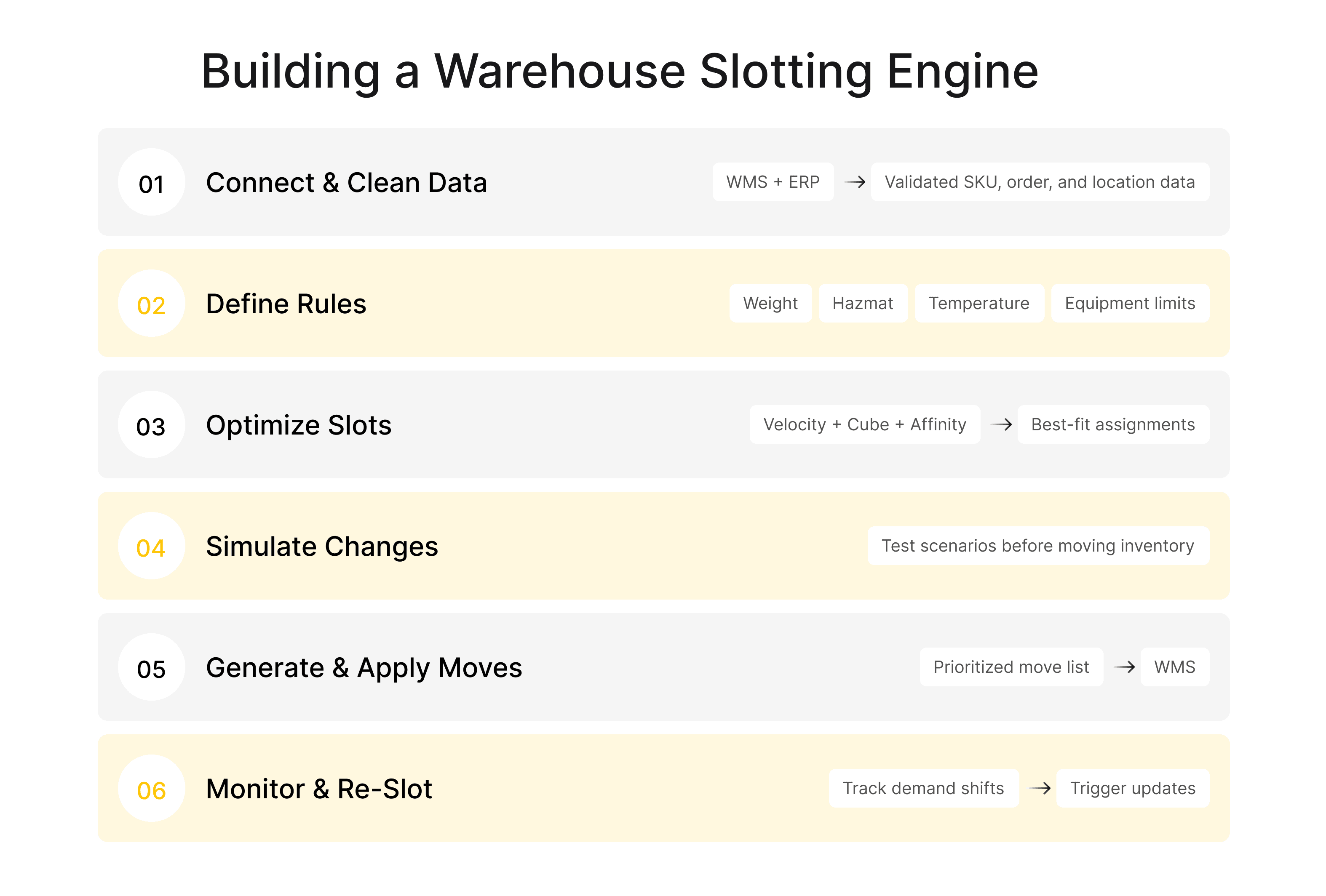
How to Build a Warehouse Slotting Optimization Module
Say you've decided to build. Here's roughly what a real warehouse slotting engine looks like, from first connector to live floor.
Step 1. Data Audit and the Integration Layer
It all starts with the data flowing. You build connectors to your WMS and ERP, validate what comes through, and stitch together one reliable source of truth for SKUs, orders, and locations.
Skip this and everything downstream wobbles.
Step 2. The Constraint and Rules Engine
Next comes the rulebook: weight limits, hazmat zones, temperature needs, equipment reach.
This layer ensures every recommendation is physically possible and stays within your operational lines. Think of it as the guardrail keeping the optimizer honest.
Step 3. The Optimization Core and Scoring Model
This is the engine room. It scores possible slot assignments against your goals, usually minimizing travel, and searches for the strongest arrangement it can find.
Here you blend velocity, cube, and affinity logic in whatever mix fits your operation best.
 Click to expand
Step 4. Simulation and What-If Interface
Before anything physically moves, managers get a place to experiment. What happens if fast movers shift to Zone A? How does peak season change the picture?
A good what-if screen turns slotting from a leap of faith into a decision you can test, and defend ahead of time.
Step 5. Move List Generation and Write-Back to WMS
Good recommendations mean nothing until they become action. The system generates a clear, prioritized move list, then writes approved changes back to the WMS so the floor and the software stay in lockstep.
This is the point where warehouse slotting optimization crosses from analysis into daily operations.
Step 6. Monitoring, Drift Detection and Re-Slotting Triggers
Finally, the system keeps watching. As demand shifts, today's map slowly drifts out of tune, so it should catch that drift and flag re-slotting while it still matters.
Handled this way, efficiency doesn't leak away unnoticed.
Integrating Slotting With WMS, ERP, WES and Warehouse Automation
Slotting never works in a vacuum. It has to talk to your WMS for locations, your ERP for product and order data, and your WES if automation is running the floor.
This matters even more alongside modern warehouse automation technology, where robots and conveyors depend on accurate slot data to move without tripping over themselves.
And if you run a virtual warehouse or a multi-node network, your slotting logic has to reason across locations, not just aisles. Broadly speaking, the more connected your systems are, the smarter your warehouse slotting can be.
The practical hurdle is keeping everything in sync. A slot change is useless if the WMS never hears about it, and an automated system fed stale locations will happily send a shuttle to the wrong place.
That's why the integration layer isn't a footnote; it's the whole game. Real-time, two-way data flow is what turns a clever recommendation into something that actually happens on the floor.
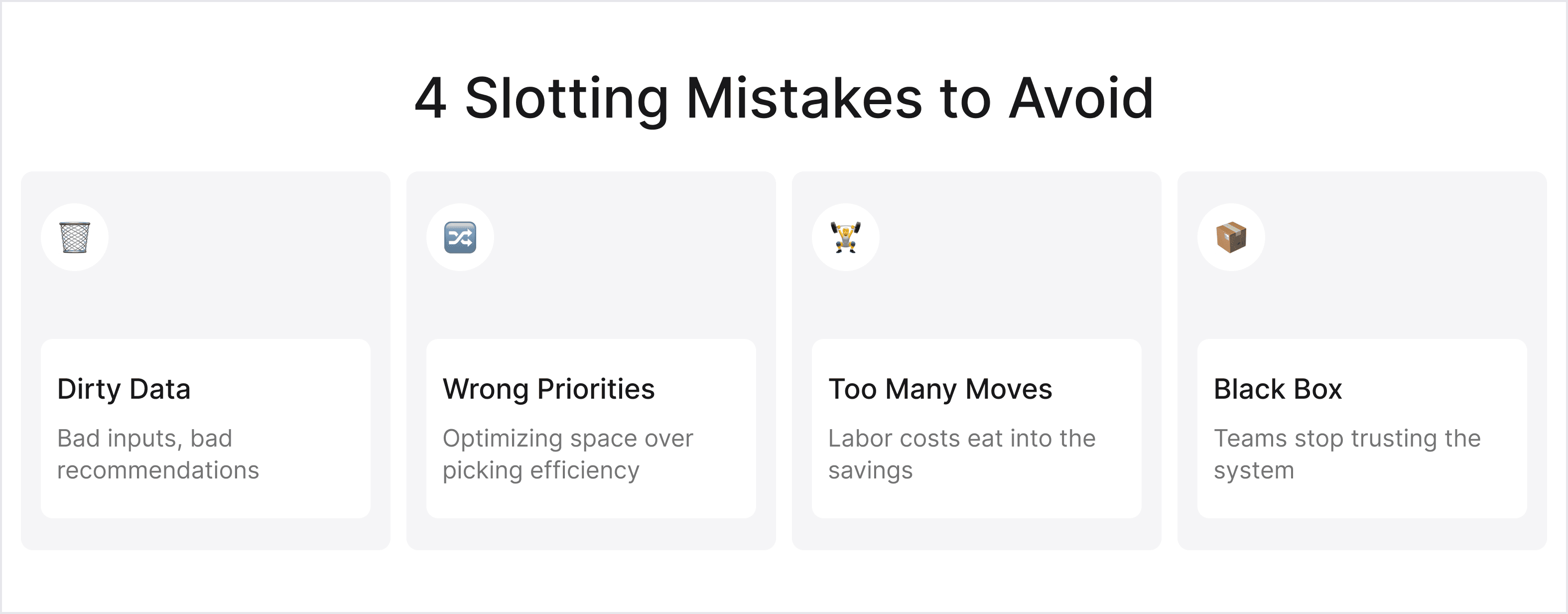
Common Mistakes in Slotting Software Projects
A handful of missteps show up again and again. Teams chase a dazzling algorithm while ignoring dirty data. They optimize for storage density when pick efficiency is the real prize.
They re-slot so aggressively that the labor to move things swallows the savings. Or they build a black box the floor team never trusts, so everyone quietly reverts to memory.
 Click to expand
Dodge those 4, and you're already ahead of most warehouse slotting projects.
One more slips past almost everyone: treating go-live as the finish line. A slot map only fits the demand it was built for, and demand never sits still.
A team celebrates launch, stops tuning, and 6 months later they're walking too far all over again. Slotting rewards steady attention, so keep reviewing the data, adjusting the map, and measuring what changes.
Build Your Warehouse Slotting Optimization With Incora
This is where we come in. At Incora, we build custom warehouse and supply chain software, slotting engines included, shaped around how your operation genuinely runs rather than how a template assumes it should.
Our team takes on the parts that usually get messy: auditing your data, wiring up the integrations, and building an optimization core that respects your real-world constraints.
And if you're honestly still weighing whether to buy or build, our software development consulting can help you compare the options clearly before you commit a budget to development.
Over the years, we've learned what separates a slotting tool people rely on from one that gathers dust, and it almost always comes down to fit. A system has to mirror how your warehouse truly operates, which is exactly what a custom warehouse slotting optimization build delivers.
We also know where these projects tend to fail, so we start with a focused slice of the operation, prove the value there, and scale from a position of trust.
What you end up with is a system wired into the tools your team already uses, making recommendations they can actually understand and act on.
Not sure where to start with warehouse slotting?
We can help you figure out what's actually slowing you down and what to build first.
Final Takeaway
To pull it all together: slotting is one of the most practical levers in a warehouse, precisely because it attacks the biggest source of picking labor, which is travel.
So start with clean data, slot by real pick activity, and review the map on a rhythm.
And when standard tools can't keep pace with your complexity, a well-built warehouse slotting engine turns the floor space you already have into a genuine advantage. The gains rarely look dramatic on day one, but they show up quietly on every single shift.
FAQ
What is slotting in a warehouse?
It's the practice of assigning each product to a specific storage location based on how it's picked, sized, and stored.
Ask 10 managers what is warehouse slotting and you'll hear roughly the same answer: put the right item in the right place so pickers walk less and orders move faster.
What is the difference between slotting and warehouse layout?
Layout is the fixed structure of the building, the racks, aisles, and docks, while slotting decides what goes where inside that structure.
Because you can lift performance through better warehouse slotting without touching a single wall, it's often the smartest place to start.
How often should you re-slot a warehouse?
It really depends on how fast your demand moves. Many operations run light reviews monthly and larger moves quarterly.
Continuous warehouse slotting software can suggest smaller tweaks far more often, keeping you efficient without the pain of a big, disruptive overhaul.
What data do you need for warehouse slotting optimization?
At a minimum: pick history, order data, SKU dimensions and weight, storage constraints, and product affinities.
The cleaner and more complete that data, the better your results. For any serious warehouse slotting project, data quality is genuinely the starting line.
Can slotting optimization be added to an existing WMS?
Yes, and it happens all the time. You can extend your current system with a custom module or connect a standalone tool through integrations.
Most teams don't rip and replace; they simply layer smarter slotting in warehouse capabilities on top of what they already run.





Get in Touch
Got no clue where to start? Why don’t we discuss your idea?

