



By Bohdan Vasylkiv
- CEO & Co-Founder
15 Best Enterprise Software Development Companies in 2026: Specialists vs Global Integrators
Compare 15 enterprise software development companies in 2026 - specialist engineering firms and global integrators, with rates, tiers and how to choose.
Key Takeaways
- "Enterprise software company" can mean a product vendor like SAP or a team that builds custom systems, so decide which one you need first.
- The best enterprise software development companies fall into two groups: specialist engineering firms and global systems integrators.
- Specialists are usually faster and more flexible. Integrators handle huge, multi-country programs.
- Choose a partner whose usual projects look like yours.
Every software company says it's "enterprise-ready." So how do you tell who can actually handle your project?
Start with this: many lists of enterprise software development companies put small engineering firms and giant consultancies side by side. But they rarely compete for the same work. Rebuilding one ERP system and running a five-year transformation across ten countries are two very different jobs, and they need different teams.
That's why we split this list into 2 tiers. Tier 1 is specialist firms that build, connect, and modernize business systems. Tier 2 is global integrators that run large, long-term programs.
For each company, you'll see what it does best, when it's a good choice, and what to watch out for. By the end, you'll have a clear idea of which tier fits you, what to ask on a first call, and how to spot the wrong enterprise software development partner early.
"Enterprise Software Company" Means Two Different Things
When people search for enterprise software companies, they usually mean one of two things.
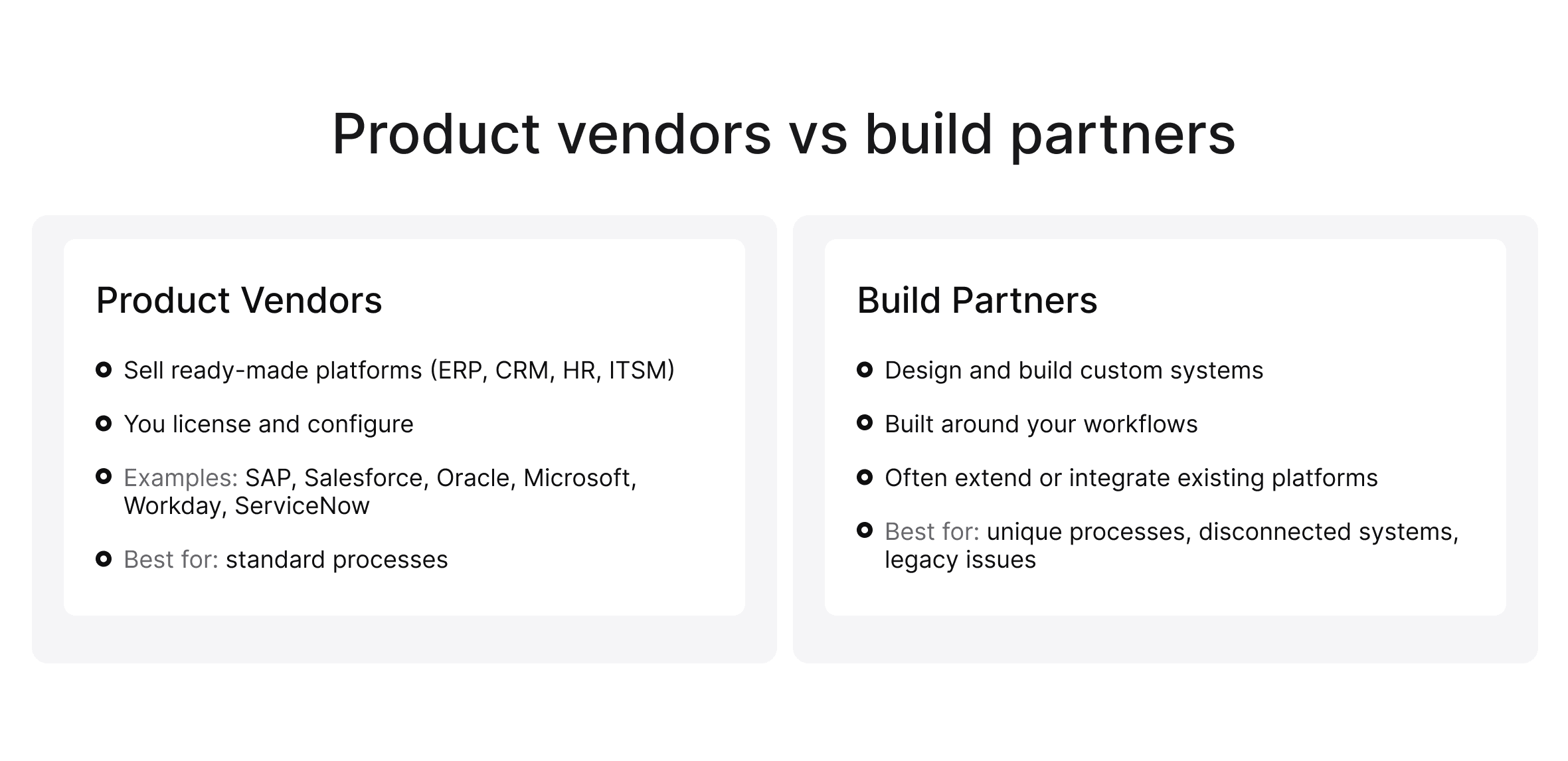
The first is product vendors, like Salesforce, SAP, Oracle, Microsoft, Workday, and ServiceNow. They sell ready-made platforms for sales, finance, HR, or IT support. Companies buy a license and configure the platform to fit their needs. These are the names you'll find on most lists of top enterprise software companies.
The second is build partners. They don't sell a product. Instead, they design and build software around your business, either from scratch or on top of the platforms above.
Think of it this way. Enterprise software vendors sell you a house. Build partners renovate it, add a new room, connect it to the neighbors, and sometimes build a new house when the old one no longer fits.
 Click to expand
So which do you need? For standard tasks like payroll or accounting, a vendor is usually enough. You need a build partner when:
- your processes are unique;
- your systems don't work together;
- an old system keeps slowing you down.
Many companies need both. In this article, we focus on build partners.
How We Selected and Tiered These Enterprise Software Development Companies
To choose the top enterprise software development companies for this list, we looked at five things in each firm's public work:
- Enterprise case studies: real systems for large organizations, not just startup apps.
- Integration experience: work with ERP, CRM, login, and data platforms.
- Their own engineers: a core in-house team rather than mostly subcontractors.
- Track record: years on the market, client reviews (for example on Clutch), and returning clients.
- Security: clear security processes, certifications, or audit reports.
We based the list on public information, including websites, case studies, and reviews. Details like team size change often, so double-check them when you talk to a company.
Then we split the firms into 2 tiers.
Tier 1: specialists. These are mid-sized engineering firms, usually from a few hundred to a few thousand people. You get experienced enterprise software developers, quicker starts, and more flexible contracts. They're a strong match for focused projects, roughly from the low six figures up to a few million dollars.
Tier 2: global systems integrators. These are huge firms with offices in dozens of countries. They can manage complex programs, coordinate many vendors, and put hundreds of people on a project at once. They fit best with multi-year transformations, which often cost tens of millions.
The numbers inside each tier aren't a ranking. Company #7 isn't worse than #3; each one is simply strong in different areas.
Enterprise Software Development Companies at a Glance
Here's the short version. Use it to build a shortlist, then read the details below.
You'll probably recognize most Tier 2 names. They show up on nearly every list of enterprise application development companies. The Tier 1 firms are less famous, but they're often quicker to start and closer to the actual work.
Tier 1: Specialist Enterprise Software Development Companies
Specialist firms are built around engineering. You usually talk to senior people from the first call, and the people who plan your project are close to the people who build it.
If you're looking for enterprise custom software development companies that can fully own a system without layers of management, this is the tier to start with.
1. Incora - Best for Custom Enterprise Platforms and Legacy Modernization
Incora is a software development and tech integration company working with clients worldwide. We build custom enterprise platforms, update legacy systems, and connect the tools our clients already use, so their business runs on one system instead of a dozen disconnected ones.
Over the years, we've delivered many projects like this across different industries. One of them is a custom ERP for a homebuilding company. Standard ERP modules couldn't keep up with how the business actually manages its projects, so we designed a system around its real day-to-day workflows. You can find more of our case studies on our website.
Good fit if: you need a custom platform, a legacy rewrite, or a cleanup of messy integrations, and you want to work directly with senior engineers.
Keep in mind: we're not the right choice for a global rollout with consultants in dozens of countries. For that, look at Tier 2.
2. Itransition - Best for Full-Cycle Enterprise Platform Engineering
Itransition has been building software since the late 1990s. It covers every stage, from consulting and design to development, testing, and support. This works well if you want one partner to look after your platform from start to finish.
Want to know what "every stage" actually includes? Our guide to full-cycle software development explains it step by step.
Good fit if: you want mature processes and one team responsible for a long-term platform.
Keep in mind: a large firm brings more process, which can slow down small, fast-changing projects.
3. ScienceSoft - Best for Enterprise Data, BI and Analytics Platforms
ScienceSoft was founded in 1989 and is based in McKinney, Texas, which makes it one of the oldest enterprise software solutions companies that build custom systems. It's best known for data work: data warehouses, BI, and analytics. It also builds software for healthcare and finance.
Good fit if: your data lives in many places and nobody trusts the reports.
Keep in mind: they offer many services, so ask for case studies that match your exact task, not just your industry.
4. Innowise - Best for Large-Scale Delivery Teams
Innowise is a large European engineering company with thousands of specialists. Its main strength is its size: it can assemble a large team quickly.
That helps when you suddenly need many enterprise software developers, for example, for a migration or a deadline you can't move.
Good fit if: you need a lot of people, fast.
Keep in mind: in fast-growing teams, experience levels can vary. Meet the engineers who'll actually work on your project.
5. Netguru - Best for Enterprise Product Design and Digital Products
Netguru is a Polish company that started with product design and digital products. Today it also builds enterprise tools like customer portals, internal apps, and fintech and retail products. Design is central to every project.
Good fit if: the system will be used by customers, field teams, or sales reps- people who won't use it if it's confusing.
Keep in mind: if your project is mostly behind-the-scenes integration, their design strength matters less.
6. AgileEngine - Best for US and LatAm Nearshore Enterprise Teams
AgileEngine is based in the Washington, D.C. area, with engineering teams in Latin America and Europe. For US clients, the Latin American teams work at the same time of day so that you can discuss and fix things in real time.
Some buyers need an enterprise software development company in USA specifically: a US legal entity, US contracts, and US working hours. AgileEngine is built for exactly that.
Good fit if: daily live collaboration is a must for you.
Keep in mind: nearshore rates are often a bit higher than Eastern European ones, so check whether the time-zone match is worth it for you.
7. Trinetix - Best for Enterprise Workflow Automation and Intelligent Apps
Trinetix started in Ukraine and now works with clients in the US and Europe. It focuses on automation and smart apps, replacing email and spreadsheet processes with systems that route, approve, and track work, often with the help of AI.
Good fit if: you want to digitize processes that involve several departments.
Keep in mind: ask how they'll work with the tools you already use, like Microsoft, ServiceNow, or Salesforce. Otherwise, you may end up with yet another separate system.
8. EffectiveSoft - Best for Compliance-Heavy Enterprise Systems
EffectiveSoft has been building software since 2000, mostly for healthcare, fintech, and other regulated industries. In these fields, audits, data privacy, and tracking changes are part of the job from day one.
It's a good option among mid-sized enterprise software companies that build custom systems, especially when your legal team starts every conversation with compliance.
Good fit if: rules like HIPAA or PCI DSS affect every technical decision.
Keep in mind: projects with heavy compliance take longer, so plan your timeline accordingly.
9. Sigma Software - Best for Enterprise R&D and Long-Running Programs
Sigma Software has Ukrainian roots and is part of the Swedish Sigma Group. It's known for long-term partnerships and research-heavy work in automotive, telecom, gaming, and government technology.
Good fit if: you need a partner for years of ongoing work, not a single project.
Keep in mind: they're strongest for long-term work. For a quick project, another option may be a better fit.
10. Andersen - Best for Large Dedicated Enterprise Teams
Andersen focuses on dedicated teams, stable groups of engineers who work as part of your own department.
So it's less like an enterprise software development agency that delivers a finished project and more like a way to grow your engineering team.
Good fit if: you have a strong product team and just need more engineers.
Keep in mind: dedicated teams need clear direction. If no one on your side owns the roadmap, work can drift.
 Click to expand
Tier 2: Global Systems Integrators for Enterprise Programs
Global integrators aren't worse than specialists. They're simply built for a different project size.
Imagine launching one ERP system in dozens of countries, training tens of thousands of employees and coordinating several vendors at the same time. That takes many people, strong project management, and close ties with platform vendors. For programs like that, integrators are among the best enterprise software development companies you can hire.
Keep in mind that contracts take longer to sign, there are more management layers, and the total cost only makes sense for big programs. Hourly rates aren't always the problem, though. Integrators with large offshore teams can be quite competitive on price.
For each firm below, you'll see when it makes sense and what program size it usually takes on.
11. Accenture - Best for Multi-Year Enterprise Transformation Programs
Accenture is one of the world's largest consulting companies. It works closely with SAP, Salesforce, Microsoft, Oracle, and ServiceNow, and many of the top enterprise software companies list it among their biggest implementation partners.
When it makes sense: you're changing how the whole company works, from strategy and technology to processes and training.
Program size: usually multi-million and multi-year. Accenture takes on smaller projects too, but its size pays off most on big ones.
12. IBM Consulting - Best for Regulated Industries and Mainframe-Adjacent Estates
IBM Consulting knows mainframes, hybrid cloud (including Red Hat, which IBM owns), and strictly regulated industries like banking, insurance, and government.
When it makes sense: your core systems still run on mainframes or older servers, and you need to update them without disrupting daily work.
Program size: usually large. It fits best when downtime or a compliance issue would cost more than the consulting fees.
13. Infosys - Best for Global Application Management at Scale
Infosys is headquartered in Bengaluru and has one of the largest global IT delivery teams. It's one of the best-known enterprise application development companies for application management, which means keeping large sets of apps running, updated, and improving.
When it makes sense: you want to hand over many applications under a long-term contract with clear service levels.
Program size: usually multi-year support contracts. The focus is on running everything you already have, rather than building one new system.
14. Capgemini - Best for European and Cross-Border Enterprise Rollouts
Capgemini is based in Paris and has a very strong presence in Europe, plus large teams in North America and India. It handles cross-border projects well: different languages, different laws, and rules like GDPR.
When it makes sense: one system has to launch in several European countries, or a US company is growing into the EU.
Program size: usually large, multi-country programs backed by senior leadership.
15. Cognizant - Best for Long-Term Enterprise Application Outsourcing
Cognizant is based in Teaneck, New Jersey. It's known for long-term outsourcing, especially in healthcare, insurance, and finance.
When it makes sense: you want a partner to develop and support your core business apps for years, with clear service levels and predictable costs.
Program size: usually large, multi-year contracts. Since you'll work together for a long term, pay close attention to the first contract's terms.
Which Tier Fits Your Program: Budget, Timeline and Governance
3 simple questions will help you decide.
- First, what's your budget?
For projects up to roughly a few million dollars, a specialist usually gives you more engineering for your money. For much bigger programs with many parallel streams of work, an integrator's coordination becomes worth the cost.
- Second, how soon do you need to start?
Specialists can often start within a few weeks. Integrators usually need more time for contracts and staffing.
- Third, how much oversight do you need?
If the board, many departments, and regulators are involved, the structure integrators bring is useful. If you have one clear owner and a focused goal, that structure mostly slows you down.
Let's look at an example. A logistics company wants a portal for its carriers, connected to its current ERP, in about six months. That's a specialist's job. If the same company decides to replace its finance, HR, and supply chain systems on three continents, that's a job for an integrator.
In fact, many large companies use both. The integrator runs the big platform rollout, while specialist enterprise software development companies build the custom parts around it, like portals, integrations, and data tools, faster and with less overhead.
In short, choose a partner based on the size of the project, not the size of your company. A large corporation with a six-figure task doesn't need a partner built for eight-figure programs.
What Enterprise Software Development Companies Actually Build
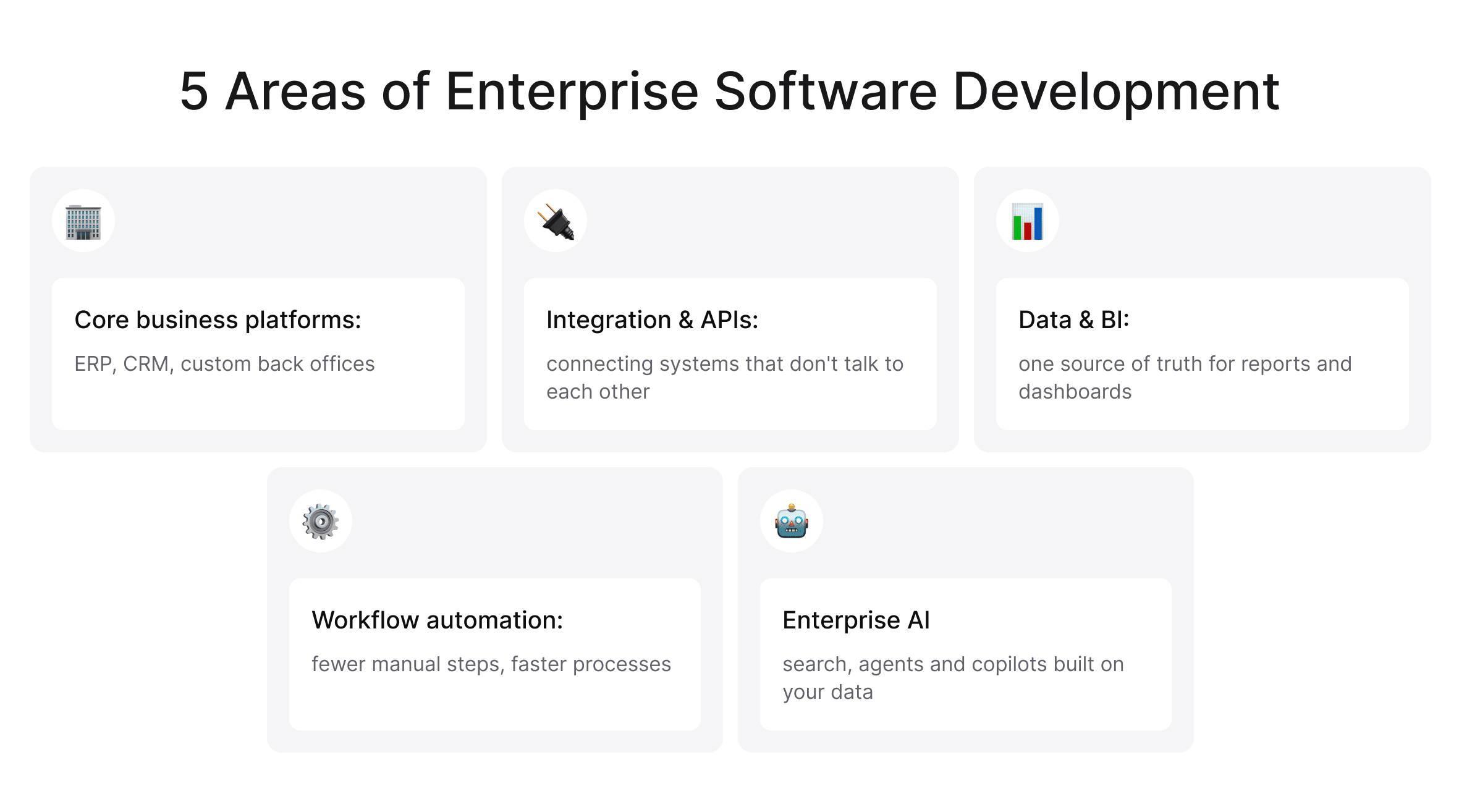
What does this work look like in practice? Most projects that enterprise software solutions companies take on fall into 5 areas. At Incora, we work in all five and build custom solutions wherever ready-made tools stop fitting.
Core Business Platforms: ERP, CRM and Custom Back Offices
These are the main systems a business runs on: orders, stock, finance, customers, and daily operations.
Sometimes it's enough to set up an existing platform like Dynamics or NetSuite. Other times the business is too specific, and a custom system is the better choice. Our ERP developers do both: we extend existing ERPs and build new ones when standard modules get in the way.
Getting this right matters, because the ERP affects almost every team in the company.
System Integration and API Layers
Often the real problem isn't a missing tool. It's that your tools don't talk to each other.
Integration connects ERP, CRM, billing, warehouse, HR, and data systems through APIs and middleware. Good enterprise software developers build this layer so you can replace one system later without breaking the rest.
This work stays in the background, but it often brings the quickest results.
Enterprise Data Platforms, BI and Reporting
Management sees one number, finance sees another, and sales sees a third.
A data platform fixes this. It brings data into one place (for example, Snowflake, BigQuery, or Databricks), sets shared definitions, and builds dashboards people trust. Part of the job is technical, and part is getting teams to agree on basics, like what "active customer" means.
Once the data is reliable, forecasting, automation, and AI all get easier.
 Click to expand
Business Process and Workflow Automation
Approvals get stuck in email. Spreadsheets travel back and forth. Someone copies data between two systems by hand every week.
Automation replaces this with systems that pass tasks along, trigger the next step, and keep a record of everything. Many enterprise software companies sell automation tools, but to fit your real process, they usually need custom setup or development.
The result is less manual work, fewer mistakes, and faster processes.
Enterprise AI: Search, Agents and Copilots
This is the newest area, and everyone is talking about it. It includes search across company documents, AI agents that handle routine tasks, and AI assistants built into the tools your team already uses.
The AI model is usually the easy part. Most of the work goes into data access, permissions, quality checks, and connecting everything to your systems. For example, we worked with BlackBird.AI on its narrative intelligence platform, which analyzes online narratives and disinformation at scale using large data flows and machine learning.
Our advice: start with one task where you can clearly measure the result. "We need AI" isn't a task yet.
Build, Buy or Extend Your Enterprise Stack
Before you talk to any development team, ask yourself one question: do you really need custom software?
Sometimes you don't. Enterprise software vendors have been improving their platforms for decades, and for many tasks, buying one is the right choice. Here's how to tell.
When a Platform Already Covers It
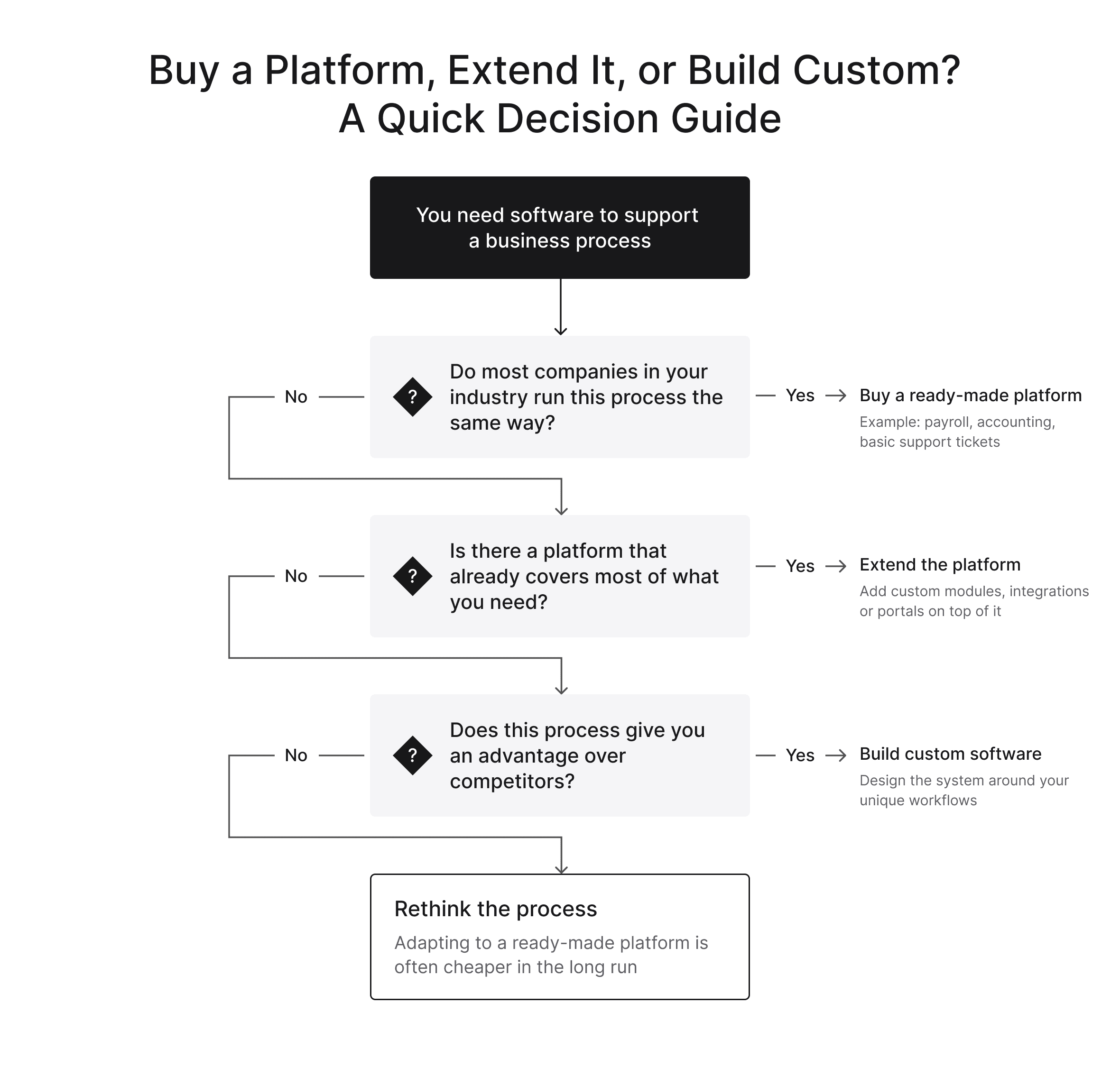
If a process works the same way at most companies in your industry, like payroll, accounting, basic support tickets, or a standard sales pipeline, buy a platform. Building your own accounting system in 2026 rarely makes sense.
A simple test helps here. If your competitors do it the same way and it doesn't give you an advantage, a platform will likely do the job. Keep your custom budget for the areas that make you different.
When Extending the Platform Is the Right Move
Often a platform covers most of what you need, and the remaining gap is exactly where the friction lives.
That's where extensions help: custom modules, integrations, portals, automation, and data syncing on top of Salesforce, SAP, ServiceNow, or Microsoft. Many enterprise application development companies spend most of their time on this kind of work.
The key is to build around the platform's core without changing it. That way, updates won't break your custom work.
 Click to expand
When a Custom Build Pays Off
Custom software makes sense when the software itself gives you an edge. That could be a unique pricing system, a way of working competitors can't copy, or a customer experience you don't want to compromise.
It can also pay off when license fees and workarounds keep growing. If you're paying for unused licenses and extra tools to fill the gaps, a custom system may cost less over a few years. Do the math for your own case.
Just remember that with custom software, the roadmap, support, and documentation are yours to manage.
How to Choose an Enterprise Software Development Company
There's no single best enterprise software development company for everyone. There's only the one that fits your project, your tech stack, and your team.
For a broader guide, read how to hire the best custom software development team. Below are the five things that matter most for enterprise projects.
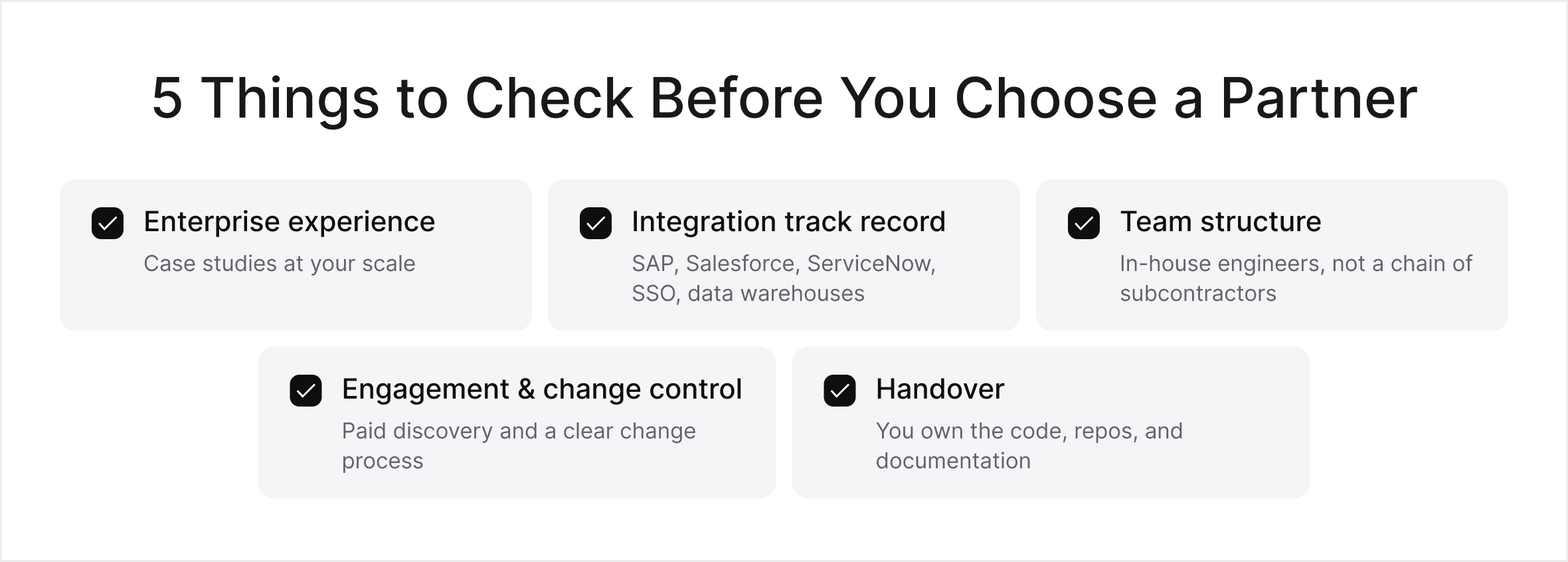
Enterprise-Class Experience vs SMB Experience
Building an app for a startup and building a system for a company with thousands of employees are very different tasks.
Enterprise projects involve single sign-on, access roles, activity logs, data storage rules, formal approvals, and connections to very old systems. So even with top enterprise software development companies, ask for examples of work for clients similar to you in size and complexity.
If all their examples are startup apps, they may not be the right fit.
 Click to expand
Integration Track Record: SAP, Salesforce, ServiceNow, SSO, and Data Warehouses
Ask specific questions:
- Which SAP modules have you worked with?
- How did you deal with Salesforce API limits at high volume?
- Have you set up single sign-on with Okta or Microsoft Entra ID?
- Which data warehouse did you use, and what did you do when data loads failed?
A general "we've done lots of integrations" isn't enough. Look for specific systems, specific solutions, and real lessons learned.
Team Structure: In-House Engineers vs Subcontractors
Who will actually write your code? Some companies sign the contract and then hand the work to other firms. That's not always bad, but you should know about it from the start.
Ask who will be on your team and how long they've worked at the company. When a stable in-house team works on your project, knowledge stays with the team and isn't lost halfway through.
Still thinking about building your own team instead? Our comparison of In-House vs. Outsourcing Software Development will help you weigh the options.
Engagement Models, Discovery and Change Control
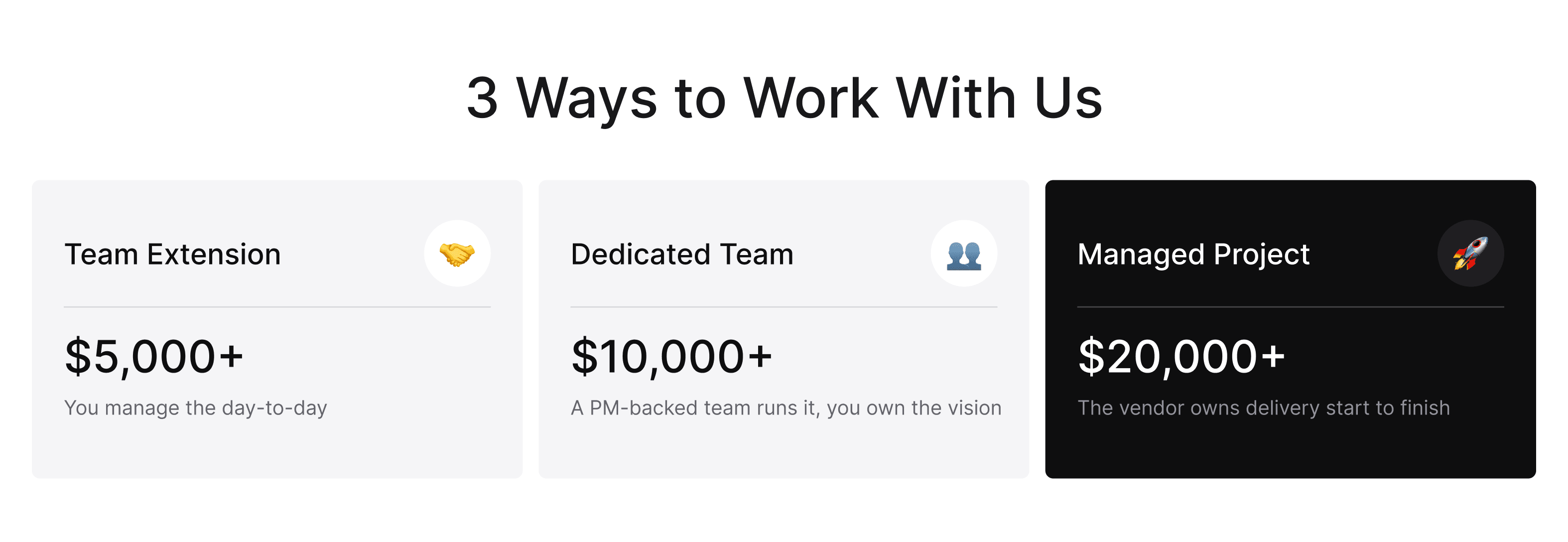
Most companies offer 3 models: fixed price, time and materials, or a dedicated team. For enterprise projects, a paid discovery phase is usually the best first step. In a few weeks, you map out needs, integrations, and risks, and you get a realistic estimate instead of a guess.
Also ask how they handle changes, because plans will change. A mature enterprise software development agency has a clear process for this: what gets re-estimated, who approves it, and how it affects the budget.
Without such a process, unexpected costs are hard to avoid.
Here are the most common ways to work with us:
 Click to expand
Handover, Documentation and Post-Launch Ownership
Few buyers ask this, but it's important: what happens if you stop working together?
You should own the code, the repositories, the cloud accounts, and the documentation. System descriptions, instructions, API docs, and deployment setup should all be part of the deal.
A good partner makes sure you could continue without them. That's one of the clearest signs you can trust them.
Security, Compliance and Procurement Due Diligence
Your procurement and security teams will ask about security, so it's worth preparing in advance.
Start with certifications. Ask whether the company has ISO/IEC 27001 certification, which means it follows a formal system for managing information security.
US companies usually also ask for a SOC 2 report, preferably Type II. It shows how the company's security controls actually worked over time, not just what's written on paper.
Next, look at how the team works day to day. How do they manage access to your systems? Where do they store passwords and keys? Do their coding practices cover common risks like those in the OWASP Top 10?
Regulated industries have extra requirements. For example, healthcare projects may need HIPAA compliance and a signed business associate agreement.
Many security teams also check vendors against the NIST Cybersecurity Framework. If your partner already knows it, your review will go faster.
Don't forget the legal documents: the main contract, data processing agreement, IP transfer, insurance, and background checks. Even the best enterprise software development companies can spend weeks getting through procurement, so start early.
A security problem found after launch costs much more than one caught while choosing a vendor.
Red Flags and 10 Questions to Ask Before You Shortlist
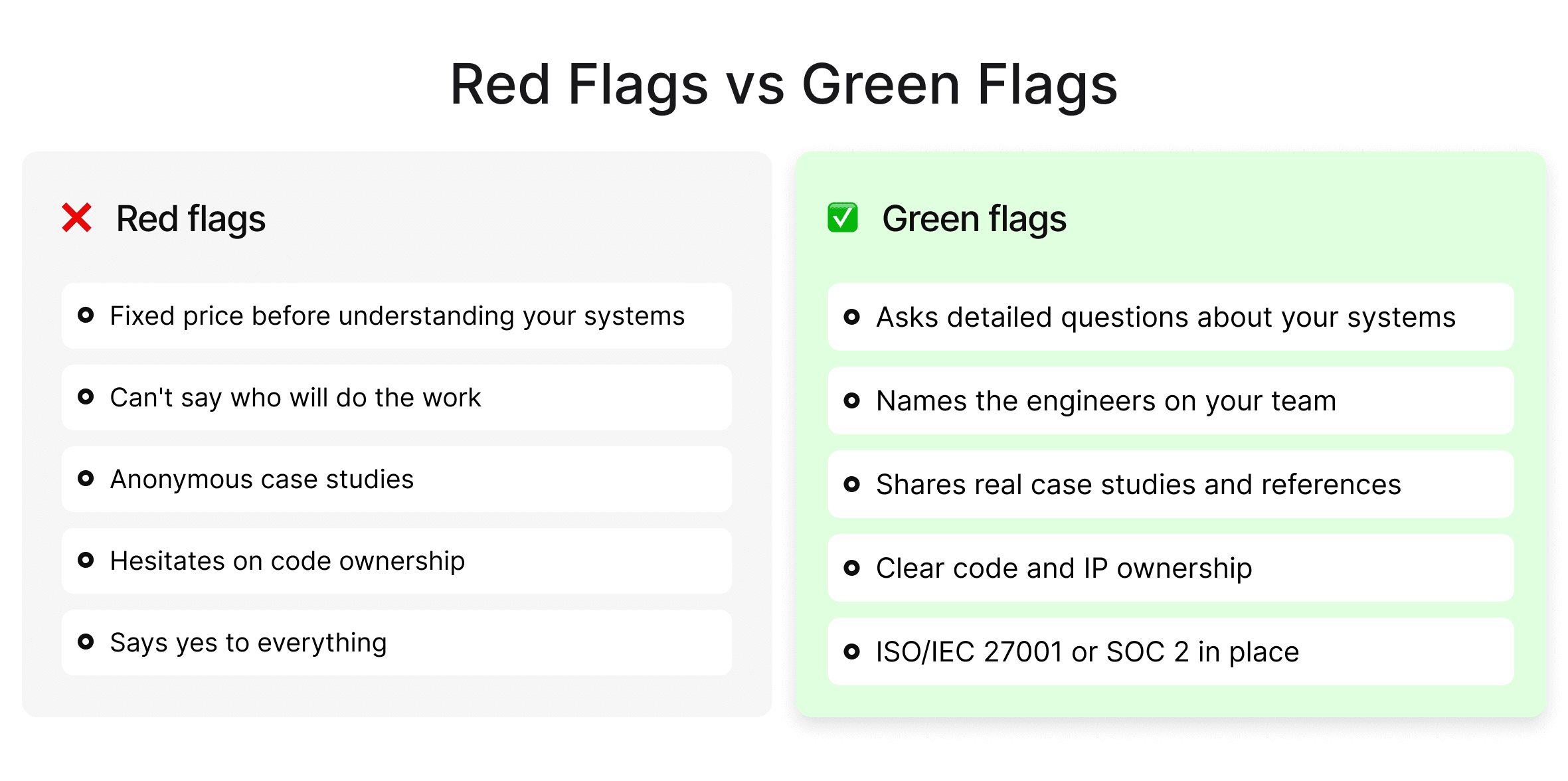
Some warning signs appear already on the first call:
- They give a fixed price before they understand your systems.
- The sales team can't say who will work on your project.
- Their case studies have no client names, results, or references.
- They hesitate when you ask about code ownership or documentation.
- They agree to everything and don't ask questions back.
 Click to expand
Many enterprise software companies look great on paper. These 10 questions help you see what's really there:
- Can you show two projects similar to ours in size, industry, and technology?
- Who exactly will be on our team, and are they your employees?
- Which of our systems have you worked with before?
- How does your discovery phase work, and what do we get at the end?
- How do you handle changes in scope?
- What security certifications or audit reports can you share?
- How do you measure quality, and how will you report it to us?
- What happens if a key engineer leaves during the project?
- Who owns the code, infrastructure, and documentation?
- Can we talk to a current client, not just a past one?
A good partner will answer these easily, and will probably have a few questions for you too.
How Much Enterprise Software Development Costs
There's no single price, because cost depends on scope, integrations, team location, and experience. Still, the numbers below can help you check whether a quote makes sense. They're approximate, so use them as a guide, not as fixed limits.
Approximate hourly rates:
Approximate project budgets:
What affects the price most? Usually 3 things: how many systems need to be connected, how messy your data is, and how many regulations apply.
Timing varies too. Many focused projects reach the first release within several months to a year, while large transformations can take years.
Also plan for costs after launch. Support and improvements often add around 15–25% of the original build cost each year.
A low estimate can look attractive, but the full cost includes support, hosting, licenses, and rework. For practical ways to keep it under control, see our guide to reducing custom software development costs.
Why Enterprise Teams Partner With Incora
We're an engineering team from Ukraine that builds custom enterprise systems for companies worldwide: ERP platforms, integrations, data pipelines, and AI products.
Our clients usually point to 3 things:
- You talk directly with senior engineers, without extra managers in between.
- We're honest about scope. If a ready-made tool or a platform extension solves your problem, we'll tell you.
- You fully own the code and documentation when the project is done.
We're not the team for a huge ERP rollout across many countries. But if you need an enterprise software development partner to build the system your business runs on, or to fix the one that's slowing you down, we'd be glad to help.
Not sure where to start with enterprise software development?
We can help you figure out what's actually slowing you down and what to build first.
Final Takeaway
The best enterprise software development companies aren't the ones with the longest client list. They're the ones that match your project.
If your goal is focused, you have one clear owner, and the budget is up to roughly a few million dollars, start with specialists. For a multi-year program across many countries, talk to integrators. And if you need both, as many large companies do, use each where it works best.
Whichever you choose, start with discovery, make sure you'll own the code, and ask the hard questions early.
FAQ
What is an enterprise software company?
The term can mean two things. It can be a product vendor that sells platforms like ERP or CRM, such as SAP, Salesforce, or Oracle. Or it can be a build partner that designs and develops custom systems for large organizations. This article is about build partners.
How much does enterprise software development cost?
It varies a lot. Many focused projects cost somewhere from tens of thousands of dollars up to around $1.5M, depending on scope, integrations, and team location. Large platform launches often cost a few million, and multi-year transformations with global integrators usually cost more. These are rough figures, and a paid discovery phase is the best way to estimate your case.
How long does an enterprise software project take?
Discovery usually takes a few weeks. The first release often comes within several months to a year, depending on scope. Large transformations can take several years and are launched in stages.
Should we hire a global integrator or a specialist firm?
Choose a specialist for focused projects, integrations, and system updates where speed and flexibility matter. Choose a global integrator for multi-year programs across several countries with many stakeholders. Many companies work with both.
How do I choose an enterprise software development company?
Check five things: projects at a similar scale, experience with your systems, an in-house team, security certifications, and clear code ownership. Then run a paid discovery phase with one or two enterprise software development companies before you commit to the full project.
What are the main Toptal competitors in 2026?
The main Toptal competitors this year are Incora, Upwork, Turing, BairesDev, Braintrust, Gun.io, and Lemon.io. Each one fits a different need — open marketplaces, managed agency teams, nearshore squads. Start with your project, then match the model. If you need to hire SaaS developers to build a product, a dedicated team is usually the cleanest route.


INSIGHTS


Get in Touch
Got no clue where to start? Why don’t we discuss your idea?

