



By Bohdan Vasylkiv
- CEO & Co-Founder
In-House vs. Outsourcing Software Development: How to Choose
Compare in-house vs. outsourcing software development - costs, control, speed, risks, and hybrid models - to choose the right model for your 2026 project.
Key Takeaways
- In-house gives you the most control and the deepest product knowledge, but it's slow to staff and costly to run.
- Outsourcing gets you specialized skills faster and cheaper, with communication and oversight as the things you manage.
- Most companies land in the middle, using staff augmentation, a dedicated team, or a hybrid setup.
- Your best model depends on timeline, budget, how core the software is, and how much risk you can absorb.
Every founder and engineering leader eventually hits the same fork. You have a product to build, a deadline that already feels tight, and a budget that never stretches far enough.
So you sit down to weigh in house vs outsourcing software development, and an hour later, you've got twelve tabs open and no clear answer. Here's the thing: there's no universal winner. The right call depends on your situation.
So instead of crowning one model, this guide helps you match the right one to your project. We'll cover what each approach really involves, where the hidden costs hide, the middle-ground options most people forget, and a simple way to decide. Let's get into it.
The In-House vs. Outsourcing Decision in One Comparison Table
Short on time? Start here. This table covers the trade-offs that actually move the decision, and most of the in house development vs outsourcing debate lives in these 7 rows.
Keep these in mind as we dig into the details, because every section below is really just one of these rows unpacked.
What In-House Software Development Actually Involves
In-house development means you hire, employ, and manage your own engineering team. They sit on your payroll, use your tools, follow your process, and report to your leadership. Simply put, the software gets built by people who work for you and only you.
That sounds straightforward, and in a way it is. The catch is everything around the code.
You own recruiting, onboarding, salaries, benefits, equipment, reviews, and retention. And when you compare software in house vs outsourcing, that operational weight is the part that teams underestimate. Building the product is one job. Building and keeping the team that builds it is a second full-time job on top of that.
Where In-House Teams Genuinely Shine
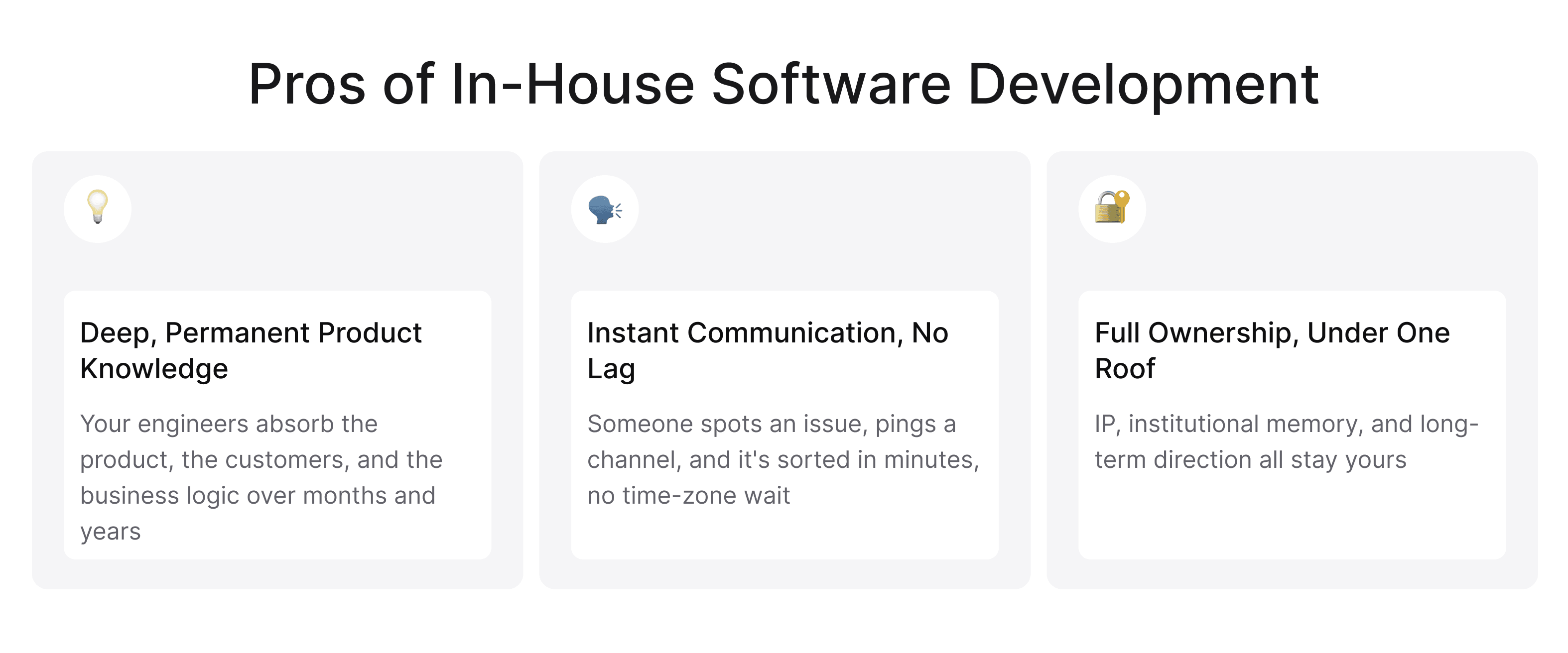
When the software is the heart of your business, in-house is hard to beat. Your engineers absorb the product, the customers, and the business logic over months and years, and that context matters. A developer who's lived in your codebase for 3 years catches problems a newcomer never would.
You also get instant communication. Someone spots an issue, pings a channel, and it's sorted in minutes. No time-zone lag, no overnight wait.
 Click to expand
On top of that, the ownership stays under one roof. The intellectual property, the institutional memory, the long-term direction, all yours. For a product you'll run for a decade, that continuity compounds in your favor.
The Hidden Costs and Limits of Building Internally
Now the flip side. Hiring senior engineers in the US or Western Europe is slow and pricey, and the salary is only the sticker price.
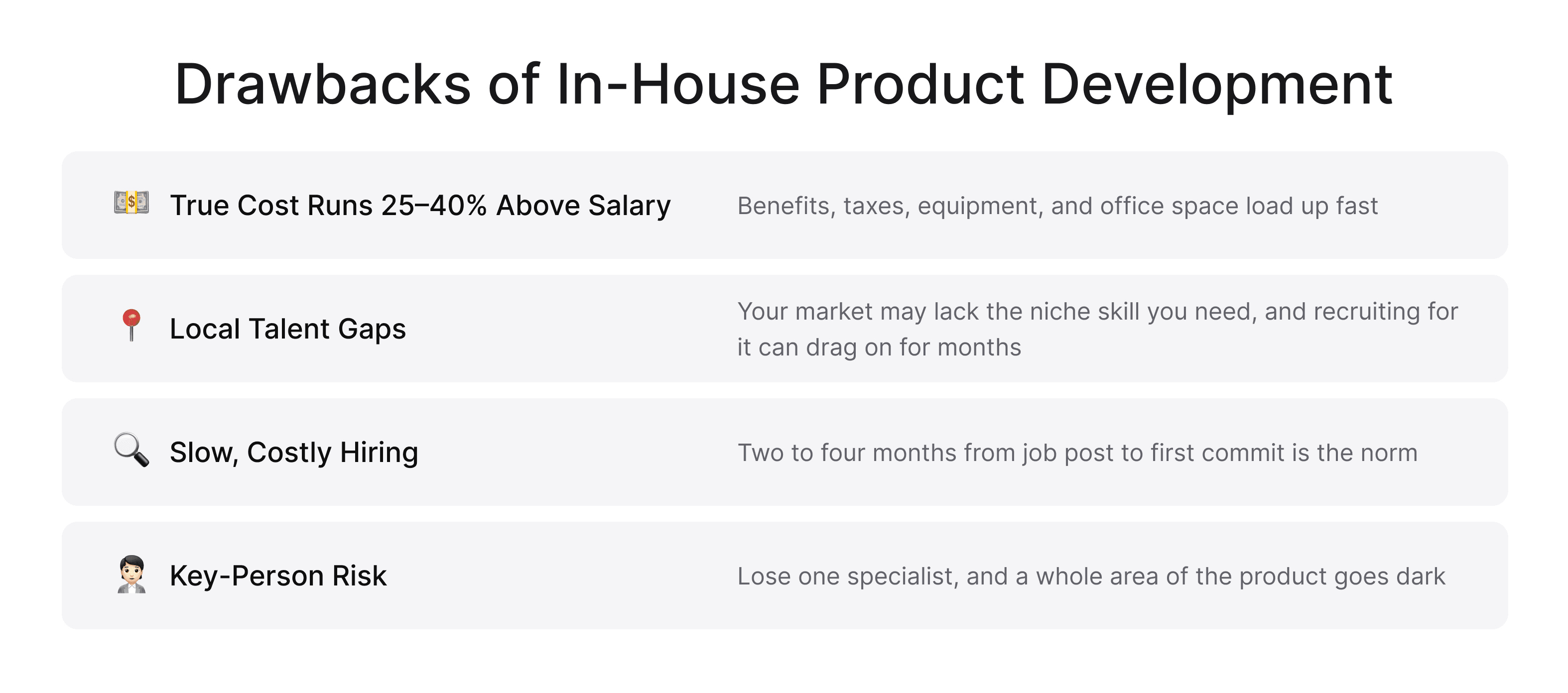
Add benefits, payroll taxes, software licenses, hardware, office space, and the recruiter's fee. Here's why that matters: a common blind spot in the in-house software development vs outsourcing comparison is that a $140,000 salary quietly becomes $180,000 or more once you load in everything around it.
Then there's the talent gap. Your local market may simply not have the niche skill you need, whether that's a specific ML framework, a payments integration, or a legacy system nobody wants to touch. Recruiting for it can drag on for months.
 Click to expand
And small teams carry real key-person risk. Lose one specialist, and a whole area of the product goes dark. None of this makes in-house wrong. It just means the true cost and the ramp-up run higher than the salary line suggests.
What Outsourcing Software Development Really Means
Outsourcing means you bring in a third-party company to build or extend your software. Instead of hiring people one by one, you contract a partner that already has the developers, the processes, and management in place. They carry their own recruiting, retention, and overhead. You get the output.
That said, the inhouse vs outsource software development conversation often gets oversimplified, because outsourcing isn't one thing. It ranges from handing over a fully scoped project end-to-end to plugging one or two senior engineers into your team. That range is exactly why we break out the middle-ground models further down.
The market explains why this keeps growing. The global IT outsourcing market is on track for roughly $639 billion in 2026, per Mordor Intelligence.
The motivation has shifted, too. Only about a third of organizations now cite cost reduction as their main driver, recent industry research shows. Today, the top reasons are access to talent and speed to market. For most teams, the real prize is skills they can't hire fast enough at home.
Where Outsourcing Pays Off
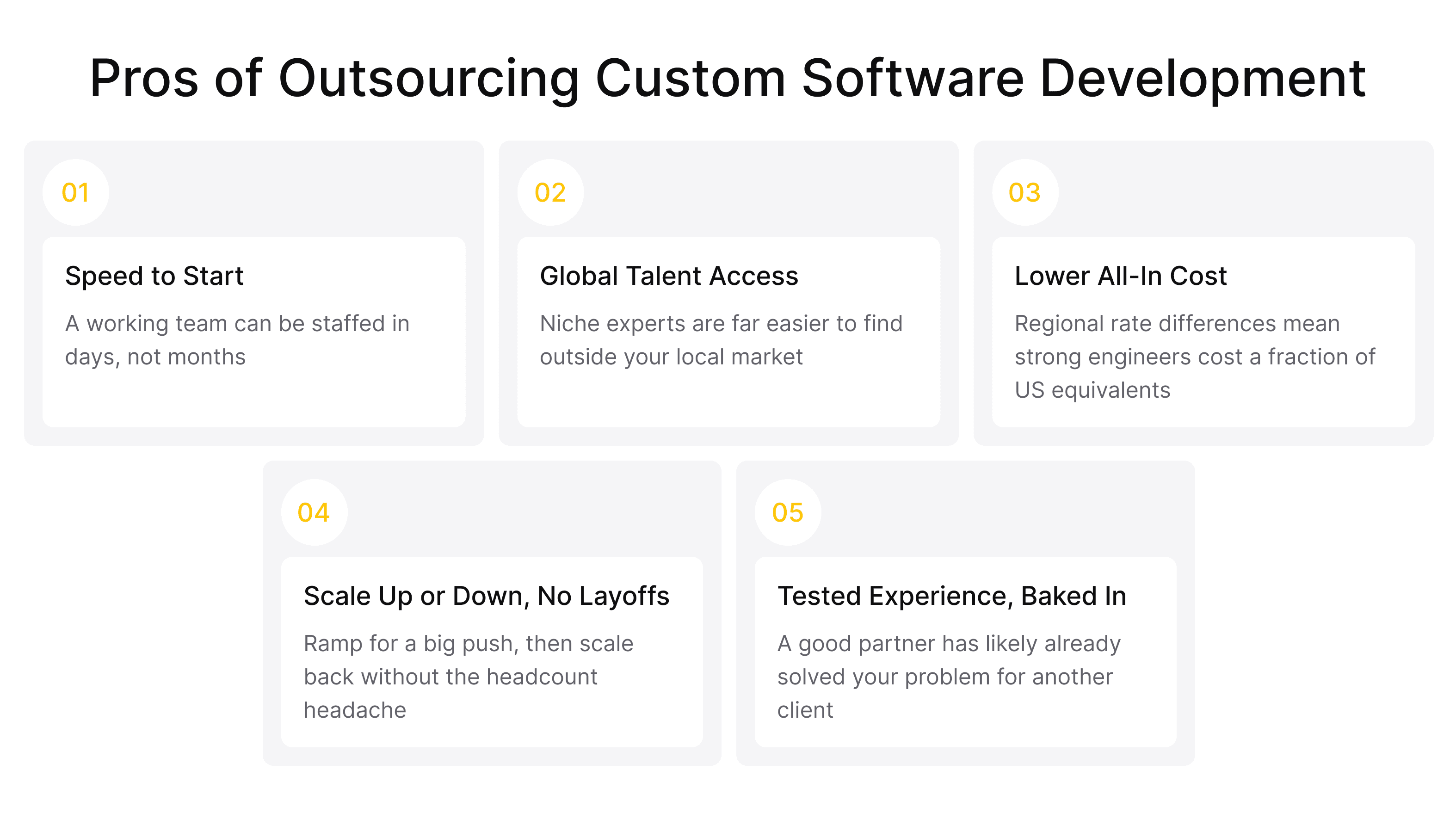
The first win is speed. A good partner can put a working team on your project in days, while an internal hire drags on for months. And since most software makes no money until it ships, shaving weeks off the start date has real value.
The second is access. You're no longer limited to who lives nearby or who'll relocate. You reach a global talent pool, so niche experts are far easier to find. On raw speed and reach, in-house software development vs outsourcing tilts hard toward the partner.
The third is cost and flexibility. Regional salary differences mean strong senior engineers in Eastern Europe or Latin America often cost a fraction of their US equivalents, at the same quality of work.
 Click to expand
You can also scale up for a big push, then scale back down afterward without layoffs. Even the largest tech companies lean on outside developers, keeping their own people on the highest-priority work.
The Trade-offs You Sign Up For
None of this comes free of friction. When you weigh in house software development vs. outsourcing, the honest downsides of outsourcing come down to 3 things: communication, control, and commitment.
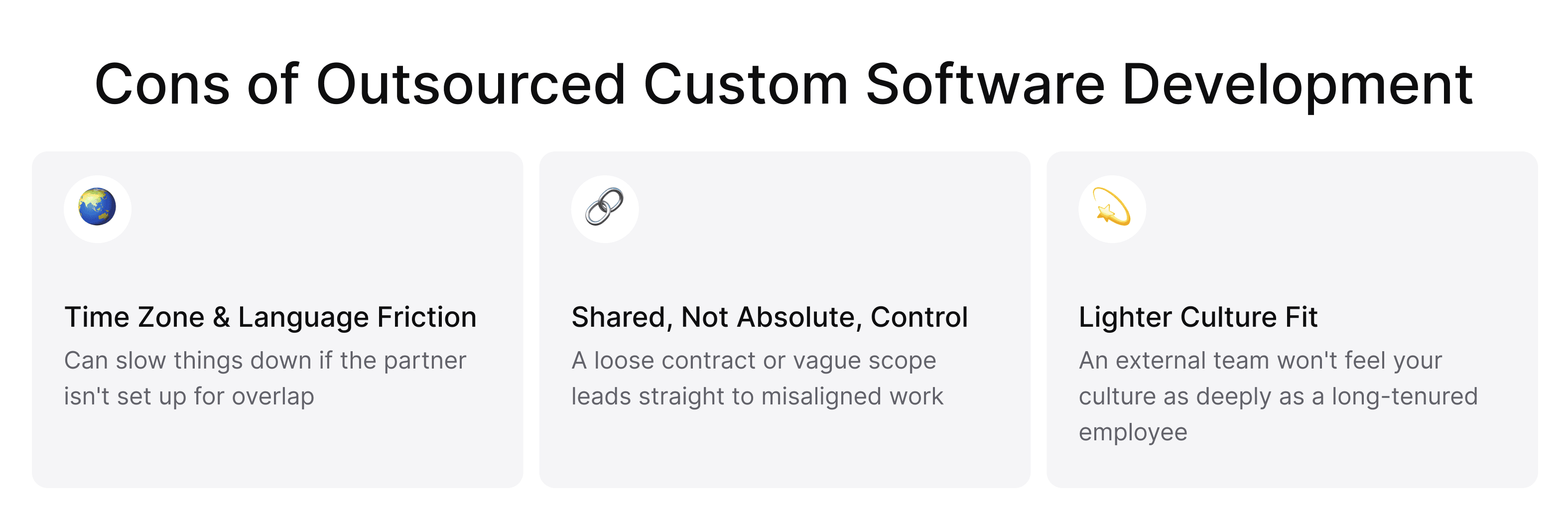
Time zones and language can slow things down if the partner isn't set up for it. A team 8 hours ahead is great for round-the-clock progress, and frustrating when you need an answer at 3 p.m. and everyone's asleep.
 Click to expand
Control is shared rather than absolute, so a loose contract or vague scope leads straight to misaligned work. And by default, an external team won't feel your culture as deeply as a long-tenured employee. Every one of these is manageable, and we'll get to how. Just walk in with your eyes open.
Beyond the Binary: Staff Augmentation, Dedicated Teams, and Hybrid Models
Here's what most articles skip: the choice was never really 2 options. Framing everything as in house vs outsourcing software development hides the fact that the most popular setups today live somewhere in between. They exist because pure in-house and pure project outsourcing each leaves gaps that the other fills.
Staff Augmentation (Team Extension)
Staff augmentation is the lightest touch. You keep full ownership of your product, roadmap, and process, and you slot vetted external engineers into your existing team.
They work your hours, join your standups, and report through your leads, just like employees, except they sit on the partner's payroll. It's the fastest way to close a specific skill gap or add capacity for a crunch. If you want to see this in practice, our team extension service is built for exactly that: senior developers embedded straight into the workflow you already run.
Dedicated Development Teams
A dedicated team goes a step further. The partner assembles a full unit, including developers, QA, a project manager, and sometimes designers, that works only on your product for the length of the engagement.
So you get the focus and continuity of an internal team without the burden of hiring, HR, and retention. It suits longer projects where you want stable people who build up product knowledge over time. Spinning up a dedicated development team is often the sweet spot for companies that need real depth but don't want to become a recruiting operation on the side.
The Hybrid Model: Keeping Core In-House, Outsourcing the Rest
The hybrid approach is what many mature companies quietly do. You keep a small core team in-house for what's strategic, sensitive, or tightly tied to your business, and you outsource the rest.
Feature development, integrations, maintenance, testing, one-off builds, all go to a partner, while your in-house engineers stay on the crown jewels. For many teams, the whole in-house vs outsource question dissolves the moment they realize they can do both on purpose.
In-House vs. Outsourcing: Head-to-Head on What Matters
Let's put the 2 side by side on the 5 factors that decide most projects. This is where the in house development vs outsourcing choice stops being abstract and starts being about your numbers.
True Cost: Salaries vs. Total Engagement Price
An in-house salary is the number everyone quotes, and it's the one that misleads. The real figure includes benefits, taxes, tools, hardware, office space, recruiting, and the productivity lost while a seat sits empty. Loaded up, an internal engineer runs 25% to 40% above base pay.
Outsourcing bundles that overhead into a single agreed-upon rate. So, looking at in house vs outsourcing software development purely on the hourly number misses the point: the outsourced rate is all-in, while the internal rate is only the starting line.
Access to Talent and Niche Expertise
In-house limits you to your local market and whoever you can convince to join. Outsourcing opens up the whole world, so when you need a rare skill fast, there's really no contest. A good partner has likely already solved your problem for another client, so tested experience comes baked into every hour you pay for.
Speed to Market and Delivery Timelines
Hiring a senior engineer internally realistically takes 2 to 4 months from job posting to first commit. A partner can staff a project in days. When your launch window is fixed and the clock is running, that head start often matters more than anything else, because delivering on demand is literally the partner's business model.
The effect compounds, too. A partner can add a second or third engineer the moment the first proves out, so you don't restart the whole hiring process for every new role. For a startup racing a competitor to launch, that difference in tempo can decide who gets to market first.
Scaling Up or Down Without the Headache
Business needs move in waves. In-house teams are hard to flex: hiring is slow, and cutting means layoffs nobody enjoys. Outsourced and augmented teams scale both directions on short notice. Ramp up for a launch, ramp down after, and match your team size to your actual workload instead of carrying fixed headcount through the quiet months.
Picture a seasonal retailer that needs six extra engineers for a Q4 release, and none of them are available by February. With a partner, that's a planned ramp. With an internal team, it's a hiring spree followed by an awkward round of cuts. That flexibility is often the whole reason teams outsource in the first place.
Control, IP Ownership, and Security Risk
This is where in-house has a natural edge, and outsourcing needs careful management. With employees, control and IP are automatic. With a partner, you handle both through contract, which is why the paperwork matters.
The good news is that these risks are well understood and very manageable. Clear NDAs, IP assignment clauses, access controls, and appropriate security measures for outsourcing close most of the gap. So when people compare inhouse vs outsource software development on risk, the real variable is whether you set up the guardrails from day one, far more than the model itself.
What It Really Costs: A Side-by-Side Budget Breakdown
Let's make the money concrete because, for many teams, this is the deciding factor. Take one mid-level developer for a year.
In-house, in the US, base pay for a mid-level developer averages around $147,500 a year, with a typical range of $120,000 to $173,000, according to ZipRecruiter's 2026 salary data. After accounting for benefits, payroll taxes, equipment, software, and office overhead, the fully burdened cost ranges from $185,000 to $205,000. Then add recruiting fees and the weeks the seat sits empty. That's your true internal number, and it recurs every year they stay.
Now the other side. That same mid-level developer through a partner in Eastern Europe or Latin America typically runs $30 to $60 an hour, all-in (2026 regional rate benchmarks), which works out to roughly $60,000 to $120,000 a year for a full-time engineer, with no separate overhead on your books.
The savings come from structurally lower salaries and overhead in those regions, and the engineering quality holds up. You simply skip the overhead you'd otherwise carry yourself. Weighed on a full-year, fully loaded basis, software in house vs outsourcing often shows a gap wide enough to fund a second engineer. And if trimming the budget is the priority, our guide on reducing software development costs goes into more detail than we can here.
When to Choose In-House Custom Software Development
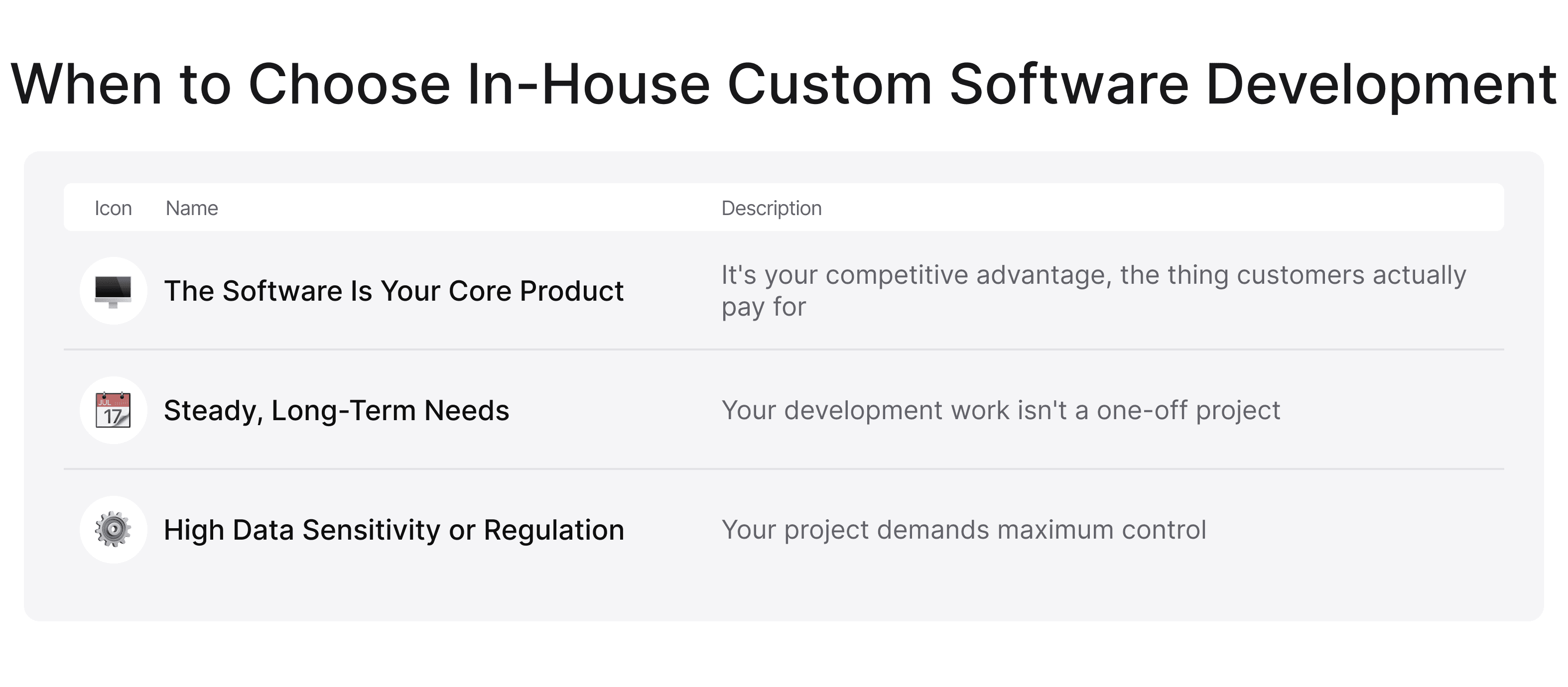
In-house makes the most sense when the software is your core product and your competitive advantage, the thing customers actually pay for. In that case, the deep product knowledge and tight control are worth the higher cost and slower ramp.
It also fits a few other cases. Your development needs are steady and long-term, not a one-off project. Data sensitivity or regulation demands maximum control. Or you already have the budget and the leadership bandwidth to run a team properly.
Put simply, choosing in house vs outsourcing software development in favor of building internally is a sound bet when you're a well-funded company building something you'll own and keep refining well past the first release.
 Click to expand
When to Choose Outsourcing Custom Software Development
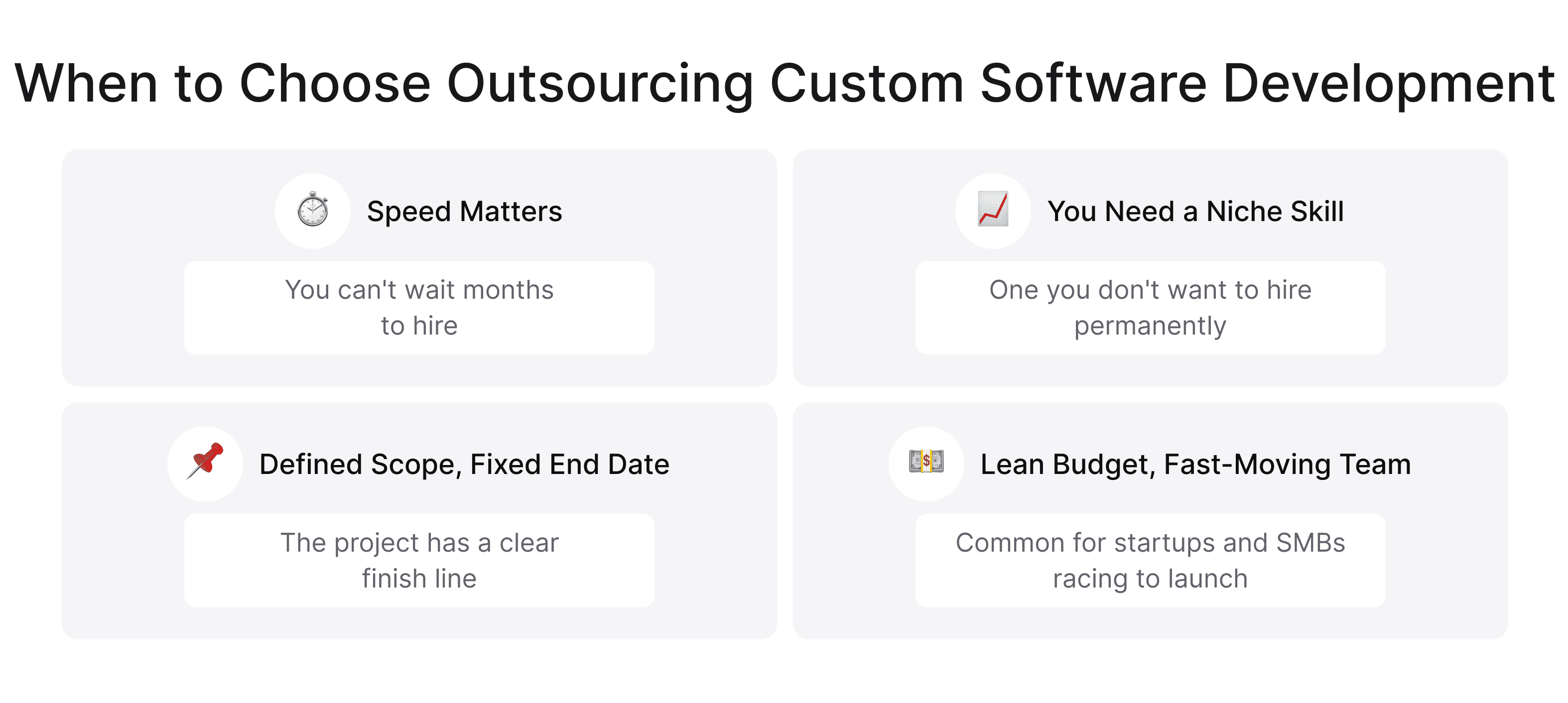
Outsourcing is the stronger play in more situations than people expect. Go this route when speed matters and you can't wait months to hire, when you need a niche skill you don't want to hire permanently, when the project has a defined scope and end date, or when you're a startup or SMB moving fast on a lean budget.
It's also the natural choice when you need to quickly scale a team for a specific push. Bottom linе: the in house development vs outsourcing decision tilts toward outsourcing whenever flexibility, speed, and cost efficiency outrank total control. And if you're new to it, our walkthrough on how to outsource app development covers the practical steps, from writing the brief to running that first sprint.
 Click to expand
How to Vet and Choose a Reliable Outsourcing Partner
The model matters less than the partner you pick. A great outsourcing company makes the downsides disappear, and a bad one makes every fear come true. So vet properly.
Look at their portfolio and case studies for work like yours. Ask for client references, then actually call them. Check that their communication is clear and prompt from the very first email, because that's how the whole engagement will feel. Confirm they have solid processes for code quality, testing, and security, and that the contract spells out IP ownership and confidentiality.
When in doubt, start small. A short paid pilot, one sprint, or a single well-defined feature, tells you more about a partner than any sales call. You see how they estimate, how they handle feedback, and how the code actually looks before you commit to a long engagement.
Mind time-zone overlap and English fluency, too, if those matter to your workflow. Whichever way you lean on in-house vs outsource, the vetting is what protects you. And once work starts, managing an outsourcing team well is what keeps it on track.
Why Teams Outsource to Incora, and How We De-Risk It
At Incora, we build custom software for companies that want the speed and cost upside of outsourcing without the usual headaches. We've spent years eliminating the common worries that come with outsourcing: senior, vetted engineers; transparent communication; airtight IP and security terms; and delivery models built around how you already work.
Not sure whether to build in-house or outsource?
Contact us and we'll help you figure out the right model for your project, budget, and timeline.
Whether you need a full build, a dedicated team, or a couple of specialists embedded into your staff, our custom software development services give you the upside of in-house vs. outsourcing software development without forcing you to pick one extreme. We build what you need, integrate it cleanly with what you already have, and hand over documented code that's genuinely yours.
Final Takeaway
Bottom line: there's no trophy for building everything yourself, and none for outsourcing in principle. In-house buys you control and deep product knowledge at a high, ongoing cost. Outsourcing gives you speed, reach, and flexibility, while you actively manage communication and oversight.
So treat in house software development vs outsourcing as a spectrum of options you can mix. The smartest teams often pair a lean internal core with outside help for the rest. Start from your real constraints, your timeline, your budget, how core the software is, and how much risk you can carry, and the right model tends to pick itself.
FAQ
Is it cheaper to outsource or build software in-house?
Outsourcing is usually cheaper for a given project. A US in-house developer costs about $185,000 to $205,000 a year, fully loaded, once you add benefits, taxes, tools, and office space to the salary, while an outsourced developer bills at a single all-in rate with no overhead on your side. In-house wins on cost only over the long run, for a core product that a permanent team maintains for years.
What's the difference between outsourcing, outstaffing, and a dedicated team?
Outsourcing means a partner delivers a fully scoped project end to end. Outstaffing, or staff augmentation, plugs individual engineers into your team while you keep control of the work. A dedicated team is a full unit, developers plus QA, and a project manager, working only on your product for the length of the engagement.
How do I protect my IP and data when outsourcing?
Put everything in writing: an NDA, an IP-assignment clause that makes all work legally yours, and access controls that limit who can see what. Choose a partner with clear security practices and, where applicable, compliance certifications such as SOC 2 or ISO 27001. Handled this way, your IP is as safe as it is when handled by employees.
Can I combine in-house and outsourced teams?
Yes, and many companies do, through the hybrid model. You keep a core in-house team on strategic, sensitive work and send features, integrations, and maintenance to a partner. It gives you internal control where it counts and the flexibility you need everywhere else.
How do I choose a reliable software outsourcing company?
Check their portfolio for similar projects, call client references, and judge how clearly they communicate from the first message. Confirm their processes for code quality, testing, and security, and ensure the contract is explicit about IP and confidentiality. Time-zone overlap and English fluency matter too.


YOU MAY ALSO LIKE

Get in Touch
Got no clue where to start? Why don’t we discuss your idea?

