



By Bohdan Vasylkiv
- CEO & Co-Founder
How Much Does Website Maintenance Cost?
How much does website maintenance cost? See 2026 price ranges by site type, a full cost breakdown, and tips to keep your maintenance budget low.
Key Takeaways
- Most sites cost $50-$500 a month to maintain. Stores and custom platforms run much higher.
- Hosting, domain, SSL, and updates are unavoidable. Content, marketing, and premium tooling are optional.
- Complexity, release frequency, and integrations move the number far more than page count.
- Skipping upkeep is a loan. Most owners repay it within a year, with interest.
Your site launched, the design looked sharp, and everyone moved on. 10 months later, the hosting bill jumped, a plugin update broke the contact form, and nobody remembers who owns the SSL renewal.
Then you start collecting quotes, and they range from $80 to $2,400 a month for what sounds like identical work. So, what is website maintenance cost, and why does nobody give you a straight number?
Because the cost of website maintenance hides in 7 places at once, and most quotes show you 3 of them. Here is the full picture for 2026.
So, How Much Does Website Maintenance Cost?
Most sites land between $50 and $500 a month. That range is close to useless without context, so let us tighten it.
Here is a realistic website maintenance cost per month in 2026:
- Personal blog or portfolio: $10 to $60
- Small business or brochure site: $50 to $250
- Corporate or content-heavy site: $250 to $1,200
- eCommerce store: $500 to $3,500
- Custom web app or marketplace: $2,000 to $10,000 and up
The average monthly cost for website maintenance for small and mid-sized businesses sits near $200. That covers hosting, security, light content work, and a few hours of developer time each month.
One nuance is worth keeping in mind before you celebrate a cheap quote. A low website maintenance cost usually means a small site, and sometimes it means postponed work. Sites that run on $20 a month are often the same sites that need a $15,000 rebuild in year three.
What's Actually Included in Website Maintenance
Before you argue about price, agree on scope. 2 quotes that look wildly different usually cover different work, and the gap is almost never where you expect it.
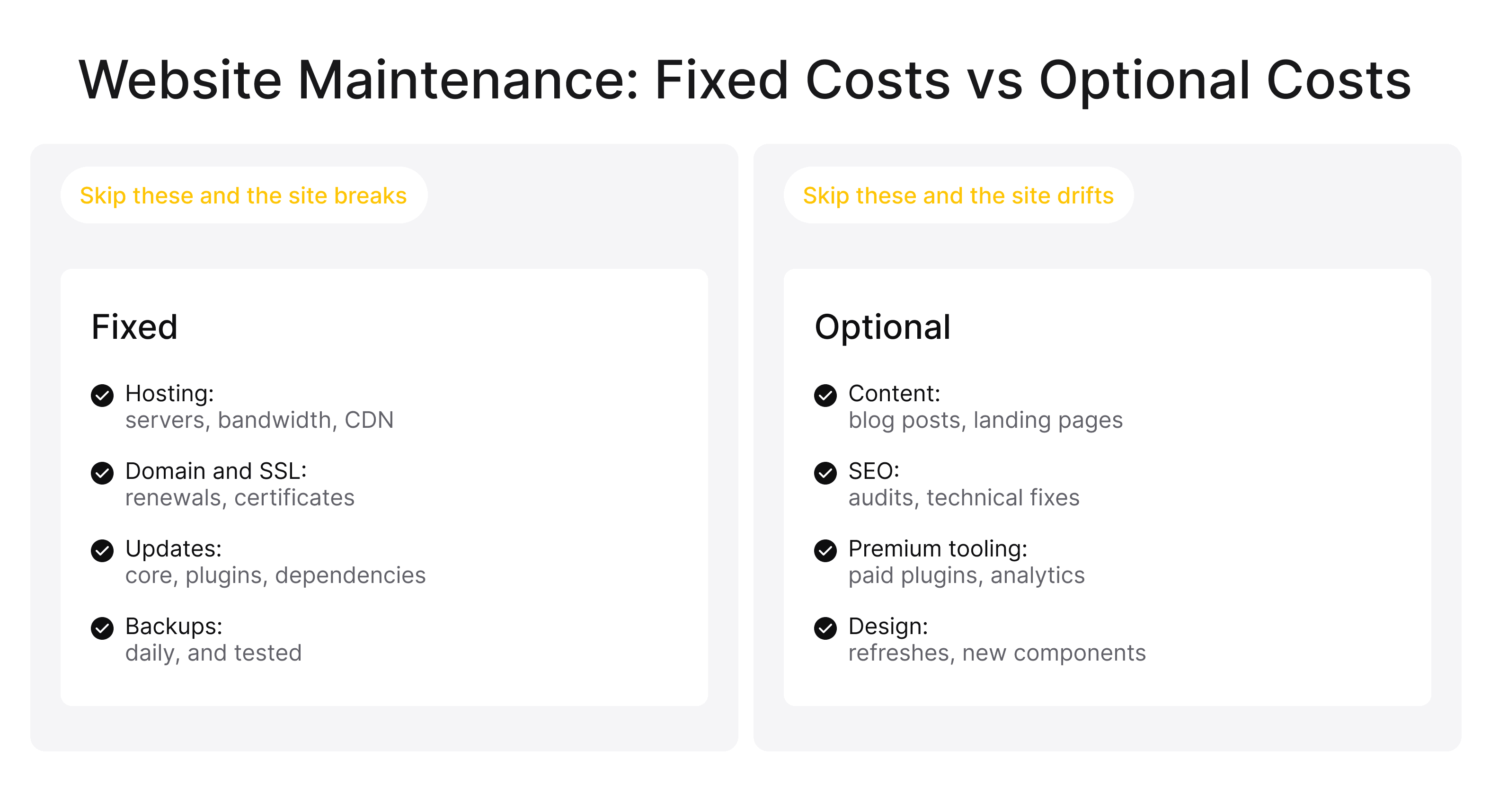
A standard plan starts with hosting, domain renewal, and SSL. Website maintenance and hosting are usually bundled into a single invoice, which makes budgeting easier but comparison shopping harder.
 Click to expand
From there, you pay for core, plugin, and dependency updates, plus the testing that follows each one. Add security monitoring, malware scanning, firewall rules, backups you have actually restored once, uptime alerts with a human on call, content changes, and bug fixes.
Look at that list again. Almost all of it is labor. Software is cheap in 2026, and skilled attention is expensive, which is why website maintenance costs swing so widely between 2 sites that look identical from the outside.
Bottom line: ask any vendor what happens when the checkout breaks at 3 a.m. on a Saturday. The answer tells you what you are buying.
Factors Affecting Web Maintenance Costs
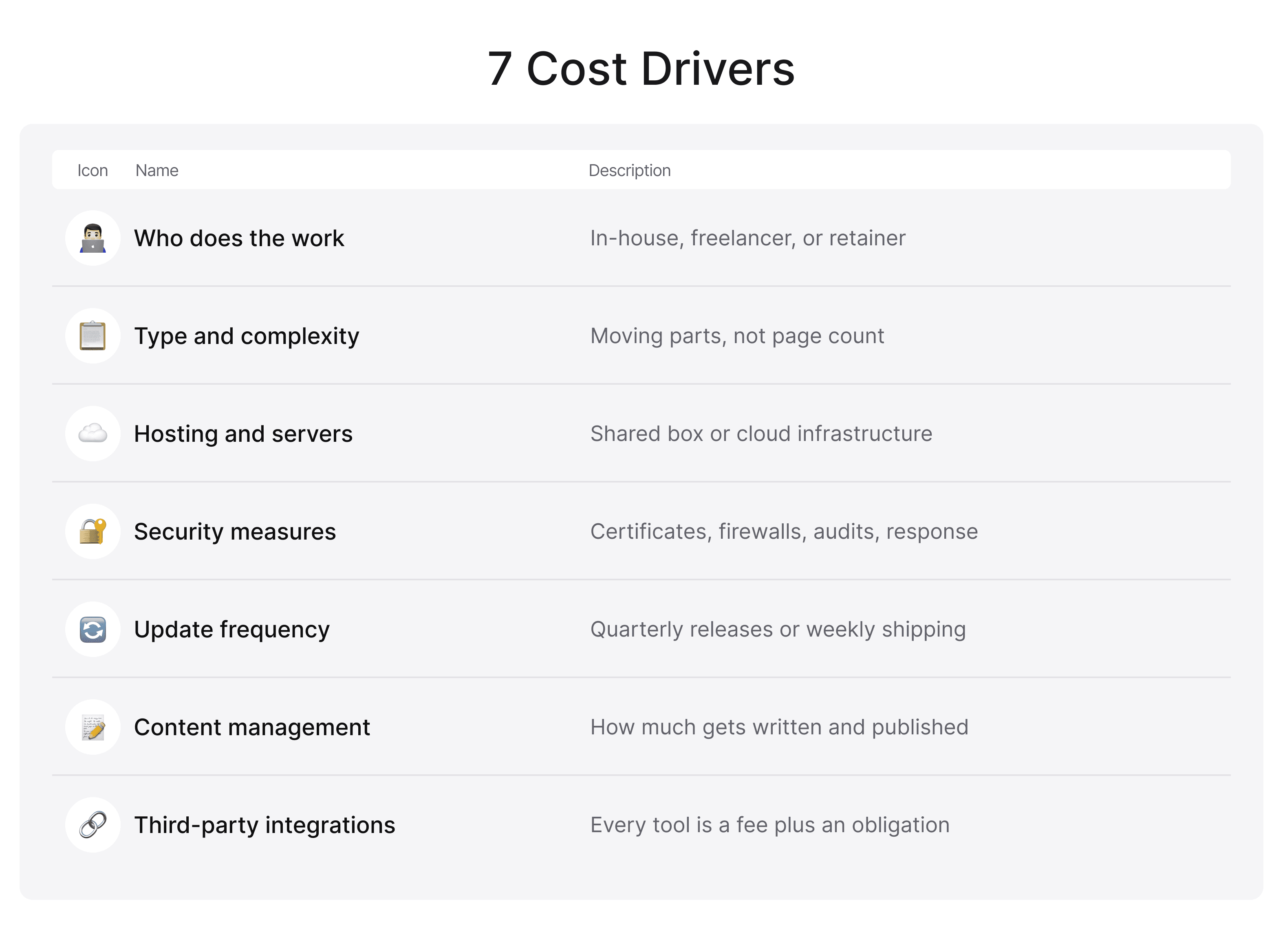
2 sites can look the same and cost wildly different amounts to run. Seven things explain almost all of that gap, and they compound rather than add up.
1. Type and Complexity of the Website or Web Application
A five-page brochure site and a booking platform with payments and user accounts are different animals. The cost of website maintenance scales with moving parts, never with page count.
Content sites need updates, backups, and the occasional fix. Platforms built through custom web application development host databases, background jobs, third-party APIs, and user data, and each of these needs monitoring, patching, and an engineer who knows the codebase.
Industry adds another layer. A healthcare portal holding patient records answers to compliance rules a recipe blog will never see, and that paperwork carries an hourly rate.
2. Frequency of Updates
Some sites change once a quarter. Others ship something every Thursday, and that cadence quietly sets your website maintenance price.
Each release entails code changes, testing, deployment, and a rollback plan in case things go sideways. Weekly shipping carries four times the coordination overhead of monthly shipping, even when the changes are small.
Frontend work stacks up fastest. Design refreshes, new landing pages, and accessibility fixes keep arriving, so teams offering front-end development services spend most of their maintenance hours here. Simply put, the faster you want to move, the more you pay to move safely.
 Click to expand
3. Hosting and Server Costs
Hosting is the line item everyone understands, and almost everyone underbudgets.
Shared hosting runs $3 to $15 a month in 2026, and managed WordPress runs $25 to $80 a month. Cloud instances start near $20 and climb fast once you add load balancers, CDN bandwidth, staging environments, and database backups.
Domains look trivial until you notice the floor is moving. A .com renews at $12 to $25 a year, and Verisign raises the wholesale .com fee from $10.26 to $10.97 on November 1, 2026, with roughly 7% increases expected annually through 2030.
For a small site, hosting adds about $150 to your website maintenance cost per year. For a mid-sized store on AWS, that same line hits $6,000 to $20,000, driven by traffic spikes, heavy image catalogs, and video.
4. Security Measures
Security is where cutting corners gets expensive.
A basic SSL certificate is free through Let's Encrypt, while extended validation runs $50 to $300 a year. Web application firewalls add $20 to $500 a month, and malware scanning, intrusion detection, and offsite backups each carry their own fee.
Then comes the human layer: penetration tests, dependency audits, and incident response. A scoped web application pentest runs $5,000 to $30,000 in 2026, and the average engagement across all types lands near $18,300. That is why a fintech dashboard and a photography portfolio can show a tenfold gap in website maintenance cost while running on nearly identical technology.
Here is why that matters. A typical small-business breach costs $120,000 to $1.24 million by Verizon's numbers, and every hour of downtime burns roughly $53,000. Against those figures, a firewall subscription starts to look like an expense.
5. Content Management
Someone has to write, publish, and refresh the words and images, and that someone bills for it.
The software itself is cheap. WordPress is free; Webflow reworked its plans in May 2026, so Basic is $15 a month on annual billing, and Premium is $25, and headless platforms like Contentful start at nearly $300.
The real spend is editorial. If your monthly website maintenance includes four blog posts, product page updates, and a landing page per campaign, you are paying writers, editors, and designers. Budget $500 to $3,000 a month, depending on volume.
That said, content is the one line you can pause. Cut it when cash is tight, and nothing breaks. Your rankings just drift downward while you wait.
6. Developer Rates and Maintenance Plans / Development Team (In-House vs. Outsourcing)
Who does the work sets the number more than anything else on this list.
US and Western European developers bill $80 to $180 an hour. Eastern European teams, including engineers in Poland and Ukraine, sit at $35 to $65 for comparable seniority, which is why so much long-term upkeep quietly migrated east.
In-house hires give you availability and context, at the price of salary, benefits, and idle weeks you pay for anyway. A team extension model splits the difference: dedicated engineers who learn your codebase and stay with it, billed as a service.
Honestly, most confusion about website maintenance pricing comes from comparing an hourly freelancer to a retainer that includes monitoring, testing, and guaranteed response times. Those are 2 different products wearing the same label.
7. Third-Party Services and Integrations
Every integration is a subscription plus a maintenance obligation, and only the first half shows up on your invoice.
Payment gateways charge per transaction. Email tools, CRMs, analytics suites, chat widgets, and shipping calculators each take $20 to $500 a month. Stack 10, and you have a second hosting bill.
APIs also change without asking. When a vendor deprecates an endpoint, someone rewrites your integration on their schedule, and that is the part of the website cost and maintenance planning spreadsheets that are missing. The fee is visible; the hours triggered by someone else's roadmap stay invisible until they land.
What Website Maintenance Costs by Site Type
Averages hide more than they reveal. Here is what each tier really pays in 2026, and what that money buys.
Small Business and Portfolio Sites
Expect $50 to $250 a month, or $600 to $3,000 a year.
You need hosting, a domain, SSL, CMS updates, backups, and a few hours of support. Most owners at this tier ask how much website maintenance will eat from a marketing budget, and the honest answer is less than one paid ad campaign.
Website maintenance for small business sites usually means a light retainer: a fixed monthly fee covering updates, uptime monitoring, and a small block of change requests. Quotes at the bottom of the range are either fully automated or quietly neglected. Ask which.
Corporate and Content-Heavy Sites
Expect $250 to $1,200 a month, or $3,000 to $14,000 a year.
Dozens of landing pages, gated content, a careers section, CRM, and marketing automation integrations. Publishing cadence alone justifies a part-time editor.
Website maintenance costs here are driven as much by coordination as by engineering. Several people request changes, someone approves them, one team deploys them, and every step has a calendar. Add staging environments, accessibility compliance, and translation for every market you sell into.
eCommerce Stores and Web Apps
Expect $500 to $3,500 a month, or $6,000 to $42,000 a year. Large stores go well past that.
Payments, inventory sync, tax rules, fraud screening, abandoned cart flows, and search all need care. The eCommerce website features that drive conversion are the same ones that buckle during peak traffic, and Black Friday ignores your backlog.
eCommerce website maintenance costs also include PCI DSS compliance, performance tuning, and support coverage during checkout outages, because a slow checkout costs conversions before it costs anything else. Custom web apps sit higher still, at $2,000 to $10,000 and up, since upkeep there means real engineering: refactoring, dependency upgrades, and scaling.
Monthly vs. Annual: How the Numbers Add Up
Monthly pricing feels manageable. Annual pricing tells the truth.
A $150 website maintenance cost per month reads as pocket change. Multiply by twelve, add the yearly renewals (domain, SSL, premium plugins, one SEO audit), and you are at $2,400 instead of the $1,800 you had in your head.
So, how much does it cost to maintain a website across a full year? Rough 2026 ranges:
- Blog or portfolio: $120 to $700
- Small business site: $600 to $3,000
- Corporate site: $3,000 to $15,000
- eCommerce store: $6,000 to $42,000
- Custom platform: $24,000 to $150,000 and up
Most vendors offer a 10% to 20% discount for annual prepayment, which is tempting. Locking in for 12 months with an untested team is still a bad trade, so start monthly and switch after 2 solid quarters.
One more thing about annual maintenance cost for website budgets: leave 15% headroom. Emergencies arrive in exactly the months you planned nothing for.
DIY vs. Hiring a Pro: Which Actually Pays Off?
DIY is free until your time has value.
Handling it yourself costs $30 to $80 per month in tools and 4 to 8 hours of attention. Fine for a portfolio, painful for anything transactional.
The failure mode is predictable: updates get postponed, a plugin conflict takes the site down, and your Saturday disappears into a search results spiral.
Hiring out costs $100 to $2,000 a month and buys response times, tested backups, and someone who has seen this exact failure before. When owners ask how much does website maintenance cost against doing it themselves, the number that settles the argument is downtime. One day offline for a store earning $5,000 a day wipes out three years of retainer fees.
A hybrid works nicely for website maintenance for small business owners. Keep content in your hands, outsource security, updates, and monitoring. You control the message and hand off the risk.
Hidden Costs That Catch Site Owners Off Guard
Every budget leaks somewhere. These are the 6 holes nobody quotes for.
- Plugin and theme renewals. That $79 license renews annually, and you own 11 of them.
- Testing after updates. Every dependency bump needs verification, and teams that skip QA & software testing pay for it in production, usually on a Friday afternoon.
- Technical debt interest. A fix that took two hours in year one takes six by year four.
- Migration. Hosts raise prices, frameworks reach the end of life, and PHP and Node versions get deprecated. Budget a migration every three to four years.
- Compliance drift. Accessibility standards, cookie rules, and payment regulations keep moving.
- Emergency work. Off-hours rates run 1.5x to 2x the standard rate.
Most website maintenance pricing sheets cover the predictable half of that list. Ask about the other half before you sign.
The Real Price of Skipping Maintenance
Neglect is a loan with a terrible interest rate, and the repayment schedule is not yours to set.
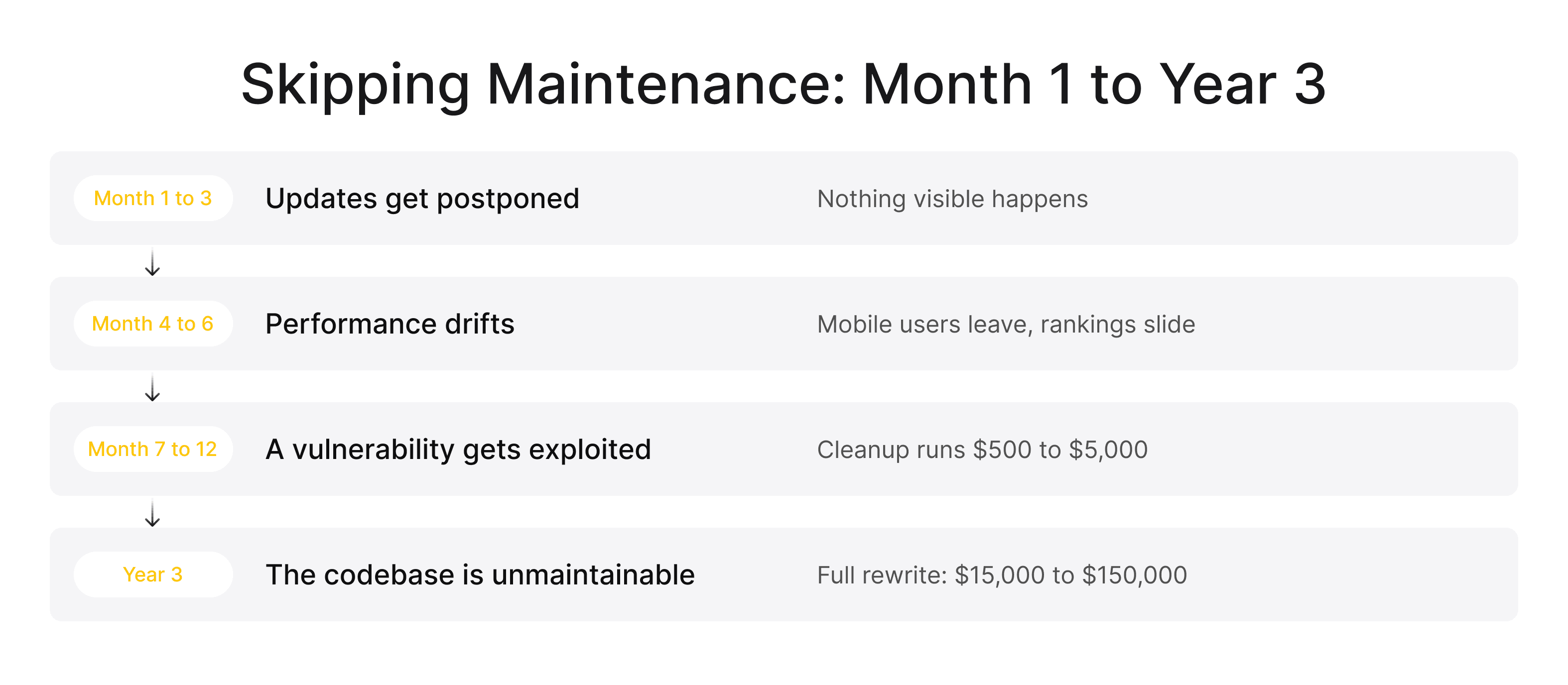
Unpatched CMS installations remain the leading cause of small-business site compromises. Cleanup runs $500 to $5,000, assuming clean backups exist, and Google blacklisting costs you traffic for weeks after the technical fix lands.
Performance decays more quietly. Bloated pages lose mobile users, Core Web Vitals feed straight into rankings, and six months of drift can erase more organic traffic than a year of content investment wins back.
 Click to expand
Then there is the rebuild. Sites left alone for three years usually need a full rewrite at $15,000 to $150,000. Against that, a $200 website maintenance cost each month looks like insurance priced well below its payout.
So when someone asks how much does it cost to maintain a website, the sharper question is what it costs to leave one alone.
How to Keep Website Maintenance Costs Under Control
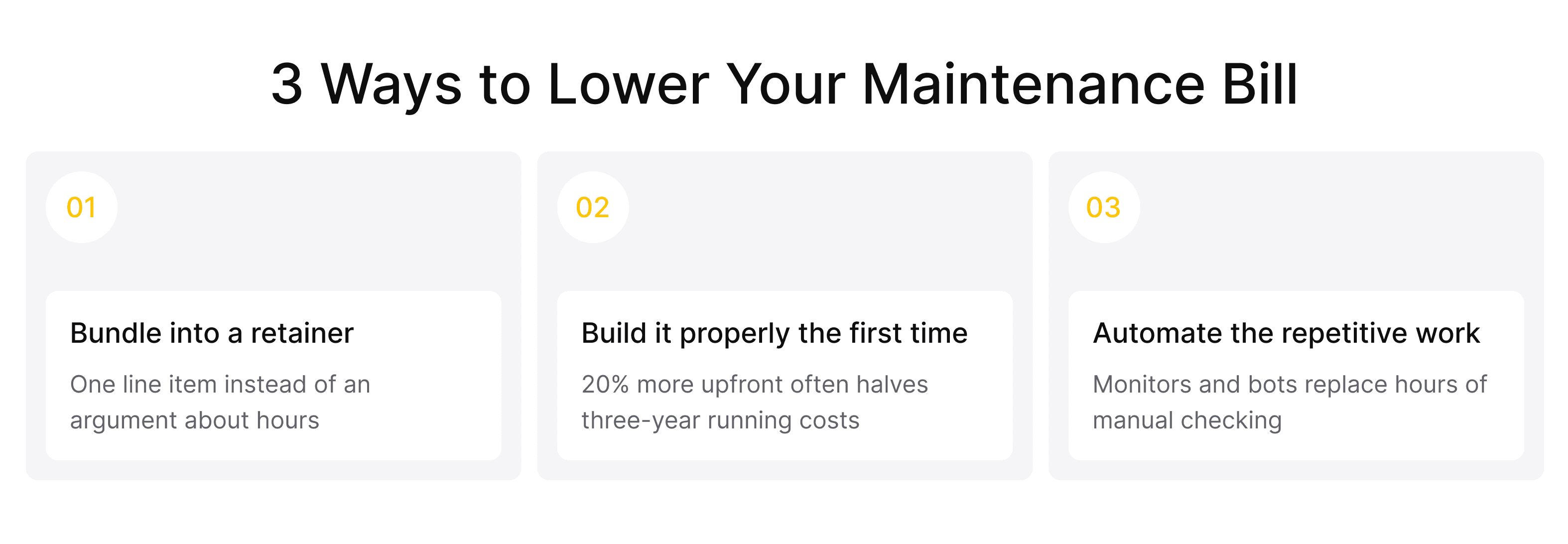
You cannot avoid maintenance. You can avoid paying for it twice, and three moves do most of the work.
Bundle Into a Predictable Monthly Retainer
Hourly billing punishes you for asking questions. A retainer removes that friction on both sides of the table.
Fixed plans bundle hosting, monitoring, updates, backups, and development hours into one line item. Your vendor gets predictable revenue in return, so they invest in learning your stack properly.
When you compare plans, stop asking how much does website maintenance cost and start asking what is included, what response time is guaranteed, and what falls out of scope. Two plans priced at $400 can differ threefold in real value. Push for a quarterly review, because scope creeps in both directions.
 Click to expand
Invest in a Quality Build to Cut Long-Term Upkeep
Cheap builds are expensive to own.
Clean architecture, documented code, automated tests, and a sane dependency tree cut maintenance hours for years. Teams that rush the build ship faster once, then pay a tax on every change afterward.
This is the counterintuitive part of reducing software development cost: spending 20% more on the initial build often halves your three-year running expenses. Test suites catch regressions before humans do, component libraries make design changes cheap, and infrastructure as code makes environments reproducible.
Ask for a technical audit before you commit to a long retainer on inherited code. You are about to pay for whatever the last team left behind.
Automate Monitoring and Routine Updates
Machines are cheaper than people for repetitive work.
Together, uptime monitoring, automated backups, dependency bots, staging deployments with rollback, and error tracking cost $50 to $200 a month. They replace hours of manual checking and surface problems before customers do.
That shift matters more than the savings. Automation moves your website maintenance cost from reactive to predictable, engineers spend their hours on improvements instead of firefighting, and emergency rates disappear from your invoices.
Set alert thresholds around real business impact, though. Alert fatigue is its own hidden expense.
How Incora Keeps Your Site Running Without Surprise Bills
Incora builds and maintains web platforms for companies in eCommerce, fintech, healthcare, and logistics. We work as a long-term technical partner, so the team that ships your platform keeps it healthy afterward.
In practice, that means a fixed monthly retainer with clear scope, response-time commitments, automated monitoring and backups, and a quarterly review showing where the hours went.
Our engineers handle infrastructure, security patching, performance tuning, and feature work under a single agreement, and we build custom solutions when off-the-shelf tooling no longer fits.
Already have a codebase and an internal team? We plug into it. Need a rebuild? We say so plainly and show you the math behind it.
Not sure where to start with website maintenance?
We can help you figure out what's actually slowing you down and what to build first.
Final Takeaway
Budget $50 to $500 a month for most sites, $500 to $3,500 for eCommerce, and more for custom platforms. Hosting, domain, SSL, and updates are unavoidable. Everything else is a decision you make on purpose.
The question of how much does it cost to maintain a website has a better version hiding inside it: what is this site worth to my business, and what does protecting that worth require? Answer that honestly, and the budget writes itself.
Treat upkeep as an operating expense, review it quarterly, and leave room for the year something breaks. It will.
FAQ
How much does website maintenance cost per month?
Most sites run $50 to $500 monthly. Blogs sit at the bottom, small business sites range from $100 to $250, corporate sites range from $250 to $1,200, and online stores range from $500 to $3,500. Custom platforms start around $2,000 and climb with traffic and compliance needs.
Is website maintenance a one-time or recurring cost?
Recurring, always. Hosting renews monthly, certificates yearly, and software needs patching continuously. Bigger projects, like a redesign or a framework migration, come up every three to four years, so treat upkeep as an operating expense and set aside a reserve for them.
How often should you do website maintenance?
Security patches within days of release. Backups daily, verified weekly. Update plugins and dependencies monthly, with testing. Run performance and SEO audits quarterly, and a full technical review annually. High-traffic stores compress every interval.
What are the signs that my website needs maintenance?
Pages load slowly on mobile. Forms stop delivering. Broken links multiply, and your CMS dashboard shows a stack of pending updates. Browsers warn visitors about an expired certificate, and rankings slide for no clear reason.
What happens if a website is not maintained?
Vulnerabilities pile up until someone exploits one. Malware, defacement, or a data breach follows, and Google may blacklist the domain. Performance degrades, rankings fall, and conversions follow. Recovery costs several thousand dollars, and a fully neglected site usually needs a rebuild.
Can I handle website maintenance myself, or should I hire a professional?
Handle it yourself if the site is a simple blog, you are comfortable with backups, and downtime costs you nothing. Hire out once the site accepts payments, stores user data, or generates revenue. A hybrid works well: keep content in-house, and outsource security and updates to an on-call team.


YOU MAY ALSO LIKE





Get in Touch
Got no clue where to start? Why don’t we discuss your idea?

