



By Bohdan Vasylkiv
- CEO & Co-Founder
Why Startups Should Choose a Software Development Partner, Not Just a Vendor?
Discover why startups benefit from a software development partner, not just a vendor, and how the right team accelerates growth and MVP success.
Choosing a software development partner rather than a vendor improves your startup’s ability to build a scalable, investor-ready product. Startups operate in high uncertainty, and delivery alone does not eliminate that uncertainty. Strategic alignment does.
The 2024 Startup Genome Global Report shows that over 70% of startups fail because of premature scaling, poor product-market fit, or operational misalignment. Technology decisions directly affect each of these failure factors.
A vendor builds what you request. A strategic partner helps you determine what to build, how to build it, and when to scale it. That difference affects your time to product-market fit, your exposure to technical debt, your infrastructure scalability, and your investor readiness.
Investors examine architecture maturity during due diligence. They review code maintainability, DevOps practices, cloud scalability, and system resilience. An MVP built without long-term foresight often becomes an obstacle during Series A growth.
A software development partnership turns technology into a growth lever rather than a delivery function.
If you are building an early-stage product, you do not just need developers. You need structured product thinking, architectural planning, risk evaluation, and decisions about scalable infrastructure. A true long-term partner provides those layers of support.
This article explains the structural difference between a vendor and a partner, why startups specifically benefit from partnership models, and how to select the right partner for long-term growth.
Software Development Partner vs Vendor: What’s the Real Difference?
A vendor executes predefined tasks, while a development team aligns technology decisions with measurable business outcomes.
The distinction is structural. Vendors optimize for scope completion. A product development partner optimizes for sustainable growth and scalability.
Here is a direct comparison:
A vendor typically asks what features you need implemented. A technology team for startups asks which business objective the feature supports and how it should evolve when your user base grows tenfold.
This difference influences technology stack selection, DevOps maturity, infrastructure provisioning, and integration architecture. It also influences how confidently investors assess your technical foundation.
A trusted software partner participates in product decisions rather than simply executing instructions.

Is a Vendor More Cost-Effective?
Short-term development costs may appear lower with a vendor, but long-term expenses often increase.
The 2023 Stripe Developer Coefficient Report states that 45% of engineering time in scaling companies is spent addressing technical debt. Most technical debt originates from early architectural shortcuts made under time pressure.
A long-term development partner reduces hidden future costs by planning for scalability from the beginning. That planning does not slow MVP delivery. It prevents expensive rebuilds later.
What Defines a Real Software Development Collaboration?
A genuine partnership includes structured product discovery, shared KPIs, alignment on the technical roadmap, iterative releases, and continuous optimization. It also includes proactive risk identification.
This structure transforms an external team into a long-term strategic extension of your company.
People Also Ask
Founders evaluating long-term development collaborations typically ask these questions before committing.
What is a strategic development collaboration?
It is a working model in which an external engineering team aligns product development with business goals, scalability planning, and long-term growth strategy.
How is a software development partnership different from outsourcing?
Outsourcing focuses on delegating tasks. A partnership focuses on shared outcomes, architectural foresight, and strategic collaboration.
Why do startups need a technology partner?
Startups face rapid change and high uncertainty. A startup partner in technology reduces risk by aligning technical architecture with evolving business goals.
##Why Startups Specifically Need a Software Development Partner?
Startups require adaptive execution, strategic product thinking, and scalable architecture — not just feature delivery.
Early-stage companies operate under runway constraints, frequent pivots, pressure to validate the market, and investor scrutiny. A vendor model struggles under rapid change because it relies on predefined scope stability.
The engagement anticipates change and designs systems that accommodate evolution without constant restructuring.
Startups Need Product Thinking, Not Just Development
Building features without validating them significantly increases the risk of failure.
CB Insights’ 2023 Startup Failure Report shows that 35% of startups fail due to a lack of market need. Speed alone does not correct strategic misalignment.
A product development partner challenges assumptions before writing code. They evaluate whether a feature improves a measurable metric and whether it supports product-market fit.
Instead of simply implementing requirements, a product-focused engineering team asks which user problem the feature solves and how it contributes to growth.
If you are developing an MVP, structured MVP development services should validate business hypotheses rather than simply deliver interface components. Many successful startups rely on iterative product development models that shorten feedback cycles and improve decision-making speed.
The development team improves product logic, not just code quality.
Faster MVP Launch Without Costly Rebuilds
Launching quickly without architectural planning often leads to expensive infrastructure rewrites.
Many startups rebuild core systems within 18 to 24 months after funding because early systems cannot scale under growth pressure.
The technical team balances rapid delivery with long-term scalability. They implement modular architecture, CI/CD pipelines, scalable database structures, and cloud-native infrastructure from the beginning.
Choosing technologies such as Node.js development services or React JS development services is not about popularity. It is about ecosystem maturity, performance stability, and developer availability in your target hiring markets.
An experienced end-to-end development partner evaluates projected user growth, cloud cost forecasting, integration complexity, and security compliance requirements before committing to architectural decisions.
You launch fast without sacrificing future growth capacity.
Flexibility When Startup Priorities Change
Startups pivot frequently, and your development model must absorb change without creating friction or technical chaos.
Priorities shift because markets shift. Customer feedback reshapes product direction. Investors adjust strategy after funding rounds. Regulatory requirements evolve. If your development structure resists change, your runway shortens.
A vendor typically treats scope changes as contractual events. Each modification may trigger renegotiation, budget adjustments, or timeline disputes. That model slows adaptation.
This collaboration model assumes change is normal. Planning cycles anticipate reprioritization. Architecture supports modular feature evolution. Roadmaps remain flexible without breaking infrastructure stability.
Flexibility is not about uncontrolled scope expansion. It is about structured adaptability. A collaborative development approach allows the backlog to be reshaped within strategic guardrails. Engineers participate in planning discussions rather than waiting for finalized requirements.
Flexibility becomes critical during the following scenarios:
- Product-market fit validation
- Pricing model experimentation
- Feature de-scoping to reduce churn
- Enterprise pivot strategies
When priorities change, your system should bend, not break.
A long-term development ally designs architecture with abstraction layers, API flexibility, and scalable data models. That preparation reduces the cost of change.
Adaptability is not a soft benefit. It directly protects your runway and growth momentum.
For founders evaluating flexibility during vendor selection, reviewing their experience choosing a software partner for startups is essential. Startup experience determines how well a team handles uncertainty without escalating cost or complexity.
Strategic Tech Decisions That Support Growth
Technology decisions determine whether growth compounds or collapses under scale.
Infrastructure is not neutral. Architecture is not cosmetic. DevOps maturity is not optional. Every technical choice either accelerates or restricts expansion.
Investors understand this clearly. During due diligence, technical audits assess scalability, security posture, documentation quality, and deployment processes. Weak systems raise risk flags.
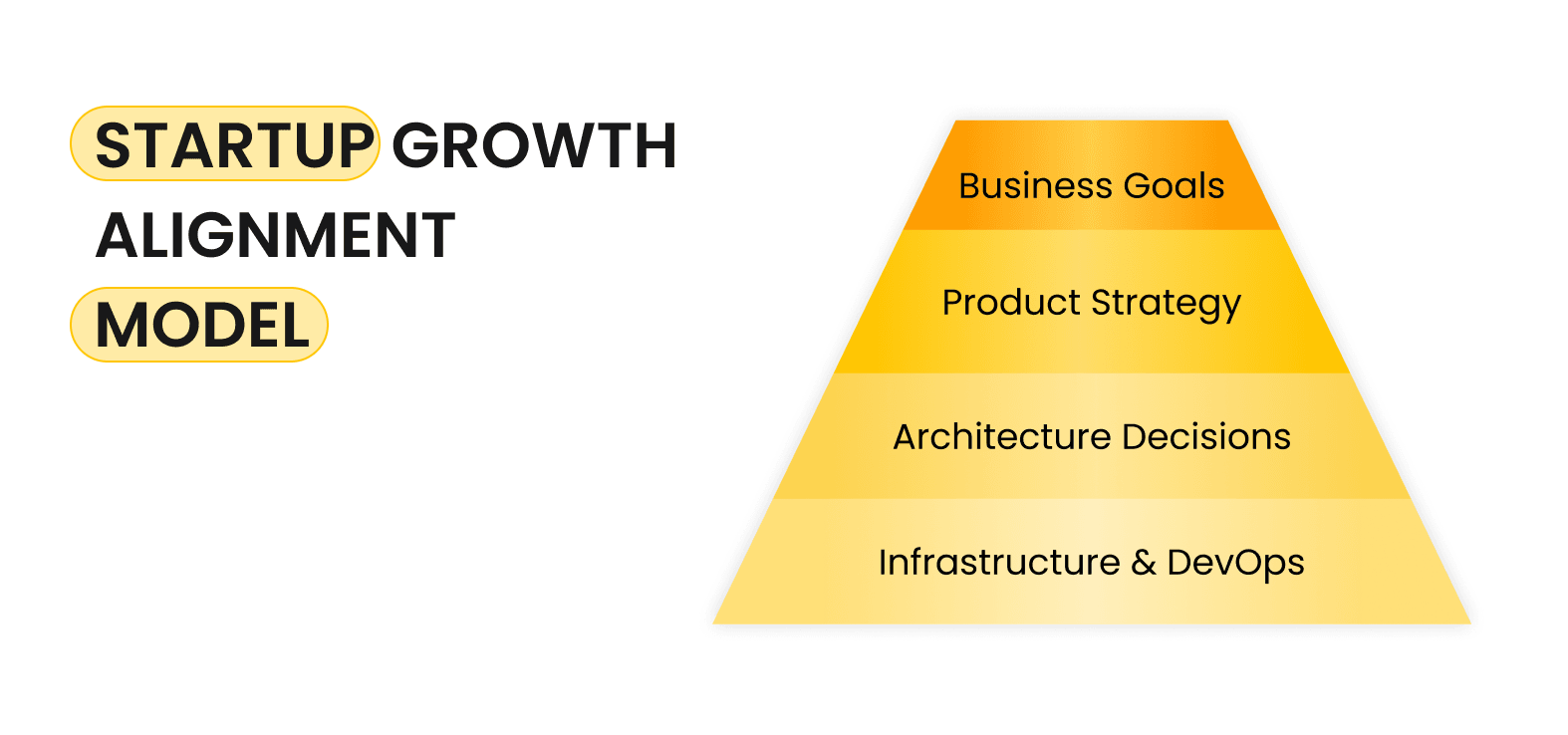 Click to expand
Each lower layer supports the one above it. Misalignment at any layer creates friction.
A strategic technology partner ensures those layers stay synchronized. Business goals inform product strategy. Product strategy informs architecture. Architecture defines infrastructure implementation.
Without this alignment:
- User growth creates performance bottlenecks
- Integration complexity slows onboarding
- Infrastructure costs spike unpredictably
- Security gaps delay enterprise deals
With alignment:
- Scaling becomes predictable
- Cloud costs remain controlled
- Feature velocity increases
- Investor confidence strengthens
A technology partner for startups translates revenue targets into technical requirements. For example, projected monthly active user growth informs the database sharding strategy. International expansion influences data residency planning under GDPR or US privacy laws.
Choosing frameworks such as Node.js or React is tactical. Designing scalable event-driven architecture or microservices infrastructure is strategic. That distinction separates vendors from a true software development partner.
An experienced end-to-end development partner also evaluates the long-term feasibility of hiring. If your stack is overly niche, recruiting engineers in the US or EU markets becomes difficult. Stack decisions influence operational cost for years.
Growth is not just about acquiring users. It is about sustaining performance under pressure.
A well-structured development collaboration ensures that technical debt remains controlled, monitoring systems provide actionable insights, and DevOps automation supports continuous deployment.
When technical foundations are strong, scaling becomes incremental instead of disruptive. When foundations are weak, growth exposes structural cracks.

Real Startup Outcomes When Working With a Partner
A strategic partner drives measurable business results rather than simply shipping features.
The difference becomes visible in onboarding speed, scalability readiness, automation depth, and revenue acceleration. Below are real startup cases that demonstrate how a structured collaboration translates into operational and financial impact.
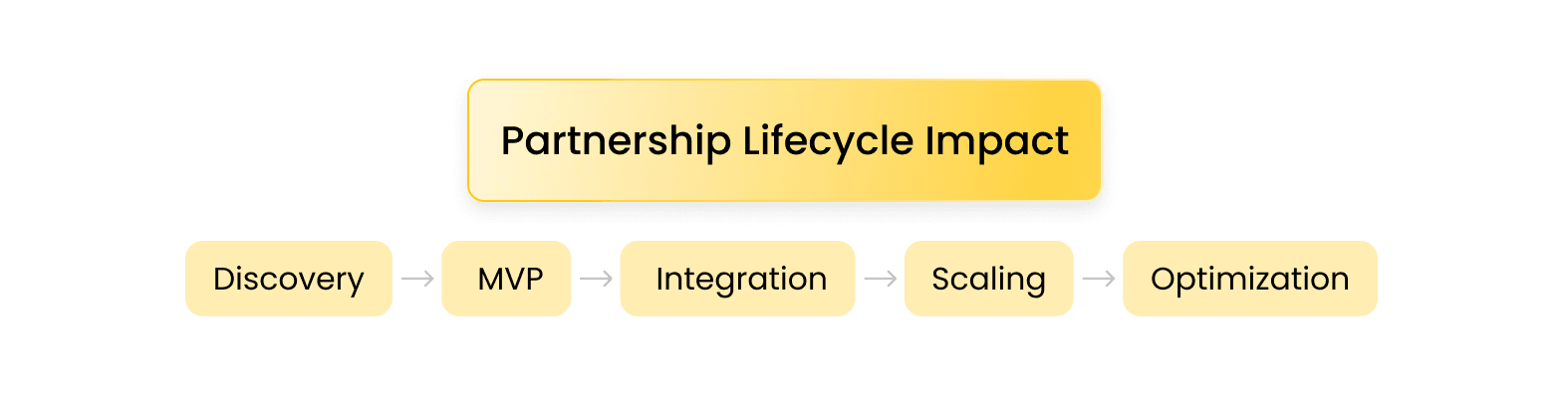 Click to expand
Under each stage, measurable impact metrics should be displayed. This visual reinforces that a software development partner contributes across the entire lifecycle, not only during development.
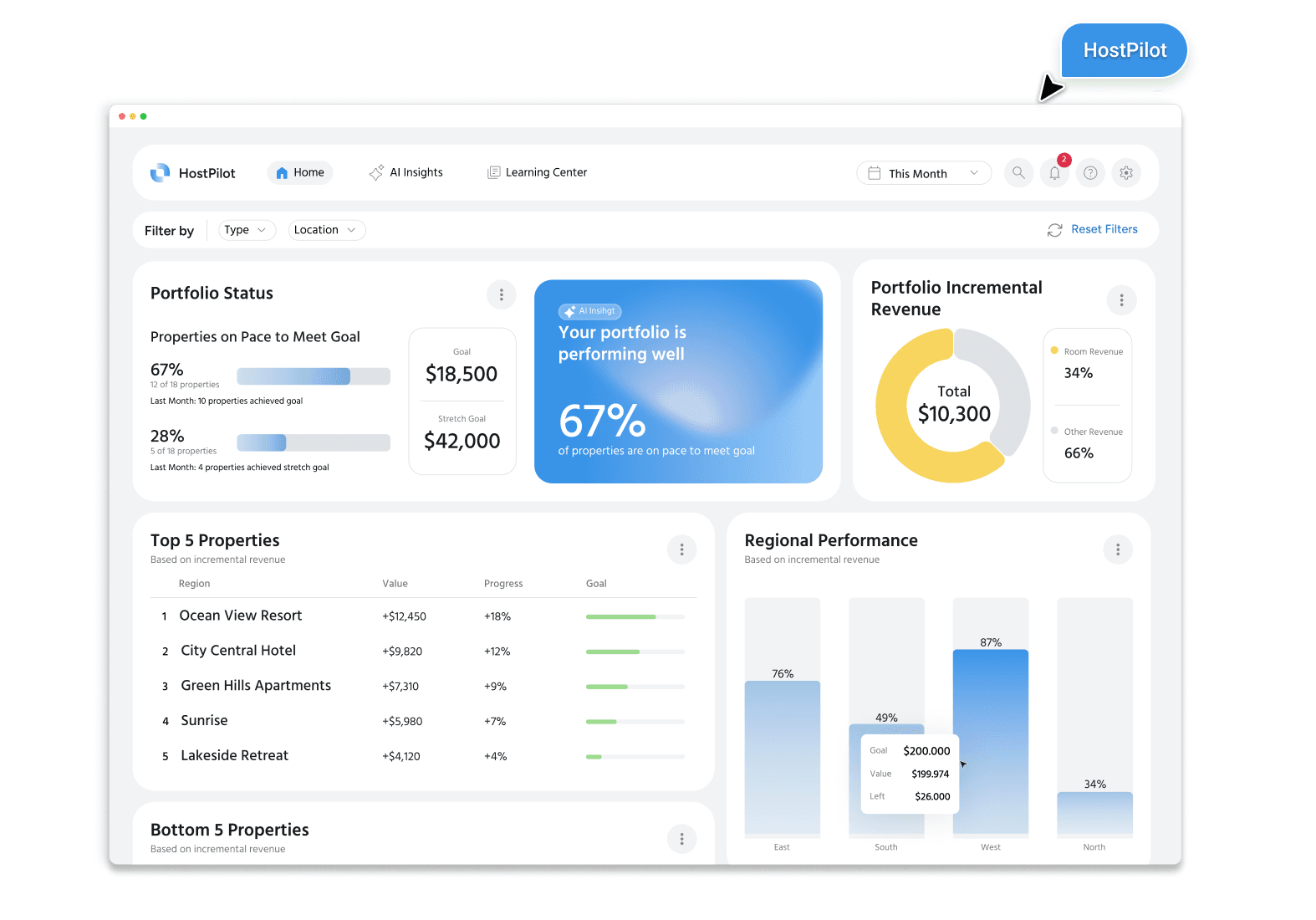
HostPilot
Hospitality & Restaurant Staff Management Platform
Strategic integration architecture reduced onboarding time by 50% and manual tasks by 60%.
HostPilot required a centralized platform to manage hospitality and restaurant operations across multiple properties. The core challenge involved integrating diverse POS systems and external platforms while maintaining data consistency.
The project demanded more than implementation. It required an architectural design that could support future growth in a fragmented industry.
Key Challenges:
- Integration with heterogeneous POS systems
- Data normalization across inconsistent client formats
- Manual infrastructure provisioning
- Slow onboarding of new clients
A vendor could have built isolated connectors. The technical team designed a scalable integration framework instead.
The solution used a microservices architecture deployed on AWS. The team implemented ETL pipelines with AI-powered validation logic. Where APIs were unavailable, robust web scraping solutions ensured uninterrupted data extraction.
AI agents automated infrastructure provisioning and reduced manual onboarding effort.
The system also introduced incentive planning dashboards, performance tracking, and learning modules. These features improved internal efficiency and employee engagement across properties.
This outcome demonstrates how a technology partner for startups builds infrastructure that scales with operational complexity.
 Click to expand
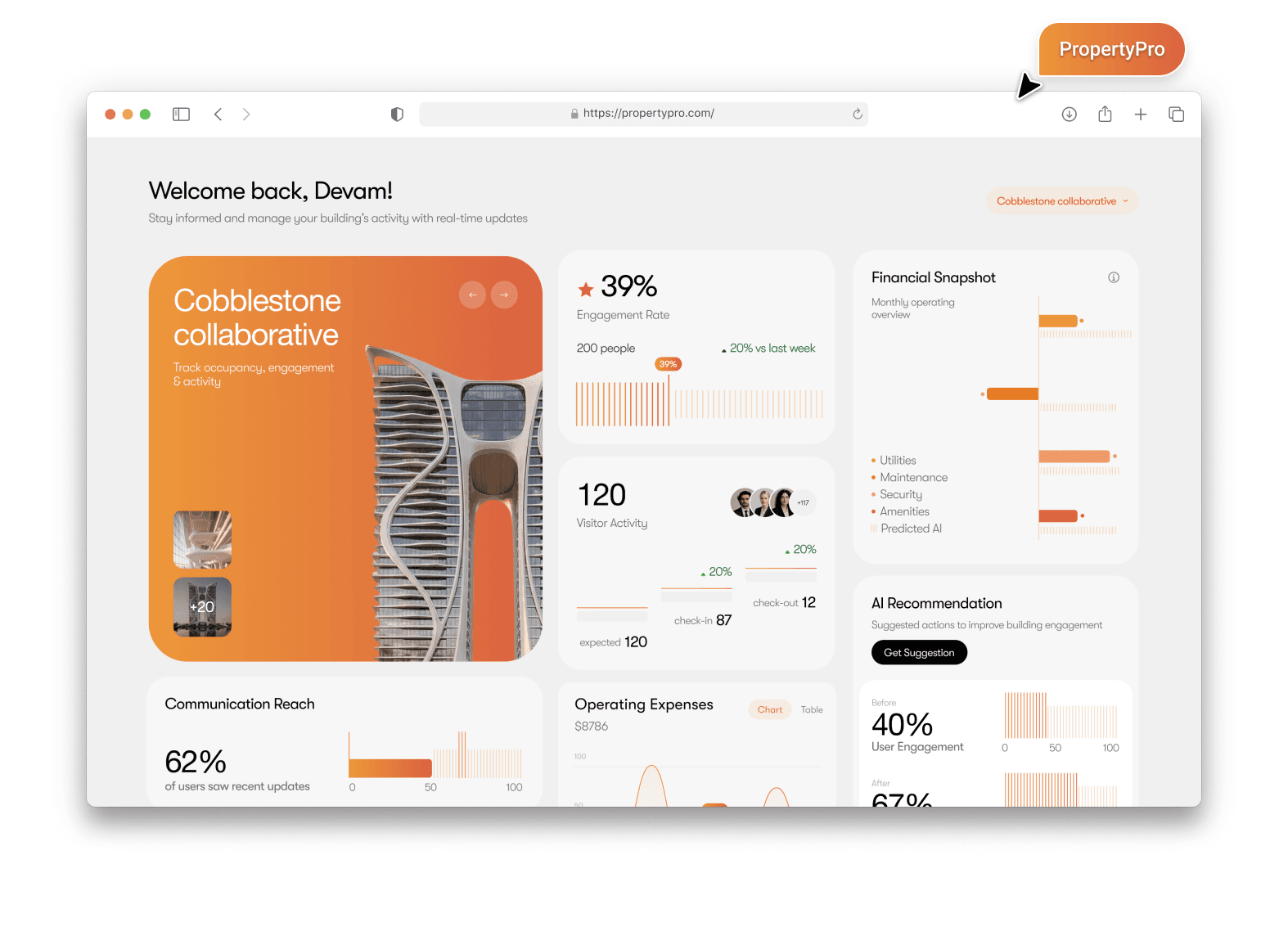
PropertyPro
Commercial Real Estate Tenant Management Platform
Microservice architecture and performance optimization delivered 4x faster SQL execution and improved user experience by 40%.
PropertyPro required a scalable system capable of supporting thousands of real-time users. The platform also demanded high-precision document scanning, license plate recognition, and seamless third-party integrations.
The challenge was not just feature implementation. It was high-load resilience.
The team implemented microservices with Kafka for real-time event processing. SQL queries were optimized for large data volumes. Infrastructure was deployed on AWS EKS with scalable database clusters.
Twilio and Braze integrations automated tenant communication workflows. Vendor document scanning improved compliance verification.
This transformation positioned the platform to scale without degradation as user growth continued.
The architecture remained aligned with projected long-term scalability requirements.
 Click to expand
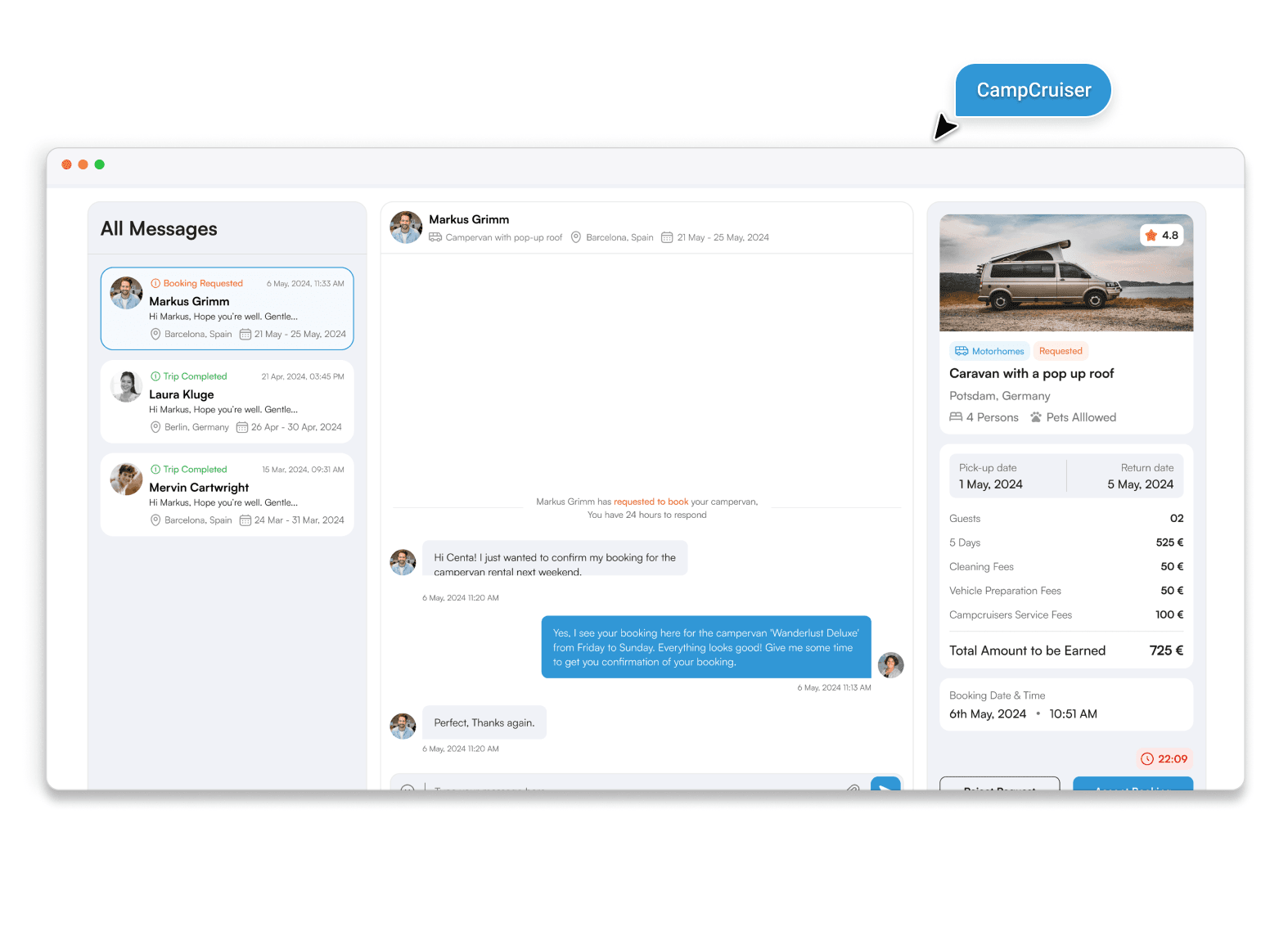
CampCruisers
Vehicles Booking Web Platform
Event-driven synchronization improved booking reliability and reduced operational friction.
The booking platform required synchronization between availability data, pricing logic, and third-party integrations. Inconsistent data flows created latency issues and manual correction overhead.
A software development partnership redesigned data synchronization logic and implemented event-driven updates. The architecture ensured a consistent booking state across multiple sources.
The outcome was improved transaction reliability and reduced operational overhead.
This case reinforces the value of a fully integrated development team capable of orchestrating complex integrations rather than simply implementing features.
 Click to expand
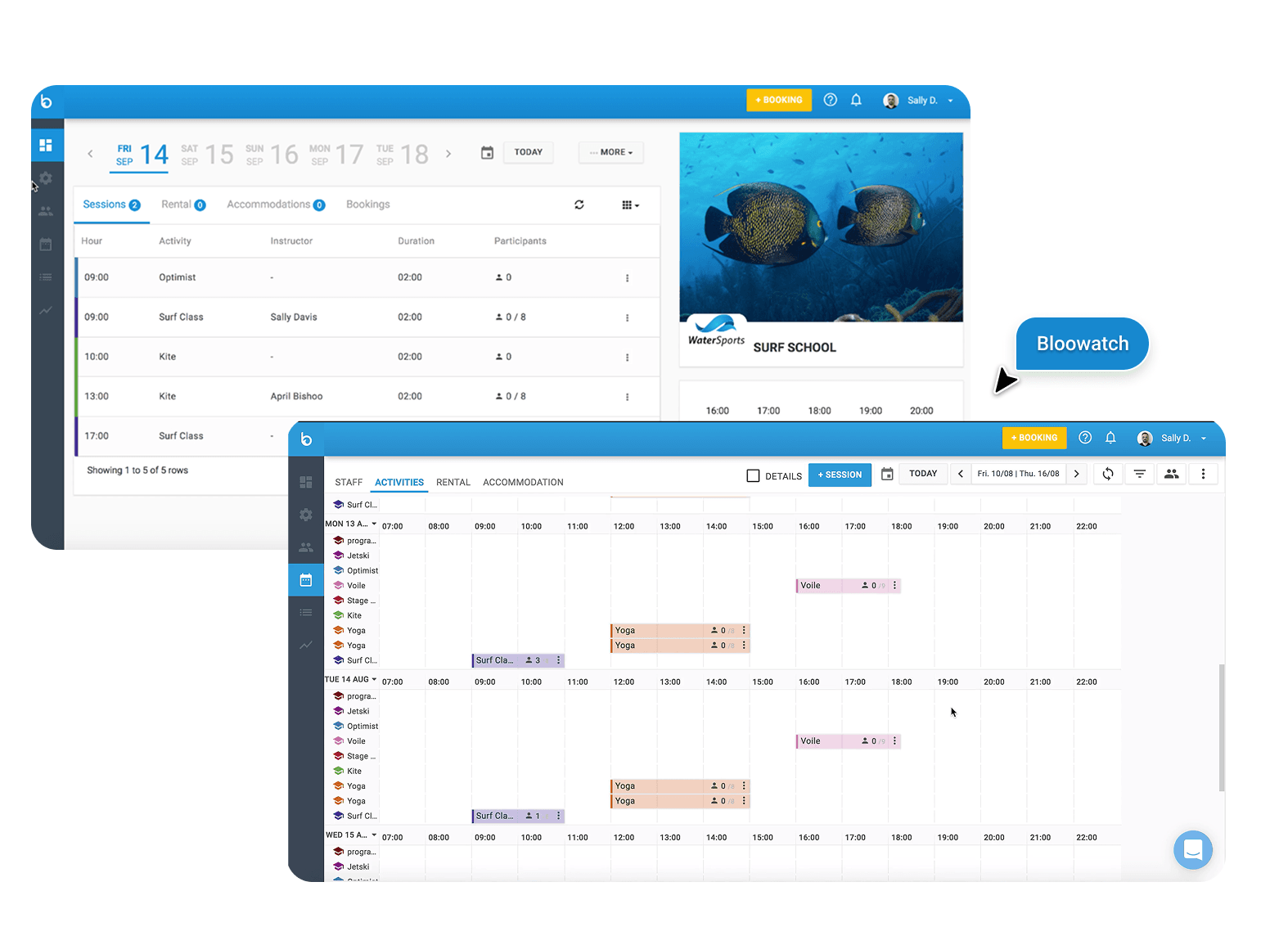
Bloowatch
Real-time monitoring and scalable backend infrastructure system
Early architectural planning prevented scaling bottlenecks during growth.
Bloowatch required scalable backend services capable of supporting increasing traffic volumes while maintaining real-time responsiveness.
The main challenge was ensuring scalability without overengineering the MVP stage. A transactional vendor approach would likely have optimized for immediate feature delivery. A software development partner optimized for growth readiness.
Instead of building a minimal short-term system, the team implemented scalable backend patterns and structured DevOps pipelines. Monitoring systems were integrated early to detect performance anomalies.
The infrastructure was designed to scale horizontally, allowing traffic spikes without system instability.
 Click to expand
The measurable result was stable performance during traffic spikes and reduced post-launch hotfix cycles.
This case highlights how a long-term development associate protects startups from reactive infrastructure firefighting.
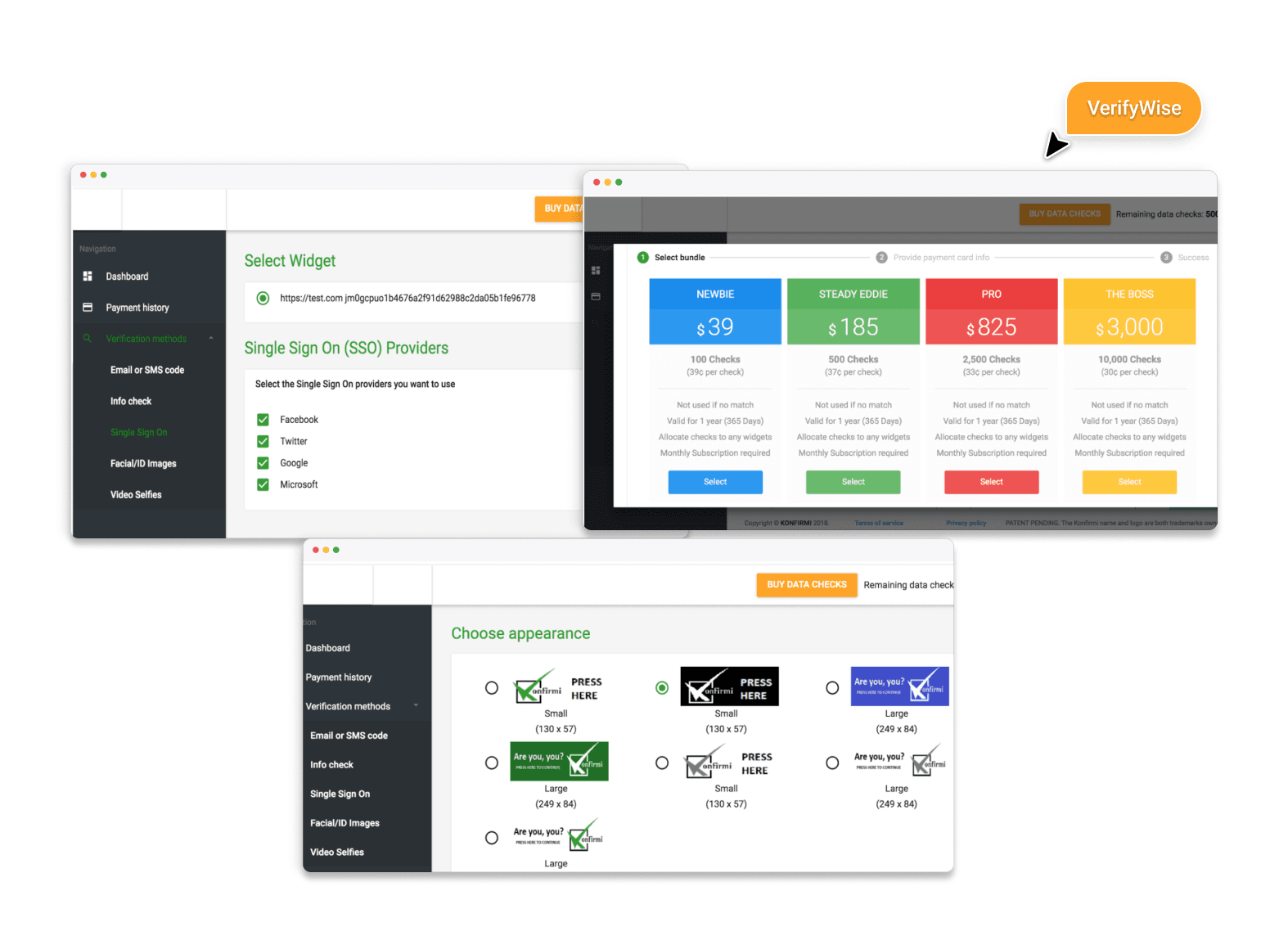
VerifyWise
Embeddable identity verification widget for websites and digital platforms
A privacy-first architecture enabled secure identity verification without storing sensitive user data.
VerifyWise was designed as a plug-and-play identity verification widget that businesses could embed into any website. The goal was to provide fast, secure user verification while minimizing integration complexity and legal risk.
The challenge was not only technical. It was architectural and regulatory.
Businesses needed:
- Secure identity confirmation
- Minimal friction for end users
- No sensitive data retention risk
- Easy integration without heavy development effort
A transactional vendor could have delivered verification logic. The team prioritized long-term security, compliance, and ease of integration.
The system was built with React and Node.js. Backend services were deployed on AWS. Kubernetes ensured deployment consistency. PostgreSQL and MySQL handled structured data management.
Instead of storing sensitive personal data, the team implemented encrypted processing pipelines with zero data retention by default. This privacy-first model reduced legal exposure and increased user trust.
Integration complexity was addressed through a no-code widget approach. Businesses could implement verification using only a few lines of HTML or JavaScript. An API was also developed for WordPress and popular plugins, including WooCommerce and Gravity Forms.
The widget supports multiple verification types, including Single Sign-On (SSO), two-factor authentication, knowledge-based authentication, selfie ID verification, video ID verification, and age verification. CAPTCHA layers prevent automated bot abuse.
Support for multiple platforms, including WordPress and CRM integrations, expanded adoption flexibility. Admin-side customization allowed businesses to control verification limits and required data fields.
This case demonstrates how a software development partner builds secure, scalable infrastructure that reduces operational and regulatory risk.
Instead of focusing only on feature implementation, the strategic engineering alliance prioritized long-term trust, compliance resilience, and integration scalability.
For startups in DevTools or identity verification markets, this level of architectural foresight directly impacts enterprise adoption readiness.
 Click to expand
How to Choose the Right Software Development Partner?
The right software development partner should demonstrate measurable scalability thinking, structured communication, and long-term architectural planning.
This decision affects infrastructure resilience, burn rate efficiency, and investor readiness. You are not selecting a coding provider. You are evaluating strategic capability.
Below are the core areas to assess.
Evaluate startup experience
A partner without startup experience may struggle with uncertainty, pivots, and runway constraints.
Startups operate differently from enterprises. Requirements evolve weekly. Priorities shift based on feedback and funding. Architecture must balance speed and scalability.
Ask directly:
- Have they worked with pre-seed or Series A companies?
- Do they understand lean validation cycles?
- Can they explain tradeoffs between speed and technical debt?
Strong teams demonstrate iterative validation processes, awareness of controlled burn rate, and infrastructure planning aligned with funding stages.
Review their experience in MVP launches and early-stage scaling. If relevant, examine their approach to MVP development services and how they structure validation cycles.
Experience in startup environments often signals adaptability and product-first thinking.
Ask for similar case studies
Relevant case studies reveal whether a partner understands your domain and technical complexity.
A credible software development partner should provide structured examples, not generic portfolios. Look for measurable outcomes, architectural explanations, and specific challenges.
When reviewing case studies, assess:
- Architecture complexity
- Integration strategy
- Performance optimization
- DevOps maturity
If you are building a real-time SaaS platform, ask for real-time scaling examples. If your product depends on frontend performance, review experience in React JS development services. Backend-heavy systems may require strong expertise in Node.js development services.
Domain familiarity reduces onboarding time and architectural risk.
Assess product & business understanding
The right partner asks business questions before discussing frameworks.
During early discussions, notice what they focus on.
Do they ask:
- Who is your primary user?
- What metric defines success?
- What growth targets are expected within 12–24 months?
Or do they immediately recommend a tech stack?
A product development team aligns architecture with revenue strategy. They connect projected user growth with database scaling. They connect enterprise ambitions with security compliance.
This is where a true strategic technology partner stands apart from a vendor.
If your discussions revolve only around features and timelines, strategic alignment may be missing.
Review the communication & collaboration model
Structured communication prevents misalignment and protects your runway.
A healthy product engineering alliance includes:
- Regular sprint planning
- Transparent reporting
- Shared KPIs
- Clear escalation paths
Avoid teams that rely solely on email updates or sporadic progress reports. A collaborative development model integrates your internal stakeholders into planning sessions.
Ask:
- How often do we review roadmap priorities?
- Who owns architectural decisions?
- How do you handle scope changes?
The answers reveal whether the team operates transactionally or strategically.
Clear communication also reduces hidden delays and budget surprises.
Ensure a long-term support model exists
A scalable product requires ongoing optimization, not one-time delivery.
After launch, you will need:
- Performance monitoring
- Security updates
- Infrastructure tuning
- Feature expansion
- Technical debt management
A long-term development partner provides structured post-launch support.
Review whether they operate as a full-cycle development partner or only deliver project-based engagements. Continuous support ensures your system evolves with user growth.
A mature end-to-end development partner offers DevOps automation, performance audits, and architectural reviews as your product scales.
If post-launch support is undefined, you risk rebuilding relationships during critical growth phases.
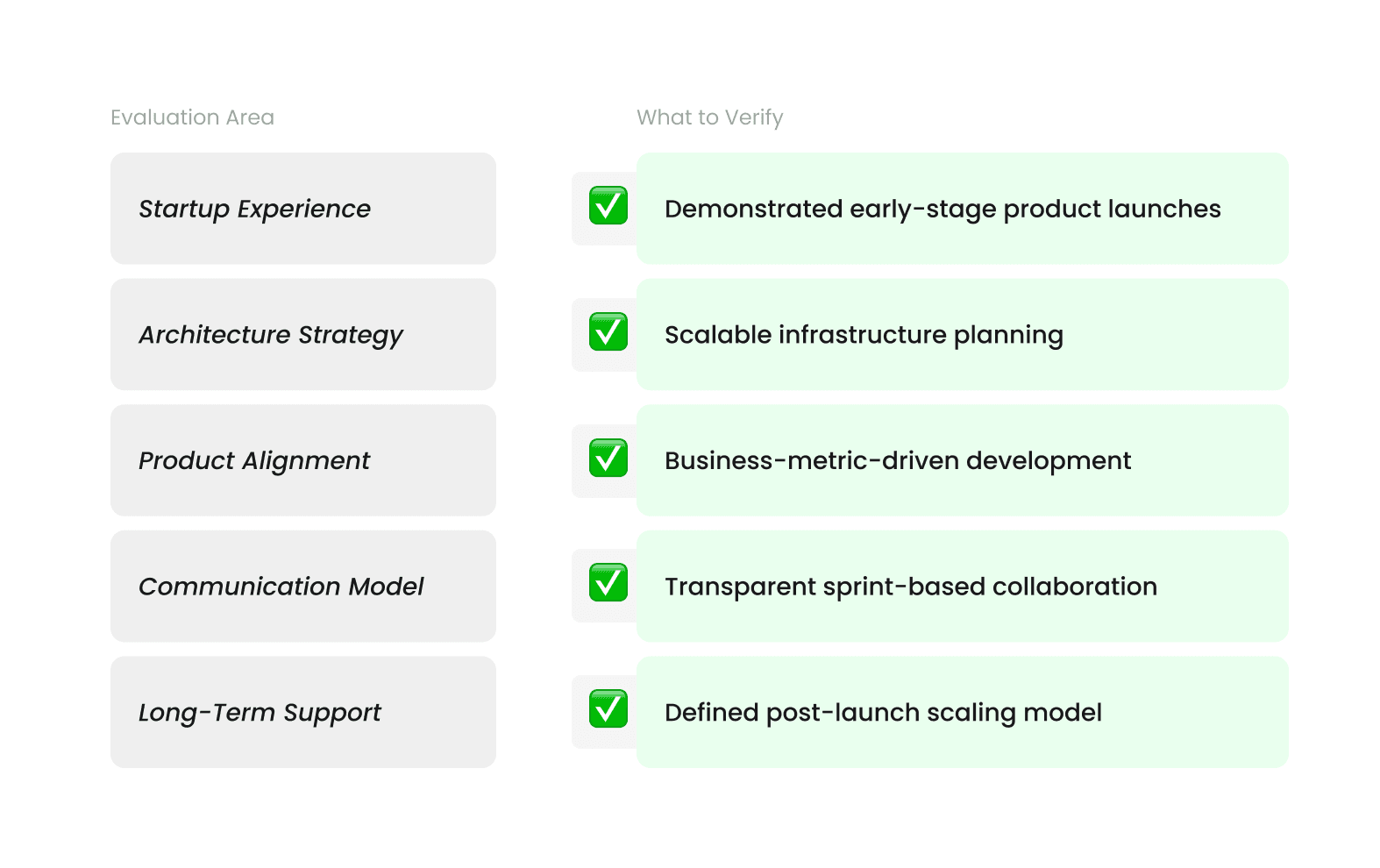
Quick Evaluation Checklist
 Click to expand
If a candidate meets all five criteria, you are likely evaluating a genuine trusted software partner, not just a vendor.
Final Takeaway
A software partner becomes an extension of your strategic decision-making, not just your engineering capacity.
The right partnership reduces risk, accelerates product-market fit, and prepares your startup for sustainable growth. The wrong choice may deliver features but undermine scalability.
Technology directly influences valuation. Architecture shapes resilience. Partnership shapes long-term success.
If you approach this decision strategically, your long-term development collaboration becomes a competitive advantage rather than a cost center.
FAQ
What is a software development partner?
A software development partner is a company that aligns engineering execution with business strategy and long-term scalability. Unlike a vendor, they participate in product decisions, architecture planning, and growth forecasting.
How can a partner help launch an MVP faster?
A partner accelerates MVP delivery by defining clear validation scope, avoiding overengineering, and implementing scalable architecture from the start. This reduces rework and shortens iteration cycles.
Which factors should startups consider when choosing a partner?
Startups should evaluate startup-specific experience, architecture planning capability, communication structure, and post-launch support model. Alignment with growth strategy matters more than hourly rates.
What technology decisions can a partner assist with?
A partner supports decisions around tech stack selection, database design, cloud infrastructure, DevOps automation, security compliance, and scalability planning based on projected growth.


Get in Touch
Got no clue where to start? Why don’t we discuss your idea?

