



By Bohdan Vasylkiv
- CEO & Co-Founder
Essential eCommerce Website Features for a Successful Online Store
Discover the must-have eCommerce website features - product pages, search, secure checkout, mobile design, and personalization - that drive sales in 2026.
Key Takeaways
- A strong store rests on a few essentials: fast page load times, easy search, clear product pages, and a checkout that people actually complete.
- Security and trust signals like SSL, secure payments, and real reviews decide whether a first-time visitor hands over a card.
- Personalization, recommendations, and live support turn one-time buyers into repeat customers.
- Start with the basics, watch how people behave, then add advanced features once the foundation is solid.
Going online keeps getting cheaper and faster for store owners, and shoppers now expect a polished experience from the first tap. The catch is that a pretty homepage wins nothing on its own. What keeps people browsing, buying, and coming back is the set of ecommerce website features working quietly behind the scenes. This guide walks through the features that matter in 2026, why each one earns its place, and how to decide what to build first.
What Are eCommerce Website Features (and Why They Matter)
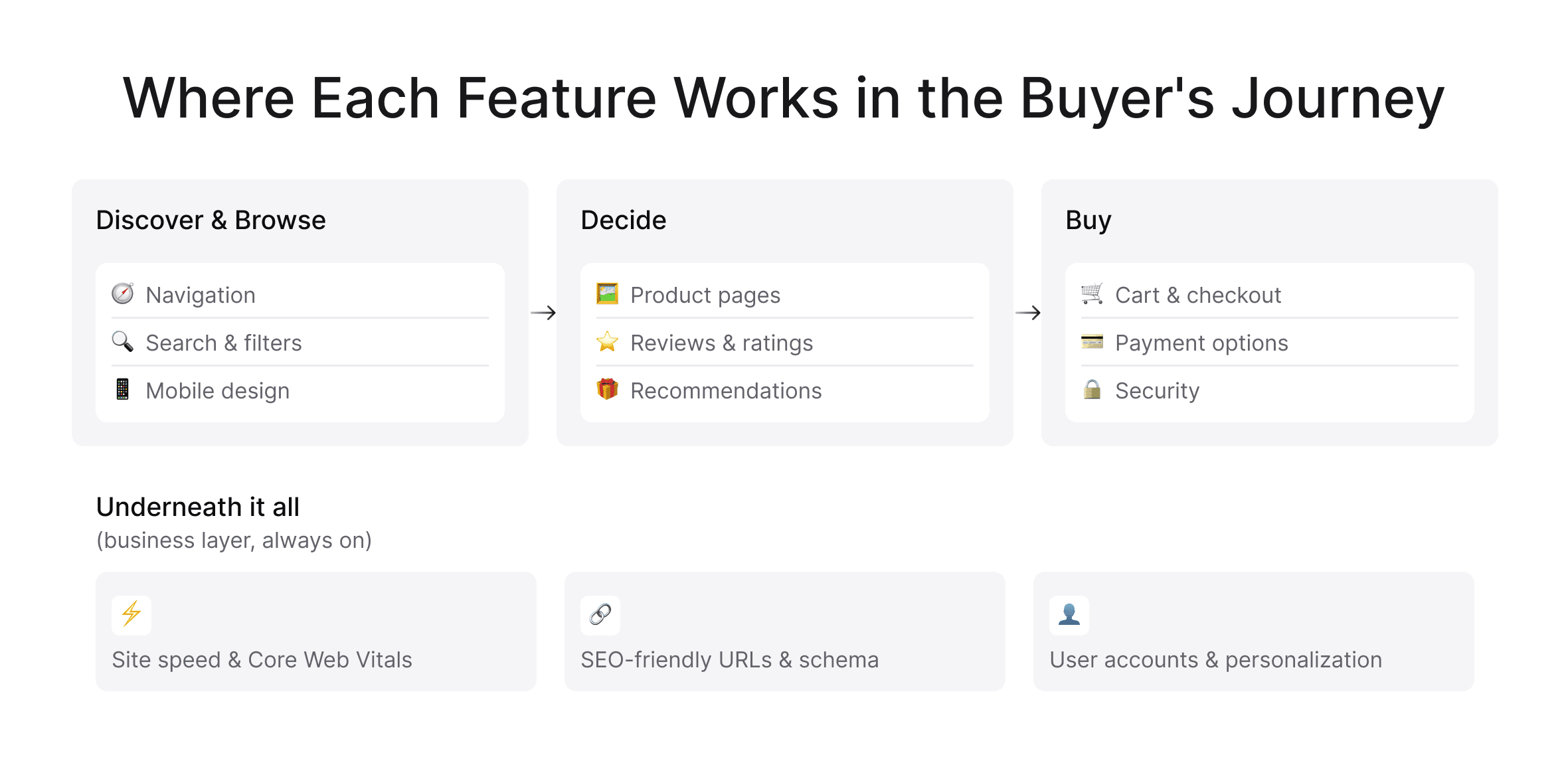
Simply put, ecommerce website features are the functional building blocks that let people find products, trust your store, and complete a purchase. They cover everything from the search bar and product pages to payment gateways, security layers, and personalized recommendations.
Here's a useful distinction worth keeping in mind. The features of an ecommerce website are what your customers interact with directly, such as the cart, filters, search bar, and reviews. These are the parts people judge in the first few seconds, and they shape whether a visit turns into an order.
Underneath that sit the ecommerce platform features, meaning what the system gives you out of the box, such as inventory management, tax rules, and order processing. Both layers have to work together because the smoothest storefront in the world falls apart if the backend can't keep up.
 Click to expand
Why does this matter so much? Attention online is thin, and a competitor is one tab away. Every extra second of load time, every confusing menu, every hidden fee gives a shopper a reason to leave. Good features remove those reasons one by one.
Must-Have eCommerce Website Features at a Glance
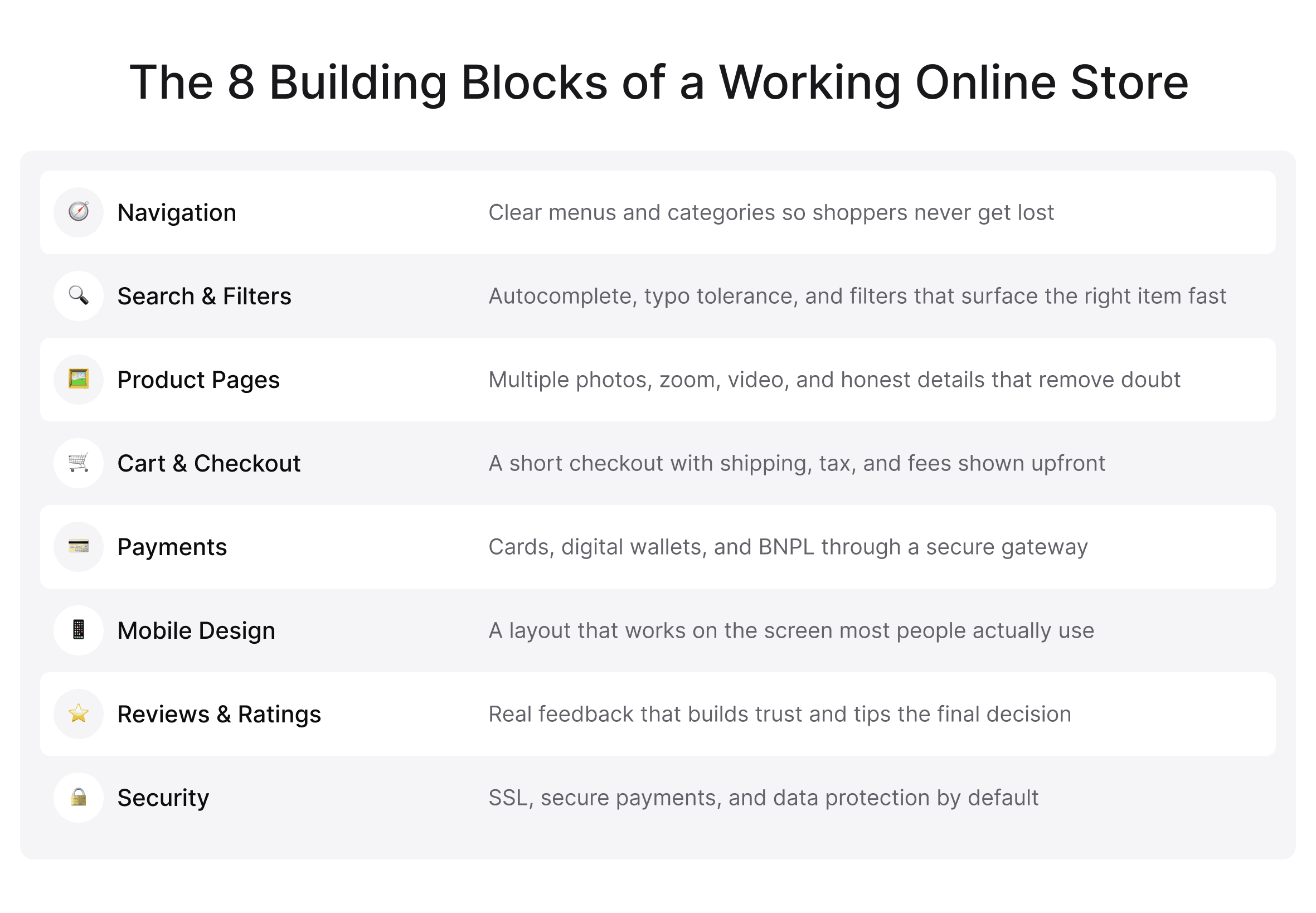
Before we go deep, here's a quick map. Think of these as the must have features for ecommerce website projects that simply cannot launch without them.
If you ever need a single reference to hand a developer, this short ecommerce website features list covers the essentials:
- Intuitive navigation and site structure
- Search with filters and sorting
- Detailed product pages with strong visuals
- A shopping cart and a short, clear checkout
- Multiple secure payment options
- Mobile-first, responsive design
- Customer reviews and ratings
- Strong security and data protection
Honestly, most of the friction in any features of e commerce website audit traces back to one of these eight. Get them right, and you've handled the majority of what shoppers actually care about.
Core eCommerce Website Features Every Store Needs
The ecommerce website features in this section are the ones you build first, because everything else depends on them. Skip one and the rest start to wobble.
Think of these as the key features of an ecommerce website that quietly move a visitor from "just looking" to "order placed." Each one removes a small reason to hesitate.
Intuitive Navigation and Site Structure
People should never have to think about where to click. Clean menus, logical categories, and a visible path back to the homepage keep shoppers oriented. When navigation is one of the strongest features of ecommerce website design, browsing feels effortless, and bounce rates drop. If you're unsure how your structure holds up, that's exactly the kind of problem our UI/UX design services are built to solve.
Advanced Search, Filters, and Sorting
A shopper who knows what they want reaches for the search bar first. Give them autocomplete, typo tolerance, and filters for size, price, color, and availability. Sorting by relevance, rating, or price lets people narrow a big catalog in seconds. The faster they find the right item, the closer they get to checkout.
Detailed Product Pages with High-Quality Visuals
Photos do the heavy lifting here. Multiple angles, zoom, short video, and where it fits, a 360-degree or AR preview help people judge a product they can't physically hold. Clothing, shoes, and jewelry sell far better with model shots and accurate color. Pair the visuals with honest descriptions that explain how the product improves a buyer's day, and you remove much of the hesitation before it ever starts.
Shopping Cart and Streamlined Checkout
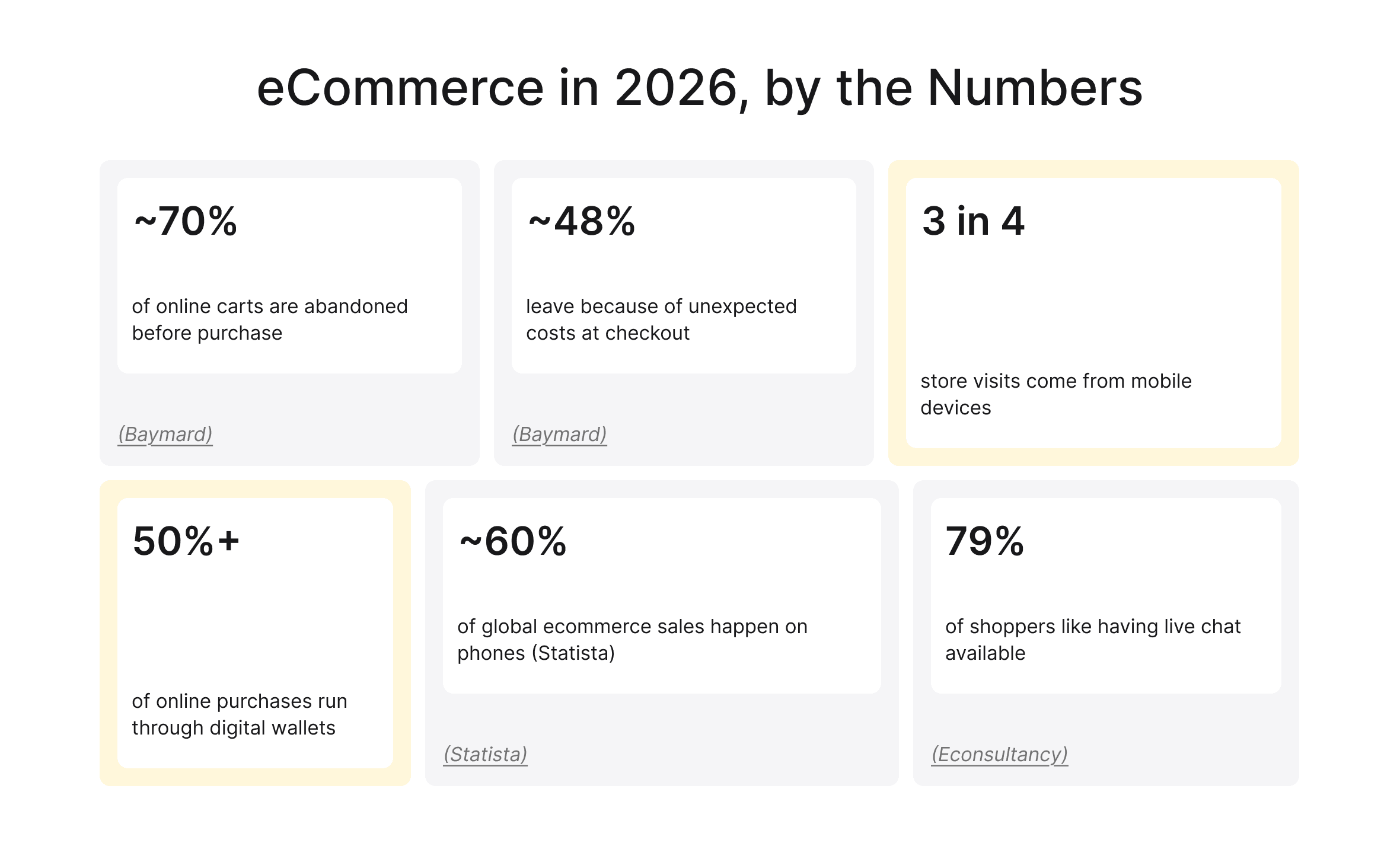
This is where money is won or lost. Roughly 70% of online carts are abandoned before purchase, and the single biggest trigger is unexpected costs appearing at checkout, which sends about 48% of those shoppers away. Show shipping, tax, and any fees early. Offer guest checkout, keep form fields to a minimum, and let people see their progress. Every field you cut tends to lift your completion rate.
 Click to expand
Multiple Secure Payment Options
Shoppers pay the way they prefer, or they don't pay at all. Cards, digital wallets, and increasingly Buy Now, Pay Later all belong here, and digital wallets alone now handle more than half of online purchases. Platforms like Shopify, Magento, and WooCommerce bundle PCI-compliant gateways, so you can add payment methods without building the security plumbing from scratch.
Mobile-First, Responsive Design
Mobile stopped being the secondary screen a while ago. In 2026, around 60% of global ecommerce sales will happen on phones, and roughly three out of four store visits will come from mobile devices. A layout that reflows cleanly on any screen is also what Google rewards with mobile-first indexing, so responsive design helps shoppers and rankings alike. Strong front-end development services make the difference between a site that merely shrinks and one that genuinely works in a thumb's reach.
Customer Reviews and Ratings
The vast majority of shoppers read reviews before they buy, and a rating often tips the balance in the final decision. Keep them genuine. Floods of bot praise look fake and can draw search penalties. Reviews also flag problems early, which gives you a fast, cheap way to fix issues and earn loyalty. You can collect feedback on your own pages or pull in social proof from places like Yelp and Reddit, where buyers already talk about products openly.
Security Features for eCommerce Websites
Trust is the currency of online retail. Shoppers hand over card details expecting them to stay safe, and a single breach can undo years of goodwill. Strong security features for ecommerce website projects protect both the customer and the owner.
Here's the thing about security: it works best when it's planned in from day one. Treat it as one of the non-negotiable features for ecommerce website build, never something you scramble to bolt on the week before launch.
SSL, Encryption, and PCI DSS Compliance
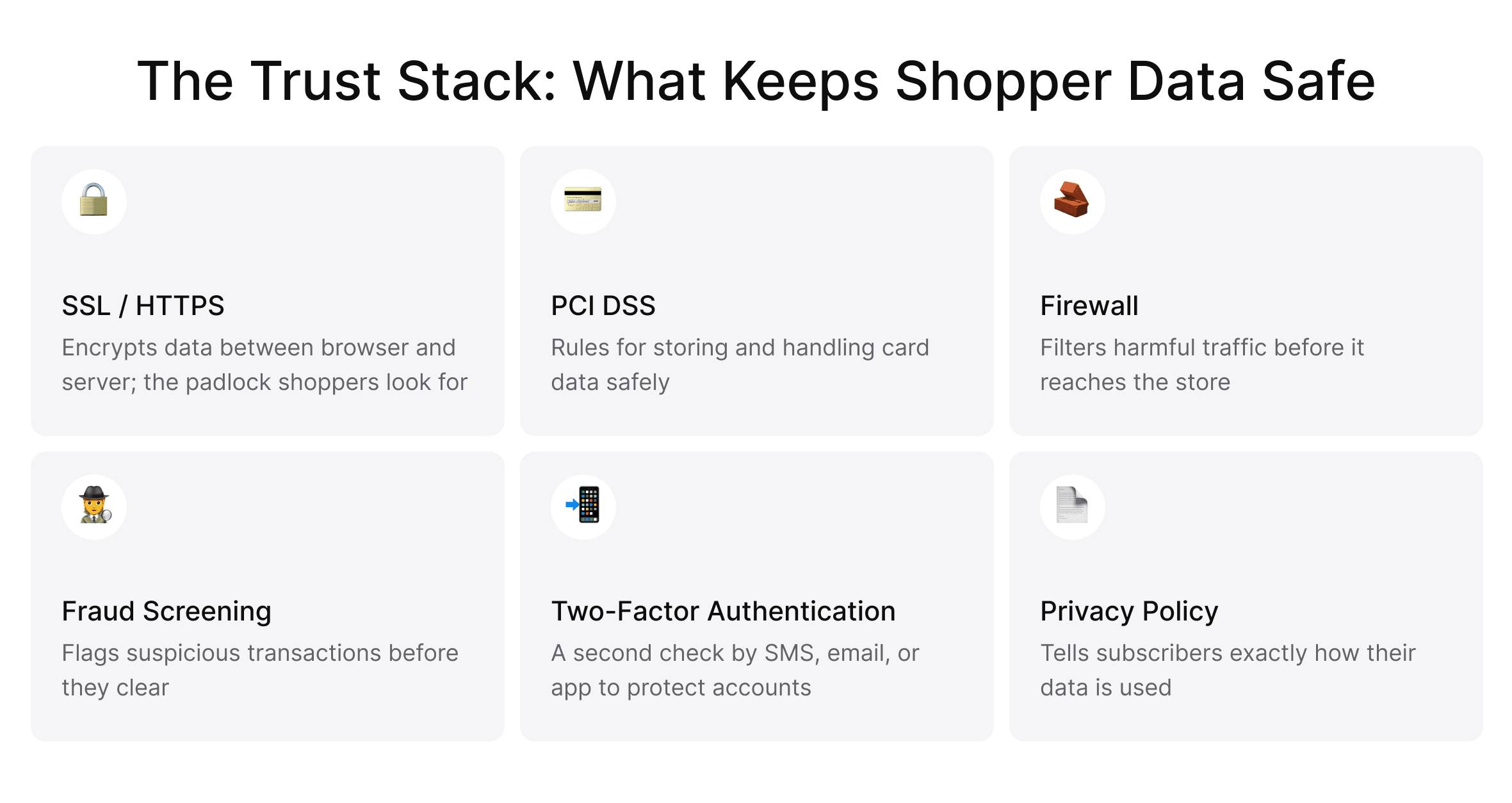
An SSL certificate, the padlock you see in the address bar, encrypts data between the browser and your server, and it's the first trust signal most people look for. PCI DSS compliance governs how card data is stored and handled. A firewall filters harmful traffic before it ever reaches your store. Most hosted platforms include these by default, which is one reason small teams lean on them.
 Click to expand
Fraud Prevention and Secure Authentication
Beyond encryption, you want fraud screening for transactions and two-factor authentication for accounts, typically via a code sent by SMS, email, or an app. A clear privacy policy belongs here too, since it tells subscribers exactly how their data gets used. Before launch, it's worth putting the whole stack through proper web application security testing so that weak points surface in a lab rather than in the headlines.
Features That Boost Conversions and Retention
Once the foundation is solid, these ecommerce website features push average order value up and bring shoppers back for more.
Personalization and Product Recommendations
Shoppers want to feel known. Use purchase history, browsing behavior, and favorite categories to surface relevant products and tailored offers. Birthday vouchers and personal discounts cost little and build real loyalty. As Katherine Barchetti, the former owner of K. Barchetti Shops, put it, "Make a customer, not a sale." Among the best features for ecommerce website growth, smart personalization sits near the very top.
'You May Also Like': Upselling and Cross-Selling
Recommendation widgets like "you may also like" lift basket size and reveal which products sell together. Amazon credits its recommendation engine with a meaningful share of sales. Every cross-sell is also data, showing you what to stock and how to bundle. Done well, it feels less like a pitch and more like a helpful nudge toward something the shopper genuinely wanted.
User Accounts and Wishlists
A saved profile means faster repeat orders, stored shipping details, order history, and wishlists. It also gives your marketing team an email or phone number, which opens the door to new-arrival alerts, discounts, and re-engagement. Just keep account creation optional at checkout, since forcing it is a well-documented reason people abandon their carts.
Live Chat and Customer Support
People clarify the smallest details before buying. About 79% of online customers said they like using live chat, because the answers arrive immediately. On top of that, 44% of consumers said that being able to ask questions to a live person mid-purchase is one of the most useful things a site can offer. Put a chat link on every page so help is always one click away, never buried a few screens back.
 Click to expand
Social Proof and Social Media Integration
Connecting accounts to social logins speeds up sign-up and gives you a powerful channel for sharing products and news. Most shoppers aged 16 to 35 check a brand's social presence before they commit, so being active there shapes first impressions. Social proof, customer photos, and shares all reinforce the reviews living on your own pages.
SEO and Performance Features
Great products mean little if nobody finds them. The features of ecommerce website performance and discoverability work hand in hand.
Site Speed and Core Web Vitals
Speed is the first thing a visitor judges, often before they read a single word. Google's Core Web Vitals measure loading, interactivity, and visual stability, and they feed directly into rankings. Compress images, lazy-load anything below the fold, and trim heavy scripts. Faster pages convert better and rank higher, which is rare for one fix to do both.
SEO-Friendly URLs, Schema, and Content
Clean URLs, descriptive titles, and structured data help search engines and AI summaries understand your catalog. Product schema can surface price, availability, and ratings right inside search results. Pair that with content that creates value instead of keyword filler, and you give shoppers and crawlers alike a reason to trust the page. Transparency about delivery, returns, and pricing fits here too, since clarity is its own conversion booster.
B2B and Custom eCommerce Website Features
Selling to businesses changes the rulebook. B2b ecommerce website features usually include tiered pricing, bulk ordering, quote requests, purchase orders, account hierarchies, and net payment terms. Buyers expect to reorder fast and manage several users under one company account.
Industry context matters too. A construction ecommerce website essential features set, for example, leans on bulk SKUs, freight calculators, and contractor pricing rather than impulse-buy widgets.
That's the whole value of features for custom ecommerce website builds: you shape the toolset around how your customers actually buy. For larger operations, this is also where migrating to SaaS software and headless setups start to pay off.
Behind the storefront, the operations side carries just as much weight. Order management, inventory syncing across warehouses, role-based permissions, and reporting all need somewhere to live. A clean admin or dashboard app key features view turns a sprawling catalog into something a small team can actually run without drowning in spreadsheets.
Basic vs Advanced eCommerce Features: What to Prioritize
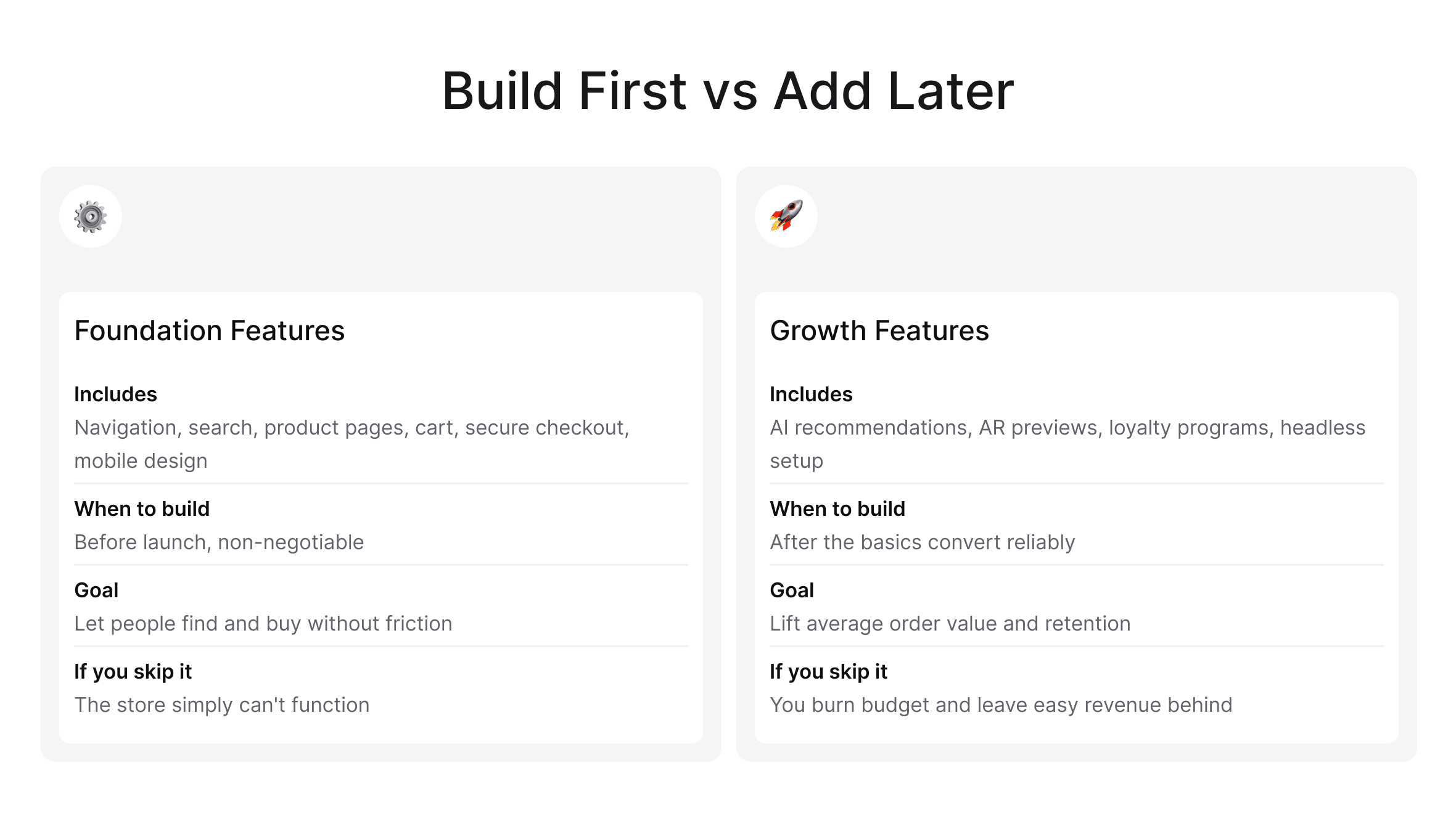
Not every store needs every bell and whistle on day one. The basic ecommerce website features, meaning navigation, search, product pages, cart, secure checkout, and mobile design, are mandatory. They're table stakes.
Advanced ecommerce platform features like AI recommendations, AR previews, loyalty programs, and headless architecture deliver real returns, but only once the basics are stable.
 Click to expand
Chasing the best ecommerce features before your checkout works is a classic way to burn budget. Build the foundation, prove it converts, then layer the extras on top. Money matters here, so it helps to understand ongoing eCommerce website maintenance cost before you commit to a long feature wishlist.
How to Choose the Right Features for Your eCommerce Website
Start with your customers and your numbers, never with a feature wishlist. The honest answer to "what features do I need for an ecommerce website" depends on what you sell, who buys it, and where people currently drop off. A fashion brand and a B2B supplier rarely need the same toolset, so resist the urge to copy whatever a competitor happens to show on their homepage.
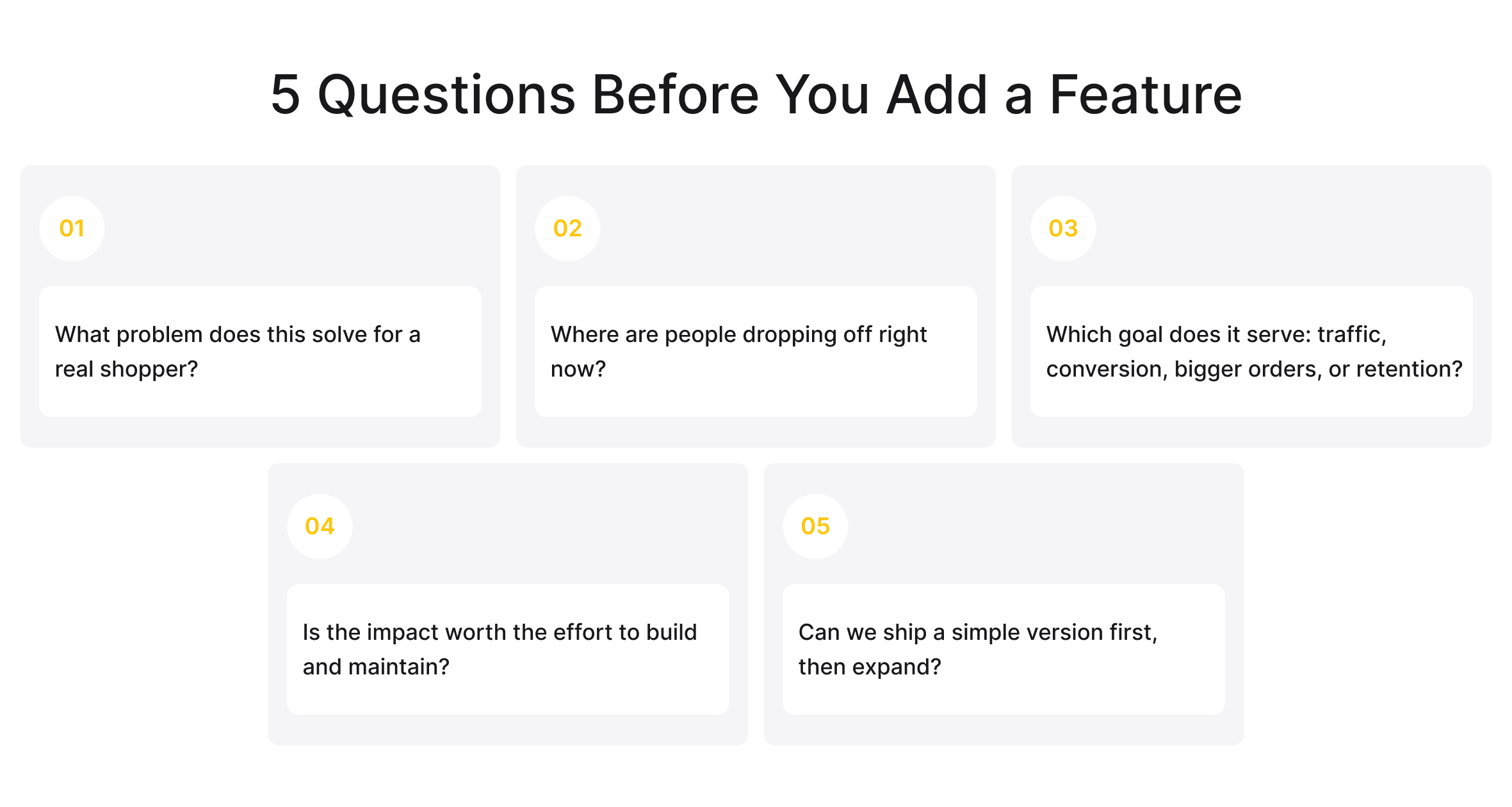
A simple way to prioritize the right ecommerce website features is to map each one to a single goal: more traffic, higher conversion rate, larger orders, or stronger retention. Then weigh effort against impact and start where those two lines cross.
The best ecommerce website features for your store are the ones that fix your biggest leak first, whether that's a slow mobile checkout, a confusing menu, or a thin product page that gives shoppers nothing to act on.
 Click to expand
Here's the practical part. Launch a focused MVP with the essentials, watch how real people behave, and let the data point to what comes next. Features are cheap to imagine and pricey to maintain, so every addition should earn its place by solving a problem you've actually seen. Build, measure, refine, and grow the store one proven step at a time.
How Incora Builds Feature-Rich eCommerce Websites
At Incora, a software development team based in Ukraine, we build custom online stores tailored to how your customers actually shop, rather than using a generic template. Whether you're refining checkout, adding AI recommendations, or scoping a full rebuild, we focus on the ecommerce website development features that move your metrics. For founders validating an idea, our startup product development process gets a lean, conversion-ready store live quickly, then grows alongside the business.
Not sure where to start with your store's features?
We can help you figure out what's actually slowing you down and what to build first.
Final Takeaway
The strongest e-commerce website features all serve one goal: helping a real person make a confident decision and come back later. Audit your store honestly. Does it load fast, feel trustworthy, work on a phone, and answer questions before they're even asked? Start with the essentials, listen to how people behave, and keep refining. Bottom line, your aim isn't only to sell today, it's to build the kind of experience that earns a second visit.
FAQ
What are the most important features of an eCommerce website?
The most important features of an ecommerce website are intuitive navigation, reliable search, clear product pages, a short, secure checkout, and a mobile-first design. Together, they cover how most people find and buy.
What features should an eCommerce website have?
At a minimum, think through what features should an ecommerce website have in this order: usability, trust, payments, and support. Add personalization and recommendations once those basics convert reliably.
What are the essential security features for an eCommerce website?
SSL encryption, PCI DSS-compliant payments, a firewall, fraud screening, two-factor authentication, and a clear privacy policy. Hosted platforms cover much of this by default, while custom builds need a deliberate security plan from the start.
What features do I need for a B2B eCommerce website?
B2B stores need tiered pricing, bulk and repeat ordering, quote requests, purchase orders, multi-user accounts, and net payment terms. The buying process is longer and involves more people, so the tooling has to match.
How many features should an eCommerce website have?
Enough to serve your customers well, and no more. Start lean with the essentials, measure where shoppers struggle, then add advanced features that solve a proven problem rather than padding a list.


YOU MAY ALSO LIKE




Get in Touch
Got no clue where to start? Why don’t we discuss your idea?

